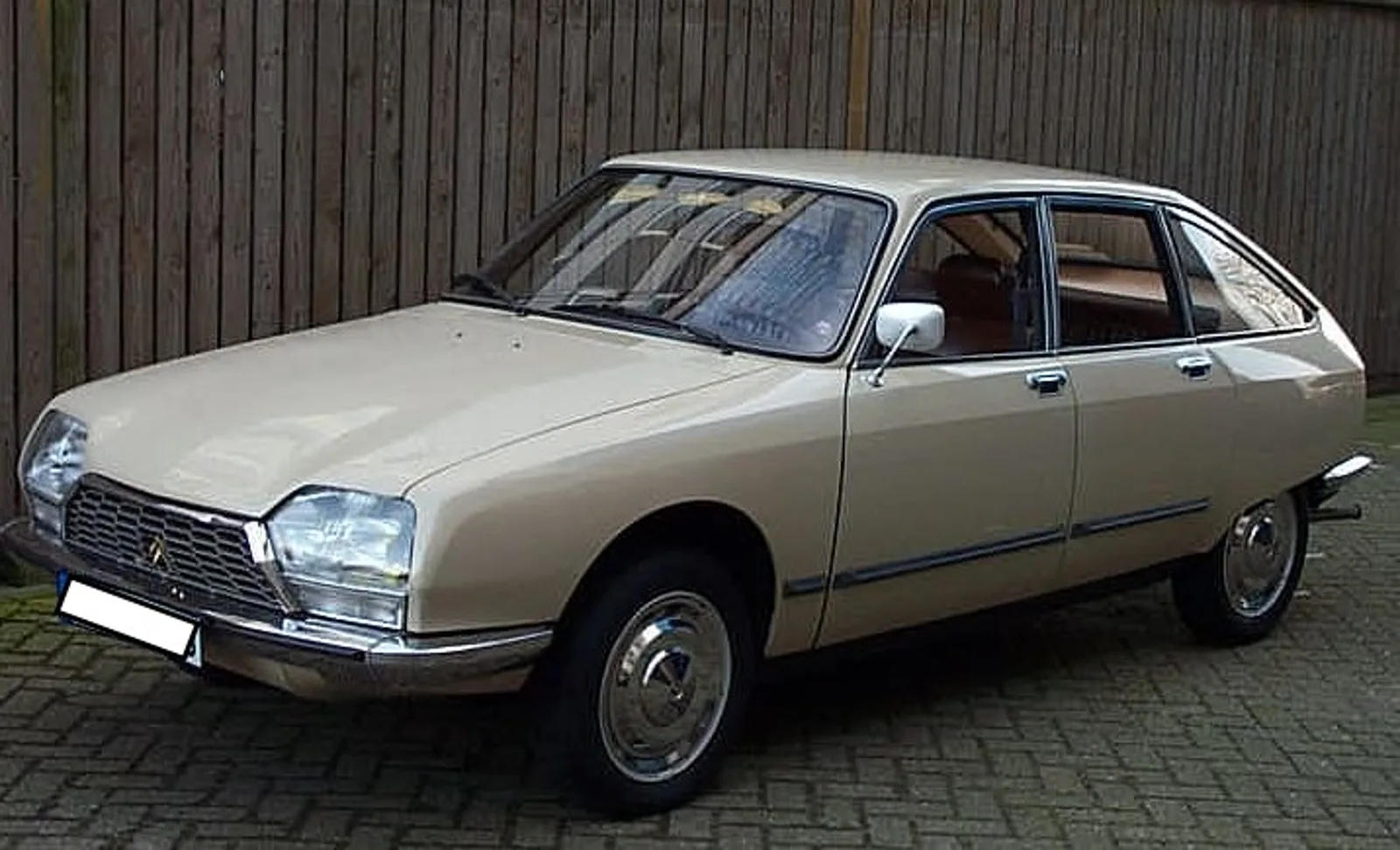
Launched in 1970 with a drag figure few rivals could match, the GS and its hatchback successor the GSA sold about 2.5 million cars across two series.
The Citroen GS was a small family car built by Citroen from 1970 to 1986. It had an air-cooled flat-four engine, hydro-pneumatic suspension and a drag coefficient of 0.318. Its GSA hatchback successor took combined output to approximately 2.5 million cars.
Few small family cars of the early 1970s were as unusual as the Citroen GS, which Citroen built from 1970 to 1986 across two series. It was known for an unusually slippery body, a flat-four engine and hydro-pneumatic suspension borrowed from bigger models. Its hatchback successor, the GSA, pushed total output to roughly 2.5 million cars.
Where did the GS come from?
The GS took 14 years to develop from the first idea to the showroom. Work began with the C10, a bubble car prototype, before the programme moved on to a series of concepts. Project F was too similar to the 1965 Renault 16, so it was suspended in 1967, and many of its mechanical parts carried over into Project G, which became the GS.
The GS was designed by Robert Opron, and its smooth two-box body bore some resemblance to a 1967 design study by Pininfarina called the Berlina Aerodinamica. Citroen launched the car on 24 August 1970, and it went on to win the European Car of the Year title for 1971.
A slippery little family car with hydro-pneumatic suspension that sold almost two million examples in its first series.
Why did Citroen need the GS?
The GS filled a gap in Citroen's range that had opened up beneath the DS. The DS had climbed well above the Traction Avant in price, which left the middle of the market open to rivals for years. The GS was the answer to that opening.
Development costs for the DS replacement, the CX, and the 1973 and 1974 oil crisis all weighed on the company. An aborted Wankel rotary engine added to the strain, and Citroen declared bankruptcy in 1974. The GS met with instant acceptance in the market and sold in enormous numbers.
How did the GS perform when it launched?
The GS was one of the most aerodynamic cars of its time, with a drag coefficient of 0.318. That figure let the car make good use of its available power, although it was considered underpowered when it first arrived.
In September 1972 Citroen addressed the power issue with an optional 1,222 cc engine. Output went from 55.5 PS (41 kW; 55 bhp) up to 60 PS (44 kW; 59 bhp), and torque went from 7.2 to 8.9 kg m (71 to 87 N m). Larger front brake discs were fitted at the same time.
How did the GS compare with its rivals?
At launch the GS was measured against the Fiat 128, Ford Escort, Renault 6 and Vauxhall Viva. Buyers cross-shopping these models had to weigh space, economy and comfort against each other. The GS offered a different balance of aerodynamics and ride comfort from the start.
Its drag figure and hydro-pneumatic suspension were its main points of difference from those rivals. Buyers who valued a quiet, comfortable motorway car found in the GS something the conventional small family cars did not offer.
Why did judges praise the GS in 1971?
The judges described the GS as technologically advanced, with class-leading comfort, safety and aerodynamics. The award came the year after launch, which gave the car an early reputation at a time when rivals were still catching up on those qualities.
Journalists also praised its smooth ride. The hydro-pneumatic suspension absorbed bumps and ripples that would have been uncomfortable in a conventionally sprung car, and that quality carried through into the GSA years later.
What was the GS design like?
The fastback body had a sharp kammback tail, with semi-enclosed rear wheels and a sharply vertical Kamm-tail. The low nose and two-box silhouette gave the car a sleek look that stood apart from the upright family cars of the day.
Inside, the radio sat between the seats, and the parking brake lived on the dashboard. The early car and the GSA used a rotating drum speedometer, similar in construction to bathroom scales. The steering wheel had a single spoke, which limited its potential to injure the driver in an impact.
What changed with the GSA?
The GS was facelifted in 1979 and given a hatchback, and it was renamed the GSA. The change followed the growing success of small family hatchbacks in Europe, which had been boosted by the Volkswagen Golf. The grille, plastic bumpers, tail-lights and door handles were all revised.
The GSA dashboard moved its auxiliary controls onto column-shaped satellites, so drivers could reach them without leaving the single-spoke wheel. The tall lower lip of the new hatch kept the body stiff, but it made heavy items harder to lift into the boot. The GSA was offered only with the larger 1.3-litre engine.
The larger BX arrived in 1982 and gradually took over from the GSA, which kept selling in smaller numbers until 1986. The GS family was then gone, and Citroen would wait until the ZX arrived in 1991 before entering the small hatchback market again.
How did the suspension and brakes work?
The GS used four-wheel independent suspension, with double wishbones at the front and trailing arms at the rear. Both axles carried rigid sub-frames, which gave a ride and road holding that were unmatched for the time, even on narrow factory tyres.
The hydro-pneumatic self-levelling system came from the DS, and it powered four disc brakes with the front discs mounted inboard to reduce unsprung weight. The brakes adjusted their pressure to match the cargo load, and the pedal had virtually no travel even in hard braking.
The suspension could raise the car for rough country lanes and lower it for easy access to the rear wheels. The hydraulic system slowly depressurised over several hours, so the car gradually sank to its bump stops when the engine was off. Owners learned to expect a car that could sit low in town and rise for rough tracks, a practical trick that few rivals offered.
Which engines did the GS use?
The GS was powered by an air-cooled flat-four with front-wheel drive. Engine sizes ran from 1,015 cc to 1,299 cc, and power ranged from 40 kW (54 hp) to 49 kW (66 hp), depending on the version and market.
With the 1,222 cc engine the GS could reach a steady 151 km/h (94 mph) at 6,250 rpm. Its shape made the most of that output on the open road. The GSA's five-speed gearbox raised the top speed to 164 km/h (102 mph) and made high-speed cruising easier.
Which trims were offered?
The GS was offered in four trims. The G Special was the base model, the GS Club sat in the middle, the GS X was the sports version, and the GS Pallas was the luxury option. The GS X and Pallas were mostly sold as saloons, although a Break Pallas was available in Portugal.
The GSA X3 had closer, sportier ratios on its five-speed gearbox, while the Pallas received wider spaced ratios for better economy and quieter running. Those choices let buyers pick between sport and comfort in the same family body.
How many GS cars were built?
A total of 1,896,742 GS models and 576,757 GSA models were produced. A total of 1,896,742 GS models and 576,757 GSA models were produced.
Production extended beyond France. Vigo in Spain built 385,000 units, and the car was also assembled in South Africa, Chile and Rhodesia, which is now Zimbabwe. Those overseas lines show how widely the car was accepted beyond its home market.
Was the GS built in other countries?
Yes. The South African market received the GS-X2 Le Mans special, which came only in silver, red or black with an all-white interior. It used a 1,222 cc engine producing 48 kW (65 PS), and it also featured a rear spoiler and a window louvre.
In Indonesia, PT Alun Indah built all three body styles at Cakung in East Jakarta, and that production continued until at least 1990. Yugoslavia also took part through Tomos, which assembled the saloon at Koper, and the GSA was known there as the GA.
What was the GS Birotor?
In 1973 Citroen launched a two-rotor version, the GS Birotor, also called the GZ. It used a 79 kW (106 hp) Wankel birotor from the joint NSU-Citroen Comotor project, and its smooth power suited the car's hydropneumatic ride.
The Birotor cost as much as the larger DS, and about 70 percent more than the standard GS. Its fuel economy was worse than the largest DS, the DS23EFI, and it was poor, and it was launched in October 1973, just as the oil crisis began. It was quickly withdrawn after 847 units were sold, and Peugeot later bought Citroen and tried to buy back the surviving cars.
Its flared fenders, five-bolt wheels and more luxurious interior set the Birotor apart from the standard GS. Peugeot took over Citroen as a subsidiary in 1975, and the new owner had little interest in supporting the model.
Did the GS reach America?
Citroen never sent the GS through official American channels, although the 2CV, Ami, DS and SM had all been imported. Engineers had nearly finished a US export model before the company withdrew, and a small batch of cars reached the country in 1971 for testing and display.
After the project was cancelled, those cars were sold off, mostly to dealership employees. They remain a small and unusual footnote in the car's history.
Which GS concept cars were built?
Citroen explored a two-door coupe and a three-door hatchback, and several prototypes were built, but none entered production. The best known was the GS Camargue from 1972, designed by Bertone. Other proposals were built and shown, but none reached showrooms.
The Birotor and the Camargue both show how far the GS programme was willing to stretch. They also explain why the production line stuck with the saloon, estate and van bodies that sold in large numbers.
How popular was the GSA in East Germany?
Between 1979 and 1983 around 5,500 GSA cars were exported to East Germany, which made the car one of the few western models on the roads there. The East German party leader Erich Honecker also kept a fleet of the larger CX.
Frequently asked questions
What was the Citroen GS drag coefficient?
The GS had a drag coefficient of 0.318, which was among the best figures of its time. That low drag let the car use its modest engine power far more effectively.
When did the GSA replace the GS?
The GSA arrived in 1979 with a facelift and a hatchback body, and it was built until 1986. The larger BX took over from the GSA in 1982, and Citroen did not return to the small hatchback market until the ZX in 1991.
How many GS and GSA cars were made?
Production reached 1,896,742 GS models and 576,757 GSA models. Combined output came to approximately 2.5 million cars across both series.
Was the GS sold in the United States?
No official import took place, and the test cars that came over around 1971 were later sold to dealership staff.