A 1919 founding, six Le Mans wins, a 1931 sale to Rolls-Royce and a Volkswagen revival built around Crewe and the Bentayga.
Bentley was founded by W. O. Bentley in 1919 in Cricklewood, North London, and is now headquartered in Crewe, England. Its Le Mans record runs through the late 1920s and includes a 2003 win. Volkswagen has owned the company since 1998.
Bentley Motors Limited is a British maker of luxury cars and SUVs, now headquartered in Crewe, England. W. O. Bentley founded the company in 1919, and the marque became known for its run of Le Mans wins in the 1920s. Volkswagen has owned the business since 1998, and it was later consolidated under Audi.
Who founded Bentley and when?
W. O. Bentley founded Bentley Motors in 1919 in Cricklewood, North London, on 18 January 1919, the day the Paris Peace Conference began. He had already worked with his brother Horace, selling DFP cars in Cricklewood before the First World War, but he wanted to design and build his own cars.
The first two recruits were draughtsmen, Harry Varley and Frederick Tasker Burgess. Their job was to turn Bentley's ideas into working drawings for a new kind of car, and the company's early effort centred on a new 3-litre engine that Bentley himself designed.
The company's engineering roots reach back to the war. Aluminium pistons were first used in Sopwith Camel aero engines during the war, and that lighter metal shaped Bentley's thinking about engine design.
Six Le Mans wins, a Rolls-Royce takeover and a Crewe factory that now builds the grand tourers of a new era.
When did the first Bentley cars reach customers?
The first cars were scheduled for June 1920, but development took longer than planned. Deliveries began from September 1921, and the early cars soon built a reputation for durability in hill climbs and at Brooklands.
The third car was sold to the South Wales engineer Ivor Llewelyn. The company's first major event came at the 1922 Indianapolis 500, where Douglas Hawkes completed the full race in a modified road car and finished 13th after starting 19th.
The Indianapolis entry was a bold step for a young company. Its cars were then rushed back to England to take part in the racing calendar at home, which kept the brand's name in front of enthusiasts.
How did Woolf Barnato save the company?
Woolf Barnato financed Bentley in May 1926 and became chairman, holding 149,500 of the new shares and giving him control of the business. His money came from a fortune built on South African gold and diamond mines, and it kept the company and its workforce afloat.
Barnato had incorporated Baromans Ltd in 1922 as his finance and investment vehicle. Through it he injected further cash in the years that followed, and that money let W. O. Bentley design another generation of cars.
Barnato's own racing success at Brooklands had shown what the cars could do. His involvement linked the commercial side of the company to the sporting reputation that would make the marque famous.
What were the main Bentley models of the 1920s?
The 3-litre was the original model, built from 1921 to 1929. As customers fitted heavier saloon bodies to the chassis, a larger six-cylinder 6 1/2-litre followed in 1926, and in 1927 the 4 1/2-litre appeared after two cylinders were cut from the 6 1/2-litre engine.
The Speed Six arrived in 1928 as a lighter 6 1/2-litre, and it became one of the most successful racing Bentleys. In 1930 the new 8-litre was launched, and it was so quiet and powerful that it became a model of its own in the range.
The 6 1/2-litre and 4 1/2-litre cars gave the company a sporting range with several engine sizes. Each step gave Bentley a different balance between touring comfort and racing pace.
Why was the Blower Bentley so controversial?
The Blower Bentley was the most iconic model of the period, with a supercharger projecting forward from the bottom of the grille. Birkin bought 50 4 1/2-litre cars that the company urgently needed to sell, and he added superchargers in his own workshop.
W. O. Bentley was against the project, and the results bore out his doubts. The overstressed engine components made the Blower Bentleys unreliable, and none ever won a race, although Birkin finished second in the 1930 French Grand Prix at Pau in a stripped version of the racer.
The Blower Bentley shows how commercial pressure can push a design beyond its limits. W. O. Bentley's warnings proved right, and the car became a footnote to a racing story built on the 4 1/2-litre and the Speed Six.
Did Bentley win at Le Mans?
Bentley's Le Mans record lists 1924, 1927, 1928, 1929, 1930 and 2003. The 1924 win came in a 3-litre works entry, and the company recorded four consecutive Le Mans victories from 1927 to 1930, a sequence that defined its reputation.
In 1928 a 4 1/2-litre driven by Woolf Barnato and Bernard Rubin won the race outright. In 1929 the Speed Six achieved a 1-2-3-4 finish, and it was the most successful of all the company's racing cars.
The company quit racing once the 1930 Le Mans was over. The decision ended the company's most famous racing chapter, although the marque returned to endurance racing decades later.
What was the Blue Train race?
In March 1930 Barnato wagered GBP 100 that he could beat the record set by a Rover Light Six, which had raced a train from Cannes to Calais. He travelled on public highways, racing the Blue Train from Cannes to Calais, then taking the ferry to Dover and driving on to London.
Barnato won the contest, which became one of the most talked-about stunts of the period. The race is still remembered as an example of the Bentley Boys' appetite for speed and publicity.
Who were the Bentley Boys?
The Bentley Boys formed a circle of wealthy British enthusiasts, among them Barnato, Sir Henry Birkin and Glen Kidston. They favoured the cars and kept the marque's performance reputation alive through the late 1920s.
The 4 1/2-litre later became famous in popular media as the car of choice for James Bond in the original novels, and John Steed in The Avengers also drove a Bentley. These appearances helped keep the name in the public mind long after the racing days ended.
How did Rolls-Royce take over Bentley in 1931?
The Wall Street crash and the Great Depression cut demand for expensive cars, and a receiver was appointed in July 1931. Napier offered to buy the business, but a sealed bid of GBP 125,000 from British Central Equitable Trust won the auction, and that trust turned out to be a front for Rolls-Royce.
Barnato received GBP 42,000 for his shares. Rolls-Royce then formed a subsidiary, Bentley Motors (1931) Ltd, and production resumed at the Rolls-Royce works in Derby after a two-year pause.
The new owner shaped the cars that followed. The 3 1/2 litre of 1933 was a sporting take on the Rolls-Royce 20/25, and Rolls-Royce promoted it as the silent sports car, a slogan it kept for Bentley cars for years.
What did Bentley build after the Second World War?
The Mark VI of 1946 was the first steel-bodied Bentley, built as a ready-to-drive saloon rather than a rolling chassis for a coachbuilder. The R Type followed from 1952 to 1955, and the S-series came after it.
The S3 was replaced in October 1965 by the monocoque T series. Its successors carried the marque into the Vickers era, when the firm tried to rebuild its sporting standing with cars such as the Mulsanne of 1980.
How did the Vickers years revive the brand?
Under Vickers the company set out to recover its sporting image. The Mulsanne launched in 1980, and the Turbo R ran from 1985 to 1995 as a turbocharged performance version. The Continental R followed as a turbocharged two-door model from 1991 to 2002.
The Arnage was in production from 1998 to 2009, and it was the model that took the brand into the Volkswagen era. Each car was part of a push to rebuild the name after the company had been swallowed into the Rolls-Royce group.
How did Volkswagen change Bentley?
Volkswagen bid GBP 430m for the Rolls-Royce motor car business in 1998, beating BMW's final offer of GBP 340m. BMW then paid GBP 40m for a licence to use the Rolls-Royce name and logo, which left the two marques with separate owners.
Volkswagen then invested GBP 500 million (about US$845 million) in upgrading Crewe and raising output. The workforce at Crewe grew to about 3,500 by early 2010, from about 1,500 in 1998, and the plant had a capacity of roughly 9,500 vehicles a year.
Demand was so strong that the factory could not keep up, and buyers faced a wait of over a year. Part of the new Flying Spur was built at the Transparent Factory in Germany until the end of 2006, after which production returned to Crewe.
How many Bentleys has the company sold?
Bentley sold 8,627 cars worldwide in 2005, including 3,654 in the United States. In 2007 sales reached 10,014, the first time the company broke the 10,000 cars-per-year threshold, and a record profit of EUR 155 million was announced for that year.
The downturn was sharp. Global sales plunged 50% to 4,616 vehicles in 2009, and the company recorded an operating loss of EUR 194 million that year. Sales then recovered to 5,117 in 2010, rising 11%, and to 7,003 in 2011, up 37%.
The 2011 recovery owed a great deal to the new Continental GT, which made up over one-third of sales and showed how much the company leaned on one model during the rebuild.
What does the current Bentley range include?
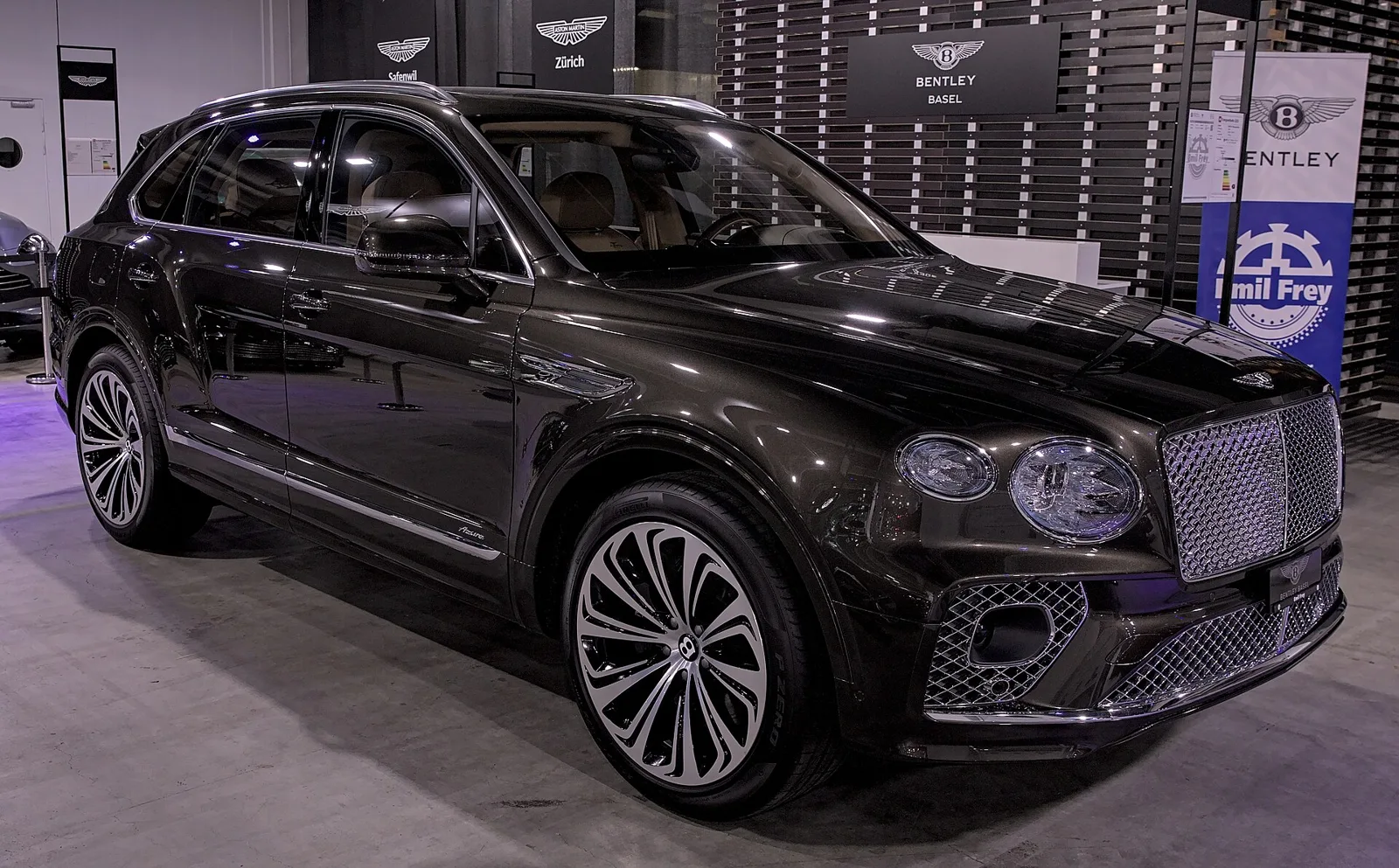
The current line-up includes the Bentayga, in production since 2016, and the third-generation Flying Spur, in production since 2019. The fourth-generation Continental GT has been in production since 2024, and it sits at the centre of the brand's grand tourer line.
Frank Steffan Walliser has been chief executive since June 2024, and he leads a company that now builds its cars at Crewe with a much larger workforce than it had at the start of the Volkswagen era.
How is Bentley moving to electric power?
In November 2020 Bentley announced that all new cars sold would be electric by 2030. The company's Continental Supersports, shown at the 2009 Geneva Motor Show, had earlier shown another route, as it could run on petrol or on E85 ethanol through FlexFuel technology.
The move towards electrification is one part of a wider reshaping. In March 2026 the company reported an operating profit of GBP 186m on revenue of GBP 2.25bn, which gives it the financial base for the next phase of the transition.
What were Bentley's most recent motorsport results?
Between 2001 and 2003 the company returned to Le Mans with the Speed 8, taking the LMGTP class every time. In 2003 it also won the 12 Hours of Sebring in the LMGTP class, a result that marked the end of that chapter.
The Silverstone round of the 2014 Blancpain Endurance Series went to a Continental GT3 run by M-Sport's factory team. That result returned the marque to the British racing scene, and it was a sign that the sporting side of the brand had not disappeared.
What are the key Bentley models and figures?
The table lists selected Bentley models with the period on sale, a defining figure and the role each car played in the range. Where a model had several versions, the figure shown is the one that best describes it, so the range is not blended into a single number.
| Model | Period | Defining figure | Role |
|---|---|---|---|
| 3-litre | 1921 to 1929 | Original model of the company | First Bentley model |
| 4 1/2-litre | 1927 to 1931 | Won Le Mans outright in 1928 | Long-chassis racing and road car |
| Speed Six | 1928 to 1931 | 1-2-3-4 finish at Le Mans in 1929 | Lighter 6 1/2-litre racer |
| 3 1/2 litre | From 1933 | Sporting variant of the Rolls-Royce 20/25 | Derby-built Bentley |
| Mark VI | 1946 to 1952 | First steel-bodied Bentley | Ready-to-drive saloon |
| Turbo R | 1985 to 1995 | Turbocharged performance version | Vickers-era performance model |
| Arnage | 1998 to 2009 | In production from 1998 | Early Volkswagen-era luxury saloon |
| Continental GT | 2003 to 2011 | W12 engine built in Crewe | Luxury coupe that defined the Volkswagen era |
| Bentayga | 2016 to present | In production since 2016 | Current SUV |
Frequently asked questions
What was Bentley's best sales year?
The record year was 2007, when 10,014 cars were sold. It was the first time the company passed the 10,000 cars-per-year mark, and it was accompanied by a record profit of EUR 155 million.
What is the Speed 8?
The Speed 8 was the car Bentley used at Le Mans from 2001 to 2003. It won the LMGTP class each time, and a 2003 Sebring victory came in that class.
Who bought an early Bentley car?
The third car went to Ivor Llewelyn, an engineer from South Wales, and the early cars were admired for their durability.
When did Rolls-Royce buy Bentley?
Rolls-Royce bought the Bentley business in 1931, after it had gone into receivership. The winning bid of GBP 125,000 came through a front company, and Barnato received GBP 42,000 for his shares.