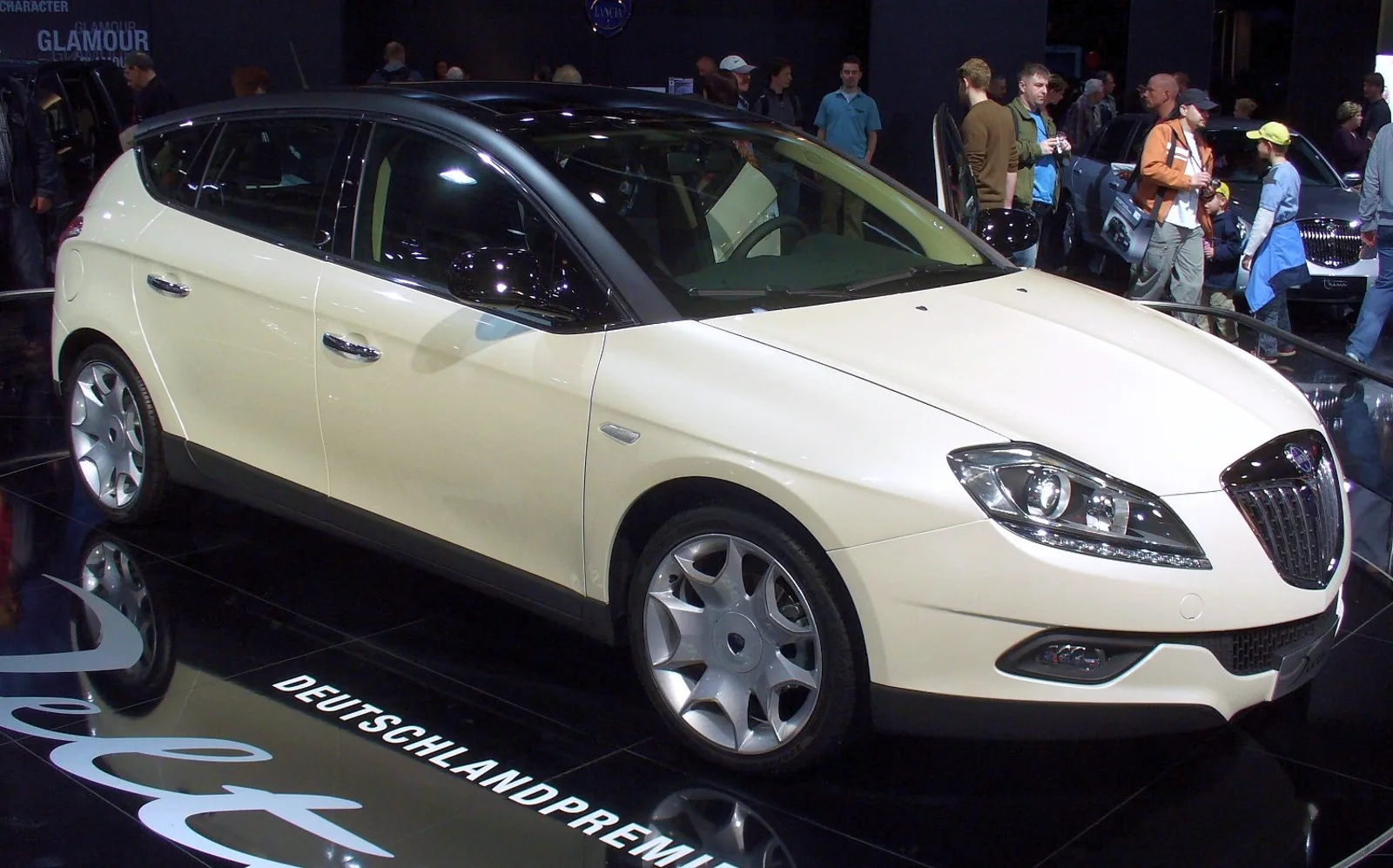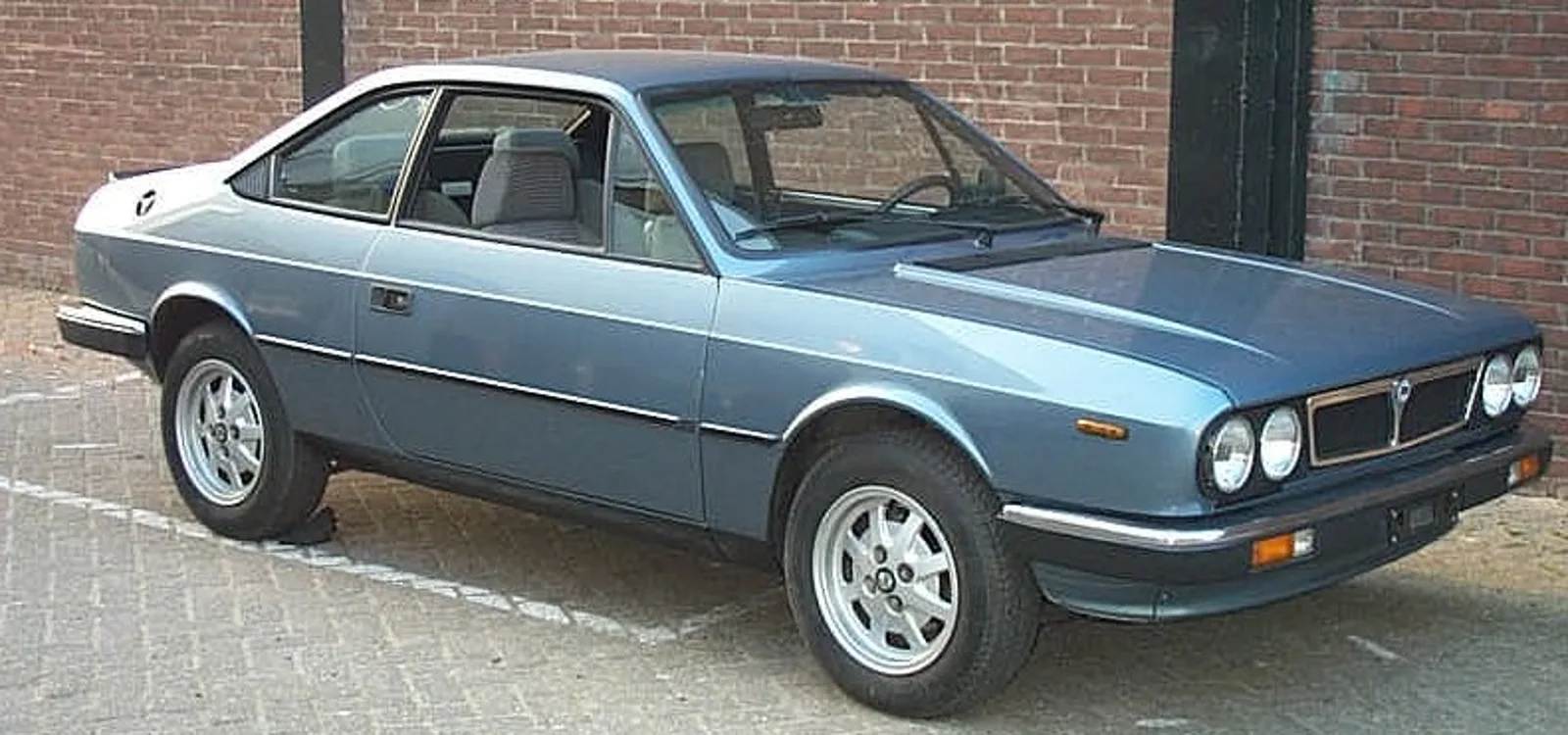
A front-wheel drive range launched after the Fiat takeover, with supercharged Volumex models, a mid-engined Montecarlo and a long rust problem.
The Lancia Beta was an entry-level luxury car built by Lancia from 1972 to 1984. It was the first new Lancia model after Fiat took over the company in 1969, and it used a Fiat twin-cam engine in saloon, coupe, Spider, estate and Montecarlo forms.
The Beta was built in a hurry, on a limited development budget, using Fiat engineering. It became the best-selling Lancia to that point, but a rust reputation later damaged the car and the marque. The range covered saloons, coupes, a Spider, an estate and the mid-engined Montecarlo.
Why is it called the Beta?
Lancia chose the name Beta in 1972 as a symbol of a fresh start. Founder Vincenzo Lancia had named his early cars with Greek letters, and Beta had already been used on a 1908 car and a 1953 bus. The Alpha name was avoided because it could be confused with Alfa Romeo.
The naming habit ran through Alpha, Beta, Gamma and Delta, so the Beta name was a return to Lancia tradition. The car was launched late in 1972, with a production target that had to be met by the end of that year.
A Fiat engine in a Lancia body: the Beta gave the marque its best sales and its worst reputation for rust.
Why did Lancia use a Fiat engine?
Development time and money were both short, so Lancia used a Fiat twin overhead cam engine that was already well regarded. The engine was a straight four with an alloy head and cast iron block, and it was fitted transversely to drive the front wheels.
Lancia's engineers made changes to the Fiat unit, including new inlet and exhaust manifolds and different carburation. The mounting points on the block also differed, so the engine could sit across the car, and it is not interchangeable with the Fiat 132 engine.
The engine was designed by Aurelio Lampredi, who had built engines for Ferrari before Fiat employed him. It stayed in production well into the 1990s and was used in highly developed form in the Lancia Delta Integrale and the Fiat Coupe.
How did the Beta's layout and suspension work?
The Beta used a transverse engine and gearbox mounted on a subframe, tilted 20 degrees rearwards to shift weight over the driven wheels. It had MacPherson struts and discs on all four corners, along with a DOHC engine and five-speed gearbox on every version.
The rear suspension was an independent layout with MacPherson struts attached to parallel transverse links, which pivoted on a centre-mounted crossmember. Lancia never patented the design, and other manufacturers copied the idea during the 1980s and 1990s.
Power steering from ZF was available on some left-hand drive cars and reached right-hand drive models in 1981. Electronic ignition arrived in 1978, along with automatic transmission, which made the Beta the first Lancia with a factory automatic option.
Which body styles did the Beta come in?
The Beta came as a four-door fastback saloon, a notchback Trevi, a two-door coupe, a targa Spider, a three-door HPE estate and a mid-engined Montecarlo. Most were saloons, and the Montecarlo was a separate sports car built on a different layout.
Berlina
The Berlina arrived in 1972 with a wheelbase of 2,535 mm (99.8 in) and fastback styling that looked like a hatchback but had a conventional boot. Its 1400, 1600 and 1800 twin-cam engines were joined in 1974 by the 1.8ES, which had electric windows, alloy wheels and a sunroof.
The 2.0-litre replaced the 1600 and 1800 in 1975, with torque up 20% to 128 lb ft at 2800 rpm. Automatic versions came in 1978, and electronic fuel injection followed in 1981, the year production ended. Berlina production totalled 194,914 cars.
Trevi
The Trevi was a later and substantially reworked four-door three-box notchback saloon, developed with help from Pininfarina. It introduced a dashboard designed by Mario Bellini, which was then applied to the third series Berlina. The Trevi VX used a Roots-type supercharger on the 2.0-litre engine.
Coupe
The coupe was a 2+2 with a 2,350 mm (92.5 in) wheelbase. It was launched in June 1973 but did not reach the public until early 1974, because of the fuel crisis. Its bodywork was developed in-house by Centro Stile Lancia, led by Aldo Castagno, with Piero Castagnero as styling consultant.
Production reached 111,801 coupes. The 2.0 gained fuel injection in 1981, and a supercharged 2.0 VX with 135 bhp arrived in 1983.
Spider
The Spider was a two-door convertible with 2+2 seating that used the coupe's shorter wheelbase and a targa top panel. Pininfarina designed it, but Zagato built it, and each body passed between the two firms three times. Lancia probably lost money on every car built.
Production began in 1975 and totalled 9,390 cars. The Spider was sold as the Zagato in the United States from 1979 onwards.
HPE
The HPE, which stood for High Performance Estate, was a three-door sporting estate introduced in March 1975. It combined the Berlina's longer floorpan with the coupe's front end and doors, and Pininfarina developed it.
The HPE was renamed High Performance Executive from 1979 and gained a fuel-injected 2.0 in 1981. It ended production in 1984 after 73,626 cars had been built.
Montecarlo
The Montecarlo was a rear-wheel drive, mid-engined two-seater announced in March 1974. Pininfarina first designed it as a contender to replace Fiat's 124 Coupe, but Bertone's cheaper design became the Fiat X1/9 instead. Lancia gave the Montecarlo a 2.0-litre twin-cam engine rather than the X1/9's 1.3-litre single cam.
First-series cars from 1975 to 1978 carried the Lancia Beta Montecarlo badge. A brake problem led to a two-year gap, and the fix was to remove the brake servo. The second series from 1980 to 1981 was badged simply Lancia Montecarlo, and 7,798 were built between 1975 and 1981.
How did the Beta fare in North America?
Lancia returned to the US in 1975 with the Beta, but federalisation was difficult and dealers were scarce. The 1756 cc engine produced 86 hp (64 kW), and the Berlina was dropped in 1981 as Lancia focused on sportier models. The US effort ended in 1982.
Power dropped to 83 hp (62 kW) as emissions rules tightened. The 1979 two-litre engine raised power to 87 hp (65 kW) and gave 17 per cent more torque. A 500-car Zagato Limited Edition appeared for 1979, and the Montecarlo was sold as the Scorpion because Chevrolet already held the Monte Carlo name.
Fuel injection pushed the 2.0 to about 108 hp (81 kW), although published figures varied widely. Lancia skipped the 1980 model year after quality problems at the plant.
What were the Volumex models?
The Volumex cars were the highest-performance Betas. A Roots-type supercharger sat between the carburettor and the low-compression 2.0-litre engine, giving 135 bhp (101 kW) and much higher torque than the normal car's 200 N.m (148 lb ft). The Trevi VX, Coupe VX and HPE VX were the three Volumex models.
The Coupe VX and HPE VX were identified by a bulge on the bonnet to clear the air intake, a spoiler below the front bumper and a rubber rear spoiler. Production was 1,272 Coupe VX, 2,370 HPE VX and 3,900 Trevi VX, and only one right-hand drive Trevi VX was built.
Most Volumex cars were left-hand drive. Around 150 right-hand drive Coupes and 186 right-hand drive HPEs reached the UK, but exact right-hand drive totals for other markets remain unknown.
Was the Beta built outside Italy?
Yes. SEAT announced Spanish production of the Beta in August 1976 and began building Coupes and HPE lift-back versions at its Pamplona plant in 1979. The arrangement ended in 1980 after a falling out over investment, and the plant later switched to the Volkswagen Polo.
Lancias were rarely assembled outside Italy, which made the Pamplona arrangement exceptional. Only the Coupe and HPE lift-back versions were included in the Spanish programme.
How serious was the Beta's rust problem?
The Beta gained a reputation for rust, especially on first-series cars built from 1972 to 1975. Corrosion around the subframe mounts could make the subframe loose enough to fail inspection, and the UK was then Lancia's largest export market.
A rumour said the steel came from Soviet supplies, traded for building the Lada factory, but that has never been verified. The more likely causes were poor rustproofing and the prolonged strikes that plagued Italy at the time.
Lancia responded in the UK with a buy-back campaign for affected cars, and it had introduced a six-year anti-corrosion warranty there a year earlier. The Daily Mirror and television programmes reported the problem on 9 April 1980, using photographs of scrapped first-series saloons.
By late 1983 the Hallett Metals scrapyard in Crewkerne, Somerset, had crushed the last affected cars, and Series 2 cars outnumbered Series 1 models by a large margin. Later cars had reinforced subframe mounts, and a revised crossmember was turned round so that dirt and water could not collect.
Were there special Betas and concept cars?
Yes. Giovanni Michelotti produced three concepts on Beta mechanicals, and Giorgetto Giugiaro built the Medusa on Montecarlo running gear in 1980. Lancia itself built the twin-engined Trevi Bimotore for early tests of its four-wheel drive rally programme.
The Trevi Bimotore had a Volumex engine at each end, with linked gearboxes and an electronically controlled throttle. The Medusa had four doors, which was unusual for a mid-engined car, and its body was shaped for a very low drag coefficient for the time.
What are the Lancia Beta specifications?
| Specification | Detail |
|---|---|
| Type | Front-wheel drive compact luxury saloon and coupe family |
| Production years | 1972 to 1984 |
| Engine | Fiat twin-cam four-cylinder, 1.3 to 2.0 litres, fitted transversely |
| Transmission | Five-speed manual, automatic from 1978 |
| Suspension | MacPherson struts front and rear, disc brakes on all four wheels |
| Volumex output | 135 bhp (101 kW), 2.0-litre with Roots-type supercharger |
| Berlina and Trevi production | 194,914 Berlinas and 36,784 Trevis |
| Coupe production | 111,801 |
| Spider production | 9,390 |
| HPE production | 73,626 |
| Montecarlo production | 7,798, from 1975 to 1981 |