A small Italian family hatchback that became one of the most successful rally cars ever built, through the HF 4WD, the Integrale and the Evoluzione.
The Lancia Delta was a small Italian family car sold in three generations from 1979 to 2014. Its HF 4WD, Integrale and Evoluzione rally versions won six straight manufacturers' titles from 1987 to 1992. Its rally fame was built on the HF 4WD and Integrale cars.
Lancia's Delta was a compact family hatchback built in three generations between 1979 and 2014. Its first generation earned its fame on rally stages with the HF 4WD, the Integrale and the Evoluzione, while the later cars took a more everyday path. This guide follows the car from its design to its rally career, its special versions and its later models.
What is the Lancia Delta?
Lancia built the Delta in three generations, from 1979 to 1994, 1993 to 1999 and 2008 to 2014. Its first generation earned its reputation on rally stages through the HF 4WD and the Integrale models, while the later cars were more everyday. Each generation had its own character and its own market.
For the third generation, Lancia's marketing presented the name as a symbol of change and evolution. The idea tied the modern car back to a model name that had carried weight in the company's history.
Rally champion, family hatchback and collectors' coupe, all from one Italian name that Lancia kept reinventing.
Where did the first Delta come from?
The car was codenamed Y 5 during development and sat below the larger Beta in Lancia's range. Giorgetto Giugiaro's Italdesign produced the design, and the car was built on a platform derived from the Fiat Ritmo, with a stiffer chassis. It was first shown at the September 1979 Frankfurt Motor Show.
Lancia engineers revised Fiat's four-cylinder SOHC engines with Weber twin-choke carburettors and new manifolds, lifting output to 85 PS or 63 kW and 84 hp. The car also offered fully independent suspension, rack and pinion steering and a split-folding rear seat, features that were unusual in its segment.
Saab helped with the heating and ventilation, and it also claimed a part in the car's rust proofing. Saab's engineers were involved in developing the split-folding rear seats and the extended bootlid, which made loading simpler.
What was the first Delta's launch range?
At launch there were three versions: a base model with a four-speed gearbox, a version with a five-speed gearbox and extra features, and a 1500 with 85 PS and five speeds. The Delta was named European Car of the Year for 1980 by a jury of 53 journalists from 16 countries.
Sales started in October 1979, and 43,000 cars were sold in 1980. By the end of 1981 production had passed 100,000, which showed how quickly the hatchback found buyers across Europe.
An automatic option, the 1500 Automatica, arrived in early 1982, with a three-speed gearbox built at the Verrone plant. In March the top LX trim joined the range with alloy wheels and Zegna cloth upholstery, and the 1.3 later received a higher output.
What changed in the 1982 facelift and the GT?
In November 1982 the Delta received its first facelift, with one-piece thermoplastic bumpers, a more prominent front spoiler, a roof spoiler and a weight saving of 40 kg. Alongside it came the Delta GT 1600, the first sporting variant, with a DOHC engine.
The GT 1600 also gained disc brakes on all four wheels, lower profile tyres and retuned suspension. Its cabin was upholstered in Zegna cloth, and a GT badge on the grille set it apart from the rest of the range.
The 200,000th Delta rolled out of the Chivasso factory on 9 March 1984, a sign of the model's success before the performance cars arrived. The sporting models that followed would take the Delta into a very different market.
What was the Delta HF?
The Delta HF, introduced in July 1983, was the first true performance Delta. It used a turbocharged version of the GT engine with a Garrett turbocharger, a ZF five-speed gearbox and wide Michelin tyres, and the HF name came from high fidelity.
Lancia strengthened the oil system and cylinder heads to cope with boost, and sodium-filled valves were used. The exterior changes were understated, limited to HF badging, a deeper chin spoiler and eight-spoke alloy wheels, which kept the look restrained.
Roughly ten thousand HFs were built over two years. A limited HF Martini edition appeared at the 1984 Geneva show with Martini stripes and Recaro seats, a nod to the Lancia-Martini rally cars of the day.
How did the HF turbo and HF 4WD differ?
The HF turbo gained bolder styling and better equipment in October 1985, and the four-wheel-drive HF 4WD was unveiled in April 1986 as the new top model. Its 1,995 cc turbo engine produced 165 PS or 121 kW and 163 hp, and the torque split was 56/44 front to rear.
The fuel-injected HF turbo i.e. version sat below the HF 4WD in the line-up. The 1986 facelift then brought enveloping bumpers and a fresh front end to the whole range, with a new grille and headlight covers that protruded from the bodywork.
The Delta turbo ds brought the first diesel to the range, a 1,929 cc eight-valve four-cylinder rated at 80 PS. It came with a KKK turbocharger and was positioned as an elegant sporting model, with more instruments than the petrol cars.
What made the four-wheel-drive system work?
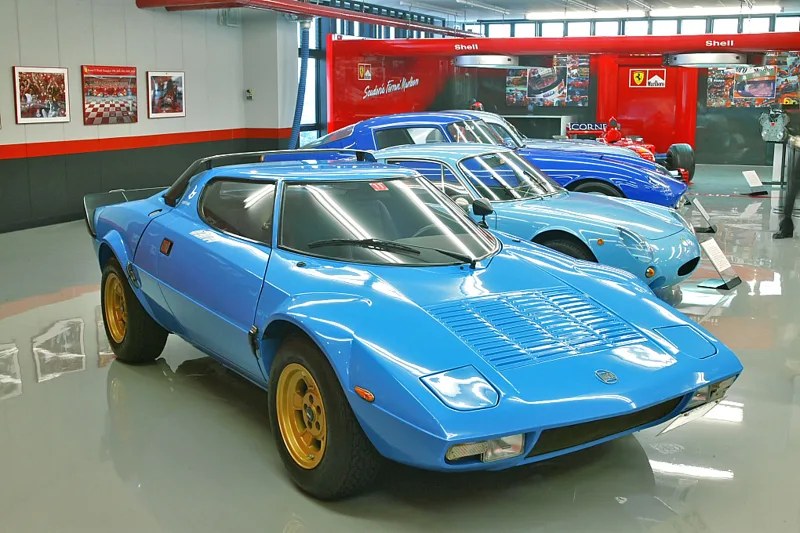
The four-wheel-drive system used three differentials: an epicyclic centre unit controlled by a Ferguson viscous coupling, an open front differential and a Torsen rear unit. Its layout was adapted from the Delta S4 Group B rally car, though it was set out for a front-engined transverse arrangement.
The viscous coupling did nothing while both axles turned at the same speed. Once a speed difference appeared, it began moving torque to the slower axle, and it locked up when the gap grew large, which gave the car strong traction on loose surfaces.
The Torsen rear differential, supplied by the American Gleason Corporation, shifted drive between the rear wheels as traction changed. That combination of three differentials proved competitive on rally stages and later became a hallmark of the Integrale family.
How did Group A rallying shape the Delta?
When Group B was abolished after a string of fatal accidents, Lancia faced Group A machinery instead. The Delta HF 4WD was pressed into service for 1987, and it won the Monte Carlo Rally on its first outing before going on to claim the manufacturers' title that year.
The HF 4WD won nine of the 13 championship races in 1987, and Juha Kankkunen took the drivers' title that season. Lancia later produced the Integrale and then the 16v, which stayed competitive through 1991 and added four more world titles for the team.
The Delta's success also boosted sales. Italian sales climbed 42% in the first half of 1987, a rise tied to the rallying wins. That kind of result shows how motorsport could lift a road car's image in its home market.
Which Integrale models followed the HF 4WD?
The Integrale brought the rally car's formula to the road in a more accessible form. Its eight-valve engine delivered 185 PS or 136 kW and 182 hp at 5,300 rpm, and it had permanent four-wheel drive with a front transverse engine and a five-speed gearbox.
The 16v Integrale, introduced at the 1989 Geneva Motor Show, used a raised bonnet centre for its new 16-valve engine, which produced 200 PS or 147 kW and 197 hp at 5,500 rpm. It reached 0-100 km/h in 5.7 seconds, and the torque split changed to 47 per cent front and 53 per cent rear.
The Evoluzione followed in September 1991 with 210 PS and a heavily revised body, including a new bonnet, wider track and projector headlamps. The Evo II of 1993 raised output to 215 PS or 158 kW and 212 hp DIN, with a three-way catalyst and a more advanced engine control system.
How many Delta rally titles did the team win?
The Delta won six consecutive manufacturers' championships between 1987 and 1992, a record that still stands. Four evolutions of the Delta together won 46 world championship events, and Lancia drivers took the drivers' crown in 1987, 1988, 1989 and 1991.
Lancia's factory involvement ended after the 1991 season, but privateer Evos carried on in 1992. The team's sixth successive title came from those factory-backed privateers, and the Delta's run remains one of the most striking results in the sport's history.
What was the Saab-Lancia 600?
Saab sold a rebadged Delta as the Saab-Lancia 600 in Northern Europe, with Sweden as the most important market. The deal was part of wider co-operation between Saab and the Fiat Group, and it helped Saab replace an ageing compact model without developing an entirely new model.
Saab's version had its own heater, changed rust protection and a 1.5-litre engine with 85 PS. Severe rust problems in Scandinavia led to many cars being removed from the road, and the model is now very rare. Only 159 of the 6,419 Saab-Lancias built for Sweden were still in existence as of 2012.
What was the Lancia Hyena?
The Hyena was a two-door coupe built by Zagato on the basis of the HF Integrale Evoluzione. The idea came from Paul V.J. Koot, a Dutch restorer and collector, who wanted a coupe version of the Integrale as a road car. Only 24 were completed between 1992 and 1995.
Koot used fully finished Integrales bought through the Dutch Lancia importer, because supplying bare rolling chassis was held up by bureaucracy. Zagato then fitted aluminium and composite bodywork, and the car used carbon fibre for its interior panels, which kept its weight down.
Power rose from 205 to 250 PS, and the car could reach 100 km/h in 5.4 seconds. The Hyena sold for about 140,000 Swiss francs, roughly $100,000, which made it expensive even among collectors of the period.
Which concept cars were built?
The Italdesign Orca was a 1982 concept with an aerodynamic five-door fastback body, based on the Delta platform. It combined a drag coefficient of 0.245 with four-wheel drive that could be disengaged at speed, and it showed how far the design team was willing to push the shape.
The Lancia HIT, shown at the 1988 Turin Motor Show, was a 2+2 coupe with a Pininfarina body and cold-glued carbon fibre sandwich panels. It used the mechanical layout of the Delta HF Integrale, and it remained a one-off study rather than a production car.
What is the second-generation Delta?
The second-generation Delta, known as the Nuova Delta (Tipo 836), arrived in 1993 and stayed in production until 1999. It was styled at the I.DE.A Institute by Ercole Spada and built on the Fiat Tipo platform, aimed at buyers who wanted comfort and convenience rather than rally pedigree.
Development took five years and, according to Fiat's chief executive, cost 700 billion Lire. Planners expected sales of 60,000 a year, with half going abroad. The range opened with a small SOHC four and two DOHC fours, while the HF 2.0 turbo produced 186 PS or 137 kW and 183 hp.
There were no four-wheel-drive versions of the second generation, and the most powerful HF variants stayed front-wheel drive. The HF was given wider front wings, specific seven-spoke alloys and black side skirts, which gave it a sportier stance.
How were the later second-generation cars updated?
The three-door HPE arrived at the 1995 Geneva Motor Show as the first three-door Delta, with flared wings and a wider front. Its name stood for high performance executive, and it was offered with the top engines at first. The mid-decade revision replaced the naturally aspirated engines with 16-valve units and added a variable-valve-timing engine.
A later revision brought a renewed 2.0 HF producing 193 PS or 142 kW and 190 hp, and the model ended in 1999, leaving no direct successor, once nearly 139,000 units had been built.
What is the third-generation Delta?
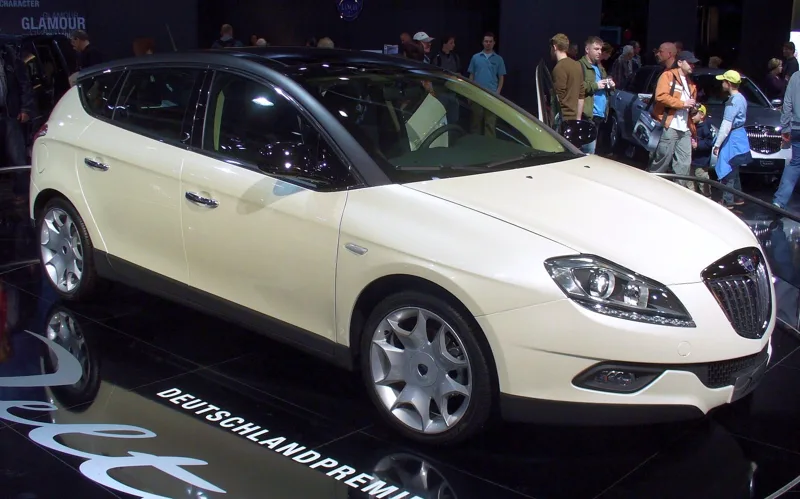
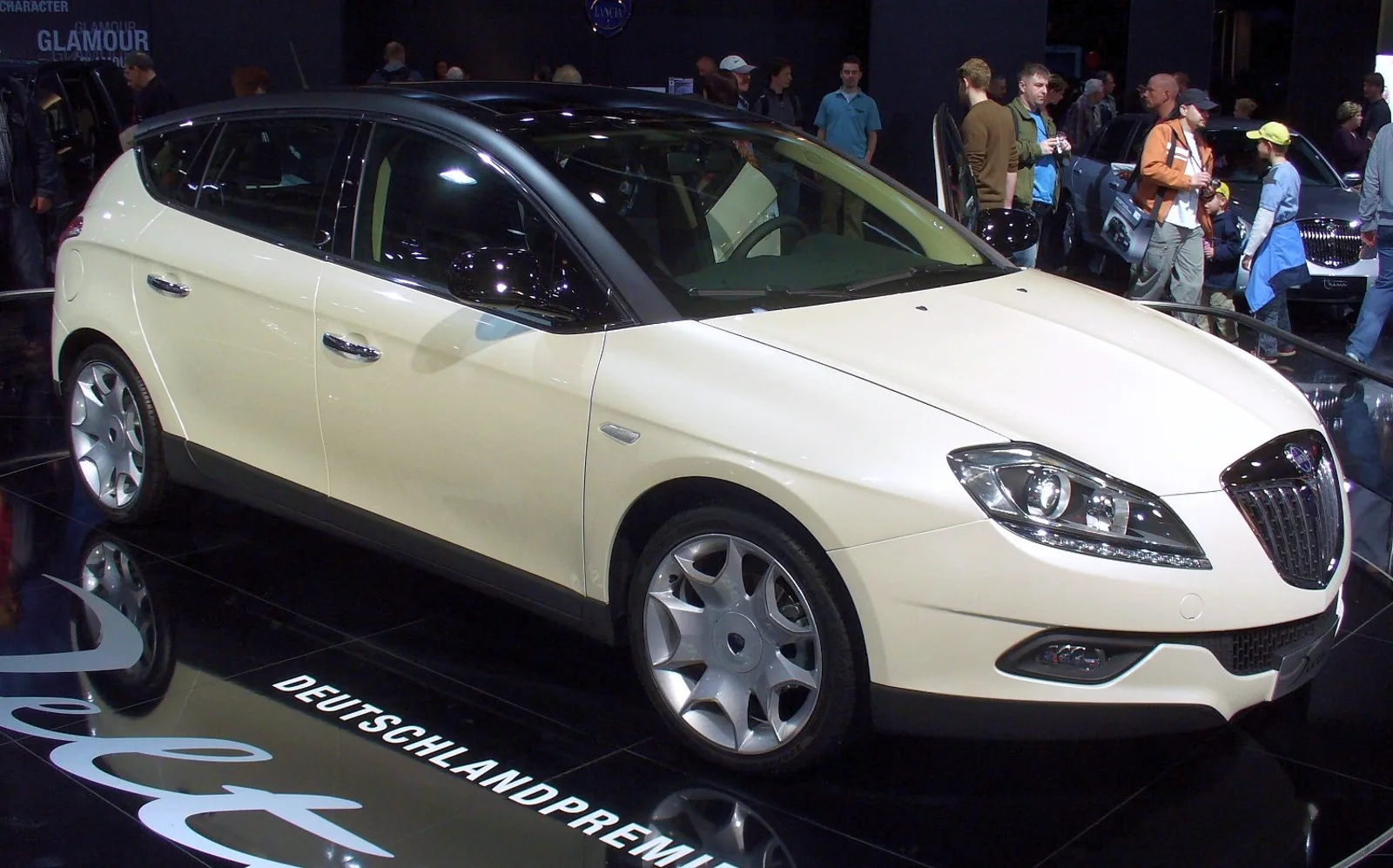
The third-generation Delta, Type 844, was announced as a revival and unveiled at the 2008 Geneva Motor Show. It was built on the Fiat C platform, on a 2,700 mm (106.3 in) wheelbase, and targeted premium buyers in the small family segment.
The car offered a Bose sound system, Blue&Me connectivity built with Microsoft input, and satellite navigation from Magneti Marelli. Electronic stability control and electronically controlled damping were also included, along with a semi-automatic parking assistant.
The late facelift brought trim changes, a grille derived from Chrysler's family look and a MultiJet diesel option. Launch engines included 1.4 turbo petrols with 120 and 150 PS, a 2.0 MultiJet with 165 PS and a 1.9 twinturbo MultiJet with 190 PS.
A fourth generation is reportedly expected in late 2028, with hybrid and fully electric options. Production is scheduled at the Cassino factory in Frosinone province.
Lancia Delta specifications at a glance
The table below gathers the core figures for the three generations and the rally variants. Where a figure belongs to one model, engine or generation, the table says so, so the Integrale and Evoluzione values do not blend into the road cars.
| Specification | Detail |
|---|---|
| Generations | First 1979 to 1994; second 1993 to 1999; third 2008 to 2014 |
| First generation total | 478,645 cars |
| Second generation total | Nearly 139,000 units |
| Integrale production | 44,296 cars |
| HF 4WD engine | 1,995 cc turbo, 165 PS or 121 kW and 163 hp at 5,250 rpm |
| Integrale 8V | 185 PS or 136 kW and 182 hp at 5,300 rpm |
| 16v Integrale | 200 PS or 147 kW and 197 hp at 5,500 rpm; 0-100 km/h in 5.7 seconds |
| Evoluzione | 210 PS or 154 kW and 207 hp at 5,750 rpm |
| Third-generation wheelbase | 2,700 mm (106.3 in) |
| Manufacturers' titles | Six in a row, 1987 to 1992 |
Frequently asked questions
How many Deltas were built?
The first generation totalled 478,645 cars, and the second generation reached nearly 139,000 units before production ended in 1999. Separately, 44,296 Integrales were produced, which makes them one of the rarer high-performance versions.
What was the Delta Futurista?
In 2018 the Italian coachbuilder Automobili Amos created the Delta Futurista, a modern take on the Integrale with 330 PS and a weight of 1,250 kg. Only twenty were built, and each cost 270,000 pounds.
Did an electric Delta race?
Yes, briefly. GCK Motorsport planned to revive the Delta as an electric rallycross car for the championship. A fire destroyed both cars in July 2023, ending the programme.
What did the Evo 3 concept add?
The Evo 3 Viola raised output from 215 to 237 PS and added a GKN limited-slip differential and a new injection system. It was the only car of that name, painted in an intense violet that gave it its nickname.