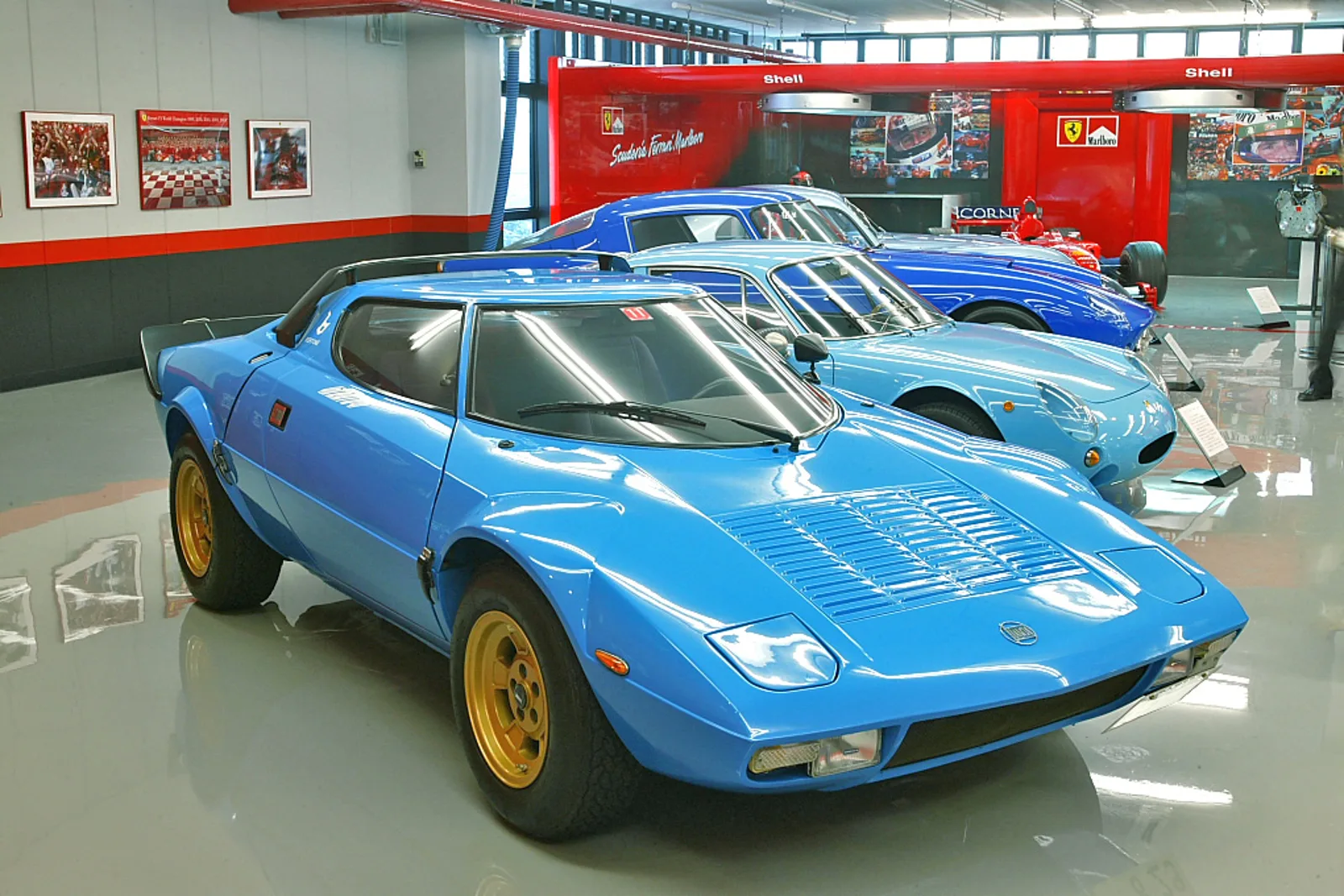
Bertone's mid-engined rally car took three World Rally Championship titles on a Dino V6, and its road-going HF Stradale was built to qualify it.
Lancia's Stratos used a 2.4 L Dino V6 inside a wedge body from Bertone. Lancia won three World Rally Championship titles with the car between 1974 and 1976. Production of the 500 homologation cars began in 1973 and ended in 1975.
The Lancia Stratos was a rear mid-engined rally car that Bertone designed and Lancia built in the early 1970s. It won the World Rally Championship in 1974, 1975 and 1976, and the road-going HF Stradale was produced to meet the homologation rules that allowed the racing version to compete.
Who designed the Lancia Stratos?
Bertone designed the Stratos, a notable change for Lancia, which had long worked with Pininfarina. Marcello Gandini, the Bertone designer who had also penned the Lamborghini Miura, took a personal interest in the bodywork. Lancia then carried out the final assembly at its Chivasso plant.
The arrangement split the work across three firms: Bertone designed and built the body, Lancia assembled the car at Chivasso, and Ferrari supplied the engines.
Bertone's approach began with a running model. The company borrowed the running gear of a Fulvia Coupe that belonged to one of its friends, then built a body around it. When Bertone drove the finished car through the Lancia factory gates, the workers gave it a warm welcome.
Lancia wanted a replacement for the ageing Fulvia for rallying, and Bertone's proposal fitted that brief. The two companies agreed to develop a rally car based on Gandini's ideas, and the result was the first car designed from scratch for rallying.
Lancia's engineers also had to work within the homologation rules at every stage, which shaped the car from the start.
A wedge-shaped rally car built from scratch, carrying a Dino V6 to three World Rally titles.
From the Stratos Zero to the 1971 prototype
The Stratos Zero preceded the HF prototype by 12 months, first appearing at the 1970 Turin Motor Show. Its futuristic body sat over a 1.6 L Fulvia V4 engine, and the car was a showpiece rather than a rally machine.
Lancia presented the Bertone-designed HF prototype at the 1971 Turin Motor Show. The prototype was fluorescent red and had a crescent-shaped windscreen that wrapped around the cabin. That glass gave strong forward vision, but almost no view to the rear.
The prototype went through three engine plans. First came a Fulvia unit, then a Beta unit, and finally the mid-mounted Dino V6 for the public launch. Enzo Ferrari was reluctant to let Lancia use the Dino in a car he saw as a competitor to his own V6.
Once Dino production ended, Ferrari agreed to deliver engines for the Stratos, and Lancia suddenly received 500 units. The body shares several features with the Miura, including dual clamshell hoods that open forward and rearward.
What engine did the Stratos use?
The Stratos used the 2.4 L Dino V6, a unit also fitted to the rally cars but in a lower state of tune. The road car produced 190 PS (140 kW; 188 bhp) at 7,000 rpm and 226 Nm (166 lbf ft) of torque at 4,000 rpm.
Competition engines were more potent. The 12-valve version made around 275 hp, while the 24-valve version reached 320 hp. The car weighed between 900 and 950 kg depending on specification, so the power-to-weight figures were strong for the period.
The FIA banned 24-valve heads from Group 4 competition from the 1978 season. That rule change removed the most powerful engines from the homologated class, although the Stratos stayed competitive and was still the car to beat.
How quick was the road-going Stratos?
The road car ran from 0 to 100 km/h (62 mph) in 6.8 seconds and reached a top speed of 232 km/h (144 mph). It rode on 205/70VR14 Pirelli Cinturato tyres, which were the first fitted to the car.
Its mass fell within the same band, which depended on the event and its specification. Its reliability was a constant concern, because many cars failed through accident or transmission faults, yet a sound example gave a team a real chance of winning.
Who ran the Stratos rally programme?
Cesare Fiorio, Lancia's team manager, Mike Parkes, a British racer and engineer, and factory driver Sandro Munari were the three leading figures behind the project. Bertone's Marcello Gandini took a personal interest in the bodywork and its production.
A dedicated calculations engineer, Nicola Materazzi, worked on many chassis, steering, suspension and engine components. Lancia tested the car extensively and raced it in events where Group 5 prototypes were allowed during 1972 and 1973, before homologation began.
How many Stratos cars were made?
Lancia needed 500 cars for Group 4 homologation, and production began in 1973 at Bertone in Turin. Production ended in 1975, when the company reckoned about 492 cars had been built, and the homologation rule was later eased.
The 1976 rules cut the Group 4 requirement to 400 cars within 24 months, which made it easier for Lancia to keep the car in competition. Bertone built the bodies, and final assembly by Lancia took place at Chivasso.
The road car went on sale as the Lancia Stratos HF Stradale. The Dino V6 was phased out in 1974, although 500 engines, among the last built, had already been delivered to Lancia.
Which championships did the Stratos win?
The Stratos won the World Rally Championship titles in 1974, 1975 and 1976, with Sandro Munari and Bjorn Waldegard driving the title-winning cars. It also took the Monte Carlo Rally in 1975, 1976 and 1977, and the Chardonnet Team won the event in 1979.
Munari gave the car its Monte Carlo victories, and the Stratos also won the 1974 Targa Florio. Its record in the Tour de France Automobile was equally striking, with five wins between 1973 and 1980, a record for the event.
Those results gave the car a reputation that outlived its factory programme, which ended once Fiat's priorities changed.
Internal politics within the Fiat group handed rallying duties to the Fiat 131 Abarths, which cut the Stratos off from factory support. Private teams kept the car in contention, and the last victory came in 1981, when Bernard Darniche won the Tour de Corse with a longtime Stratos.
Silhouette racers and endurance results
Two Group 5 cars with turbocharged engines and silhouette bodywork were built for closed-track endurance events, once the Fiat 131 had taken over the rally programme. Nicola Materazzi drew on experience gained with the earlier generation for their powertrain and aerodynamics.
These cars struggled against Porsche 935s on closed circuits but did well in hybrid events. The Stratos also appeared at Le Mans, where a car driven by Christine Dacremont and Lella Lombardi finished 20th overall and second in the GTP class in 1976.
The Stratos won the Giro d'Italia automobilistico in 1974, 1976 and 1978, an Italian counterpart to the Tour de France. One silhouette car was destroyed at Zeltweg after a fire caused by overheating.
Privateers, collectors and rallycross
Franz Wurz, a Memphis teammate of Andy Bentza, first drove the rallycross car and claimed the 1976 European rallycross title in it. Bentza later took the car over and won the 1978 ERC GT Division title, racing the one-off 3.0 litre Stratos until 1983.
Ernst Hrabalek later owned the largest Stratos collection of its day, with 11 unique cars. Among them were the 1971 factory prototype, painted fluorescent red, and the 1977 Safari car. Alexander Wurz later bought the rallycross car and revealed it in May 2016.
Alexander Wurz is the son of Franz Wurz, the driver who had first taken the car on the rallycross circuit.
What concept cars came before and after the Stratos?
The Stratos Zero of 1970 came first, followed by the Sibilo in 1978, the Stola S81 in 2000 and the Fenomenon concept in 2005. Each one reinterpreted the original wedge shape in a different way.
The Stratos Zero measured 3.58 m (141 in) long and 84 cm (33 in) high, which made it unusually short. Its orange body appeared in Michael Jackson's 1988 film Moonwalker, and before its sale it had been exhibited in Bertone's museum for many years.
Bertone designed the Lancia Sibilo in 1978 as a futuristic two-seater, lengthening the wheelbase from 2180 mm to 2280 mm. Its glass surfaces seemed almost integrated into the body volumes.
In 2000 Marcello Gandini designed the Stola S81, built by Stola of Turin and shown at the 2000 Turin Auto Show. It used LED headlights and taillights, and an electric motor was fitted in 2014.
The first design planned to carry the Lancia shield on the front bumper, but Lancia asked that its logo not be used, so Gandini substituted his own.
The 2005 Fenomenon concept, shown at the Geneva show, was based around a mid-mounted 419 hp (312 kW) V8 and was developed by Prodrive.
The British design firm Fenomenon held the rights to the Stratos name at the time.
What was the New Stratos?
The New Stratos was a one-off announced in 2010 and designed by Pininfarina for Michael Stoschek and his son Maximilian. It was built on a Ferrari 430 Scuderia donor car, and Ferrari did not consent to the plan.
Ferrari also told its suppliers not to back the project, so the one-off was assembled without that help.
The donor chassis was shortened by 200 mm (7.9 in) to a 2,400 mm (94.49 in) wheelbase. Its 4.3 L V8 (4,308 cm3) was tuned to 540 hp (403 kW) at 8,200 rpm, with 520 Nm (384 lb ft) of torque at 3,750 rpm.
Kerb weight is 1,247 kg (2,749 lb). The claimed figures are 0-100 km/h in 3.3 seconds and a top speed close to 320 km/h (200 mph).
Italian coachbuilder Manifattura Automobili Torino announced on 10 February 2018 that it would build the originally planned 25 cars.
Did the Stratos appear in popular culture?
Yes. In the Generation 1 Transformers line and cartoon, the Wheeljack character became an Alitalia-sponsored Group 5 Stratos. The Alitalia markings on the toy were spelled Alitalla, most likely to sidestep trademark issues.
An earlier version of the Wheeljack toy, from the Diaclone range, wore a different livery. The Transformers link keeps the car in the minds of a wider audience long after its rally career ended.
Frequently asked questions
Why did Fiat stop backing the Stratos?
Internal Fiat group politics placed rallying with the Fiat 131 Abarths, so the factory no longer supported the Stratos. Private teams and experienced drivers kept it competitive until 1981.
How much did the Stratos Zero sell for?
A 2011 auction in Italy sold the Zero for EUR 761,600. The car had spent many years on display in Bertone's own museum before that sale.
Was there a road-going Stratos?
Yes. The road car was sold as the Lancia Stratos HF Stradale. It produced 190 PS (140 kW; 188 bhp) and reached 100 km/h from rest in 6.8 seconds.
How did the Stratos compare with the Miura?
Both cars used dual clamshell hoods and a similar door-glass shape. The Stratos was shorter and wider in its wedge, with its nose dropping below the top of the front wheel arches.
Who drove the championship-winning Stratos?
Sandro Munari and Bjorn Waldegard won titles in the Stratos, which made them central to its success on the stages.