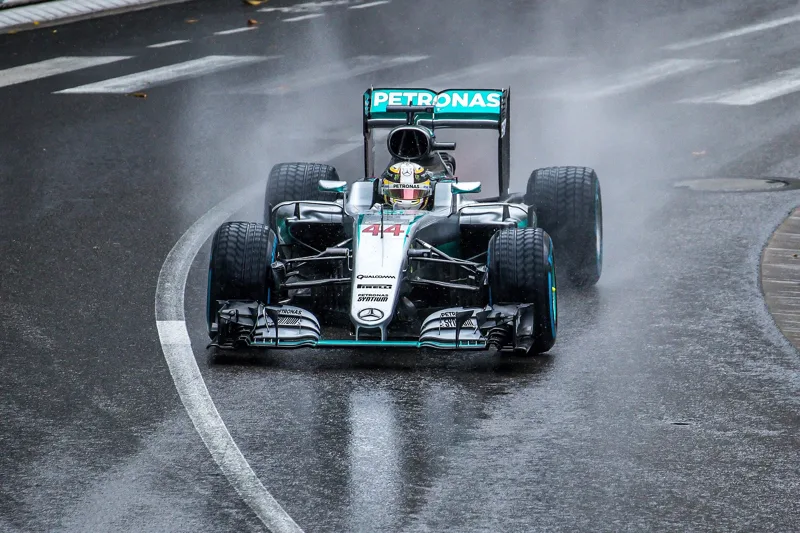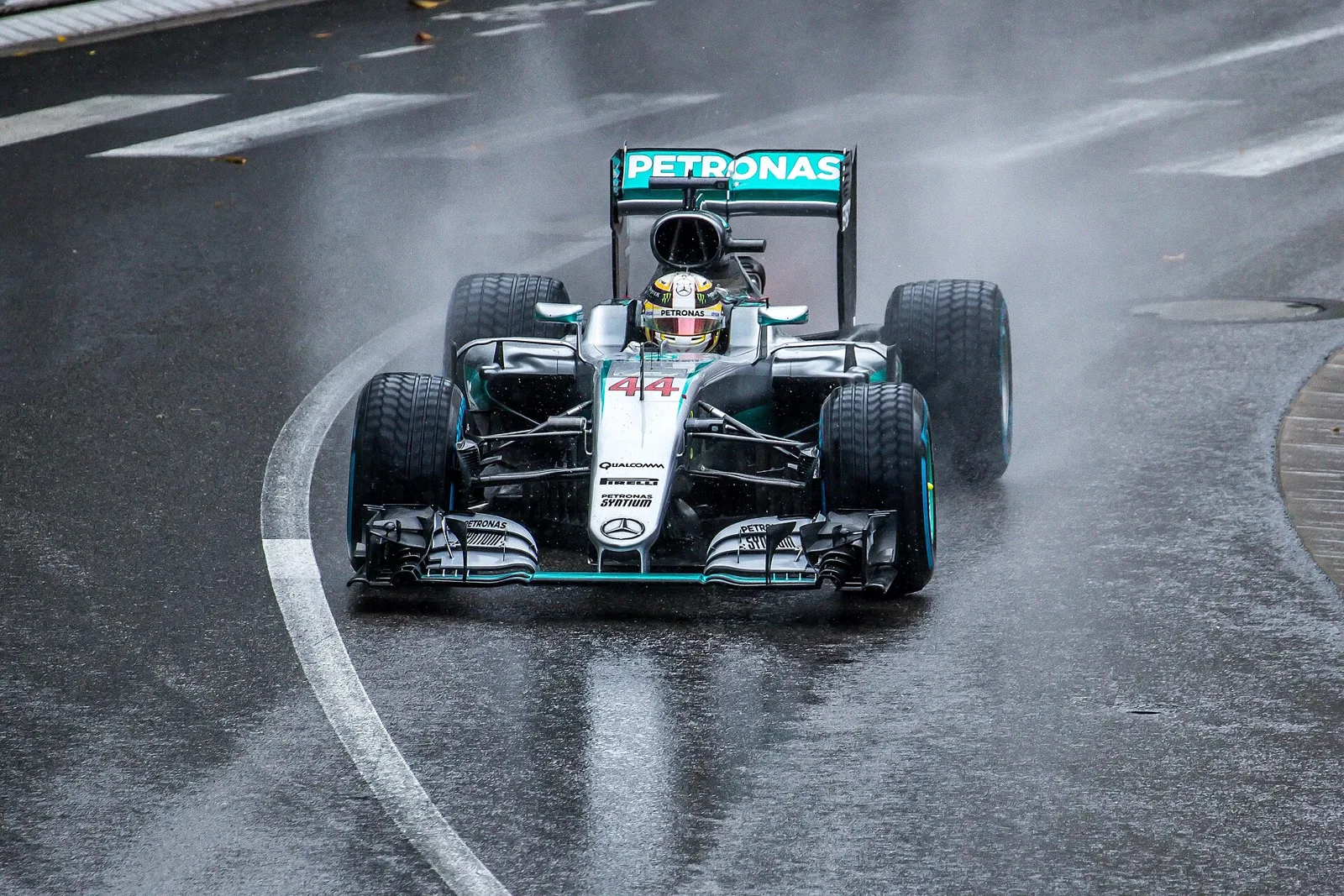
Carbon monocoques, hybrid V6 power, wings that pull the car down and a rulebook that keeps reshaping the design.
A Formula One car is a single-seat, open-wheel racing car with a carbon fibre monocoque and a 1.6 L turbo hybrid V6 producing up to 950 hp. Its front and rear wings generate downforce, and FIA rules set its weight, size and power unit limits.
Built to FIA rules, the Formula One machine is a single-seat, open-wheel racer, and the modern version pairs a carbon fibre monocoque with a turbo hybrid V6 that can produce up to 950 hp (710 kW). Wings and floor shape generate enough downforce for cornering at several times the force of gravity. The rulebook has reshaped the cars repeatedly since the late 1940s.
What makes a modern Formula One car?
A modern car is built around a carbon fibre monocoque with the engine behind the driver, a detachable steering wheel and an eight-speed semi-automatic gearbox. Large wheels carry slick tyres in dry weather, and the bodywork exists to manage the airflow that the wings and floor produce.
The power unit is a 1.6 L turbo hybrid V6. It can produce up to 950 hp (710 kW) with energy recovery adding extra boost, and the 18-inch wheels run carbon disc brakes that can handle extreme temperatures. Every part is designed to survive heavy impacts and sustained lateral loads.
Carbon fibre, a 950 hp hybrid V6 and wings that pull the car onto the track define the modern Formula One car.
How did Formula One cars evolve from the 1950s?
Early cars had engines at the front, no wings and little electronic help, so drivers worked hard at the wheel. Lighter chassis, ground effect and aerodynamic devices followed, and turbochargers in the 1980s pushed power and speed higher still.
In the 1950s the rules allowed a 4.5 L naturally aspirated engine or a 1.5 L supercharged unit with up to 317 kW (425 hp). By 1961 the engine had moved behind the driver, with capacity capped at 1300 to 1500 cc. In 1966 the FIA permitted up to 3.0 L atmospheric engines, and by 1986 the most powerful units made 1,000 kW (1,400 hp) at 12000 rpm.
Width limits also changed. Cars could be 2,150 mm (85 in) across at first, and the cap fell to 2,000 mm (79 in) by 1994. A 10 mm (0.39 in) wooden skid block was added under the car after that year's San Marino weekend, which set the path toward the modern shape.
What rules have changed the engines?
Turbochargers were banned from 1989, after which 3.0 L engines became standard, with V10 and V12 units following in the 1990s. A 2.4 L V8 arrived in 2006, and speeds were limited to 18,000 rpm from 2009. The 2014 rules introduced the current 1.6 L hybrid layout.
Since then the rules have controlled both the number of power units and the fuel. Each driver may use a maximum of five power units per season, and grid penalties follow for exceeding that. Fuel is a tightly controlled mix of petrol and ethanol, and the sport moved to fully sustainable fuel for the 2026 season.
How do wings and ground effect keep the car on the track?
Wings work like inverted aeroplane wings, pushing the car down rather than lifting it. A modern car can generate downforce equal to twice its own weight at 190 km/h (120 mph). Ground effect uses the airflow under the floor to create low pressure that pulls the car towards the surface.
Early wings were tied directly to the suspension, but accidents led to rules requiring them to be fixed rigidly to the chassis. Front wings can carry up to four elements and can be up to 1,800 mm (71 in) wide. The rear wing is a main plane with flaps, and it has been fitted with a drag reduction system since 2011.
The drag reduction system opens a slot in the rear wing when the driver requests it in designated zones, reducing drag and adding straight-line speed. Since 2022 the aerodynamic parts have been simplified to cut turbulence behind each car, and the diffuser at the back combines the underbody airflow to add more downforce.
What tyres do Formula One cars run?
Slick tyres first appeared in 1971, and grooved tyres arrived in 1998. Slicks returned in 2009, with narrower front tyres to encourage overtaking. Each weekend teams receive a fixed number of dry-weather sets, plus grooved intermediate and wet tyres, and a dry race must include at least two dry compounds.
The 2017 rules brought much wider Pirelli tyres to both axles, with front tyres of 305/670-R13 and rear tyres of 405/670-R13. In 2022 the wheels grew to 18 inches, which lifted the overall tyre diameter to 720 mm (28 in).
How do the brakes and gearbox handle the punishment?
Carbon brake discs can handle temperatures up to 1,000 degrees Celsius (1,830 degrees Fahrenheit). Air passing through many small holes in the brake ducts cools them, and an average car can slow from 100 km/h to a standstill in less than 15 m (49 ft).
The rear brakes combine friction, engine drag and energy recovery, and the driver can adjust the balance from the steering wheel. That wheel is itself a control centre, weighing about 1.3 kg (2.9 lb) with its buttons, knobs and display.
The eight-speed gearbox uses paddles on the wheel. Launch control and traction control, which were banned in the 2000s, left skill central to the car's control. Gear shifts take 2-3 ms, and the multi-plate carbon clutch weighs under 1 kg (2.2 lb).
How safe is a modern Formula One car?
Each car is built to protect its driver in serious impacts and fires. The monocoque is reinforced carbon fibre with Kevlar and fire-resistant layers, and the nose box absorbs energy while being load tested by the FIA. The halo, a set of curved metal bars above the cockpit, arrived in 2018.
Minimum sizes and weights are fixed too. The minimum weight is 798 kg (1,759 lb) with the driver, dry-weather tyres and no fuel, and the cars are capped at 5.63 m (18.5 ft) long, 2 m (6 ft 7 in) wide and 0.9 m (2 ft 11 in) tall.
How fast can a Formula One car go?
A modern car can reach nearly 375 km/h (233 mph), though its average race speed is nearer 200 km/h (120 mph). Top speed depends on the trade-off between low drag on the straights and enough downforce for the corners.
The 1.6 L hybrid accelerates from 0 to 60 mph in 1.8 seconds and reaches 100 mph in 2.6 seconds. Drivers feel 3-4 g under acceleration, 5-6 g under braking and 4-6.5 g in fast corners.
The official record belongs to McLaren, which reached 372.6 km/h (231.5 mph) in 2005 testing, recognised by the FIA. In racing, Valtteri Bottas reached 372.54 km/h (231.49 mph) at the 2016 Mexican Grand Prix. Away from the circuit, a BAR Honda 007 hit 413 km/h (257 mph) at Bonneville in 2005, and the FIA later ratified 400 km/h (250 mph) there on 21 July 2006.
Specification summary
| Feature | Current figure |
|---|---|
| Power unit | 1.6 L turbo hybrid V6 |
| Output | Up to 950 hp (710 kW) |
| Top speed | 375 km/h (233 mph) |
| Gearbox | Eight forward gears, semi-automatic |
| Minimum weight | 798 kg (1,759 lb), with driver and no fuel |
| Maximum fuel | 110 kg per race |
| Power units per season | Five |
| Wheel rim | 18 in (460 mm) |
| Brake temperature | Up to 1,000 degrees Celsius |
| Halo | Introduced 2018 |
How have engines changed in materials and output?
Teams once built engine parts from titanium and beryllium to save weight and improve durability. The FIA outlawed both materials in the late 1990s, leaving only iron and aluminium. Pneumatic valve springs then allowed engines to reach 20,000 rpm.
Through the 2000s the 3.0 L V10s produced 730 to 750 kW (980 to 1,000 hp), and the 2005 cars were reported at 730 kW (980 hp). In 2006 the FIA introduced a 2.4 L V8 formula that limited each cylinder to four valves and banned variable intake trumpets. By 2012 an engine was taking in around 450 L (16 cu ft) of air each second.
Who builds the cars?
Teams construct and run the cars, although the design and manufacture can be outsourced. The FIA writes the regulations, which have changed considerably since the late 1940s, and it has pursued cost measures such as caps on car parts since the 2000s.
Rules have also aimed to cut downforce, limit speeds and simplify car design while improving close racing. Stronger materials and new safety features have made the cars safer, and the halo was added to protect the driver's head.
What about liveries and sponsors?
Before 1968 cars were coloured by the nationality of their constructor, with standard shades such as British racing green and rosso corsa. The FIA allowed unrestricted sponsorship in 1968, and the privateer Team Gunston was the first to enter a sponsored car, at the South African Grand Prix that year.
Teams came to rely on sponsors as running costs rose. McLaren's 2014 car was a rare example of minimal sponsorship, and one-off liveries followed McLaren's special Monaco livery of 2021, often marking an anniversary, a sponsor or a driver.
What lies in the nose and the air box?
The nose box is the structure that carries the front wing. It directs air towards the floor, absorbs energy in an accident and undergoes load tests from the FIA. Behind the cockpit the air box collects high-speed air, feeds the engine intakes and absorbs turbulence created as air flows over the helmet.
The fuel bladder sits ahead of the engine, just aft of the cockpit. It is made of rubber lined with Kevlar, which protects it in a crash, and the fuel is sampled after each race for inspection.
How did the hybrid era change the sport?
The 2014 rules brought a 1.6 L six-cylinder turbo engine with energy recovery, which raised fuel efficiency and gave drivers a significant boost button. Engine allocations were cut over time, so each unit needed to last a long season of races, and penalties applied to drivers who exceeded the allowance.
The rules also set the cars' dimensions and minimum weight, which every entrant must meet before a race weekend begins. Those limits apply to every team in the same way.
The nose box, the halo and the monocoque together form the core of the car's safety design, and each is tested against the FIA's standards.