A 1920s mountain loop that became a legend, and the modern circuit built beside it when Formula One outgrew the old road.
The Nurburgring is a Rhineland-Palatinate motorsports complex whose 20.830 km (12.943 mi) Nordschleife dates from the 1920s. Its separate Grand Prix circuit opened in 1984. The Nordschleife is still used for public laps, testing and racing, and the lap records are set on its full length.
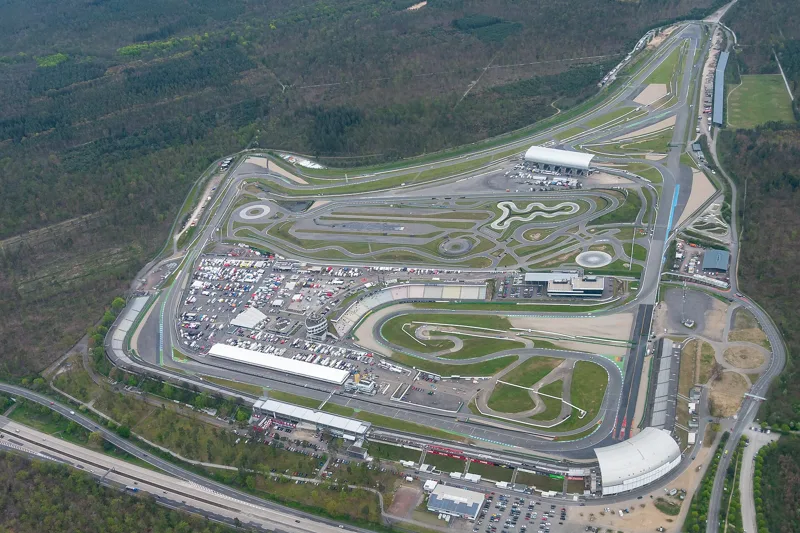
The Nurburgring is a motorsports complex in Nurburg, Rhineland-Palatinate, Germany, best known for the Nordschleife, a 20.830 km (12.943 mi) loop built in the 1920s through the Eifel mountains. Its Grand Prix circuit, completed in 1984, took over the major racing when the old loop became too hard to host a Grand Prix. Together the two layouts have made the site one of the most talked-about tracks in the world.
Jackie Stewart called the Nordschleife the Green Hell, and the name has stuck for decades. The complex now hosts professional racing, public laps, manufacturer testing and events of every kind, from truck racing to large music festivals.
What is the Nordschleife?
The Nordschleife is the north loop of the Nurburgring, a 20.830 km (12.943 mi) circuit that runs clockwise around the village and medieval castle of Nurburg. It climbs and falls by more than 300 metres (1,000 feet), and its blind crests and jumps have made it notorious. The layout is still used today for racing, testing and public access.
The loop was built as a showcase for German motor engineering, and the design was led by the Eichler Architekturbuero from Ravensburg. Construction started in September 1925, and the track was completed in the spring of 1927. The original full circuit was far longer, measuring 28.265 km (17.563 mi) when the 7.747 km (4.814 mi) south loop and the 2.281 km (1.417 mi) warm-up circuit were included.
A 1920s loop that still asks everything of its drivers, long after the racing moved to a modern circuit beside it.
When was the Nurburgring first raced?
The first races took place on 18 June 1927, with motorcycles and sidecars running before the cars the next day. Rudolf Caracciola won the over-5000cc class in a Mercedes-Benz K fitted with a supercharger, and the track was opened to the public as a one-way toll road in the evenings and at weekends.
Louis Chiron later set the fastest known time around the full circuit, averaging 112.31 km/h (69.79 mph) in a Bugatti. The complete loop was used for major races only until 1929. After that the Grands Prix ran on the Nordschleife alone, while motorcycles and minor events often used the shorter and safer south loop.
Before the Second World War the German Grand Prix was held 13 times between 1927 and 1939, which established the site as a major venue long before Formula One arrived.
Why did Formula One leave the old Nordschleife?
Formula One stopped using the full Nordschleife after the 1976 German Grand Prix. The loop was too long for the marshals, medical staff and fire crews that modern rules demanded, and television could not cover it effectively. The 1976 race was already set to be the last on the old loop when Niki Lauda crashed during it.
The first sign of trouble came in 1970. After Piers Courage died at Zandvoort, Formula One drivers refused to race at the Nurburgring unless major changes were made, and the German Grand Prix moved to the Hockenheimring. The Nordschleife was then reworked in 1971, with bumps removed, Armco barriers installed and some sections straightened.
Niki Lauda had lapped the whole 22.835 km (14.189 mi) loop in 6:58.6 in 1975. In 1976 his Ferrari's rear suspension failed at the Bergwerk kink after a magnesium component gave way, and he was badly burned. Fellow drivers, Arturo Merzario and Guy Edwards among them, helped to pull him clear of the wreck.
Making the loop safe enough for a Grand Prix would have required a complete overhaul. Officials estimated that up to six times the usual number of marshals would be needed, and the track was too long for regular fire engines and ambulances. The German Grand Prix moved to Hockenheim from 1977.
How did the modern Grand Prix circuit develop?
Work started in 1981 on a 4.556 km (2.831 mi) new circuit built on and around the old pit area, and it was completed in 1984 as the GP-Strecke, or Grand Prix Course. A bypass cut the Nordschleife to 20.832 km (12.944 mi) so that racing could carry on during the building work.
Many fans thought the new track lacked the character of its older sibling. They had to sit much farther from the action, and some nicknamed it the Eifelring, Ersatzring or Grunering. Like many circuits of the period, it offered few overtaking chances, although it was built to the highest safety standards of its day.
Formula One returned in 1984 for the European Grand Prix and again in 1985 for the German Grand Prix. From 1995 to 2006 a second German race, the European Grand Prix, was held at the Nurburgring, and the Luxembourg Grand Prix was held there in 1997 and 1998. Michael Schumacher won five times at the circuit in that period.
In 2002 the Castrol chicane was replaced by a sharp right-hander nicknamed the Haug-Hook, and an Omega-shaped section was added. The Grand Prix track grew to 5.148 km (3.199 mi) from 4.556 km (2.831 mi), and at the same moment the Hockenheimring was cut from 6.823 km to 4.574 km.
How fast is the Nordschleife?
The most famous benchmark belongs to Timo Bernhard, who set 5:19.546 in a Porsche 919 Hybrid Evo on 29 June 2018, averaging 233.8 km/h (145.3 mph) on a slightly longer version of the loop. Stefan Bellof's 1983 time of 6:11.13 in a Porsche 956 stood for 35 years, and it was set on the shorter 20.832 km (12.944 mi) layout.
| Year | Driver and car | Layout | Result |
|---|---|---|---|
| 1961 | Phil Hill, Ferrari 156 | Nordschleife, first sub-nine-minute lap | 8 minutes 55.2 seconds, 153.4 km/h (95.3 mph) |
| 1975 | Niki Lauda | Full 22.835 km (14.189 mi) loop | 6:58.6 |
| 1983 | Stefan Bellof, Porsche 956 | 20.832 km (12.944 mi) Nordschleife | 6:11.13, 199.8 km/h (124.1 mph) |
| 2018 | Timo Bernhard, Porsche 919 Hybrid Evo | Slightly longer version | 5:19.546, 233.8 km/h (145.3 mph) |
Manufacturers and the motoring press use Nordschleife lap times as a standard for production cars, and a single time is often taken as a shorthand for a car's overall performance. Industry development groups rent the track for work each year, a block that grew from 16 weeks to 18 weeks by 2019.
The approach has its critics. James May has been one of the sharpest, arguing that cars developed on the loop can lose comfort and driveability for the sake of grip. Others question whether test laps carried out without independent checks really reflect stock road cars.
Can the public drive the Nordschleife?
Yes, through Touristenfahrten, the public laps that have run since the track opened in 1927. Road-legal cars can take part on days open from mid-March to mid-November, but racing, testing and bad weather close the loop. Motorcycles have been excluded from the public laps since the 2025 season.
Ticket holders pass through a pit-lane section with toll gates, so they do not complete the full 20.832 km (12.944 mi) loop. On busy days a mobile ticket barrier is set up on the main straight to shorten queues, and racing or speed record attempts are forbidden on the public laps.
Insurance is a serious consideration. Insurers increasingly exclude cover on the track, which can leave drivers liable for damage. Drivers who crash or break down and are towed off the circuit are said to have joined the Bongard Club, named after the company that runs the recovery trucks.
What are the most famous corners on the Nordschleife?
The Nordschleife is made up of named sections such as Flugplatz, Fuchsrohre, Bergwerk, the Karussell and Pflanzgarten. Many corners are blind, many have jumps, and some are banked in ways that few other circuits attempt. Each section has its own record of accidents and of drivers who mastered it.
Flugplatz is named after a small airfield that once stood near the track. Chris Irwin's career ended in a Ford 3L GT crash there in 1968, and the Flugplatz was later renovated after a serious accident in 2016. Fuchsrohre, or Fox Hole, ranks among the quickest and most perilous stretches of the lap, running through forest with barely a few metres of grass between track and barrier.
Bergwerk has its own dark history. Carel Godin de Beaufort died in a crash there, and the kink before it became known as Lauda-Links after the 1976 accident. The Karussell is a 210-degree banked corner that drivers attack on a concrete surface, and it is named after Rudolf Caracciola, who reportedly used the ditch to help his car hug the bend.
Pflanzgarten is one of the fastest and trickiest sections, full of jumps. Peter Collins was fatally injured there in the 1958 German Grand Prix, and a later switchback sequence became known as the Stefan Bellof S after the driver's 1983 accident in a Porsche 956.
Why is the Nurburgring called the Green Hell?
Jackie Stewart gave the track that nickname after his 1968 German Grand Prix win in driving rain and thick fog. The length of the loop, the blind crests and the narrow margins made it dangerous, and the nickname has outlived the era that produced it.
Track management does not publish official fatality figures. Regular visitors who checked police reports estimate between 3 and 12 deaths a year during public sessions. Jeremy Clarkson said on Top Gear in 2004 that the track had claimed more than 200 lives.
The Nordschleife's reputation for danger has not kept it closed. The 24 Hours Nurburgring, usually held in mid-May, features around 220 cars and more than 700 drivers, and up to 290,000 spectators have attended the event.
Who owns the Nurburgring and how did it change hands?
The complex was close to bankruptcy in 2012, carrying almost $500 million of debt. The state government of Rheinland-Pfalz guaranteed $312 million on 1 August 2012 so that the track could meet its obligations, and a sealed-bid sale followed.
The track was offered for sale in 2013 at US$165 million. In March 2014 it was sold for 77 million euros to the Dusseldorf-based Capricorn Development, and it was the buyer that took the track forward. Later in 2014 Russian billionaire Viktor Kharitonin bought a majority stake.
The site also hosts large non-racing events. Rock am Ring, a major rock festival, has drawn close to 100,000 fans each year since 1985, which shows how far the complex reaches beyond motor sport.