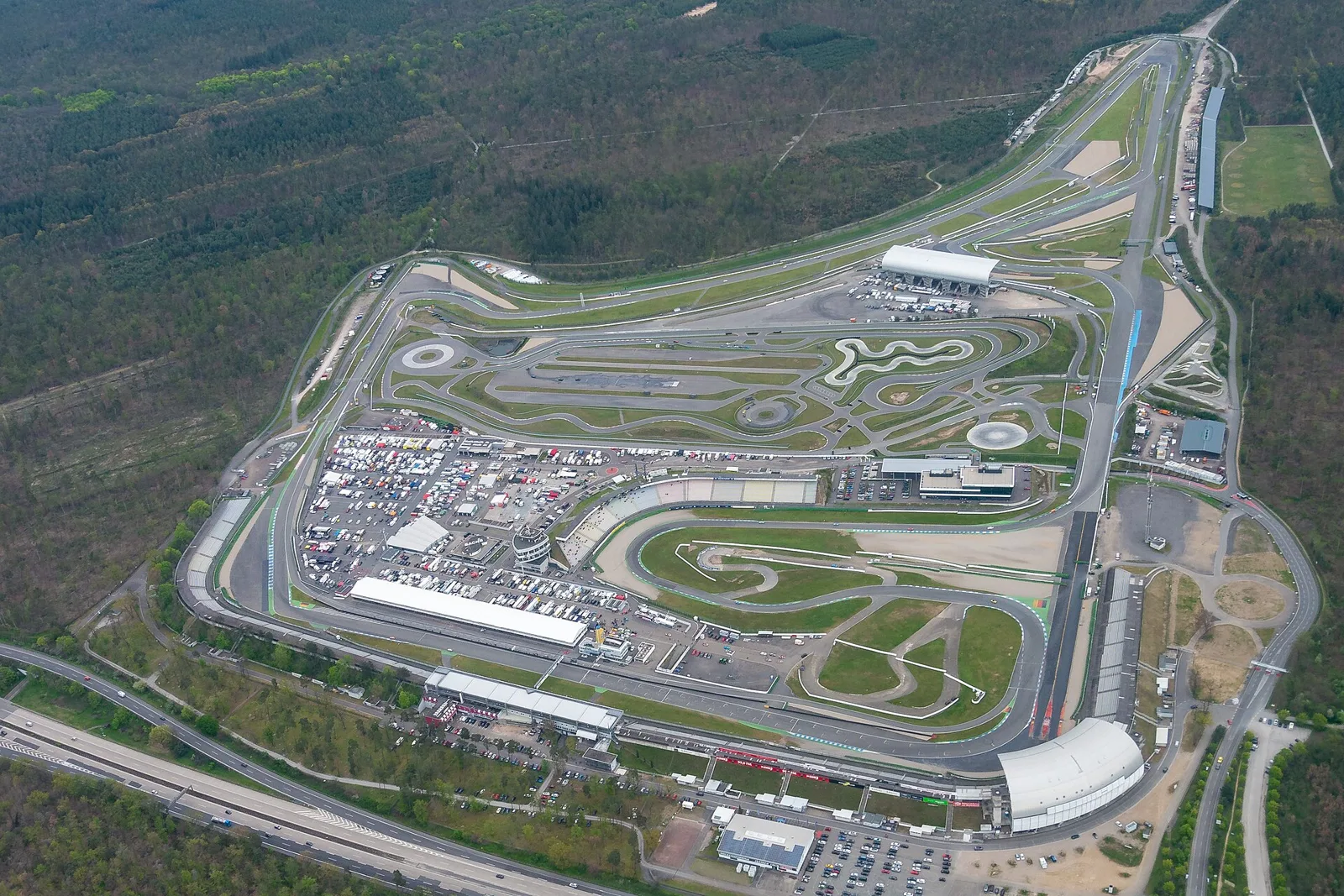
A Baden-Wurttemberg circuit that began as a triangle course in 1932, lost its forest straights in 2002 and still hosts touring cars and drag racing.
The Hockenheimring is a Baden-Wurttemberg circuit that started as a 1932 triangle course. Its 6.823 km (4.240 mi) forest layout was shortened in 2002, and it last hosted the German Grand Prix in 2019. It now centres on touring cars, drag racing and other national series.
Set in the Rhine valley beside the town of Hockenheim, the Hockenheimring is a motor racing circuit in Baden-Wurttemberg, Germany. It holds an FIA Grade 1 licence, is nearly flat, and sits on the Bertha Benz Memorial Route. The German Grand Prix was last held there in 2019, and the circuit is now known mainly for its shorter modern layout.
The track has gone through several lives. Its original forest layout ran for 6.823 km (4.240 mi), with long straights and a stadium section, before a redesign by Hermann Tilke cut the forest out of the lap. Each stage was shaped by safety concerns, Formula One demands and the changing tastes of the sport.
How did the Hockenheimring begin?
The Hockenheimring began as the Dreieckskurs, or triangle course, which was built in 1932 at the initiative of a young timekeeper named Ernst Christ. The first layout was roughly twelve kilometres long and used a large triangle, a hairpin in the town and two straights linking them.
Ernst Christ, who wanted a racing track in his hometown, submitted the plans to the mayor. They were approved on Christmas day in 1931, and the circuit took shape the following year.
The Ostkurve corner appeared in 1938, when the course was cut from twelve kilometres to a little over seven and a half. The track was renamed Kurpfalzring that year. It suffered damage from tanks during the Second World War, but it was repaired afterwards and given its present name.
After the war Wilhelm Herz, a former DKW and NSU rider and world record setter, became the manager in 1954. He promoted the track successfully, and Grand Prix motorcycle races alternated between Hockenheim and other venues.
A triangle course that became a forest giant, then a shorter modern track that still keeps its drag strip and its stadium.
What was the old forest layout like?
The old layout, used from 1965 to 2001, combined four long forest straights of roughly 1.3 km (0.81 mi) with a tight and twisty stadium section called the Motodrom. Teams had to choose between low downforce for speed on the straights and more downforce for grip in the stadium.
Construction of the autobahn A 6 in 1965 cut the village away from the racing area, so a new version was built. John Hugenholtz, a Dutch designer who also drew up Suzuka, created the Motodrom stadium section, which gave the circuit a distinctive shape.
Its length meant a usual Grand Prix comprised just 45 laps, so spectators saw the cars in the stadium only a limited number of times. Turbo-era fuel limits added drama. The race fuel allowance was 220 litres in 1984 and 1985, 195 in 1986 and 1987, and 150 in 1988. Alain Prost ran out of fuel near the end of the 1986 race and was eventually classified sixth.
The 2000 German Grand Prix exposed the problems. Rubens Barrichello won from 18th on the grid, but most of the overtaking happened in the chicanes of the forest section, and a former Mercedes-Benz employee breached security on the first forest straight. A safety car then neutralised a comfortable McLaren lead.
Jean Alesi collided with Pedro Diniz in the braking zone of the third chicane, and his car spun across the track. The FIA pressed for better spectator viewing, safety and security, and Formula One argued that the old track was no longer suited to modern racing.
Why was the track redesigned in 2002?
In the early 2000s Formula One officials pushed for a shorter version of the 6.823 km (4.240 mi) layout, threatening to move races elsewhere. The state government of Baden-Wurttemberg secured the financing for a redesign by Hermann Tilke, which was completed for the 2002 German Grand Prix and shortened the lap.
Tilke kept the stadium section largely intact, but gave it a new surface and a tighter first corner, known as the Nordkurve. Much of the first straight disappeared, along with nearly all of the run between the Ostkurve and the Senna chicane. In their place came a long new straight called the Parabolika, joined to the remaining section by a small kink.
The old forest was torn up and replanted with trees, which removed any chance of using the original course for future Formula One or historic events. The decision was controversial. Ron Dennis, Jarno Trulli and Juan Pablo Montoya all criticised the changes and said they preferred the old circuit.
The redesign also brought a memorial to Jim Clark, placed on the outside of the current turn 2 where the old track ran into the forest. The new grandstands, sponsored by Mercedes-Benz, seat 120,000 spectators.
Critics say the new layout lost the character of the older track, which had been a unique technical challenge. They argue that it became a homogenised, assembly-line circuit that shares the perceived problems of other Tilke designs.
| Feature | Old layout (1965 to 2001) | Current layout (from 2002) |
|---|---|---|
| Length | 6.823 km (4.240 mi) | Shorter, after the 2002 redesign |
| Straights | Four forest straights of roughly 1.3 km (0.81 mi) | A new Parabolika straight and a shorter final straight |
| Stadium section | Motodrom, tight and twisty | Kept, with a new surface and a tighter first corner |
| Forest section | Used for the original course | Torn up and replanted with trees |
| Grandstands | Earlier stands for the old circuit | New Mercedes-Benz grandstands seating 120,000 |
How did safety at Hockenheim change?
Safety work at Hockenheim followed a series of deaths and near misses, from Jim Clark's 1968 Formula 2 accident to Erik Comas's crash in 1991. The track gained chicanes, crash barriers and changes to the Ostkurve, and its second chicane was later named after Ayrton Senna.
Jim Clark was killed on 7 April 1968 during a Formula 2 race. After Clark's death the circuit gained two fast chicanes and crash barriers, the latter completed in 1970. Near the first chicane, which bears his name, a small memorial stands.
Patrick Depailler was killed there in 1980 during a private test, and a chicane was added at the Ostkurve in 1982. The corner was changed again in 1992, after Erik Comas crashed there in 1991, and it became a right-left-right chicane for the German Grand Prix that year.
The second chicane was renamed after Ayrton Senna following his death at the 1994 San Marino Grand Prix. Other fatal accidents at the circuit include Bert Hawthorne in 1972, Markus Hottinger in 1980, Tony Boden in 1986 during a drag racing meeting and Albert Fleming in 2014 during the Bosch Hockenheim Historic.
How many Formula One races did Hockenheim host?
Hockenheim first hosted the German Grand Prix in 1970, after Formula One drivers boycotted the Nurburgring. From 1977 to 2006 it held the race every year except 1985, and its last German Grand Prix came in 2019.
The financial model was difficult. Ongoing deficits of up to 5.3 million euros per race had to be covered by the local communities. The contract was extended to 2018 in October 2009, and the Formula One Group agreed to cover any losses the event incurred.
From 2007 Hockenheim and the Nurburgring alternated hosting the German race. Neither venue held a Grand Prix in 2015 or 2017. The 2019 race was sponsored by Mercedes-Benz, which used it to mark the company's 125th year in motorsport.
How did the old and new layouts compare?
The old layout was a 6.823 km (4.240 mi) circuit with long forest straights and a stadium section, while the current layout is shorter and suits modern Formula One. The table above sets out the main differences side by side.
The forest sections gave the old circuit its speed and danger, while the new one leans on tighter corners and more run-off. The stadium section survived the rebuild largely intact, so part of the original character remains. Whether that trade was worthwhile remains a matter of opinion among drivers, fans and engineers.
What is the Hockenheimring used for today?
Today Hockenheim hosts DTM touring cars, GT and single-seater events, and drag racing. The NitrolympX, a major European drag racing event, takes place in August alongside the public race days.
The drag strip was built in 1989 by connecting the Opel-Kurve with the first turn entering the Motodrom. Before that, the start-finish straight hosted eighth-mile drag racing from 1986 to 1988. When the track was shortened, the strip moved closer to the tall Tower stands, which offer an unusual view along its length.
The NitrolympX draws around 40,000 spectators to its Saturday night show, which adds jet dragsters and other entertainment. The event is named after Rico Anthes, the former Top Fuel driver who organised it for years. In 2016 Anita Makela recorded 3.939 seconds at 486.91 km/h (302.55 mph), the first three-second Top Fuel pass of its kind in mainland Europe.
The DTM has raced at Hockenheim regularly since its 2000 revival, and a World RX of Hockenheim round was held in 2015 as a support event. Music has also filled the circuit, and Michael Jackson played there in 1988 while Ed Sheeran performed in 2019.
The calendar is busy throughout the year. The Hockenheim Classics take place in mid-September, the IDM Superbike Championship follows in late September, and the DMV 1000km Hockenheim closes the season in late October.
The Porsche Sports Cup Deutschland ADAC Racing Weekend appears twice in the programme, in early May and early October, which shows how important the circuit remains to sports car fans.
What are the lap records at Hockenheim?
Sebastian Vettel's 2018 qualifying effort, a Ferrari SF71H lap of 1:11.212, is the quickest time ever set around the track. Official race lap records are only set during the race itself, so qualifying times do not count in that table.
Because official race records are set in races, the Vettel qualifying lap remains the reference point for fans who want the fastest time on the current track.