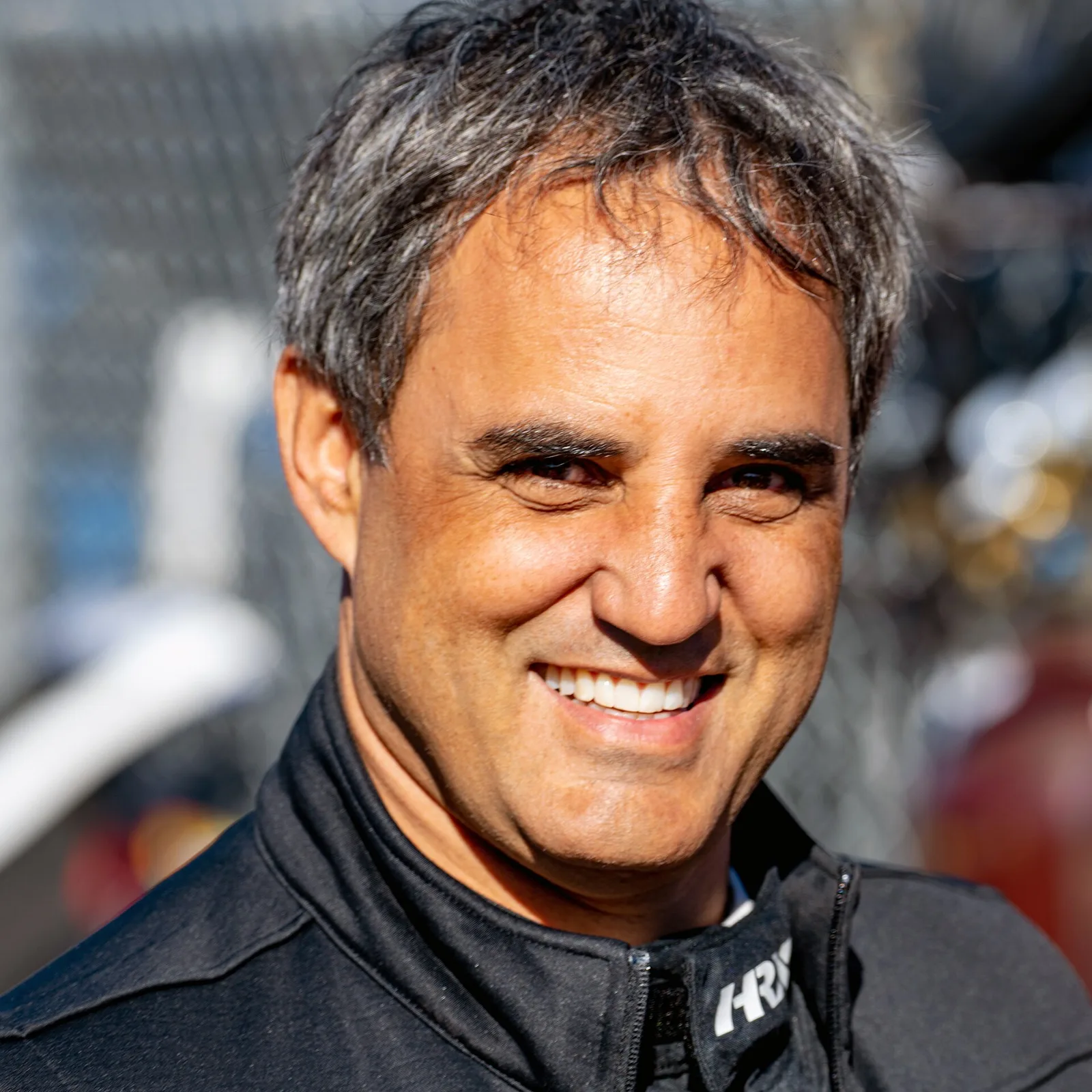
From Bogota karting to a rookie CART title, seven Formula One wins and two Indianapolis 500 victories, the career of a Colombian driver who crossed three racing worlds.
Colombia's Juan Pablo Montoya competed in Formula One from 2001 to 2006, winning seven Grands Prix. He also won the CART title in 1999 and the Indianapolis 500 in 2000 and 2015, and later raced in NASCAR and sports cars.
Juan Pablo Montoya is a Colombian former driver who raced in Formula One from 2001 to 2006, won seven Grands Prix and went on to a long career in American open-wheel and stock car racing. He was the CART champion in 1999 as a rookie, and he won the Indianapolis 500 twice. His route from Bogota karting to the top of world motorsport is one of the most unusual in modern racing.
Who was Juan Pablo Montoya?
He came into the world on 20 September 1975 at a hospital in Bogota, the eldest child of Pablo, an architect with a love of amateur karting. At the age of five Montoya began kart racing, after his father bought him a kart and taught him to drive at the Kartodromo Cajica outside the city.
The family put everything into his development. His father financed his early career and mentored him closely, and Montoya was inspired by Roberto Guerrero and Ayrton Senna. Early national karting success came in 1984, and he went on to take several national titles in the Kart Komet category before leaving karting for cars.
A Bogota karting prodigy who became a rookie CART champion, won seven Grands Prix and then conquered Indianapolis twice.
How did he climb the single-seater ladder?
Montoya started in car racing in 1992, and later that year he attended a Skip Barber school at Sonoma Raceway. In 1993 he won the National Tournament Swift GTI Championship in Colombia with seven wins and seven poles. The following year he moved to the American-based Barber Saab Pro Series, where he finished third overall.
In 1995 he drove for Paul Stewart Racing in the Formula Vauxhall Lotus Championship, finishing third with 125 points. Jackie Stewart helped him learn to use his energy and drive more smoothly. A season in British Formula 3 with Fortec followed in 1996, where he finished fifth with 137 points.
In 1997 he raced in International Formula 3000 for RSM Marko, and he finished second with 37.5 points. The following year he drove for Super Nova Racing, won the series championship and took seven pole positions along the way. That title, and a development role with Williams, brought him to Frank Williams's attention.
How did he win the 1999 CART title?
Williams signed Alex Zanardi from Chip Ganassi Racing and had no seat for Montoya, so Frank Williams allowed Chip Ganassi to sign him instead. His first CART race was the Toyota Grand Prix of Long Beach, which he won in the third round.
He drove the No. 4 Reynard, learning ovals with advice from Ganassi, team manager Mo Nunn and his team-mate Jimmy Vasser. He followed that with victory at Nazareth Speedway, where he led a race-high 210 laps, and soon took the championship lead from Greg Moore. The title came down to the final round in California. Montoya finished fourth and Dario Franchitti tenth, and the two were level on 212 points. Montoya's seven victories against Franchitti's three gave him the title, which made him the youngest CART champion, and only the second rookie to win it after Mansell.
What happened in 2000 at CART and Indianapolis?
The 2000 season, in a Lola-Toyota, was marred by unreliability. Montoya struggled early, then took four consecutive poles and Toyota's first CART victory at the Milwaukee Mile. He won the Michigan 500 with a last-lap overtake of Michael Andretti, holding him off by 0.040 seconds. He ended the year ninth overall with 126 points.
In May the same year he entered the Indianapolis 500 in a Ganassi car and started second. Leading 167 of 200 laps, he won at the first try and became the first rookie to take the race since Graham Hill in 1966, a result that tied him to the event for good.
How did his Williams debut go in 2001?
Montoya left Ganassi with the team's approval and joined Williams for 2001, replacing Jenson Button. The car was powerful but unreliable, and he was involved in many accidents early in the year. After a physical altercation with Jacques Villeneuve at the Canadian Grand Prix, his performances steadily improved.
He lost weight to become race-ready, and he learned unfamiliar tracks through simulation games. At the Brazilian Grand Prix he led after passing Michael Schumacher, but a rear-end hit on Jos Verstappen, whom he had just lapped, ended his race. He reached the podium at Spain and claimed his maiden victory at the 2001 Italian Grand Prix from pole, leading 29 of 53 laps. It was the first Formula One win for a Colombian. After that race Ross Brawn floated the idea of Ferrari, which Montoya rejected. He finished the year sixth with 31 points.
What did 2002 and 2003 bring?
In 2002 his FW24 was strong in qualifying but weaker in races, as the Michelin rubber wore quicker than Bridgestone's. He still took seven pole positions across the season and finished third in the championship with 50 points. Podium finishes at the British Grand Prix and in Germany, Belgium and Italy kept him in contention.
The 2003 car was the fastest on the grid, and Montoya won the Monaco Grand Prix. He led the Australian Grand Prix until a late spin let David Coulthard through. The German Grand Prix was a dominant victory, won by more than a minute from pole. A drive-through penalty for a third-lap clash with Rubens Barrichello in the United States race left him sixth and out of the title fight, and he finished third with 82 points, eleven short of the title.
Why did Montoya's form fall away in 2004?
The 2004 FW26 was slow and lacked the downforce that gave him confidence into corners. Williams changed to a twin-keel chassis and tried a front wing nicknamed the Walrus nose, which was dropped before Hungary. Montoya was disqualified from fifth at Canada over oversized brake ducts.
His relationship with Williams had already worsened after a radio outburst at engineers over the 2003 French Grand Prix pit stops. He still scored points in eight of the last nine races and won the season-ending Brazilian Grand Prix. He finished fifth in the championship with 58 points.
How did the McLaren years go?
Montoya signed for McLaren in August 2003 to replace Coulthard for 2005. Frank Williams refused to release him early, since he did not want to lose him a year before his contract ended. An early hairline fracture to his left scapula cost him two races, and the car struggled to heat its tyres in qualifying.
Once he was fit, he won the British Grand Prix and then the Italian Grand Prix from pole. He won again at Brazil, his third and final win of 2005, and finished fourth in the championship with 60 points.
The 2006 season went badly. The MP4-21 suffered from understeer and tyre temperature problems, and the switch from V10 to V8 engines cost it power. Raikkonen was quicker, and Montoya left F1 after the United States Grand Prix. He finished eighth with 26 points.
Why did he move to NASCAR?
Montoya had never wanted to race for McLaren, and he preferred American racing. He disliked the politics and the focus on winning inside Formula One, and his father helped persuade him to switch series. He signed a multi-year contract with Chip Ganassi Racing on 9 July 2006 to take over a car at the start of 2007.
McLaren released him four weeks early, after DaimlerChrysler intervened and Ganassi reportedly paid compensation. He turned down a Toro Rosso offer to return to Formula One, and he spent the winter training and taking advice from other stock car drivers.
How did his NASCAR career develop?
He made his Cup debut at Homestead in 2006, where his car caught fire after a collision. His first Cup win arrived at Infineon in 2007, when he got by Jamie McMurray late on. It was the first win by a foreign-born driver since 1974, when Earl Ross triumphed.
He finished second at the Brickyard 400 that year and was named rookie of the year, 24 points ahead of David Ragan. In 2008 a second-place finish at Talladega was his best result, and he was criticised for a lack of top-ten finishes. In 2009 he finished eighth in the standings with 6,252 points, with ten top-ten finishes and a second at Pocono. He won his second and final Cup race at Watkins Glen in 2010. His later NASCAR outings were occasional, including a one-off drive for 23XI Racing at Watkins Glen in 2024, which he finished 32nd.
Did Montoya return to IndyCar?
For 2014 Montoya joined Team Penske in the IndyCar Series. He won the Pocono IndyCar 500 from pole, overtaking Tony Kanaan with four laps remaining. It was his first IndyCar win since 2000, nearly fourteen years earlier, and the season ended fourth overall with 586 points.
In 2015 he won the season-opening race at St Petersburg, and his second Indianapolis 500 followed. He battled Will Power and Scott Dixon in the closing laps and passed Power with three laps to go. He finished the year second to Dixon in the championship on the tiebreak, with the same 556 points. He won at St Petersburg again in 2016 and finished eighth in the standings.
From 2017 his IndyCar work was part time, including Penske's fifth entry at Indianapolis and later drives for Arrow McLaren SP in 2021 and 2022.
What did sports car racing bring him?
Montoya won the 24 Hours of Daytona in 2007 and again in 2008, and he took the 2013 race with Charlie Kimball, Pruett and Rojas. He finished second in 2009, losing to Brumos Racing by 0.167 seconds. In 2017 he joined Penske's IMSA programme, and in 2019 he and Dane Cameron won the DPi championship with 302 points.
He also drove at Le Mans, debuting in 2017 with United Autosports. In 2021 he won his class in the 24 Hours of Le Mans in LMP2, and in 2022 he finished fourth in the LMP2 Drivers' Championship.
What does his career look like at a glance?
| Years | Category or team | Standout result |
|---|---|---|
| 1999 | CART with Chip Ganassi Racing | Rookie champion with seven victories |
| 2000 | Indianapolis 500 | First attempt, led 167 of 200 laps |
| 2001-2004 | Formula One with Williams | Italian Grand Prix win in 2001; Monaco in 2003; Brazil in 2004 |
| 2005-2006 | Formula One with McLaren | Three wins in 2005, including the British Grand Prix |
| 2007-2010 | NASCAR Cup Series | First Cup win in 2007; second win at Watkins Glen in 2010 |
| 2014-2016 | IndyCar with Team Penske | Second Indianapolis 500 win in 2015 |
| 2019 | IMSA DPi with Team Penske | Drivers' championship with Dane Cameron |
What is Montoya's legacy?
Montoya is known for an aggressive style that has been part of his racing since childhood. His early results in karting and single-seaters, and his CART title as a rookie, made him one of the most talked-about drivers of his generation. Derek Daly has written that he relied on reflexes and intuition more than on technical feedback.
Away from the track he became a United Nations goodwill ambassador in 2001 and founded the Formula Smiles Foundation in 2003 to use sport and physical education to help children in Colombia. He won the Laureus Breakthrough of the Year award in 2002, and in 2017 he won the Race of Champions, beating Tom Kristensen 2-0 in the final.