From Sao Paulo karting to three McLaren championships, the Suzuka collisions with Prost and the 1994 Imola tragedy that reshaped safety.
Ayrton Senna was a Brazilian driver who won three Formula One championships with McLaren and held the pole position record when he died at Imola in 1994. He won 41 Grands Prix over eleven seasons, and his name is linked to a charity that still supports children in Brazil.
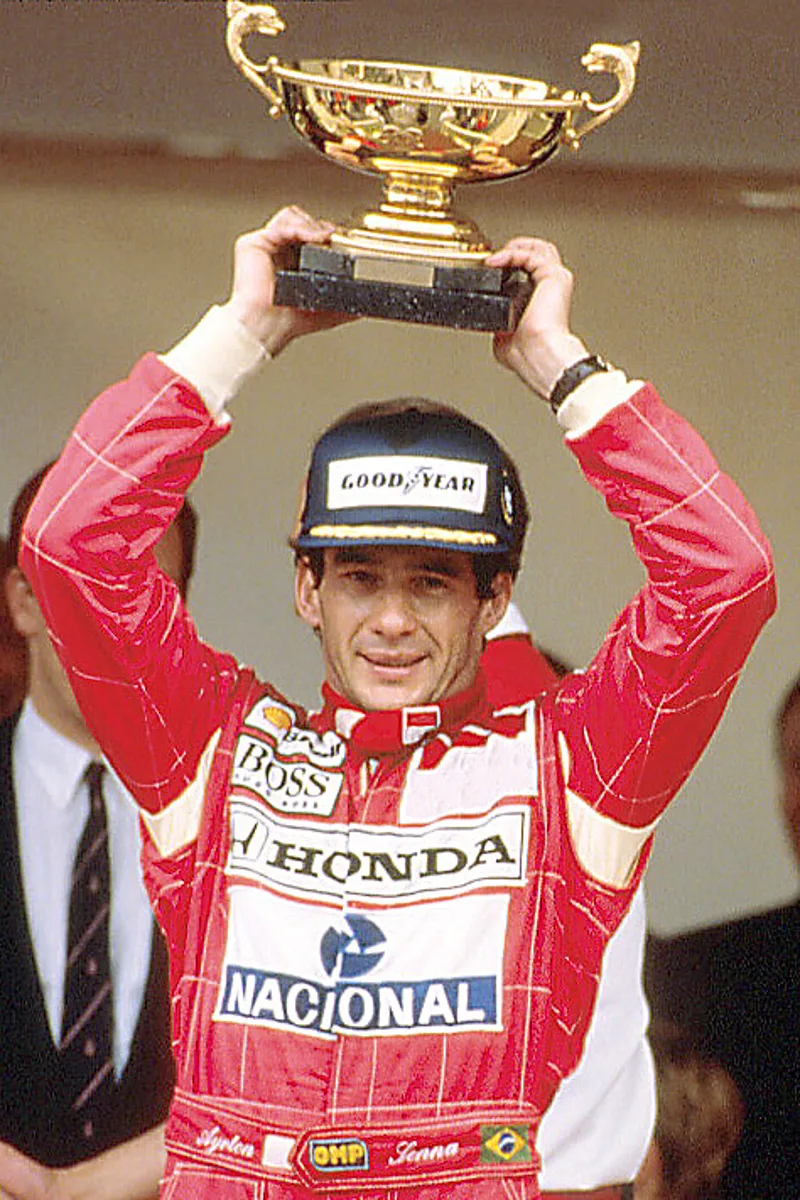
Ayrton Senna was a Brazilian racing driver who competed in Formula One from 1984 until his death in 1994. He won three world championships with McLaren, in 1988, 1990 and 1991, and when he died he held the record for pole positions. His 1994 death at Imola changed the sport's approach to safety for good.
Senna is remembered as much for his raw speed and uncompromising driving as for his results. He is also regarded as a national hero in Brazil, where his charitable work continues to shape children's education.
Who was Ayrton Senna and how did his career begin?
Senna was born in Sao Paulo on 21 March 1960, into a wealthy family. His father built his first go-kart from a small 1 hp lawnmower engine, and at 13 he began racing competitively at Interlagos. The early results were quick, and by 1977 he had won the South American Kart Championship.
He finished runner-up in the Karting World Championship in 1979 and 1980. His rivalry with Terry Fullerton at the DAP team, which produced several one-two finishes, was one of the great early contests of his karting years.
Three world titles, a rivalry with Alain Prost that defined an era, and a safety legacy that began at Imola.
How did Senna dominate the lower formulae?
In 1981 Senna moved to England to race in Formula Ford 1600. He won the British and Townsend Thoresen championships with Van Diemen that season, before returning to Brazil briefly. He then chose to adopt his maternal surname, Senna, because da Silva was so common in Brazil.
In 1982 he dominated the British and European championships, winning 15 of 17 races at the former. In 1983 he won the British Formula Three title after a close fight with Martin Brundle, and in November of that year he took the inaugural Macau Formula Three Grand Prix.
How did Senna's Formula One debut go?
Senna joined Toleman for 1984, and he made his debut at the Brazilian Grand Prix, where he qualified 17th and retired on lap 8. He scored his first championship point with a sixth place at the South African Grand Prix, and he was a rising figure in the sport by the end of the year.
His best result that season came at Monaco, where he was closing on Alain Prost when the wet race was stopped on lap 31. He finished the year ninth in the championship with 13 points, and a late-season illness that caused Bell's palsy left one side of his face paralysed.
What did Senna achieve at Lotus?
At Lotus from 1985 to 1987, Senna took his first pole position and his first win at the wet Portuguese Grand Prix in 1985, winning by over a minute from Michele Alboreto. He added a second win in Belgium that year, and he finished the season fourth with seven pole positions. Elio de Angelis, his teammate, finished fifth.
The 1986 season brought eight poles, a win at the Spanish Grand Prix in one of the closest finishes in the sport's history, and another victory in Detroit. He finished fourth overall with 55 points. The 1987 season saw wins at Monaco and Detroit, and he finished third overall with 57 points. That year he was also fined $15,000 for punching a corner marshal in Mexico, after the marshal refused to push his stalled car.
Why did Senna's move to McLaren matter so much?
Senna joined McLaren for 1988 with Honda power, partnering Alain Prost, who was then a double world champion. The partnership was intense from the start. Over the year, the team won 15 of the 16 races held, and Senna took his first title by three points.
He won eight Grands Prix that season, against seven for Prost, and he took 13 pole positions. That pole total beat the record of nine that Nelson Piquet had set in 1984. The Monaco race was a low point, as he crashed on lap 67 after leading most of the distance.
At Monza the Ferraris finished 1-2 after a collision with Jean-Louis Schlesser's Williams, the only race McLaren did not win that year.
| Season | Team | Result |
|---|---|---|
| 1984 | Toleman | Ninth overall, 13 points |
| 1985 | Lotus | Fourth overall, seven poles, first win at Portugal |
| 1986 | Lotus | Fourth overall, 55 points, eight poles |
| 1987 | Lotus | Third overall, 57 points, Monaco and Detroit wins |
| 1988 | McLaren | World champion, eight wins, 13 poles |
| 1989 | McLaren | Runner-up to Prost, six wins |
| 1990 | McLaren | World champion after the Suzuka collision |
| 1991 | McLaren | World champion, seven wins |
| 1992 | McLaren | Fourth overall, three wins |
| 1993 | McLaren | Runner-up to Prost, Brazil and Donington wins, 41st and last win in Australia |
| 1994 | Williams | Killed at Imola on 1 May during the San Marino Grand Prix |
What happened at Suzuka in 1989 and 1990?
The 1989 title was decided at Suzuka, where Senna and Prost collided at the chicane. Senna pushed to the front after a push-start, but he was disqualified for cutting the chicane. Prost took the title, and Senna finished second with six wins.
The 1990 round in Japan saw another collision, this time with Senna's car taking Prost out at the first corner. That result gave Senna his second title. A year later he admitted that he had intentionally wrecked Prost as payback for 1989.
In 1991 he took seven wins, and he became the youngest ever three-time world champion. His pole record stood at 60 from 127 events, and he clinched the title again in Japan after Nigel Mansell went off at the first corner.
How did Senna's last years at McLaren go?
Senna's form stayed strong, but the team's engines and cars were less competitive by 1992. Later that season, at the Belgian Grand Prix, he was the first to reach French driver Erik Comas after a heavy crash in qualifying. Hearing the engine still racing at full revs and fearing a fuel leak, he ran across the track to help him, an act that was widely applauded. He won three races that season, at Monaco, Hungary and Italy, but he finished fourth overall behind Mansell, Riccardo Patrese and Michael Schumacher.
In 1993 McLaren relied on Ford engines, and Senna still won his second Brazilian Grand Prix. He also won the European Grand Prix at Donington Park in changing conditions, and his sixth Monaco win set a record. He ended the year as runner-up to Prost, and at the Australian finale he pulled the retiring Frenchman onto the top step of the podium.
Why did Senna move to Williams for 1994?
Senna signed for Williams to replace the retiring Prost. He was reportedly paid a $20 million salary, and he said that the FW16 gave him a very negative feeling. He had watched the rival Benetton closely, looking for signs of illegal electronic aids.
The 1994 season began badly. He took pole at the first three races but retired from each one, and at the Pacific Grand Prix he was caught in a multi-car accident at the first corner. Senna's final Formula One win came in 1993 at the Australian Grand Prix, his 41st.
What happened at Imola in 1994?
The San Marino Grand Prix at Imola was overshadowed by a series of accidents. Rubens Barrichello, Roland Ratzenberger, JJ Lehto and Pedro Lamy all crashed, and Ratzenberger was killed in qualifying. Senna was heavily disturbed by the crashes, and on the morning of the race he spoke with Prost about improving driver safety.
On lap 7 Senna crashed at the high-speed Tamburello corner. He was flown to Bologna's Maggiore Hospital, where he was pronounced dead at 18:40 CEST. The official time of death was 14:17 CEST, the time of the crash.
Investigators focused on the steering column, which had broken in the crash. Williams had welded parts together overnight after the column was adjusted. Several people were charged with manslaughter, and in 2005 a court found that a poorly modified column had caused the accident. Patrick Head was found culpable but was protected by the statute of limitations.
How did the sport respond to his death?
Senna was the last fatality in Formula One until Jules Bianchi died in 2014. The FIA left the first two grid positions empty at the following race in Monaco, painting them in the Brazilian and Austrian colours to honour Senna and Ratzenberger.
Michael Schumacher dedicated his 1994 world title to Senna. The Brazil national football team also dedicated its World Cup victory to him, holding a banner on the pitch that paid tribute to the driver.
How large was Senna's funeral?
Senna's body was flown back to Brazil on 4 May 1994, and he lay in state at the Legislative Assembly in Sao Paulo. His funeral was held on 5 May, and an estimated three million people attended the ceremony and procession. Brazil declared three days of national mourning, and he was buried in Morumbi Cemetery in Sao Paulo.
Why was Senna regarded as the best driver of his era?
Near the end of his career Senna was almost universally recognised as the best driver in the sport. In 1990 he was named L'Equipe International Athlete of the Year, and in 1993 a poll of Formula One drivers gave him a near-unanimous vote as the best driver. After his death, various polls and ranking services rated him the best driver of all time.
He was also a formidable wet-weather driver. His performances at the 1984 Monaco, 1985 Portuguese and 1993 European Grands Prix are often cited as examples of his skill in difficult conditions.
Hall of Fame recognition followed, with an entry into the International Motorsports Hall of Fame in 2000 and the Automotive Hall of Fame in 2025. Across 11 seasons he won 41 Grands Prix, a total that stood as a benchmark for his generation.
What is Senna's legacy beyond motorsport?
Senna secretly donated large sums to help poor children in Brazil. Shortly before his death he had created the framework for an organisation that became the Instituto Ayrton Senna. Its work in schools and youth programmes has been funded at a large scale, with spending close to US$80 million across twelve years.
Frank Williams said in 1994 that Senna had been a greater man out of the car than in it. His name has also appeared in video games, including a 2013 expansion for Gran Turismo 6 with proceeds going to the institute and an F1 2019 downloadable pack focused on his rivalry with Prost.