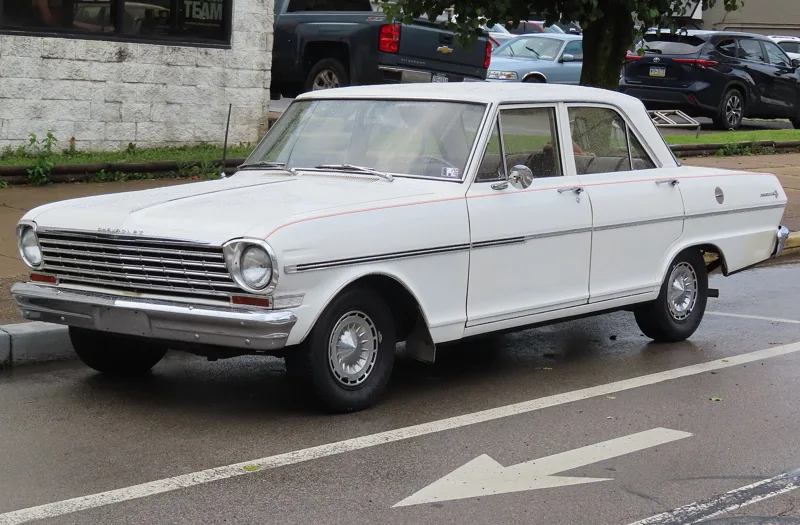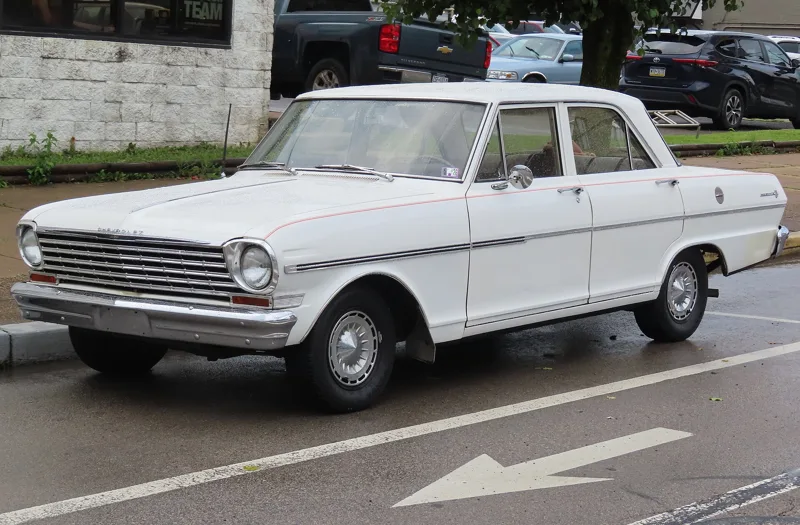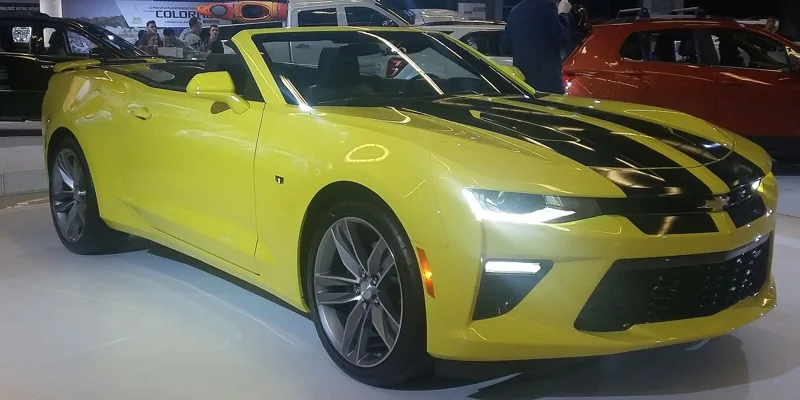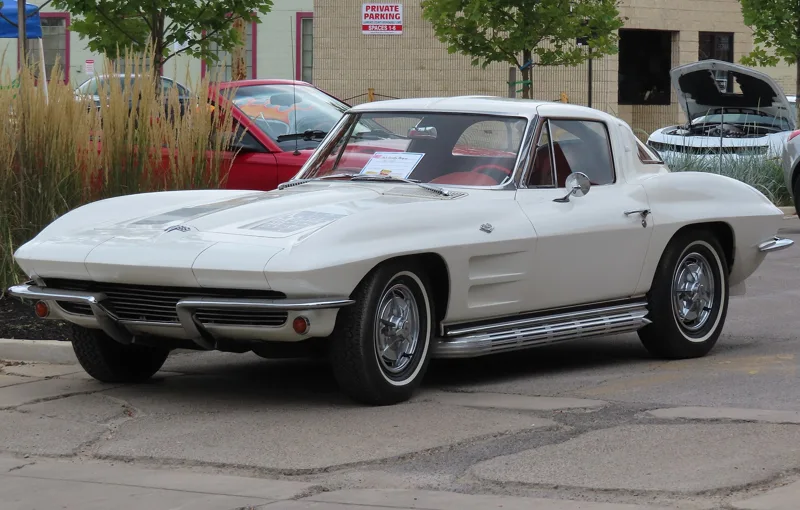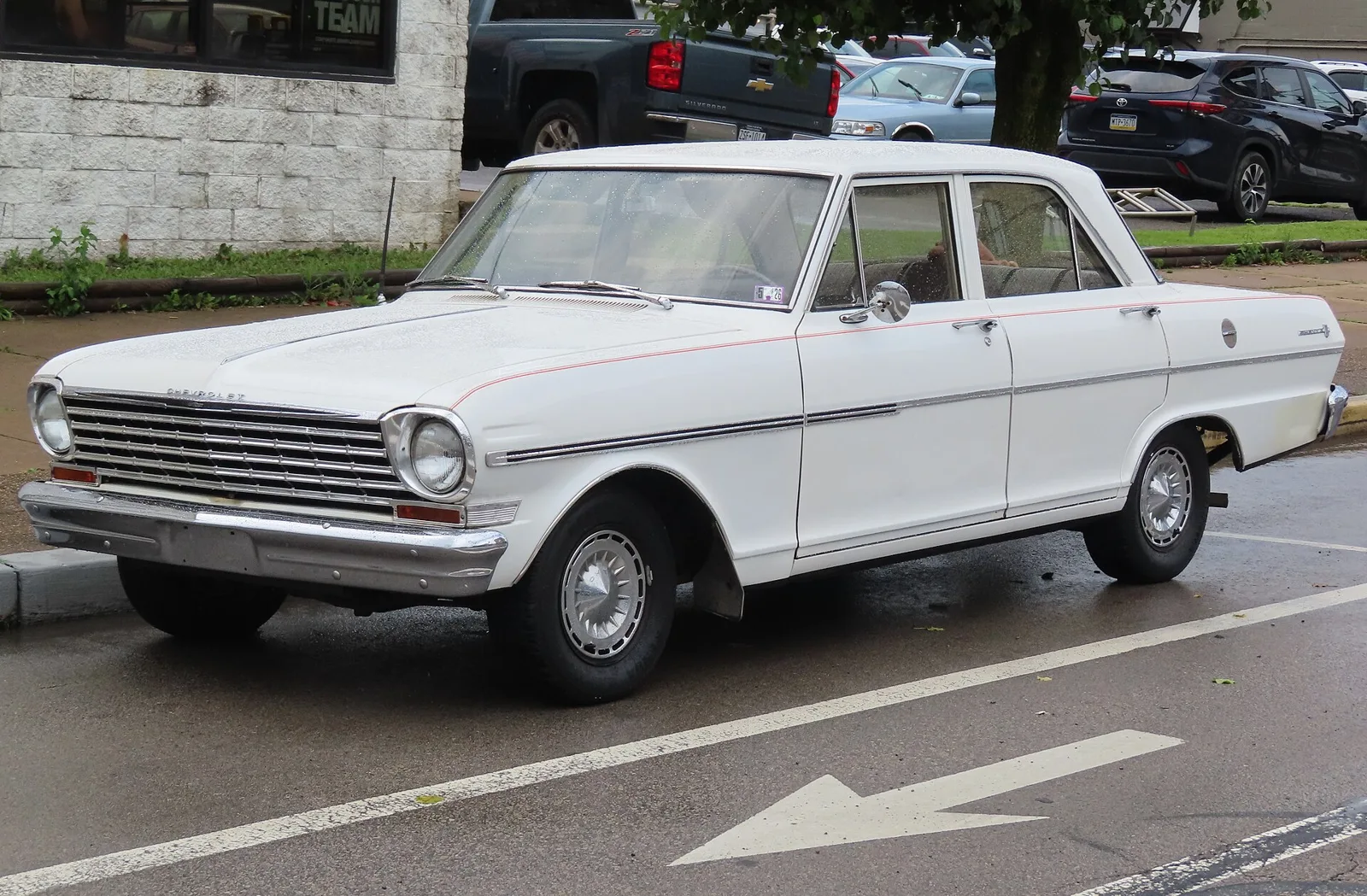
A rushed 1962 compact built to beat the Ford Falcon, which grew into a muscle car, a hatchback, a luxury trim and a front-drive subcompact.
The Chevrolet Chevy II, later the Nova, was a compact sold from 1962 to 1979 and built on GM's X platform. It was designed quickly to rival the Ford Falcon, and it returned in 1985 as a Toyota-based subcompact.
The Chevrolet Chevy II, later simply called the Nova, was a compact car that Chevrolet sold from the 1962 to 1979 model years. It was the first car built on GM's X platform, and it sat between the Corvair and the Chevelle in the Chevrolet line-up.
Roughly eighteen months passed between approval and showroom, which made it one of the quickest development programmes in GM's history. Its name also changed several times on the way, and the badge that finally stuck was the one that outlived its original rival.
Where did the Chevy II come from?
The Chevy II was a rushed answer to the Ford Falcon, which had outsold the rear-engined Corvair in 1960. Designers had roughly eighteen months from approval to the first finished car, and the first example rolled out of the Willow Run plant in Michigan in August 1961, ahead of its 29 September introduction.
Clare MacKichan, a Chevrolet designer, later recalled that there was no time for experiments and that the car had to be basic. Its wheelbase of 110 in (2,794 mm) was a fraction longer than the Falcon's 109.5 in (2,781 mm), which tells you how closely the two were matched.
Unlike the Corvair, the 1962 car avoided new technology altogether. Ed Cole, the general manager of the division, presented it as a practical car that put thrift first. It was also the second post-war Big Three car to offer a four-cylinder engine, after the Pontiac Tempest.
The name itself was argued over. Nova was one of the finalists, but it lost because it did not begin with a C. It later became the name of the top-line series, and the Chevy II badge finally went in 1969.
A rushed Falcon rival that became a muscle car, a Concours luxury compact and a front-drive import built in California.
What did the first generation offer?
From 1962 to 1965 the car came as the 100, the 300 and the Nova 400 series, with a short-lived 200 series dropped almost as soon as it appeared. The most striking model was the Nova 400 convertible at US$2,475, and 23,741 of them were built in 1962 alone.
Early engines were a four of 2.5 L (153 cu in) and a Hi-Thrift six of 3.2 L (194 cu in), and every unit had overhead valves. A two-door hardtop was offered from 1962, dropped at the start of the 1964 run and then brought back later that year under the Sport Coupe name.
The 1963 Nova Super Sport package cost US$161.40 and added special badges, bucket seats and a floor shifter. The first factory V8 arrived in 1964 as a 283 cu in (4.6 L) unit with 195 hp (145 kW). A 230 cu in (3.8 L) six, an all-new engine that replaced the old Stovebolt unit, also came that year.
A full-width grille with integrated headlight bezels arrived with the 1965 facelift, and the Super Sport became a genuine muscle option. A 327 cu in V8 offered up to 300 hp (220 kW), but only 9,100 Super Sports were built that year. The car's sales fell in 1965 while every other GM model grew, and Chevelle Malibu SS sales took much of the Nova's audience.
How did the second generation change the Nova?
The 1966 cars were restyled with squarer proportions and a bold grille, and the look owed something to the Super Nova concept. The Super Sport now cost US$159 more than a Nova 400, and a 194 cu in six was standard, although any engine except the four could be fitted.
Camaro buyers were tempted away in 1967, and output fell by over a third, to 106,500 cars, of which 12,900 were estate cars. The Nova SS total for the year was roughly 10,100, with 8,200 of those fitted with V8s. The 1967 model also brought a stronger safety package, including a collapsing steering column and dual brake master cylinders.
The Turbo-Fire 327 V8, rated at 350 hp (260 kW), appeared for 1967 and turned the mild Nova into a proper performer. Only the four-speed manual could be paired with it, since the Powerglide automatic was not offered with that engine.
What did the third generation bring?
A full redesign for 1968 put the car on a 111 in wheelbase, about an inch shorter than the Chevelle coupe's. Station wagons and the hardtop sport coupe were dropped, and the Nova became one of only a handful of compacts to lack a wagon, as AMC was then the only American maker of compact estates.
Under the skin, a separate front subframe carried the powertrain and front suspension, a layout the Camaro had introduced a year earlier. Buyers could choose from fifteen powertrain combinations on coupes and a dozen on sedans. Demand for the 1968 Chevy II Nova halved, although the car remained a capable performer.
From 1969 the Chevy II name was dropped and the car became simply the Nova. The 1969 SS, priced at US$312, carried a 350 cu in V8 rated at 300 hp (220 kW), and it was the first Nova SS with front disc brakes as standard. A two-barrel 350 producing 255 hp (190 kW) was offered on non-SS models.
The 1970 model was largely unchanged. It sold 254,242 Novas, of which 19,558 were SS 350 or SS 396 cars. Around 177 COPO Novas were ordered, and 175 of them were converted by Yenko Chevrolet, while the Nova also raced in Trans-Am that season.
In 1971 the Rally Nova arrived, a trim level that lasted only two years. Its stripes, sport mirror and six-slot Rally wheels gave a muscle-car look without the SS price or insurance surcharge. The Vega took sales from the Nova that year, but the compact recovered in the following years. The 1972 model year reached 349,733 cars, and 139,769 of those had the six.
How fast was the Nova SS?
The 1968 Nova SS was one of the smallest muscle cars that Detroit ever built. It added a heavy-duty suspension and a 350 cu in V8 making 295 hp (220 kW) for US$312. Big-block 396 cu in options produced 350 bhp, or 375 bhp (380 PS; 280 kW) for the stronger version, which also made 415 lb ft (563 N m) at 3,600 rpm.
A total of 5,571 SS coupes were produced in 1968. Novas kept the SS badge until 1976, and the option was later upgraded as a styling package rather than a performance one.
Don Yenko, a retired racer and muscle-car specialist in Canonsburg, Pennsylvania, took Novas and other GM models to new levels. The Yenko Super Nova carried a 427 cu in (7.0 L) V8 on uprated suspension and sold for four thousand US dollars, and only 37 were built. Seven are known to survive. His 1970 Yenko Deuce used the 350 cu in V8 from the new Z-28 Camaro.
How did the 1973 and 1974 cars change?
For 1973 a hatchback was added to the range, and the front and rear were reworked to meet the federal rules for bumper impacts. The new grille had a loose crosshatch insert, and the fuel tank grew to 21 gallons, which required a revised trunk pan to fit the spare tyre.
The SS option that year was merely a US$123 dress-up package with a blackout grille and Rally wheels, but 35,542 were installed, making 1973 its best year. Multi-leaf rear springs came from the second-generation Camaro, replacing the mono-leaf units used since 1962.
In 1974 the Nova adopted a centred bow-tie emblem and bumpers that lengthened the car by two inches. Sales approached 400,000 that year as the first energy crisis made compacts attractive, and the six-cylinder cars grew fastest while V8 sales declined.
Every 1974 car carried a seat-belt interlock that stopped the engine starting until the belt was fastened. Congress later removed the requirement, and owners could have the interlock bypassed.
What did the fourth generation of 1975 offer?
Among 1975 Chevrolets, the Nova had the most extensive changes. The new sheet metal kept the family look, and the 111 in wheelbase stayed. Front disc brakes and steel-belted radials became standard, and cut-pile carpet, once confined to the Custom, now came on every model.
Marketed as the most luxurious compact in the Chevrolet range, the Nova LN with reclining front seats and extra sound insulation. Its badges read 4.3 LITER or 5.7 LITER, the first metric displacement badges on a Chevrolet in the Americas. For 1976 the LN became the Concours, which competed with the Ford Granada and the Mercury Monarch. A V8 Concours cost US$547 more than the base Nova.
After testing the 1976 Nova, the Los Angeles Sheriff's Department ordered compacts in a quantity no earlier police buyer had reached. Several other departments followed with V8-equipped cars.
For 1977 a round gauge cluster replaced the speedometer, and the SS option ended, although the RPO Z26 code carried on as the Nova Rally. The Concours was dropped for 1978. Sales that year fell by almost 100,000 to 288,000, the only Chevrolet series to decline.
With rectangular headlights and a new grille, the 1979 car closed out the rear-drive Nova. Fewer than 98,000 were built. Regular production ended on 22 December 1978, and a last batch of special-order Nova Customs was built on 15 March 1979. The Citation took the Nova's place for 1980.
Why did the Nova return in 1985?
A fifth generation revived the nameplate in 1985. It was built in Fremont, California, at the NUMMI joint venture between GM and Toyota, and it was known inside GM as the S-car. The chassis came from the Toyota Corolla, while the body was styled after the Toyota Sprinter.
This Nova was the first to carry quad headlamps, because the flush units used on the Corolla and Sprinter were not yet legal in the United States. It arrived as a four-door sedan, and a five-door hatchback followed later in the year. The sedan listed at US$7,435, and the five-door at US$7,669.
Power came from a carbureted 1.6 L four producing 74 hp (55 kW). For 1988 the Twin-Cam version added a DOHC engine with 110 hp (82 kW), along with fuel injection and four-wheel disc brakes. At US$11,395 it was expensive for a subcompact, and about 3,300 were built.
The Nova gave way in 1989 when Chevrolet moved its Japanese-built cars into the new Geo brand. The car became the Geo Prizm, and the NUMMI plant closed after 2010, once GM ended its partnership with Toyota in 2009.
How did critics treat the Chevy II?
Tom McCahill, a Mechanics Illustrated tester, drove a 400 Series convertible at the 1962 press preview and found it steady at 91 mph with Powerglide. He thought its styling resembled a small Mercedes-Benz and said it would sell well at its price.
Car Life gave the Chevy II its Award for Engineering Excellence. Consumer Reports described the six as ultra-sensible with outstanding interior space, but it found the cabin noisy and the four-cylinder unrefined, which McCahill described as having a good response despite its vibration.
Motor Trend's Jerry Titus praised the single-leaf rear suspension, which allowed body roll without making the car feel unstable. A 1964 SS with Powerglide reached 60 mph in 11.3 seconds, covered the quarter-mile in 18.0 seconds and managed 100 mph flat out. Mileage varied from 12.3 mpg in heavy traffic up to 19.6 mpg on the open road.
How did the Chevy II and Nova reach other markets?
Canadian Pontiac-Buick dealers sold a re-trimmed version called the Acadian from 1962 to 1971. Canadian tariffs had kept the Tempest out, so the Acadian gave those dealers a compact to sell, and it offered the same body styles as the Chevy II. In 1966 it cost US$2,507, and 7,366 were sold that year.
In Argentina the Chevy II was sold as the Chevrolet 400 until 1974, and the Nova became the Chevrolet Chevy from 1968 until 1978. Every Argentine car used an inline six, and their Super Sport coupes and sedans used a two-barrel carburettor on a 168 hp (125 kW) engine. One Argentine magazine timed a Super Sport coupe at 11.1 seconds from 0 to 100 km/h.
A popular story says the car sold badly in Spanish-speaking countries because no va means it does not go. That is a myth. Nova is a separate Spanish word for a star, and the car sold well in Mexico and across Central and South America, where Nova was also a fuel brand.
Chevy II and Nova specifications by generation
| Generation | Years | Engines | Notable model |
|---|---|---|---|
| First | 1962-1965 | 153 cu in four; 194 cu in six; 283 cu in V8 from 1964 | Super Sport, 1965; 9,100 built |
| Second | 1966-1967 | 194 cu in six; 327 cu in V8 up to 350 hp | Nova SS; 10,100 sold in 1967 |
| Third | 1968-1974 | 230 cu in six; 307 and 350 cu in V8s | Nova SS; Rally Nova; 349,733 built in 1972 |
| Fourth | 1975-1979 | 250 cu in six; 305 and 350 cu in V8s | Concours; fewer than 98,000 in 1979 |
| Fifth | 1985-1988 | 1.6 L four, 74 hp (55 kW); Twin-Cam 110 hp (82 kW) | NUMMI-built front-drive subcompact |