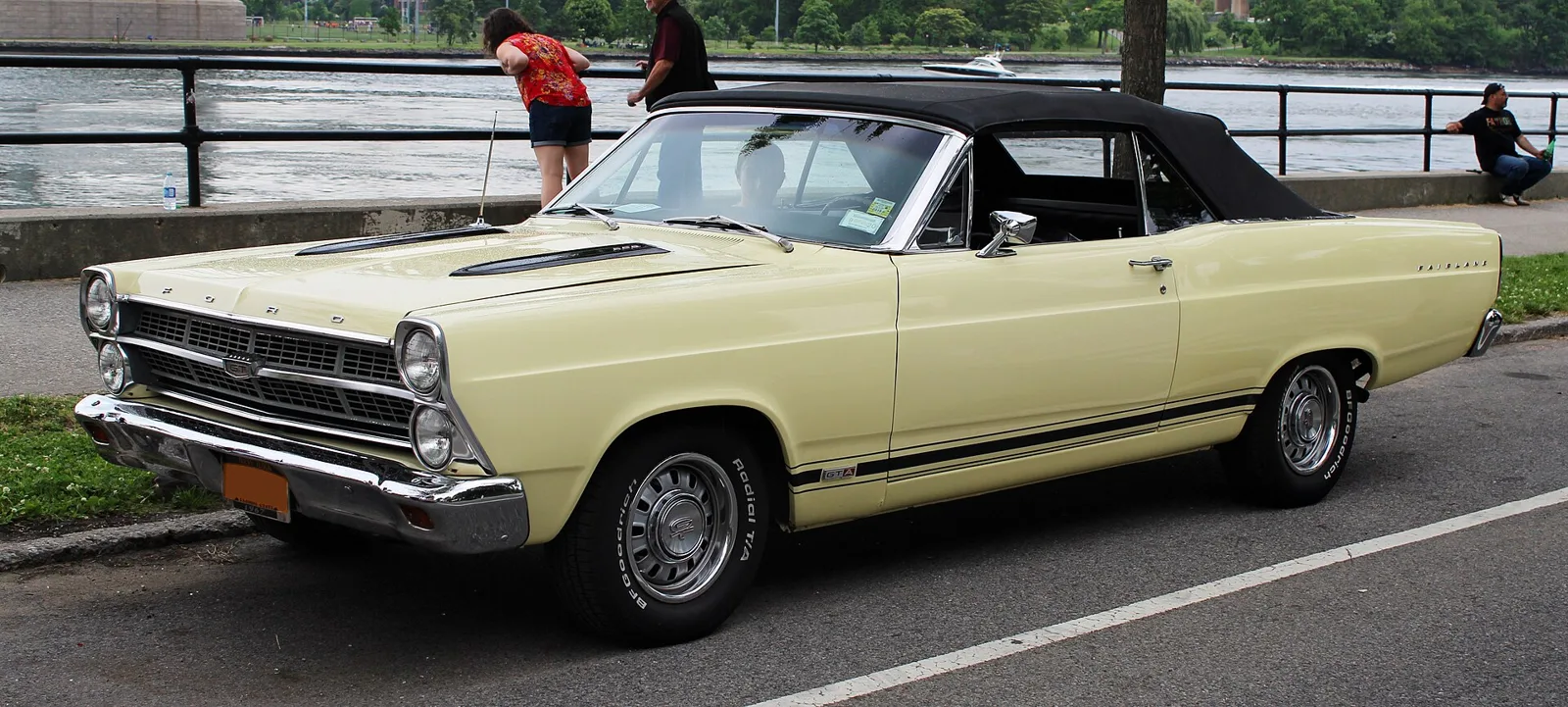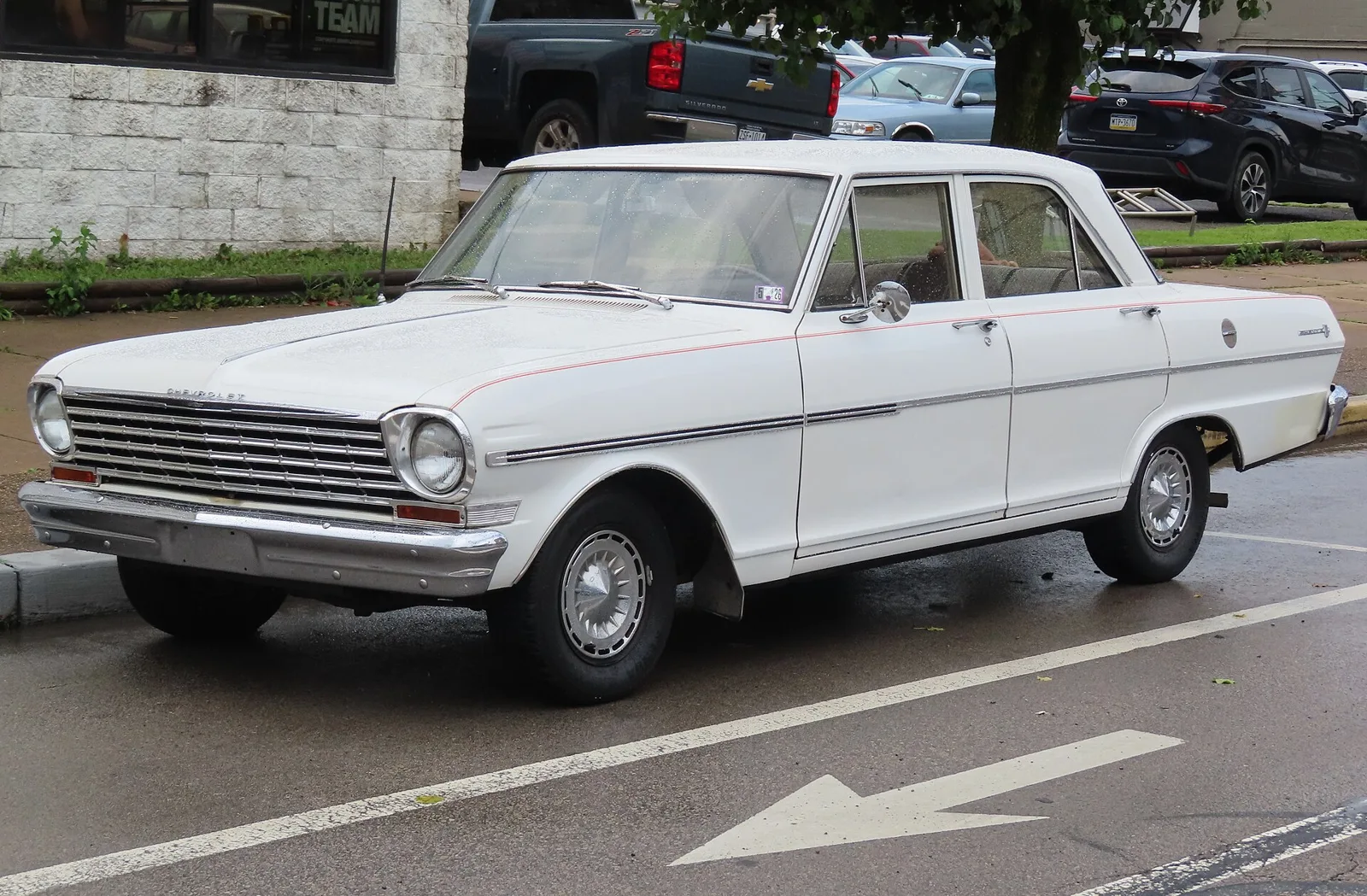
The Falcon was the car Chevrolet had to answer, and the Chevy II was built to do it, so the two compacts spent the 1960s circling each other on the showroom floor.
The Ford Falcon launched in 1960 and became a huge seller, prompting Chevrolet to build the Chevy II, later the Nova, from 1962. The Falcon sold 213,601 cars in 1965 against 122,800 Chevy IIs, and the Chevy II gained a V8 muscle image from 1965.
The Chevrolet Chevy II, later sold as the Nova, and the Ford Falcon were built to fight over the same compact buyer. The Falcon arrived first, in 1960, and it sold so well that General Motors had to answer it with a car of its own. The Chevy II was designed around the Falcon's principles, and the two lines spent most of the decade trading blows across dealer showrooms.
Why was the Falcon so important to Chevrolet?
The Falcon proved that American buyers would accept a small, practical car from one of the Big Three. Its conventional front-engine layout outsold the rear-engined Corvair, which had been the Chevrolet own compact answer. That result pushed Chevrolet to develop a more conventional car, and the Falcon's success set the template that the Chevy II followed.
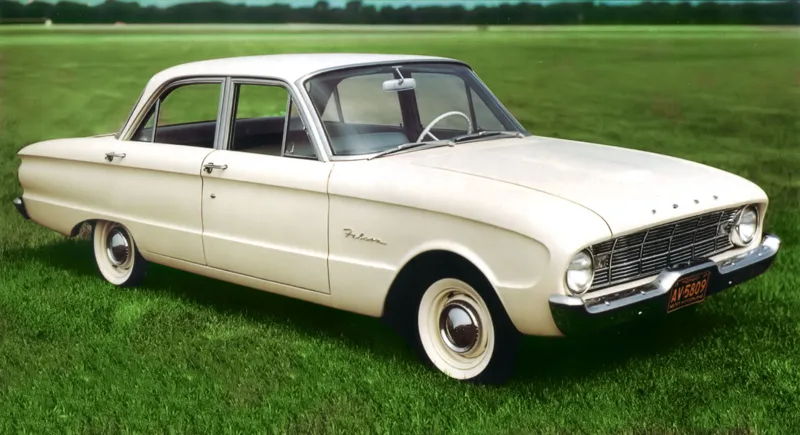
Robert McNamara, then at Ford, is often credited as the father of the Falcon. He kept costs and weight as low as possible, and engineer Harley Copp used a unibody structure on a standard suspension and parts from Ford's existing stock. The result still provided room for six passengers in reasonable comfort.
The Falcon set the template, and the Chevy II was built to match it, so Chevrolet sold a compact that was always measured against a rival.
How did the Falcon start its life?
The Falcon was launched in 1960 as a scaled-down version of the Ford Galaxie, developed for American buyers who wanted a car that was smaller than the usual full-size model. The idea grew from the mid-1950s, when full-size cars had swollen beyond what many families wanted.
Ford's European models, the Anglia, the Zephyr and the Taunus, were already being built as the Falcon arrived, yet none of them reached North America. The Comet, a Falcon-based car for Mercury dealers, launched in March 1960, and a Canadian Frontenac was sold only in 1960 before being dropped in favour of the Comet.
What did the Chevy II copy from the Falcon?
In almost every way the Chevy II's engineers used the Falcon as their benchmark. The Chevy II's 110 in (2,794 mm) wheelbase was only fractionally longer than the Falcon's, and it offered sedans, wagons, a hardtop and a convertible.
Only the Falcon's sedan delivery and the Ranchero coupe utility were missing from the Chevy II lineup.
The Chevy II's chief difference was its badge and its engines. the Chevrolet car had a 153 cu in (2.5-litre) four at launch, while the Falcon's base engine was a six. the Chevrolet marketing also pushed the car as a thrifty, practical alternative, which is the same ground Ford had already claimed with its first compact.
Specifications side by side
| Specification | Chevrolet Chevy II / Nova | Ford Falcon |
|---|---|---|
| Launch | 29 September 1961, as a 1962 model | 1960 model year |
| Production span | 1962 to 1979 model years | 1960 to 1970 model years in North America |
| Wheelbase | 110 in (2,794 mm) at launch | 109.5 in (2,781 mm) |
| Base engine | 2.5-litre (153 cu in) four at launch | 2.4-litre (144 cu in) six, 95 hp (71 kW) |
| V8 options | 4.6-litre (283 cu in) V8 from 1964; 5.4-litre (327 cu in) V8 from 1965 | 4.3-litre (260 cu in) V8, 164 hp (122 kW) from mid-1963 |
| Top engine | Turbo-Fire 327, 350 hp (260 kW), 1967 | None given |
| Body styles | Sedan, wagon, hardtop and convertible | Sedan, wagon, Ranchero coupe utility and, from 1963, hardtops and convertibles |
| Performance models | Super Sport and Nova SS | Sprint package from 1964 |
| Sales | 122,800 built in 1965 | 213,601 built in 1965 |
| Starting price | US$2,475 for the 1962 Nova 400 convertible | None given |
How did the Falcon go performance?
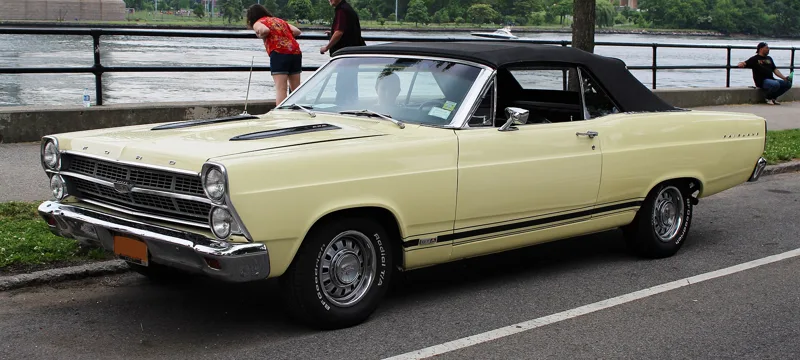
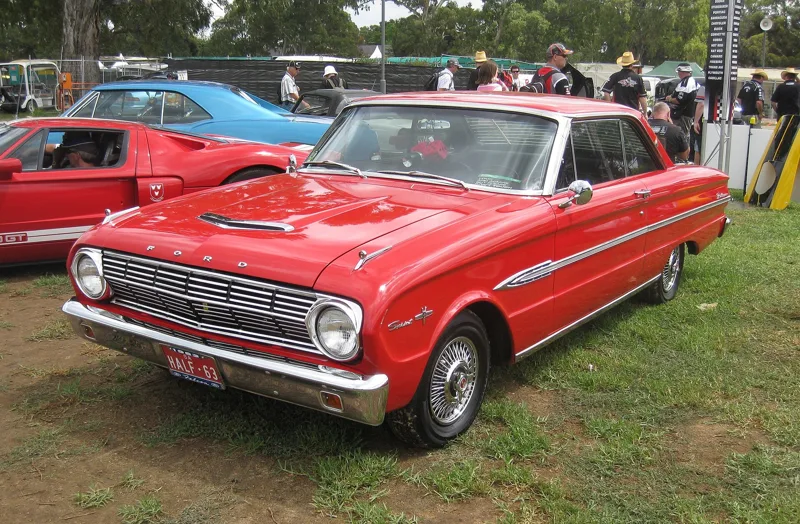
The Falcon's performance story began halfway through the 1963 model year, when a 4.3-litre (260 cu in) V8 at 164 hp (122 kW) arrived from the Fairlane. Only 10,479 hardtops and 4,602 convertibles were built, but they laid the groundwork for the early 1964 Mustang.
For 1964 Ford added a Sprint package that gave the Falcon a stiffer suspension and a louder exhaust, and the 289 V8 followed late that year. The Mustang overshadowed the Sprint, which was discontinued after 1965. The Mustang took a large share of the Falcon's sales, and the car never recovered its earlier momentum.
How did the Chevy II become a muscle car?
The Chevy II's big moment came in 1965, when a 5.4-litre (327 cu in) V8 with up to 300 hp (220 kW) turned the Super Sport into a serious performer. The 1966 Super Sport gained wide rocker panels and a bright deck lid cove, and it was the top of the line for the second generation.
The 1967 Nova SS option carried the performance story further. Its top engine was the Turbo-Fire 327 at 350 hp (260 kW), first seen in the Chevelle, and with a close-ratio four-speed it gave the compact proper muscle car credentials. About 10,100 Nova SS cars went to customers that year, and 8,200 of them had V8 engines.
What happened to the Falcon in its later years?
The third-generation Falcon arrived in late 1965 on a shortened Fairlane platform, with the Futura Sports Coupe at the top of the range. It dropped the two-door hardtop and convertible for 1966, and the Ranchero moved to Fairlane sheet metal in 1967.
Safety rules were one more pressure in the late 1960s. The 1967 models added dual-circuit brakes and an energy-absorbing steering wheel, and 1968 brought square tail lights. The 1970 model year closed out the Falcon in North America, after a long sales slide and a growing inability to meet the coming safety standards.
The Falcon platform had a longer life elsewhere. It underpinned eleven Ford lines over nearly two decades, from the Mustang and Cougar to the Granada and Monarch, and Ford Argentina built the Granada on it until 1991. Ford Australia developed its own Falcon from 1972 through 2016.
How did Ford sell the Falcon?
Ford sold the Falcon on economy and value, and it claimed 30 mpg-US for its six-cylinder models, which works out at about 7.8 L/100 km, a strong figure for the period. The brochure starred Charlie Brown and Lucy, and the television commercials gave the Peanuts characters their first animated appearances, with announcer work by Paul Frees.
Those characters stayed in the Falcon's marketing until 1965, and the television work later brought in Hazel as well. The Mustang's youthful pitch followed in 1964, and it was a very different sales message.
What changed in the second-generation Falcon?
The second-generation Falcon arrived in 1963 with more squared-off styling, and it kept the unified frame approach. Front suspension used coil springs pivot-mounted on upper arms with double-acting shock absorbers. Six-cylinder cars rode on four-lug hubs with 13-inch steel wheels, while V8 cars had five-lug wheels.
For 1965 the changes were slight: the grille grew simpler and the deluxe models got reworked side trim. Convertible production ended on 26 June 1965. Buyers could add power steering and brakes, a radio, a remote trunk opener and a parking brake warning light, and the three-speed Cruise-O-Matic automatic arrived in 1965. Front seat belts were standard by then.
How did the Falcon's trim levels stack up?
The Futura was the Falcon's most upmarket trim, offered with bucket seats, a console, a more upmarket interior, factory safety belts and different side spears. In 1962 Ford gave the Futura sedan a flat rear pane instead of the wrap-around glass of earlier cars, which brought it into line with the rest of the Ford range.
A 1962 Squire wagon with faux wood trim on its flanks offered a more rustic look, and the Falcon Club Wagon used the Econoline cab-over layout to carry eight passengers. Halfway through 1962 Ford also offered a four-speed manual transmission for the first time, which mattered to buyers who wanted more from the car.
What did the Chevy II's 1968 redesign change?
The 1968 Chevy II was fully redesigned on a 111 in wheelbase, which left it about an inch shorter than the Chevelle coupe. The station wagon and the hardtop sport coupe were discontinued in that redesign, which left American Motors the sole US builder of compact wagons until Chrysler came back in 1976.
The Falcon's wagon story ran the other way. Its third generation, from late 1965, rode on a shortened Fairlane platform, and the 1966 to 1970 wagon was in practice a midsize car on a larger body. Both makers were refining their compacts at the same time, but they were not heading in the same direction.
Did either car race?
The Falcon had a racing presence in the Trans-Am series in 1966, the year its third generation arrived. Its results are scarce, but the car gave Ford another route into touring car racing. The Chevy II's performance story was built on the street, through the Nova SS and its Turbo-Fire 327 rated at 350 hp (260 kW).
Those street cars shaped how buyers saw each make. The Nova SS offered a V8 with a close-ratio gearbox in a compact body, while the Falcon's Sprint story depended on a V8 that arrived mid-season and a package that was discontinued after 1965.
Which car sold better?
The Falcon was the bigger seller. Chevrolet built 122,800 Chevy IIs in 1965, against 213,601 Falcons, and the Chevy II was the only GM car to lose sales that year. The Falcon's first year had already topped half a million units, and it passed one million by the end of its second year.
Chevy II output in 1967 was down by over a third, at 106,500. the Chevrolet car had the stronger muscle image, while the Falcon had the bigger volume.
Range mattered too. The Falcon offered two- and four-door sedans, station wagons, the Ranchero pickup and, from 1963, hardtops and convertibles. The Futura and Sprint names gave buyers an upmarket and a sporty option within the same line. The 1962 Chevy II was offered across three model series and five body variants, which gave Chevrolet a similarly broad choice for its own compact buyers.
Which compact suits which buyer?
A buyer who wanted an early Falcon with a six and a practical wagon had a clear choice in 1960, and one who wanted a Sprint with a V8 could find one in 1963 or 1964. A buyer who wanted a Chevrolet with a Nova SS badge and a 350 hp engine had the Chevy II.
Neither car set the rules alone, and the Falcon's volume earned it a larger part of the market.