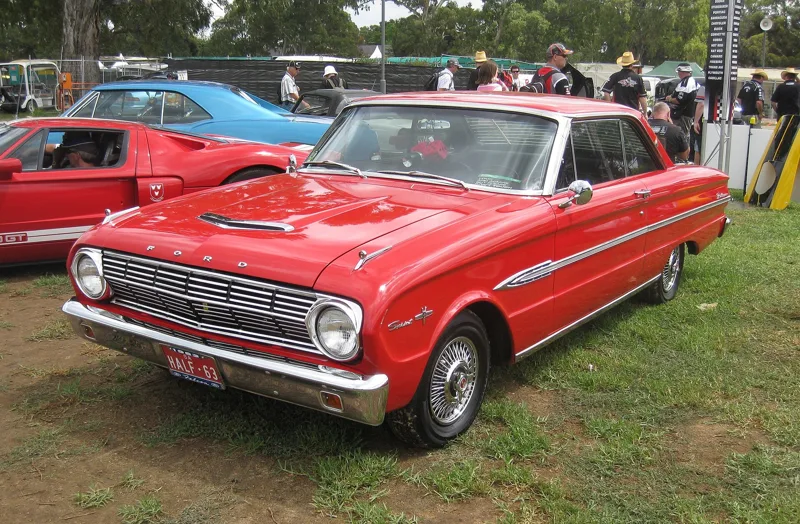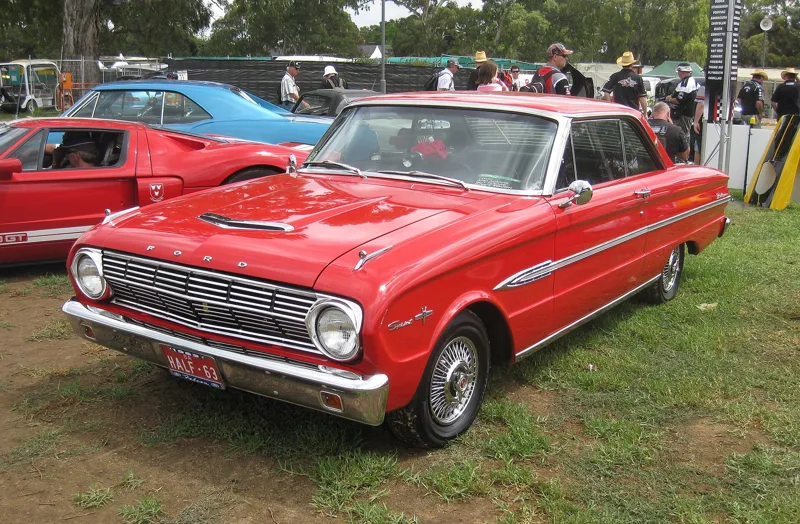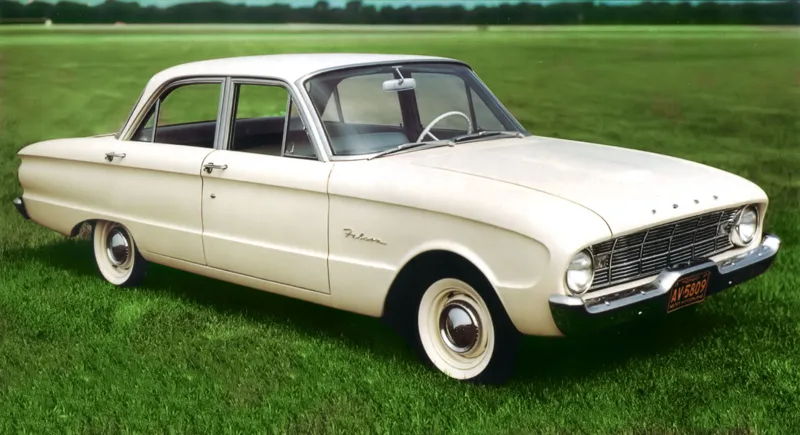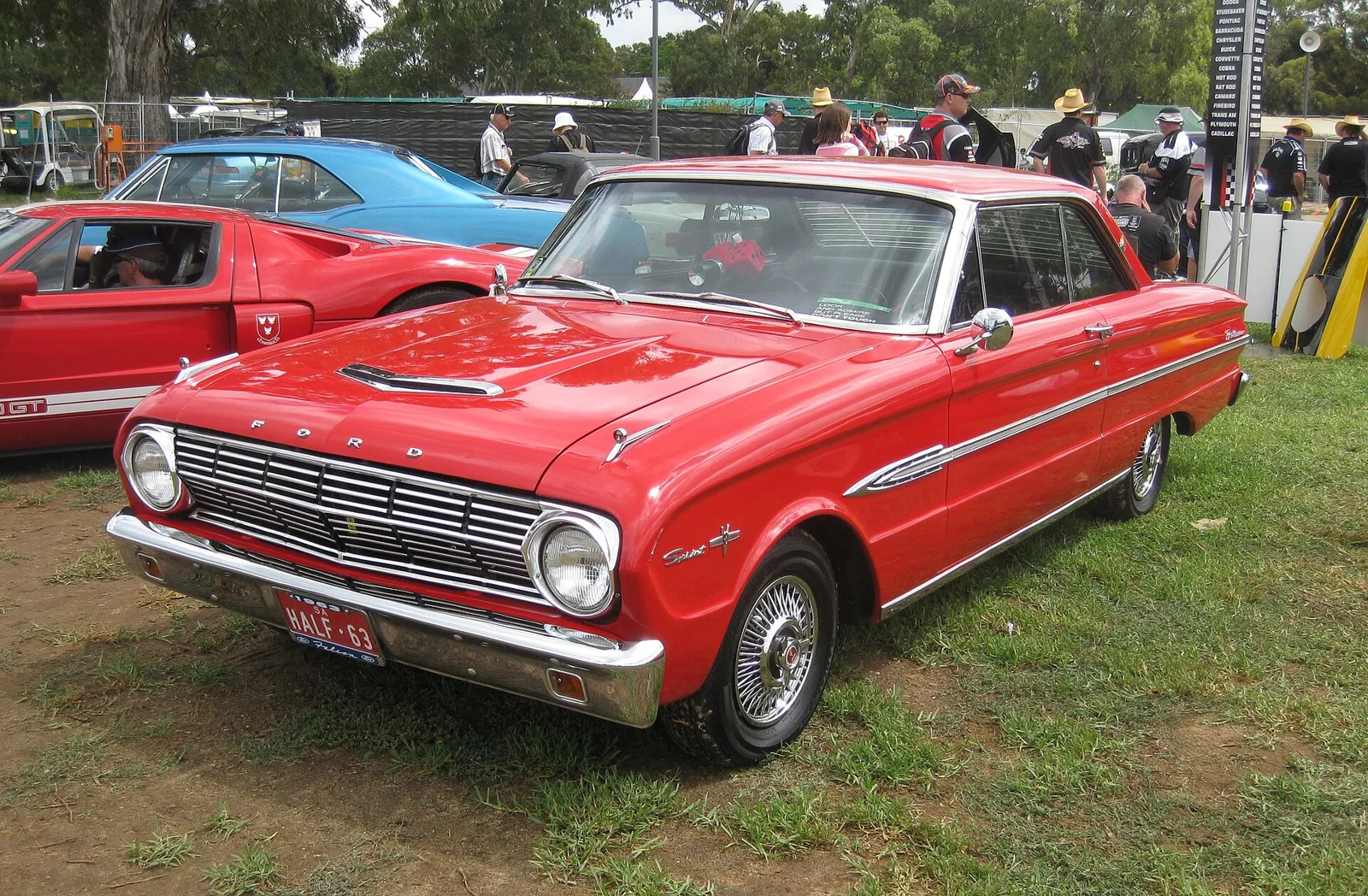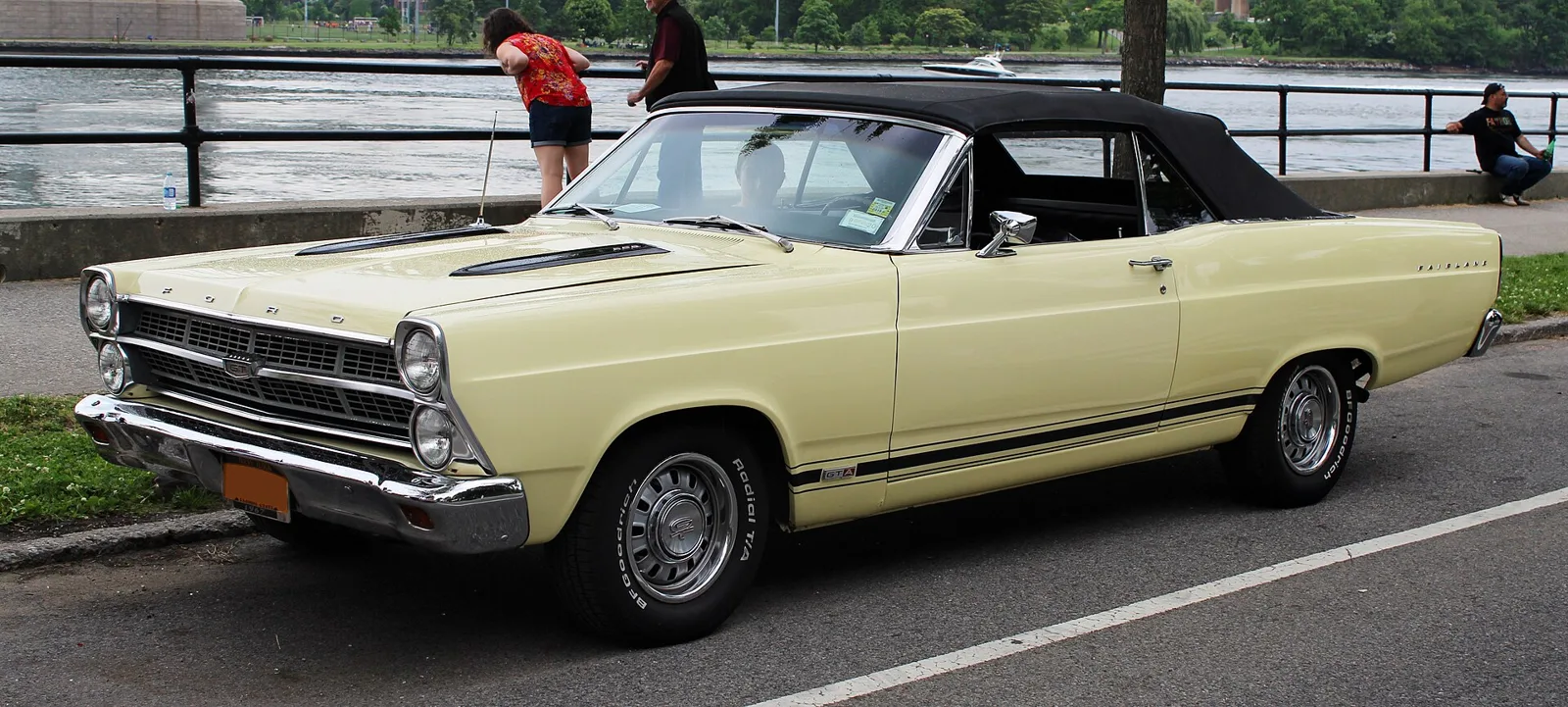
The Falcon was Ford's compact that began in 1960, and the Fairlane was a full-size flagship before it moved into the intermediate class. For a few years in the 1960s they shared a platform.
The Ford Falcon was a compact car sold from 1960 to 1970, while the Fairlane started as a full-size flagship in 1955 and became an intermediate in 1962. The two shared a platform for part of the 1960s. The Falcon was the smaller car, and the Fairlane was the larger, so the two sat at different sizes in Ford's line.
The Ford Fairlane and the Ford Falcon were both Ford nameplates of the 1960s, but they came from different parts of the range. The Falcon was Ford's compact, sold from 1960 to 1970 and built on a unibody design that Ford adapted from its full-size cars. The Fairlane began life in 1955 as a full-size flagship and moved into the intermediate class in 1962, and for part of the 1960s it shared a platform with the Falcon.
Where did the Fairlane and the Falcon come from?
The Falcon was the first compact car marketed by the Big Three American manufacturers, and it was developed as a scaled-down version of the full-size Ford Galaxie. Ford General Manager Robert S. McNamara sponsored the project, and engineer Harley Copp used a unibody on a standard suspension to keep costs down while still seating six people in reasonable comfort.
The Fairlane took its name from the Dearborn, Michigan estate of Henry Ford. For the 1955 model year it replaced the Crestline as Ford's premier full-size car, and it was used for seven generations before the nameplate ended in North America in 1970.
The 1955 Fairlane's most popular model was the four-door Town Sedan, of which 254,437 were built at a list price of US$1,960. Every version carried the stainless-steel Fairlane stripe along its side.
The two nameplates therefore took different routes. The Falcon was a new car from the start, while the Fairlane was an established full-size name that was reshaped into a mid-size car. Ford eventually replaced both with the Torino name in 1971.
Two Ford nameplates from the same decade, one a compact that sold a million in two years and one a flagship that became a muscle-car legend.
How did the Falcon sell in its early years?
The Falcon sold strongly from the start, with over half a million sold in its first year and over a million by the end of its second. Robert McNamara, who had left Ford shortly after the car's introduction, is regarded by many as the father of the Falcon, and the sales record vindicated his faith in the concept.
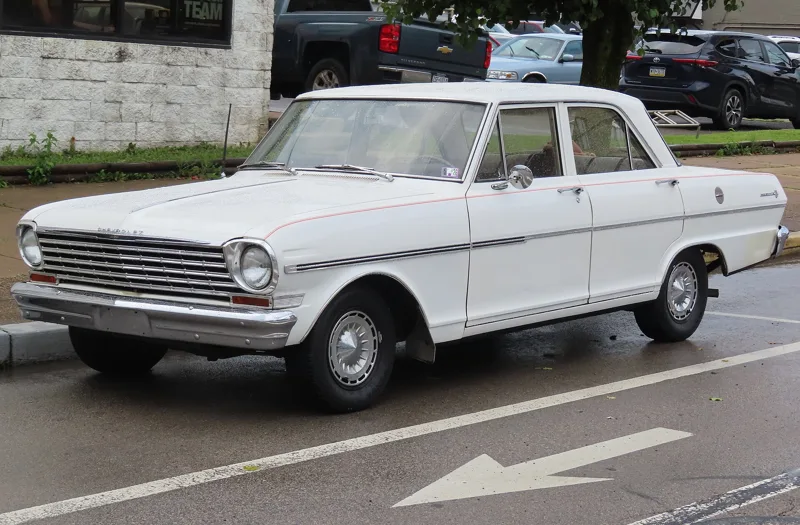
The conventional Falcon's success helped push General Motors toward its own compact, the Chevy II, which was based on the Falcon's principles. Chrysler's Valiant and GM's rear-engined Corvair were the other compacts of the period, and the Falcon was designed as a conventional alternative to the Corvair.
The Falcon's advertising used Peanuts characters from Charles Schulz's comic strip, including Charlie Brown and Lucy Van Pelt, who remained in the brochure until 1965. The car's fuel economy was also promoted, with a claimed 30 mpg-US for the six-cylinder models and 32.5 mpg-US in a Mobilgas economy run in 1962.
How big was the Fairlane compared with the Falcon?
When the Fairlane moved to the intermediate class for 1962, it measured 197 in (5004 mm) long on a wheelbase of 115.5 in (2934 mm). That made it 16 in (406 mm) longer than the Falcon, but 12.3 in (312 mm) shorter than the Galaxie, so it filled the gap between the two Ford lines.
The 1962 Fairlane was built as a unibody like the Falcon, but its body used four boxed structures called torque boxes in the lower body. Its front suspension was a short-long arm independent layout, and the rear used Hotchkiss drive. That engineering gave the Fairlane a solid structure in its new intermediate form.
The Falcon stayed compact in the same years. The Falcon's first generation used a 144 cu in (2.4 L) Mileage Maker straight-six, which produced 95 hp (71 kW), and it was the car that became the basis for many of Ford's later vehicles.
For 1957 the Fairlane got a longer, wider and lower body with low tailfins, and Ford outsold Chevrolet that year for the first time since 1935. The Fairlane 500 Skyliner was a power retractable hardtop whose solid top folded into the trunk at the touch of a button, and the Ranchero coupe utility arrived the same year.
The 1958 facelift added quad headlights and a grille that matched the Thunderbird, and a better three-speed automatic with a column-mounted selector lever was offered.
Which engines did the two families offer?
The 1955 Fairlane offered a 223 cu in (3.7 L) straight-six and a 272 cu in (4.5 L) V8, and a 292 cu in (4.8 L) Y-block was sold as the Thunderbird V-8. Later Fairlane options included 312 cu in (5.1 L) V8s, and the 1958 big-block FE V8s of 332 and 352 cu in replaced the largest previous engines.
For 1962 the Fairlane's standard engine was a 170 cu in (2.8 L) six, while the new lightweight Windsor V8 was offered at 221 cu in (3.6 L) with 145 hp (108 kW). A 260 cu in (4.2 L) Challenger V8 rated at 164 hp (122 kW) was added mid-year, and a 289 cu in Challenger version later reached 271 hp (202 kW).
The Falcon's options grew too. A 101 hp (75 kW) 170 cu in (2.8 L) six was added in 1961, and in February 1963 the 164 hp (122 kW) 260 cu in Challenger V8 from the Fairlane was offered in the Falcon for the first time as the 1963 1/2 model.
What made the Thunderbolt special?
The Thunderbolt was a small batch of Fairlane two-door sedans prepared for drag racing. Built with Ford's 427 cu in (7.0 L) V8 race engine, two four-barrel carburettors and a high-riser manifold, it was rated at 425 hp (317 kW) at 7,500 rpm and was only offered as a two-door sedan on Fairlane 500 trim.
The car used fibreglass body panels, acrylic side windows and a trunk-mounted battery, and it competed in NHRA Super Stock, where it set records in 1964 of 11.6 seconds and 124 mph (200 km/h). Between 111 and 127 were built, and production ended once NHRA rules required 500 vehicles to be built for the class.
The Thunderbolt was a cost to Ford as well. The company lost between $1500 and $2000 on each car at its sticker price of $3900, and the first 11 cars were painted Vintage Burgundy while the rest were white. Many are still raced today.
In 1962 Ford introduced the Falcon Club Wagon and Deluxe Club Wagon, an eight-passenger van built on the Econoline cab-over layout. The Futura model also came with factory-installed safety belts, and a Squire wagon with faux wood trim was offered.
In Canada, Ford's subsidiary introduced a Falcon-based Frontenac for 1960 only. It was essentially a rebadged Falcon with its own grille, tail lamps and red maple-leaf insignia, and it was replaced by the Comet for 1961.
What was the Falcon Sprint?
The Falcon Sprint was the only V8 option offered in a first-generation Falcon, and it arrived in the 1963 1/2 model in very limited numbers. A total of 10,479 Sprint hardtops and 4,602 convertibles were produced, which made the model rare.
The Sprint's mechanical layout was shared with the Fairlane, and the 1963 1/2 Falcon Sprint was nearly mechanically identical to the 1964 1/2 Mustang that followed. The Mustang's success took much of the market away from the Falcon, and the Sprint never caught on as a separate model.
The Sprint package for 1964 gave the Falcon the Fairlane's 260 V8, a stiffer suspension and a louder exhaust. It was discontinued after 1965, and the Mustang dealt the Falcon a blow from which its sales never fully recovered.
How did the designs develop in the 1960s?
For 1966 the Fairlane became a longer-wheelbase version of the revised Falcon platform, and it adopted vertically stacked dual headlights to match the full-size Galaxie. The XL, GT and GTA packages were introduced that year, along with a convertible that joined the sedans, hardtops and station wagons.
The third-generation Falcon, introduced in late 1965, was based on a shortened Fairlane platform. Its top model was the Futura Sports Coupe with chrome side window frames and an all-vinyl interior, and the two-door hardtop and convertible were dropped from the line.
The 1967 Falcon added federally mandated safety equipment, including a dual-circuit brake system and an energy-absorbing steering wheel. The square tail lights came in 1968, and the final model year in North America was 1970.
For 1965 every Fairlane came with 14-inch wheels as standard, and Fordomatic was finally phased out, which left the Cruise-O-Matic as the only automatic on offer.
Production of convertible Falcons ended on June 26, 1965, and power steering, power brakes and a radio were all optional on the later models.
What happened to the two nameplates?
The Falcon stopped in North America after 1970, and the Fairlane ended there in the same year, when Ford used the Torino name across its intermediate range from 1971. The platform had been used by eleven Ford vehicle lines, including the first Mustang and the Mercury Cougar. Its final year in North America was 1970, the same year the Fairlane nameplate ended.
Outside North America both nameplates lived on. Ford Australia built the Falcon from 1972 to 2016, and it used the Fairlane name on a long-wheelbase Falcon through 2007. In Argentina the platform continued as the Granada through 1991.
Side-by-side comparison
| Point | Ford Fairlane | Ford Falcon |
|---|---|---|
| Years in North America | 1955 to 1970 | 1960 to 1970 |
| Size class | Full-size flagship, then intermediate from 1962 | Compact |
| Construction | Unibody from 1962 with torque boxes | Unibody |
| Standard engine | 170 cu in (2.8 L) six from 1962 | 144 cu in (2.4 L) six at launch |
| Top V8 | 289 cu in Challenger, 271 hp (202 kW) | Sprint V8 of 1963 and 1964, 260 cu in |
| Performance model | Thunderbolt, 425 hp (317 kW), 111 to 127 built | Not given |
| Body styles | Sedans, hardtops, wagons, convertibles | Sedans, hardtops, wagons, convertibles, Ranchero pickup |
| Early sales | Town Sedan 254,437 in 1955 | Over half a million in its first year |
| Successor | Torino name from 1971 | Torino name from 1971; Australian Falcon to 2016 |