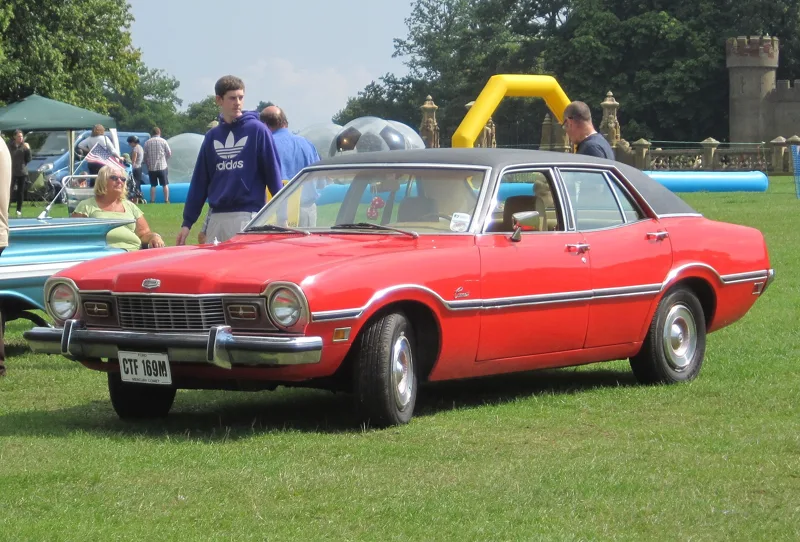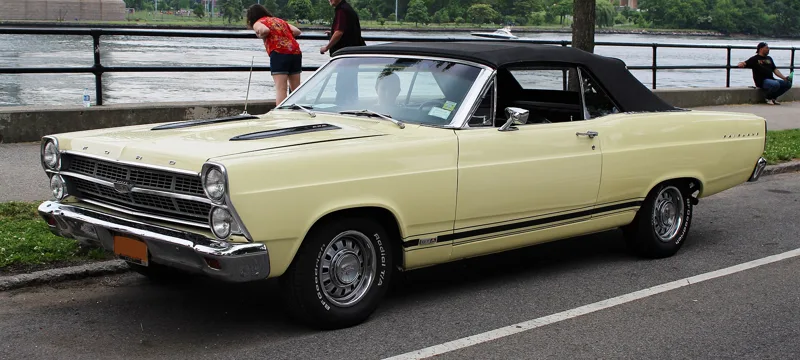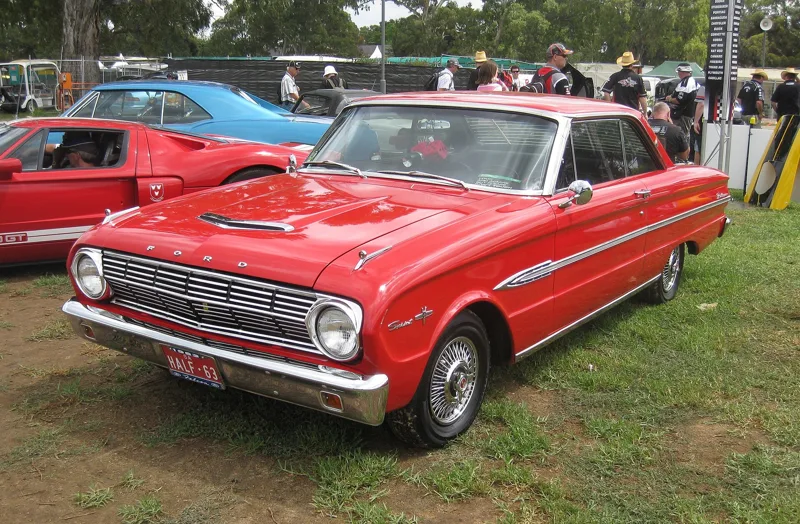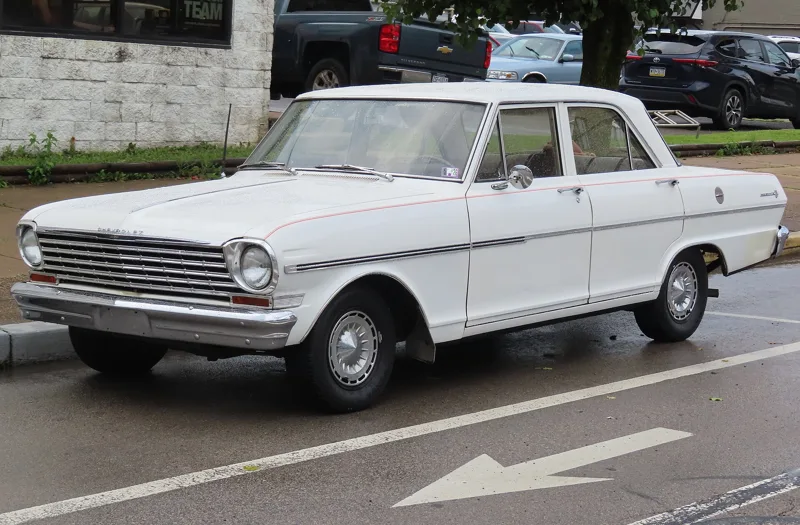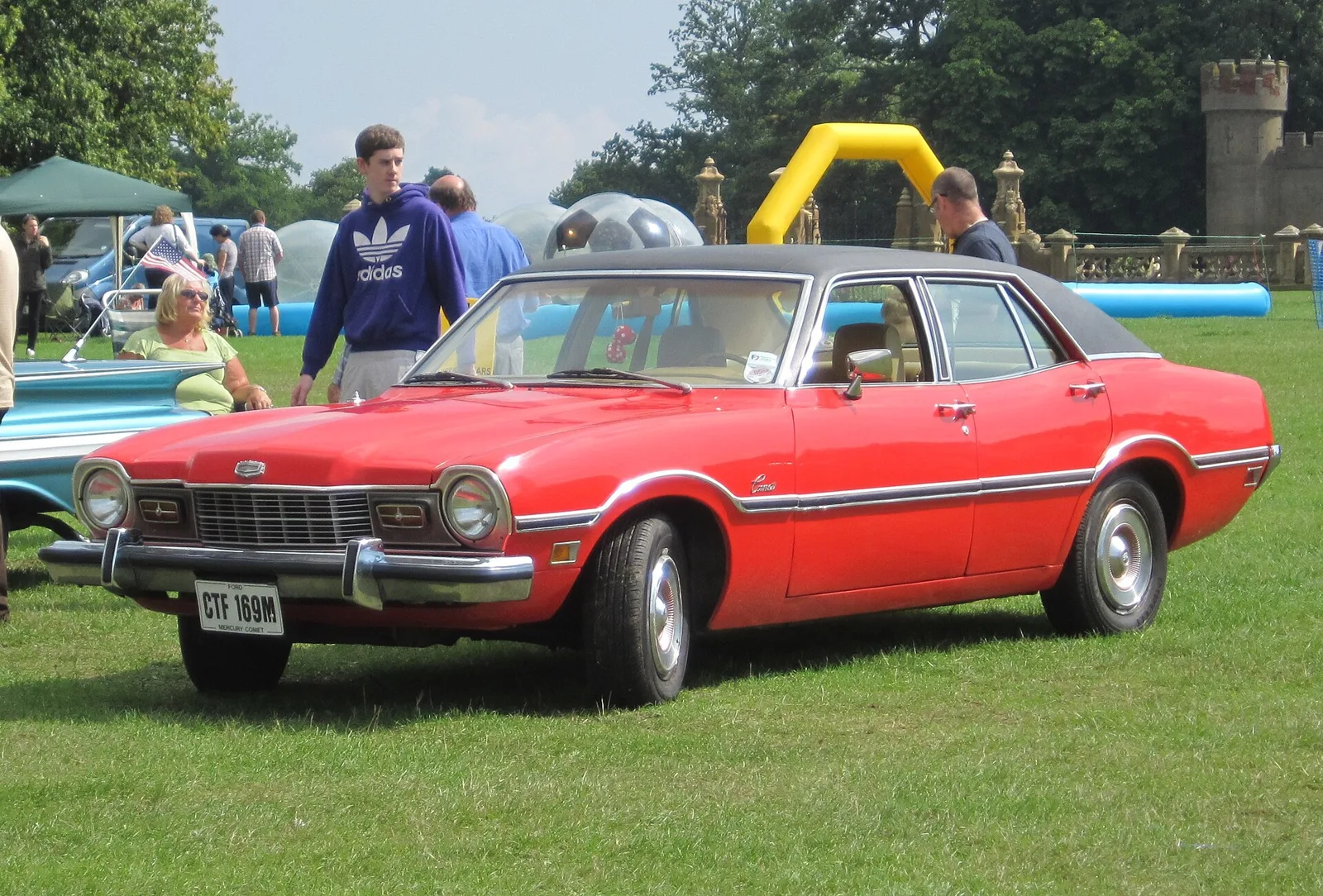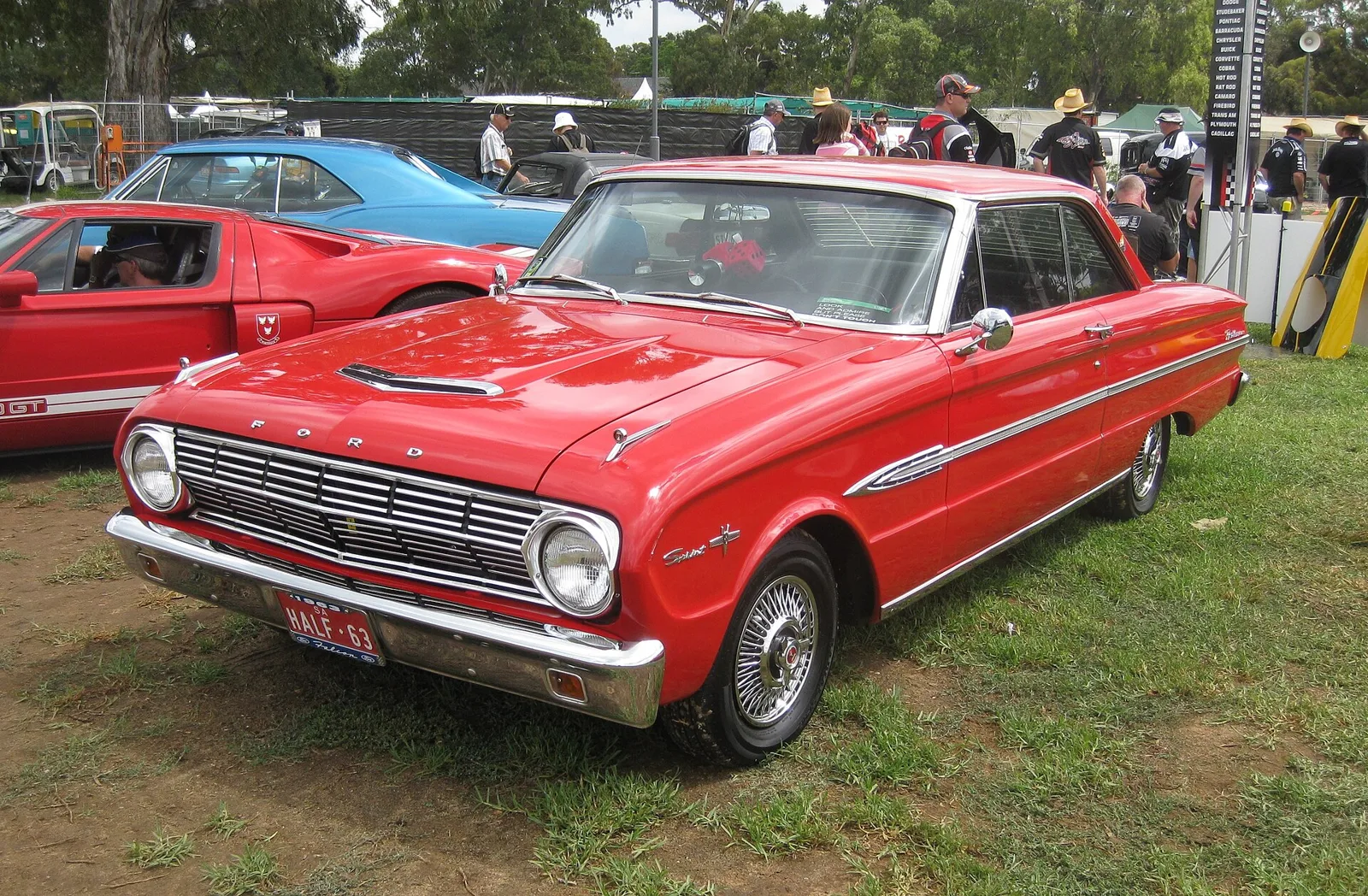
The Mercury Comet began life on the Falcon's platform, so the two compacts were in-house rivals sold through different dealers, and their paths diverged once the Comet grew up.
The Mercury Comet began in 1960 as a compact on the Falcon's platform, originally meant to be the Edsel Comet. It was sold through Lincoln-Mercury dealers and later grew into an intermediate. The two cars were in-house rivals rather than market rivals, and the Comet's performance models eventually went well beyond anything the Falcon offered.
The Ford Falcon and the Mercury Comet were both compact cars of the early 1960s, and for the first five years of the Comet they shared the same platform. The Falcon was Ford's compact, sold from 1960 to 1970, while the Comet was Mercury's version of the same idea. The two competed largely within the same family of dealers, and their paths split as the Comet grew into an intermediate.
Where did the Falcon and the Comet come from?
The Falcon was the first compact car marketed by the Big Three American manufacturers, and it was introduced for the 1960 model year. The Comet was originally meant to be the 1960 Edsel Comet, but Edsel was shut down in November 1959, so the model shifted to the Lincoln-Mercury division and went on sale in March 1960.
The Comet was initially based on the compact Falcon platform, and then on the intermediate Fairlane and finally on the compact Maverick. It was produced by Mercury from 1962 to 1969 and again from 1971 to 1977, and it was variously either a compact or an intermediate. Early Comets received slightly better interior trim than the Falcons they were based on, and a slightly longer wheelbase.
The Falcon itself was developed as a scaled-down version of the full-size Galaxie, and it was built as a sedan and station wagon from the start. The Comet's origins in the Edsel plan gave it a different heritage, with Edsel-derived taillights and keys in its first year.
One Ford compact, and its Mercury twin that began as an Edsel plan, then grew into a muscle-car intermediate.
How did the two compacts look at launch?
The 1960 Falcon came as two-door and four-door sedans, two-door and four-door station wagons, and the Ranchero car-based pickup. The Comet started with two- and four-door sedans and two- and four-door station wagons, with two trim levels, standard and Custom.
The Comet's early styling borrowed from the Edsel programme. Prototypes were already near-identical to the production car, though they wore a split grille in the Edsel manner, and the canted elliptical taillights came from the Edsel prototype.
The Comet was initially released without a divisional badge, only Comet badges, and it was sold through Lincoln-Mercury-Comet dealers. It was not branded as a Mercury Comet until the 1962 model year, when the line was folded into the Mercury range with Mercury-style rear end styling.
Which engines did the two cars offer?
The 1960 Falcon was powered by a 144 cu in (2.4 L) Mileage Maker straight-six rated at 95 hp (71 kW). The Comet used a 144 cu in Thriftpower straight-six rated at 90 hp (67 kW), which some records list at 85 hp (63 kW). Both carried single-barrel carburettors and had room for six passengers.
For 1961 the Comet gained a 170 cu in Thriftpower producing 101 hp (75 kW), after complaints about the low performance of the 144. A four-speed manual became an option, and the Comet's changes that year were minimal, such as moving the Comet script to the rear quarter and a new grille.
The Falcon's V8 came in 1963 as the Sprint, but the Comet's V8 came the same year with the 260 cu in engine borrowed from the Fairlane, rated at 164 hp (122 kW). The chassis and suspension had been redesigned to take it, and the front end carried four headlights rather than the Falcon's two.
What transmissions were available?
The Falcon came with a three-speed manual column shift as standard, and the two-speed Ford-O-Matic was optional. The Comet used a column-shifted three-speed manual and a two-speed Comet-Drive automatic, which was renamed Merc-O-Matic in 1962.
By 1965 the Comet's optional automatic was a three-speed Merc-O-Matic, which was essentially a Ford C4. The Falcon had moved to the three-speed Cruise-O-Matic in 1965, which gave both cars a more modern automatic in their final years.
Both lines therefore kept a column-shifted manual as the standard transmission, with a two-speed automatic at first. The Comet's Merc-O-Matic name was unique to the car, even though it shared a name with the unit fitted to larger Mercurys.
How did the Comet's performance models develop?
The Comet's performance models came first with the S-22, a sport package from 1961 with bucket seats and a centre console, which shared mechanicals with the regular Comets. In 1964 it was replaced by the Cyclone, the performance model in a new line-up that also included the Caliente, 404 and 202.
For 1964 Ford produced about 50 high-performance, lightweight Comet Cyclones with the racing two-carburettor 427 engine. The Cyclones ran in A/FX on 10-inch tyres, while the Thunderbolts ran in Super Stock on 7-inch tyres, so the two cars did not compete with each other. Drivers included Ronnie Sox, Don Nicholson and Wild Bill Shrewsberry.
The 1965 Comet had a 200 cu in (3.3 L) base six producing 120 hp (89 kW), and a 289 cu in (4.7 L) V8 with 200 hp (150 kW) on a two-barrel. The 289 was also offered in a 271 hp (202 kW) Mustang version with a four-speed manual, which set the stage for the later Cyclone GT.
Why did the Comet grow into an intermediate?
Beginning in 1966 the Comet grew from a compact into a mid-sized car on the same chassis as the Fairlane. The Mustang had shared the earlier Comet's platform in 1964, and when the Comet moved up, the Mercury Cougar took over the Mustang's role of platform sharing.
The 1966 Comet received distinct outer body panels and a Comet Capri that replaced the 404. The top model became the Comet Cyclone GT, and a Cyclone GT convertible was the pace car for the 1966 Indianapolis 500. The Comet wagon also introduced a Dual-Action tailgate that could fold down or swing aside, an idea soon copied by other manufacturers.
New engines for the 1966 Comet included 390 cu in V8s with 265 hp (198 kW) and 275 hp (205 kW) on two- and four-barrel carburettors, and a 335 hp (250 kW) version that was standard on the Cyclone GT. The Cyclone GT with an automatic was called the Cyclone GTA.
What happened to the 427 Comets?
In 1967 the Comet was offered in very limited numbers with the 427 cu in FE side-oiler V8, either as a single four-barrel W code rated at 410 hp or as a dual four-barrel R code rated at 425 hp. Only 60 cars were powered by the 427, with 51 R codes and nine W codes.
Every 427 Comet ran a four-speed Toploader gearbox and a Traction-Lok limited-slip differential on a 9-inch rear axle with 3.89:1 gears. Mercury also stripped out sound deadening to save about 150 pounds, and some cars had the battery moved to the trunk to improve traction for drag racing.
Six of the 60 were Capris and four were Calientes, with no convertibles built. The single W-code Capri makes it the rarest Mercury ever built.
The Falcon never had an equivalent. Its own V8 option was the 1963 1/2 Sprint, and it was built in limited numbers, which places the Comet's 427 cars in a different performance league.
From 1968 the mid-sized Mercury models shared their chassis and many parts with Ford's Fairlane and Torino, and their styling resembled the full-sized Mercurys.
Which trims and names did each car use?
The Comet's trims changed often. In 1960 it had standard and Custom versions, and the S-22 package followed in 1961. The S-22 had six bullet-shaped taillights, while regular Comets had four oval lights. In 1964 the line was renamed with Caliente, 404 and 202 trims, and the Villager wagon remained the top of the wagon range.
By 1968 the Comet was available only as a two-door coupe, the Capri had been replaced by the Montego and the Caliente by the Montego MX. The Montego MX Brougham was an option package for the MX, and Cyclone and Cyclone GT stayed as the top models.
The Falcon's trim line was simpler. Its Futura and the Comet's S-22 both offered bucket seats and a console in their sporty versions. The 1962 Futura had a flat rear window, the 1962 Squire wagon had faux wood trim, and the 1966 Futura Sports Coupe added chrome side window frames and an all-vinyl interior.
How did sales and history compare?
The Falcon sold strongly from the start, with over half a million in its first year and over a million by the end of its second. The Comet was sold through Lincoln-Mercury-Comet dealers at first, so its sales were tied to a different network from the Falcon's.
The Comet's name was itself borrowed. Its top wagon also reused the Villager name, which had been used for an Edsel Ranger wagon. Ford bought the Comet name in 1959 from the Comet Coach Company, a maker of ambulances and hearses that had once used the term for a line of funeral coaches.
The Falcon platform was used by eleven Ford vehicle lines, and it underpinned the Mustang and Mercury Cougar pony cars. The Comet's own line was the most varied of the two, moving from compact to intermediate and back to a compact name before its end in 1977.
Side-by-side comparison
| Point | Ford Falcon | Mercury Comet |
|---|---|---|
| Years | 1960 to 1970 | 1962 to 1969 and 1971 to 1977 |
| Origin | Compact developed from the Galaxie | Edsel Comet plan, then Falcon platform |
| Launch engine | 144 CID (2.4 L) Mileage Maker, 95 hp (71 kW) | 144 CID Thriftpower, 90 hp (67 kW) |
| V8 option | Sprint 260 CID V8, 1963 1/2 | 260 CID V8, 164 hp (122 kW) in 1963 |
| Performance model | Sprint package, 1964 and 1965 | Cyclone, from 1964 with the 427 |
| Top engine | 289 CID V8 in the Mustang era | 427 CID, 425 hp in 1967 |
| Sales milestone | Over half a million in the first year | Not given |
| Successor | Final model year 1970 | Comet ended in 1977 after its intermediate years |