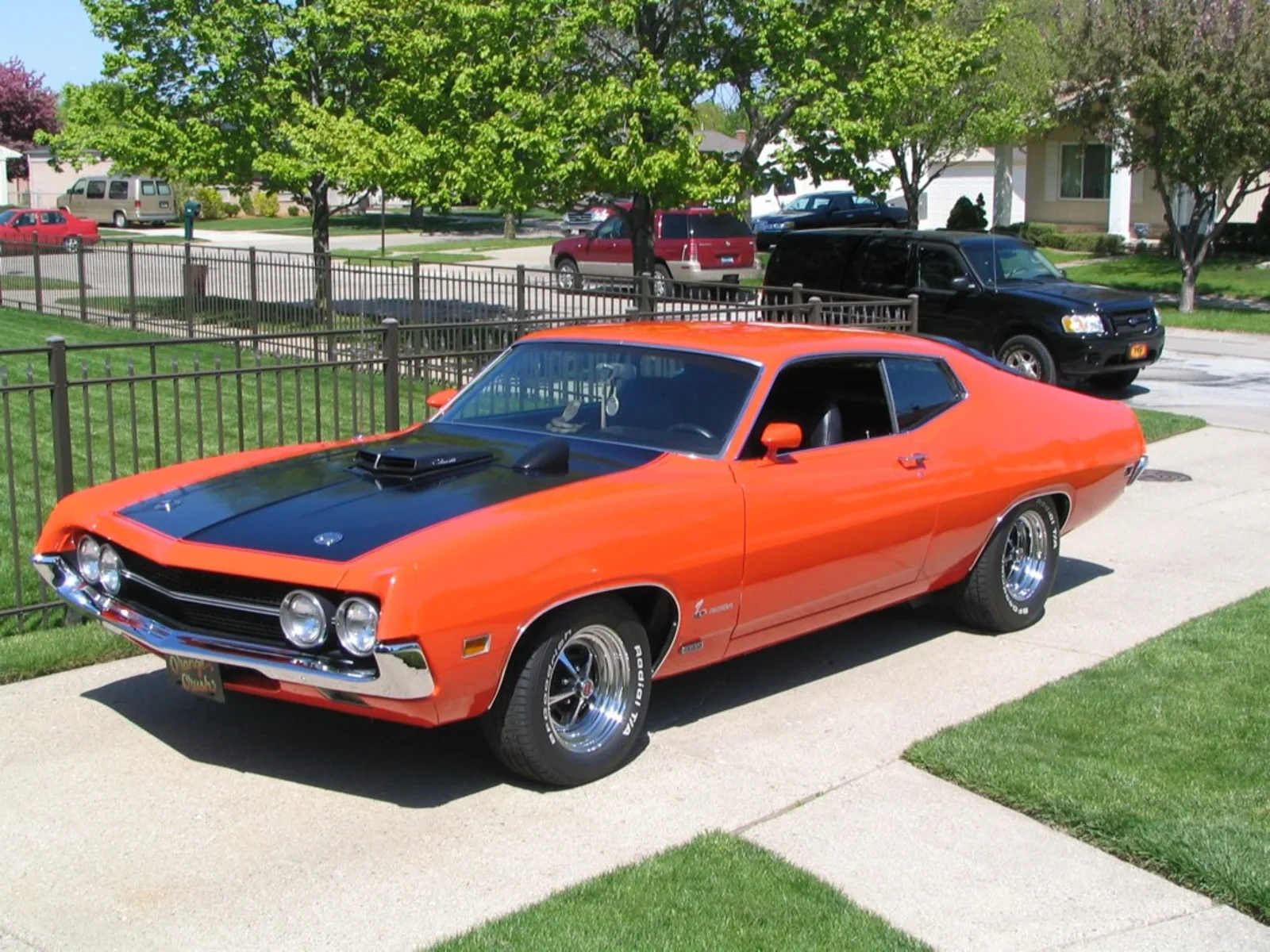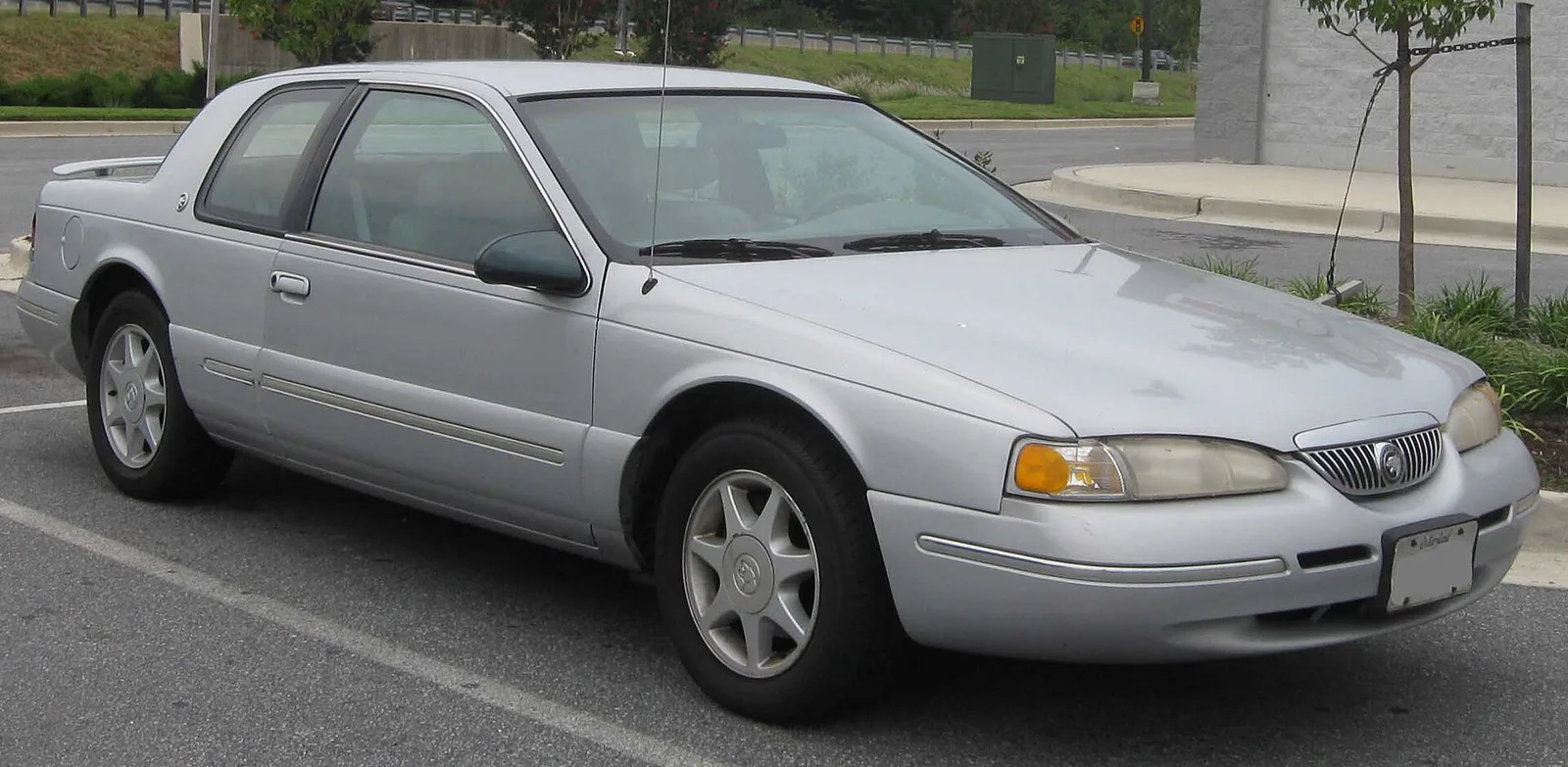
From a 1967 Mustang rival to a front-drive hatch, the Cougar became the highest-selling Mercury, won races, and outlasted most of the brand's models.
Mercury sold the Cougar from 1967 to 2002 across eight generations, most often as a two-door coupe. It reached 2,972,784 examples and became the division's best seller, while racing teams took it into Trans-Am, NASCAR and IMSA competition over the years.
The Mercury Cougar was a series of cars that Mercury sold from 1967 to 2002. Most were two-door coupes, though the nameplate also covered a convertible, a hatchback and, for part of its life, a mid-size sedan and wagon. Across eight generations it became the highest-selling Mercury vehicle, and it reached 2,972,784 examples.
What was the Mercury Cougar?
The Mercury Cougar was a series of Mercury cars sold between 1967 and 2002. Across eight generations, it ran for 34 years, skipping only the 1998 model year, which made it second only to the Grand Marquis in Mercury production longevity. It was the division's most successful model.
During the 1970s and 1980s the Cougar was closely tied to Mercury's marketing. Dealers promoted themselves as The Sign of the Cat, and other Mercury lines took up cat-related names such as the Bobcat and the Lynx.
Production moved between several plants over the years, with assembly at Dearborn, San Jose, Lorain and Flat Rock. The model was never built in one place for its whole life.
A Mustang rival that became Mercury's best seller, lost its way in the 1980s, then came back as a front-drive hatch.
Why did Mercury need a Mustang rival?
The Cougar began in the summer of 1962, when Ford and Lincoln-Mercury styling teams submitted proposals for the T-5 project, which became the Ford Mustang. The Ford design won, but Lincoln-Mercury wanted its own car in the same segment and kept pushing for one.
Ford approved the T-7 project after the Mustang succeeded, letting Lincoln-Mercury build a model from the planned 1967 Mustang update. The T-7 took the Cougar name, revived from the earlier proposal. Rather than copy the Mustang directly, as the Pontiac Firebird did to the Camaro, the Cougar was meant to create its own market segment.
It sat between the Mustang and the Thunderbird in Mercury's range, with more equipment and comfort than the Mustang offered. Its handling was tuned to be more refined than the Thunderbird's, which set it apart from both rivals.
How did the first-generation Cougar launch?
The Mercury Cougar was released by Lincoln-Mercury on September 30, 1966. It far exceeded its sales projections, and it accounted for nearly 40% of Lincoln-Mercury's sales in 1967. Unlike the Mustang, it was first released only as a two-door hardtop.
The base 1967 price was $2,854, or $28,320 in 2025 dollars. The Cougar was priced above the equivalent Ford Mustang, and it went on to take the 1967 Motor Trend car of the year prize, the sole Mercury-brand winner.
The first-generation car was internally designated T-7 and shared its chassis with the 1967 revision of the Mustang. It had a wheelbase extended 3 inches to 111 inches, and both cars used the rear-drive Ford Falcon unibody architecture.
What engines did the first-generation Cougar use?
The first generation was V8-only. A 289 cu in (4.7 L) V8 came in two-barrel and four-barrel forms rated at 200 and 225 hp, and a 390 cu in (6.4 L) Marauder V8 producing 320 hp (239 kW; 324 PS) was offered as an option on the GT.
In 1968 the 289 was briefly replaced by a 302 cu in (4.9 L) V8 built to meet new federal emissions standards. The GT-E arrived that year with a 427 cu in (7.0 L) V8 putting out 390 hp, and a 428 Cobra Jet Ram Air rated at 335 hp was introduced on April 1, 1968, replacing the 427 in the GT-E.
For 1969 the 289 was dropped altogether, and a two-barrel 351 Windsor V8 became the standard engine with 250 hp. The Boss 302 V8 arrived on April 1, 1969, with the Eliminator and produced 290 hp. For 1970 the 351 Cleveland V8 was rated at 300 hp, while the 428 Cobra Jet stayed as the top option.
What were the Cougar's performance trims?
The Cougar GT package was available on the standard car and the XR-7 for 1967 and 1968. It added the 390 Marauder GT V8 and upgraded suspension, brakes and tyres, along with a low-restriction exhaust. The Dan Gurney Special appearance option came with a signature decal and turbine-style wheel covers.
For 1968 Mercury also introduced the XR7-G, a performance appearance package built with Shelby Automotive and converted at the A.O. Smith facility. A total of 619 Cougars were built with the XR7-G package, and it could be fitted to any Cougar engine.
The GT-E sat above the GT and used a racing-derived 427 V8. Its run totalled 394 cars, of which 357 had the 427 and 37 had the 428 Cobra Jet, and power front disc brakes were standard.
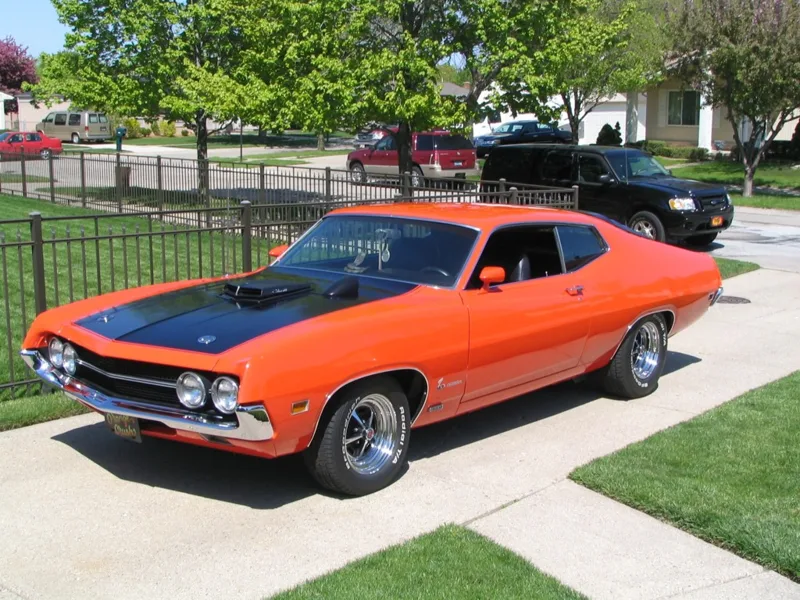
The Eliminator arrived as a running change in 1969 and replaced the GT as the performance Cougar on April 1, 1969. It was a showcase for the Boss 302 engine, which was exclusive to the Eliminator. A total of 2,250 Eliminators were built for 1969 and 2,268 for 1970.
How did the Cougar change in 1969 and 1970?
The 1969 model year brought a mid-cycle revision alongside the Mustang. The straight body sides gave way to Coke bottle styling, with a sweeping crease running from the hood line down to the rear wheels, and the vent windows were deleted.
The front fascia changed too. The split electric shaver grille gave way to a horizontally slatted design, and the headlamps moved from dual vacuum actuators to a single central one. For 1970 the split grille returned, with a new hood, a new bumper and revised front fenders.
Some of the most collectable cars were built for rental. Hertz bought 101 Eliminators for 1969 and 100 for 1970 for its Rent-A-Racer programme, all with the 351-4V engine and an automatic gearbox.
What changed in the second generation in 1971?
For 1971 Lincoln-Mercury released the second-generation Cougar, which was benchmarked against GM's A-body coupes and competed with the Oldsmobile Cutlass Supreme. The car began to move away from the plush pony car and took on aspects of both sporty and luxury cars.
The second generation used a revised first-generation chassis, with a 112.1-inch wheelbase. Its power train offered a 351 Cleveland V8 standard at 240 hp, or 285 hp as a four-barrel. The Cyclone was folded into the Montego line, then quietly retired in 1972.
Ford also brought in the imported Capri through the Lincoln-Mercury network to give the division a compact sporty car. The Capri was built in West Germany by Ford of Europe and was sized slightly smaller than the Mustang.
From 1972 Ford adopted SAE net horsepower ratings, which lowered the advertised figures. The 1973 car was given a federally required 5-mph bumper, which added three inches to its overall length.
How was the third generation different?
The third generation arrived and grew in size. It moved to a 114-inch wheelbase on the Torino chassis, and it was the first Cougar to share its wheelbase with another model line. It also switched to body-on-frame construction for the first time.
The third generation was offered with a 400 cu in and a 460 cu in V8 from the full-size Mercury line, as well as the 351 Cleveland and the 351 Cobra Jet. The redesign proved a success, and sales rose by nearly 50% over the 1971 to 1973 cars.
What did the fourth generation bring?
The fourth generation replaced the Montego as the standard Cougar. It served as the Mercury counterpart of the Ford LTD II, and it introduced Cougar sedans and wagons. The XR-7 returned as a personal luxury coupe and the Thunderbird's direct Mercury equivalent.
Power came from a 302 cu in V8 producing 134 hp for non-XR-7 cars, while the 400 cu in V8 rated at 173 hp was the largest engine. The 460 had been withdrawn from the Torino-chassis intermediates, and the 400 was later discontinued.
The fourth generation proved the most successful of the Cougars in the market, and the XR-7 remained the most popular version within the line.
Why did the fifth generation struggle?
For 1980 Mercury downsized the XR-7, which shed 15 inches in length and 4 inches in width. It also lost approximately 900 pounds of curb weight, depending on the power train, and it moved into the mid-size segment for the first time.
The fifth generation met negative market reception. Its design elements had been carried forward from the larger car, and on a radically smaller body they looked out of proportion. Its XR-7 was distinguished from the Thunderbird mainly by its grille, taillamps, trunk lid and exposed headlamps.
What did the sixth generation (1983 to 1988) bring?
The sixth generation arrived for 1983 and returned the Cougar to its early 1970s role as a luxury sports coupe. It sat above the Capri and below the Grand Marquis, and it was the first large-scale use of aerodynamic-intensive design on an American car.
The Cougar and Thunderbird were the first Ford vehicles developed with computer-aided design. The 1983 car cut its drag coefficient from 0.50 to 0.40, and a mid-cycle revision for 1987 brought it down to 0.36. The wheelbase was reduced to 104 inches.
The engines were a 120 hp 3.8 L V6 and a 130 hp 4.9 L V8 at launch, and the XR7 used a 2.3 L turbocharged inline-four rated at 145 hp with an automatic from 1984 to 1986. In 1987 the turbo four was replaced by the 4.9 L Windsor 5.0 V8.
To mark its 20th year, Mercury built the 20th Anniversary Cougar for 1987 in Cabernet Red with gold trim. A total of 5,002 were produced, and 800 of them were reserved for Canada.
How did the seventh generation (1989 to 1997) work?
The seventh-generation Cougar was introduced on December 26, 1988, for the 1989 model year. It rode on the MN12 platform, which was shared with the Thunderbird and kept rear-wheel drive, with its wheelbase stretched nine inches to 113 inches.
The MN12 chassis used four-wheel independent suspension, a first for a mass-produced front-engine rear-drive American car apart from the Chevrolet Corvette. The XR7 was powered by a 210 hp supercharged 3.8 L V6, and the LS had a naturally aspirated version of the same engine.
In 1994 the Cougar moved from the overhead-valve 4.9 L to a 205 hp 4.6 L SOHC V8 shared with the Grand Marquis. Its 1989 output of 97,246 units made it the best model year for the flagship coupe, and the final year of 35,267 units was followed by the last example in late August 1997.
Two later anniversary editions followed, and about 5,000 of each were produced.
What was the eighth generation (1999 to 2002)?
The eighth generation was introduced for 1999 and was the first Cougar to be front-wheel drive. It was built on the CDW27 world-car platform that the Contour and Mystique shared, and it replaced the Ford Probe, whose design was shifted to Mercury.
The 1999 Cougar became a three-door sport compact, the first Mercury sport hatchback in years, and it was offered with two engines. The 2.0 L Zetec four produced 125 hp (93 kW; 127 PS), and the 2.5 L Duratec V6 produced 170 hp (127 kW; 172 PS).
The Roush Edition sold 112 examples in 1999 and 2000, and Mercury built its last Cougar on 9 August 2002. Ford also sold the car in Europe and Australia as the Ford Cougar from 1999 to 2002, where a right-hand drive version opened the UK and Australian markets.
Did the Cougar race?
Yes, from the start. In 1967 the NASCAR team builder Bud Moore campaigned Mercury Cougars in the Trans-Am Series with Ford factory support, with drivers including Dan Gurney and Parnelli Jones. Mercury lost the championship to Ford by two points.
In 1968 Bud Moore raced Cougars in the newly formed Grand American series, and Tiny Lund dominated it to take the championship. The Wood Brothers Racing team later won several NASCAR races with the Cougar body style, with David Pearson and Neil Bonnett at the wheel.
Lincoln-Mercury Motorsport ran Cougars in the IMSA GT Championship's GTO class from 1989 to 1990. Both years ended with a title, lifting the team's total to seven manufacturer championships.
How safe was the eighth-generation Cougar?
The Insurance Institute for Highway Safety never evaluated the 1999 to 2002 Mercury Cougar. It did test the Contour and Mystique, which were built on the same CDW27 platform, and gave them a Poor overall rating in the frontal moderate overlap test.
Ford said the Cougar had many of its body panels and structural pieces modified, and the car was reportedly 17% stiffer than the Contour and Mystique. Its side crash beams were said to make it stronger in side impacts, which Ford linked to a possible safety advantage.
What were the Mercury Cougar specifications?
The table gathers the main figures for the eight generations. Where a value applies to one generation or engine only, the row says so.
| Specification | Detail |
|---|---|
| Years sold | 1967 to 2002, eight generations, no 1998 model year |
| Total built | 2,972,784 |
| First-generation wheelbase | 111 inches |
| Second-generation wheelbase | 112.1 inches |
| Third-generation wheelbase | 114 inches (body-on-frame) |
| Sixth-generation wheelbase | 104 inches |
| Seventh-generation wheelbase | 113 inches (MN12 platform) |
| First-generation top engine | 390 cu in (6.4 L) Marauder V8, 320 hp (239 kW; 324 PS) |
| Seventh-generation supercharged V6 | 210 hp (157 kW; 213 PS) |
| Eighth-generation engines | 2.0 L Zetec four, 125 hp (93 kW; 127 PS); 2.5 L Duratec V6, 170 hp (127 kW; 172 PS) |
| Last car built | 9 August 2002 |
Frequently asked questions
How many Mercury Cougars were built?
Mercury built 2,972,784 Cougars across eight generations. That made it the highest-selling Mercury vehicle.
Did the first Cougar share parts with the Mustang?
Yes. It shared its chassis with the 1967 Mustang, although its styling and tuning set it apart. The later XR-7 became a Thunderbird counterpart rather than a Mustang rival.
When was the last Cougar built?
The last Mercury Cougar rolled off the assembly line on 9 August 2002, bringing the nameplate to an end after 34 years of production.
Why did the 1980 Cougar shrink?
The 1980 model cut 15 inches from the XR-7's length and dropped roughly 900 pounds, moving the car into the mid-size class for the first time.