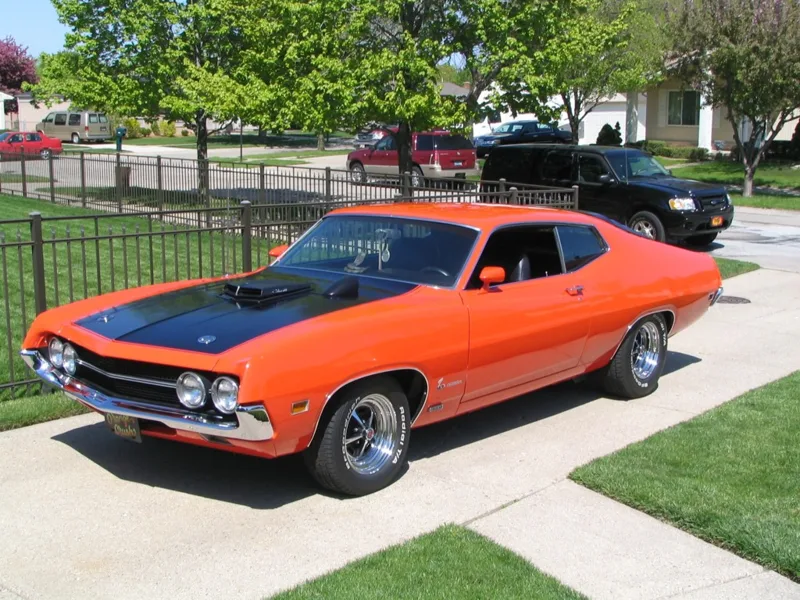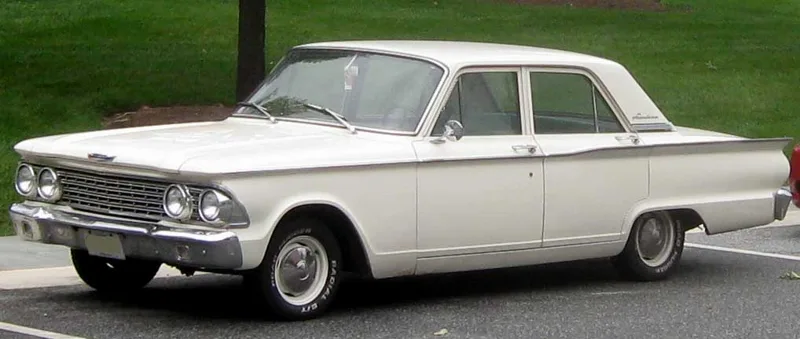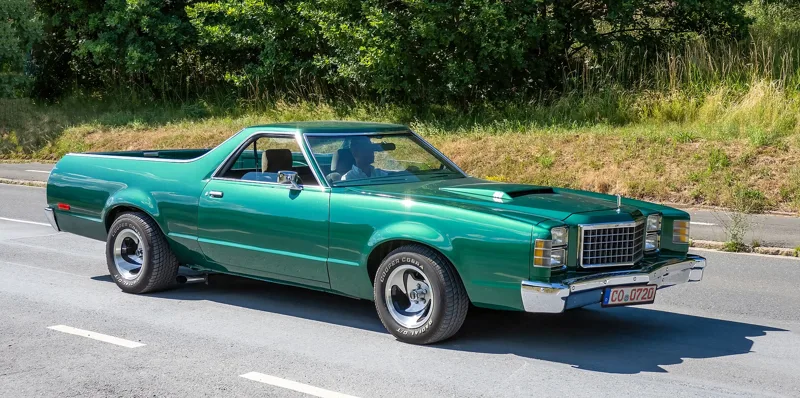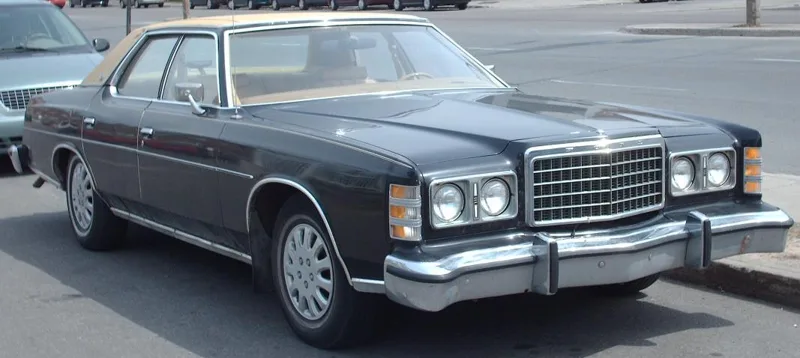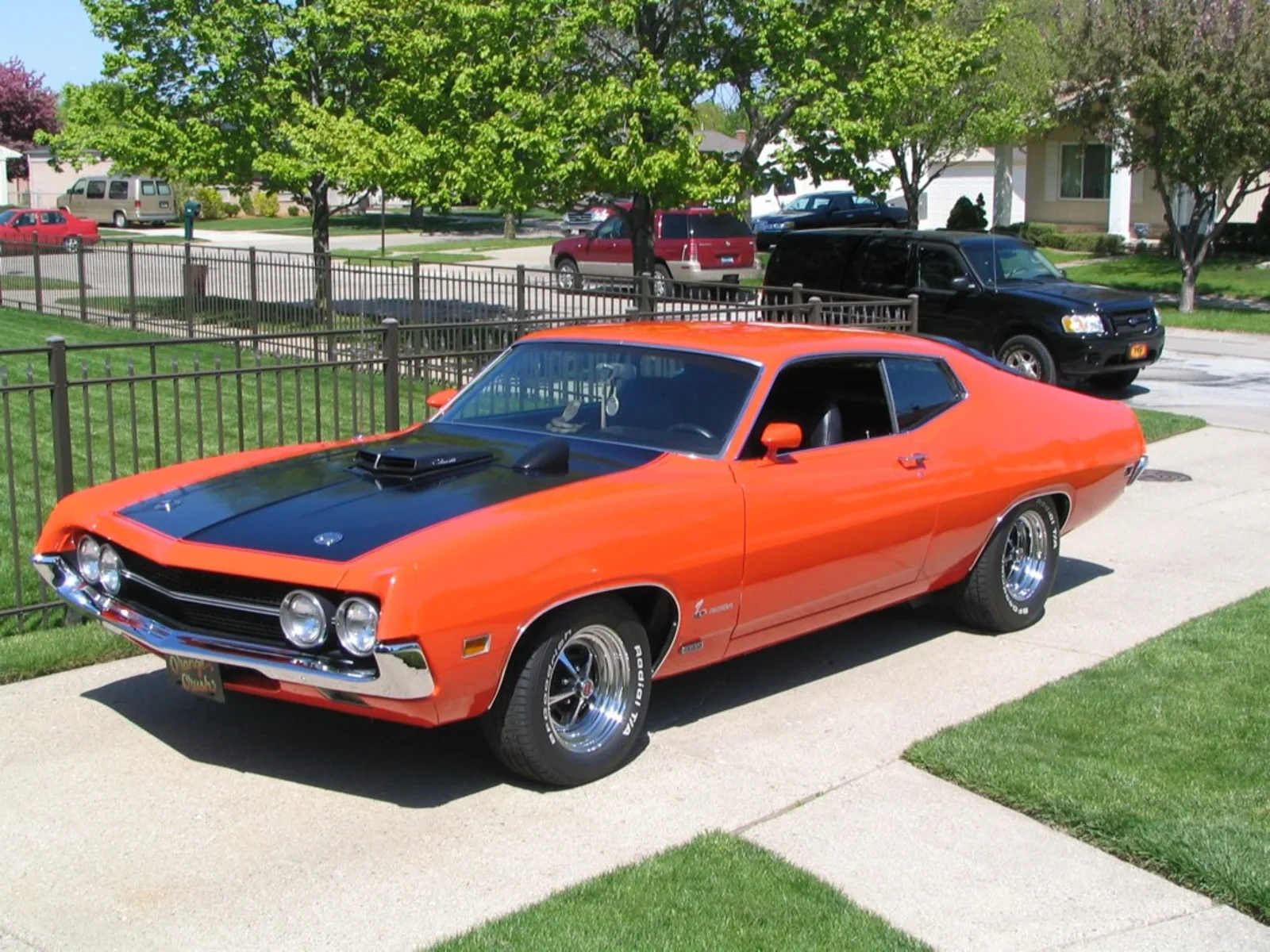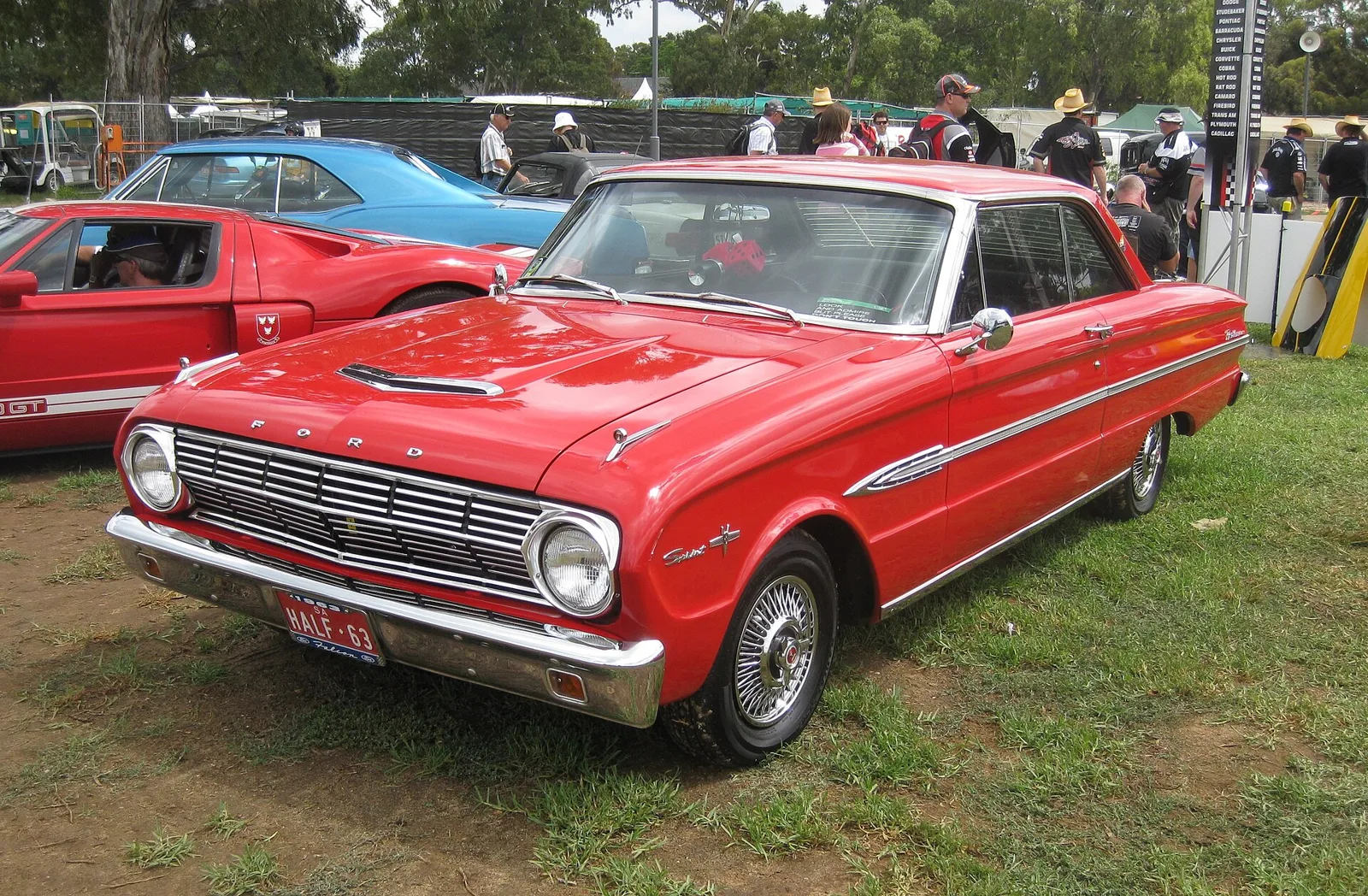
Ford's first compact, a scaled-down Galaxie whose platform underpinned the Mustang and a family of Ford and Mercury cars.
The Ford Falcon was a North American compact built from the 1960 to 1970 model years, developed as a scaled-down Galaxie and the first compact sold by one of the Big Three. Its platform went on to underpin the Mustang and a long family of Ford and Mercury models.
The Ford Falcon started life as a compact in 1960 and ran through the 1970 model year in North America. Its underpinnings went on to carry eleven Ford vehicle lines, from the first Mustang to the Lincoln Versailles.
Where did the Ford Falcon come from?
Ford developed the Falcon as a scaled-down version of its full-size Galaxie sedan, which set it apart from rivals such as the Chevrolet Corvair and the Plymouth Valiant. It was the first compact marketed by one of the Big Three American manufacturers, although Rambler's American had come earlier.
By the mid-1950s the Big Three had realised that large cars were becoming expensive, while smaller imports such as Fiats, Renaults, Toyotas and Volkswagens were looking more attractive. Research also suggested that many families wanted a second car, and that women in particular found full-size cars too large and cumbersome.
Research showed that buyers would prefer a domestic small car with a lower cost of ownership to an import. All three Detroit makers responded with compacts: Chrysler's Valiant, GM's Chevrolet Corvair and the Falcon. Studebaker added the Lark, and Rambler downsized its American in 1959.
A scaled-down Galaxie that became Ford's first compact and the root of a platform used by eleven vehicle lines.
Who was behind the Falcon project?
Robert S. McNamara, then Ford's general manager, backed the project. His team was asked for a car that counted as small in America but would be mid-size elsewhere, and by launch day McNamara had moved up to Group Vice President of Cars and Trucks.
McNamara stayed closely involved, insisting that the costs and weight of the car be kept as low as possible. Engineer Harley Copp used a unibody on a standard suspension and drew parts from Ford's existing stock to keep the price down, while still providing room for six passengers in reasonable comfort.
Many people credit McNamara as the father of the Falcon, even though he left Ford soon after the car's introduction. He later served as U.S. Defense Secretary, and his faith in the concept was borne out by the car's sales.
The Falcon's strong showing, with GM's rear-engined Corvair selling poorly, prompted General Motors to build a rival on the same principles. That car was the Chevy II.
What engine did the 1960 Falcon use?
The first Falcon's six was a lightweight Mileage Maker of 2.4 litres (144 cubic inches), rated at 95 hp (71 kW) and fed by a single-barrel carburettor. Column-shift three-speed manual was standard, and the two-speed Ford-O-Matic was optional.
The unibody had coil springs at the front, leaf springs at the rear and drum brakes at all four corners. Unibody construction had already appeared on the luxurious 1958 Thunderbird and Lincoln Continental, so the Falcon used an established idea in a cheaper car.
In 1961 Ford offered an optional 101 hp (75 kW) 2.8-litre six, which had 170 cubic inches. The same year brought the Futura, a bucket-seat and console sedan in a higher trim, and a sedan delivery body.
Which body styles did the first Falcon come in?
The first Falcon came as two- and four-door sedans, two- and four-door station wagons, and the Ranchero, a car-based pickup that moved onto the Falcon platform for 1960 from the Fairlane. The layout gave room for six people, and Ford offered a range of convertibles and hardtops as the years went on.
The Comet was originally intended for the defunct Edsel marque and was based on the 1960 Falcon. It was launched in the United States in March 1960, and by 1962 it had adopted more Mercury-based styling and become the Mercury Comet.
Ford's Canadian subsidiary also built the Frontenac for the 1960 model year only. It was essentially a rebadged Falcon with its own grille, tail lamps and red maple-leaf insignia, and it took about 5 percent of Ford's Canadian output before it was replaced by the Comet for 1961.
How well did the Falcon sell?
The Falcon sold strongly from the start. Over half a million were sold in the first year, and more than a million by the end of the second, which vindicated the concept that McNamara had championed. Its success also pushed GM to respond with its own compact.
Ford's advertising stressed the fuel economy of the six-cylinder cars, claiming 30 mpg-US (7.8 L/100 km; 36 mpg-imp), which was good for the time when compared with other American cars. A Mobilgas run later recorded 32.5 mpg-US, equal to 7.2 L/100 km or 39.0 mpg-imp.
Brochures showed Charlie Brown and Lucy Van Pelt, and the pair stayed in the advertising until 1965. The TV adverts gave the characters their first animated appearances, with announcer work by Paul Frees.
What changed with the 1962 and 1963 models?
The 1962 update brought a new grille, front bumper and tail lamps, for a slightly more angular look. The hood also gained a chrome trim piece that implied a scoop, and the Squire station wagon arrived with faux wood trim on its sides.
Mid-way through 1962, the rear window roofline was restyled in Thunderbird fashion, and a four-speed gearbox became available for the first time. The Falcon Club Wagon and Deluxe Club Wagon, eight-passenger vans based on the Econoline, also came in 1962.
In 1963 the range grew again. A four-door Futura and a Deluxe wagon were added, along with Futura convertible and Sprint convertible models, and later hardtops and the Sprint itself.
Could a Falcon be ordered with a V8?
The 1963 1/2 model was the only first-generation Falcon to offer a V8, using the 260 cubic-inch Fairlane Challenger unit rated at 164 hp (122 kW). Production was limited to 10,479 Sprint two-door hardtops and 4,602 Sprint convertibles, all with bucket seats.
These cars were the basis for the 1964 1/2 Mustang, which Ford released a year later. Many of the interior, chassis, suspension and drivetrain components came from the Falcon Sprint and Fairlane models, so the 1963 1/2 Sprint is almost mechanically identical to the Mustang while looking different.
What changed in the second generation?
The second generation arrived for 1964 with squarer styling and a Sprint package that brought the Fairlane's 260 V8 into the Falcon. Ford's Mustang followed later that year on the same unified frame design, and it took the spotlight from the Falcon.
The Sprint package added a stiffer suspension and a louder exhaust. Because the Mustang offered the same options for only a little more money, the Sprint never caught on. Even after the 289 V8 arrived in late 1964, the Sprint was overshadowed and was dropped after 1965.
North American Falcon sales never recovered once the Mustang appeared. Front suspension used coil springs pivot-mounted on upper arms with double-acting absorbers, and six-cylinder cars ran four-lug hubs on 13-inch steel wheels, while V8 cars had five-lug wheels.
For 1965 the changes were minor, including a simpler grille and revised side trim on deluxe models. Convertible production ended on 26 June 1965. Options for the year included a padded dash, power steering and brakes, a radio, a remote boot release and a light warning of the parking brake, and the three-speed Cruise-O-Matic automatic became available from 1965.
What did the third-generation Falcon bring?
The third generation arrived in late 1965 on a shortened Fairlane platform with revised styling. The top model was the Futura Sports Coupe, whose chrome side window frames gave the two-door sedan the look of a hardtop. Its premium all-vinyl interior was part of that top trim.
Two-door hardtops and convertibles disappeared from the range, and the wagon and Ranchero switched to a bigger platform shared with the Fairlane. The Ranchero left the Falcon line for good and took the Fairlane's front sheet metal for 1967.
Brakes measured 9 inches on six-cylinder Falcons and 10 inches on V8s. The heater-defroster became standard, and the 1966 Falcon was used in the Trans-Am series.
For 1967 Ford added federally mandated safety equipment, including a dual-circuit brake system, an energy-absorbing steering wheel with a padded centre hub, four-way flashers and mountings for front shoulder belts. A seatbelt reminder light followed, and 1968 brought square tail lamps.
Cars built after 1 January 1969 gained side marker lights or reflectors, front outboard shoulder belts and headrests, while the basic body and mechanical specification stayed the same.
Why did the Falcon end in North America?
1970 closed out the Falcon's North American run. Falling sales and an inability to meet coming safety standards led to a short run of 1970 cars, which were built until the end of December 1969. They matched the 1969 cars in specification.
None of those 1970 cars had the locking steering column that other 1970 Ford products received as standard, with the exception of Mavericks built before September 1969. Some early literature listed a plain Falcon series, but the cars themselves all carried the Futura name that year.
The Futura name returned in 1978 on the Fairmont Futura Sport Coupe, after the Falcon, Fairlane and Fairlane 500 names had gone.
What was the 1970 1/2 Falcon?
After a shortened 1970 model year, the third-generation Falcon gave way to the Ford Maverick. Ford then brought back the Falcon name mid-year as an entry-level intermediate below the Fairlane and Torino, which was designated the 1970 1/2 model year.
To meet federal rules the car received a locking steering column and three-point outboard belts. It came as a two-door pillared sedan, a four-door sedan and a five-door station wagon, with the wagon and four-door shared with the Fairlane and Torino.
Manual windows were standard, power windows were limited to the wagon, and radios were optional. Engines ran from a 250 cubic-inch inline-six making 155 hp (116 kW) up to the 429 Cobra Jet Ram Air V8, rated at 370 hp (276 kW).
In 1971 the Torino name was applied to the entire intermediate range, retiring Falcon and Fairlane in North America.
What happened to the Falcon name elsewhere?
Variations of the Falcon were built in Argentina, Australia, Canada, Chile and Mexico. Ford Argentina kept producing the platform as the Granada until 1991, while Ford Australia developed the Falcon as a distinct regional model from 1972 until 2016. Those two lines outlasted the North American car by decades.
The platform was used for a long list of cars. The Mustang and Mercury Cougar pony cars used its first generations, the Econoline and Club Wagon vans shared it, and two generations of successors included the Maverick, the Mercury Comet, the Granada, the Monarch and the Lincoln Versailles.
Passenger versions of the Econoline and Club Wagon were sold as Falcons from 1961 to 1967, which added yet another use for the name.
Where did the Falcon name come from?
Edsel Ford first used the Falcon name in 1935 for a more luxurious Ford he designed. That car did not fit with Ford's other offerings, so the design eventually became the Mercury. The Falcon label was later reused for the 1960 compact.
The name came back in 1960 for the compact that this article covers. Its success set off a run of models that outlasted the original car in several markets.
Frequently asked questions
Was the Falcon a shrunken Galaxie?
Yes, its design was a smaller take on the full-size Galaxie sedan, and that origin set it apart from the Corvair and Valiant.
Which Falcon offered a V8 engine?
Only the mid-1963 Sprint offered a V8 in the first generation. It was built in limited numbers, and the engine came from the Fairlane.
How fast did Falcon sales climb?
Sales passed half a million within the first year, and the car topped a million by the end of year two. Those results were a key reason the Falcon was seen as a success.
When did the Falcon name end?
The name ended in North America in 1971, when Ford applied the Torino nameplate across its intermediate line. Australia kept the Falcon name until 2016.