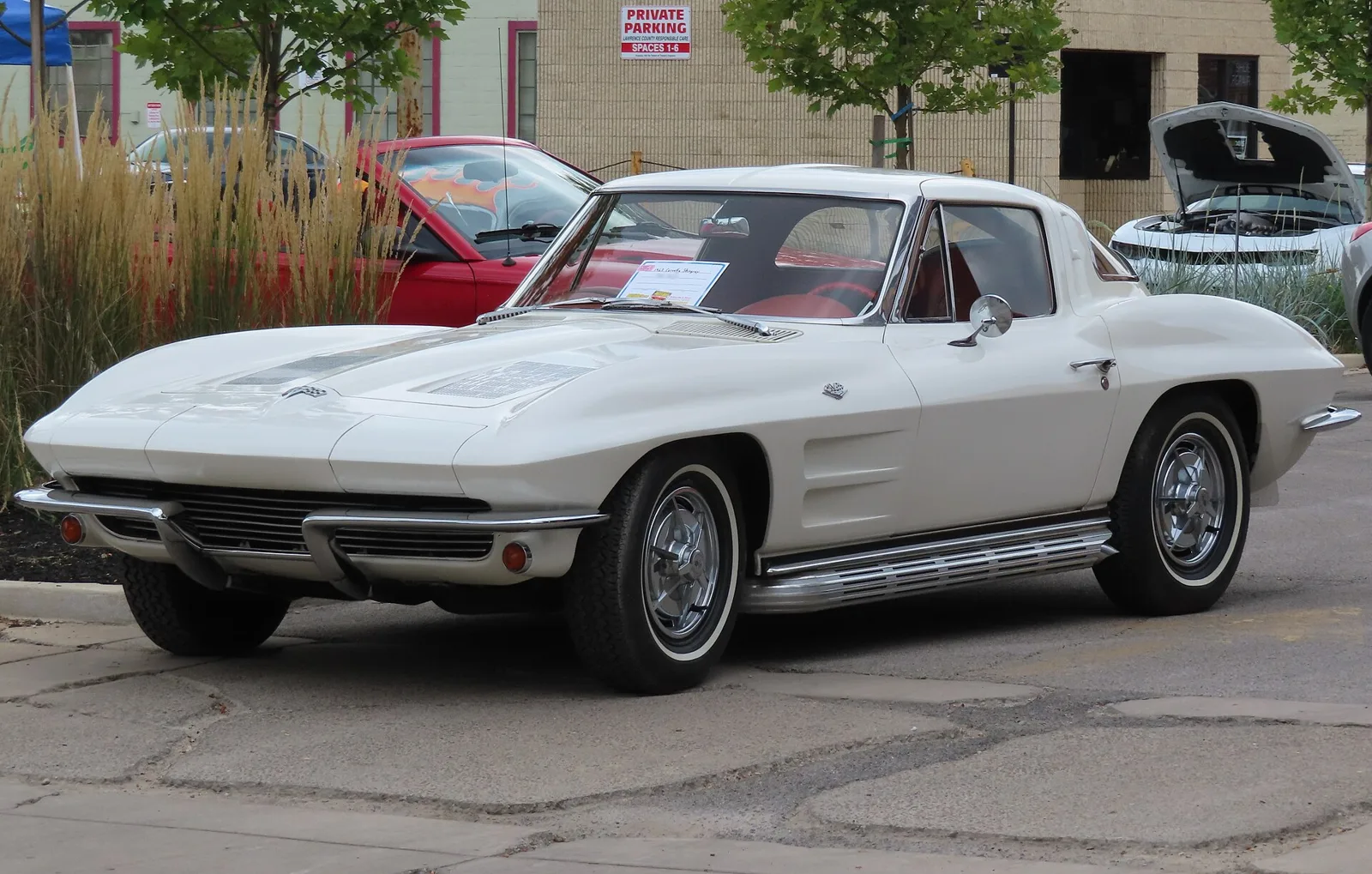
A split rear window, hidden headlamps, independent rear suspension and a 1967 L88 whose true output sat far above its advertised rating.
The Chevrolet Corvette C2, sold as the Sting Ray, was built from 1963 to 1967. Its split rear window, hidden headlamps, independent rear suspension and the 1967 L88 engine all came in that short run. Those changes were concentrated in the five model years of the generation.
The Chevrolet Corvette C2 was the second-generation Corvette, built by General Motors' Chevrolet division for the 1963 to 1967 model years. It was sold as the Sting Ray, a name that Bill Mitchell chose after an earlier racing car.
Where did the C2 come from?
Harley Earl's C1 package had run for 10 years when the Corvette's designers decided to move on. The C2 drew on several sources, including the 1957 Q-Corvette, the Sting Ray Racer of 1959 and the Jaguar E-Type. A Mako shark caught by Mitchell while deep-sea fishing was also cited as an inspiration.
Zora Arkus-Duntov explored mid and rear-engine layouts with the CERV I concept of 1959. A rear-engined Corvette progressed as far as a full-scale mock-up in 1958-60, but the experimental XP-720 project, begun in the fall of 1959, led directly to the C2.
A split rear window, hidden headlamps and a disc-braked chassis gave the Sting Ray its distinct identity.
How was the C2 engineered?
The C2 carried nearly twice as much steel support in its central structure as the previous Corvette. Thinner fiberglass offset the extra steel, so the finished car weighed a bit less than the old roadster. That balance kept the body close to the weight of the car it replaced.
Wind tunnel testing influenced the final shape for the first time in the Corvette's history. Both body styles were evaluated as production-ready 3/8-scale models at the Caltech wind tunnel.
The C2 program was directed by Ed Cole, Zora Arkus-Duntov and Bill Mitchell. Styling was led by Larry Shinoda, and Pete Brock was also instrumental in the design.
What did the C2 look like?
The coupe had a fastback body, a long hood and a raised windsplit running the length of the roof. Its quad headlamps sat in rotating housings that blended with the front end when closed. The result was a body that looked low and fast even when parked.
A space buck was completed by early 1960, and coupe styling was locked by April of that year. The split backlite predated the C2, because Harley Earl had used the same feature on the Golden Rocket show car.
The headlamps made the C2 the first American car so equipped since the 1942 DeSoto. Hidden headlamps stayed on the Corvette until the C6 debuted in 2005, and coupe doors were cut into the roof for easier entry on such a low car.
Hidden headlamps shaped the car's front end more than any other single feature. With the lamps closed, the nose read as a sharp-edged surface, and that look held for the whole run from 1963 to 1967.
Functional hood vents had been intended, but they were cancelled for cost reasons. Faux vents were kept in the hood and on the coupe's rear pillars instead.
What was inside the Sting Ray?
The dash echoed the twin-cowl motif used since 1958, but in a more practical form. Round gauges included a large speedometer and tachometer, and the control tower console returned with a clock and a vertically mounted radio. Everything was laid out for the driver's immediate use.
Luggage space was limited because there was no external trunklid, so cargo had to be loaded behind the seats. The deck emblem was hinged to double as the fuel filler flap.
How did the chassis change?
The C2 used faster recirculating ball steering and a shorter wheelbase to improve manoeuvrability. Its independent rear suspension, derived from the CERV I concept, used a transverse leaf spring and a frame-mounted differential. Both changes worked together on the handling.
Four-wheel 11-inch cast-iron drum brakes were standard. A hydraulic steering damper was added at the relay rod to soak up bumps before they reached the wheel.
The rear suspension was a clear break from the solid axle of the earlier Corvette. Its lighter weight cut unsprung mass, which mattered for how the wheels followed the road.
Steering ratio dropped to 19.6:1 from 21.0:1. Optional hydraulic power steering came at a 17.1:1 ratio.
Which engines did the C2 offer?
Drivetrains were carried over from the previous generation and built around the 327 cu in (5,360 cc) small-block V8. Carbureted engines produced 250 hp (186 kW), 300 hp (224 kW) and 340 hp (254 kW). All of them shared the same displacement.
The 360 hp fuel-injected V8 sat at the top of the chart and cost an extra $430.40. The Borg-Warner four-speed gave way to the Muncie M20 during the 1963 model year.
Option L79 in 1965 was a 350 hp small block with hydraulic lifters, and it could be ordered with power steering.
Engine choice in 1963 came down to power level. The carbureted 250 hp, 300 hp and 340 hp units formed a ladder, with the 360 hp fuel-injected V8 at the top of it.
The fuel tank grew to 20 US gal (76 L; 17 imp gal).
What happened to the Z06 at Daytona?
A special Z06 was prepared for the Daytona 250. It ran an experimental 427 cu in engine and weighed just over 2,800 lb (1,300 kg) after lightening. The Daytona 250 was a race for sports cars held at the famous oval.
Junior Johnson was due to drive the car, but the race was plagued by rain. Substitute driver Billy Krause finished third behind a Pontiac Tempest and A. J. Foyt in another Corvette.
Mickey Thompson prepared the car further and replaced the fiberglass Big Tank with a larger metal tank, which shows how far the Z06 was pushed beyond the production car.
How did the 1963 model sell?
Chevrolet built 21,513 units for 1963, up 50 percent on 1962. Production was split almost evenly, with 10,919 convertibles and 10,594 coupes. The 1962 model had been the record-setter, so the 1963 total pushed sales higher again in a year of new design.
The Z06 was an option package rather than a separate model, so buyers chose it from the order form with the rest of their options.
Options told a story about buyers. Power brakes went on 15 percent of production and power steering on 12 percent, while only 278 cars took air conditioning at $421.80.
Power brakes and power steering were the most widely ordered comfort options that year, ahead of air conditioning and leather.
Almost 18,000 Sting Rays left the factory with the four-speed manual gearbox, better than four out of every five cars built. Leather upholstery at $80.70 was ordered on 1,114 cars.
The coupe's place in the range shows up in the sales figures. Its share of output was close to the convertible's, but the open car remained the more popular choice in the years that followed.
Not until 1969 did the closed coupe outsell the convertible.
What was the Z06 package?
The Z06 package was a race-oriented option that Duntov first conceived in 1962. It was offered for the first time on the 1963 Corvette, and it cost $1,818.45 over the base coupe price of $4,252. The package was built for competition-minded buyers.
Under the hood, the Z06's only engine was the L84 327 cu in with Rochester fuel injection, rated at 360 hp (268 kW) with factory exhaust manifolds. The package also included a larger front anti-roll bar and a vacuum brake booster.
Only 199 Z06 Corvettes were produced. Their Big Tanks held 36.5 US gal (138 L) in place of the standard 20 US gal.
Did the Grand Sport reach production?
The Grand Sport was planned at 125 cars to make the model eligible for international Grand Touring racing. Only five were built, three coupes and two convertibles, before the program was stopped. The program was Duntov's initiative, begun in 1962, and it aimed at international Grand Touring races.
Dick Thompson won a race at Watkins Glen in Grand Sport 004 on 24 August 1963. Its engine was a 377 cu in all-aluminum small block rated at 550 hp (410 kW), and it was the most serious factory engine used in the program.
The Grand Sport was lightened in every way possible. Its frame was 94 lb (43 kg) lighter than the 1963 production frame, and the car weighed about 800 pounds less than the production coupe.
GM executives learned of the secret project, and the program was stopped. The cars that were built were therefore a small, hand-finished group rather than the 125-car run that had been planned.
What did the 1964 and 1965 model years add?
For 1964 the coupe's split rear window was replaced by a single arched piece of glass, and the fuel-injected engine was rated at 375 hp (280 kW). Sales that year reached 22,229 units, another record for the model. The year also brought a new set of option choices.
The 1965 Big-Block 396 cu in (6,490 cc) was rated at 425 hp (317 kW). That year Chevrolet also introduced four-wheel disc brakes with 461 sq in of swept area, against 328 sq in for the earlier all-drum system.
Drum brakes stayed available as a $64.50 credit option, and only 316 of 23,562 Corvettes had them. Only 771 fuel-injected cars were built in 1965 before that option was dropped.
How strong were the 1966 and 1967 engines?
The 1966 big-block came at 390 hp (290 kW) or 425 bhp, and the 427 cu in (6,993 cc) V8 produced 460 lb-ft (624 N-m) of torque. Estimates for the 427 went as high as 450 hp (336 kW), a reminder that advertised figures were not always the true output.
Sales rose to 27,720 units in 1966, up about 4,200 on 1965. The 1966 eggcrate grille insert replaced the horizontal bars of the earlier front end.
The 1966 Red/Red Automatic option, with power windows and air conditioning from the factory, was one of the rarest options. Records show that only 7 convertibles and 33 coupes were built with it.
A 1967 427 with Tri-Power was rated at 435 bhp (441 PS; 324 kW) at 5800 rpm. The L88 was advertised at 430 bhp, but the true rating was said to be about 560 bhp.
Running 103-octane racing fuel, the L88 used a 12.5:1 compression ratio. It cost $1,500 over the base $4,240.75 price, and only 20 buyers took one.
Sales for 1967, the last year of the second generation, totalled 22,940 units.
The 1967 car was the last of the second generation, and five years of refinements had made it the best of that line.
How did reviewers rate the C2?
Car Life gave the 1963 Sting Ray its Award for Engineering Excellence. Motor Trend tested a fuel-injected four-speed and measured 0-97 km/h (0-60 mph) in 5.8 seconds, with a 14.5-second quarter-mile. The quarter-mile figure was recorded at the same test.
The awards and road tests covered different ground. Car Life praised the engineering, while the magazines that timed the car measured its straight-line pace.
Road and Track clocked a 1964 coupe to 97 km/h (60 mph) in 8.0 seconds. Sports Car International later ranked the Sting Ray fifth on its list of the top sports cars of the 1960s, in 2004.
Chevrolet Corvette C2 specifications
| Specification | Detail |
|---|---|
| Model years | 1963 to 1967 |
| Small-block engine | 327 cu in (5,360 cc) V8, 250 to 360 hp |
| Big-block engines | 396 cu in (6,490 cc) at 425 hp (317 kW); 427 cu in (6,993 cc) |
| Steering ratio | 19.6:1, from 21.0:1; power steering 17.1:1 |
| Brakes | 11-inch drums to 1964; four-wheel disc brakes from 1965 |
| Z06 price | $1,818.45 over the base coupe price of $4,252 |
| Grand Sport | Five built; 377 cu in engine rated at 550 hp (410 kW) |
| 1963 production | 21,513 units |
| 1967 sales | 22,940 units |
| Z06 engine | L84 327 cu in with Rochester fuel injection, 360 hp (268 kW) |
| L88 (1967) | Advertised 430 bhp; true rating about 560 bhp |
| 1964 sales | 22,229 units |