How steering links the driver to the road, why rack and pinion took over, and how four-wheel and electronic systems are changing the wheel.
Steering lets the driver set a vehicle's heading, and in a car a linkage joins the wheel to the front tyres. Aircraft and ships rely on ailerons and rudders instead. Newer cars add power assistance, speed-dependent effort, four-wheel steering or electronic links with no mechanical connection at all.
Steering is the system that lets a driver control where a vehicle goes, and in a car it usually means turning the front wheels through a chain of rods, pivots and gears. Aircraft use ailerons, rudders and rotor tilt, while ships rely on rudders and tracked machines vary the speed of each track. The car's version has been refined over generations, from simple linkages to power assistance and electronics that may replace the mechanical link altogether.
What does steering do in a car?
Steering controls the direction of a vehicle's travel, and in cars it turns the front wheels through a linked mechanism operated by the steering wheel. Aircraft bank into turns with ailerons, while ships are steered with rudders. Modern car systems add power assistance, speed sensitivity, rear-wheel steering or a link that is entirely electronic.
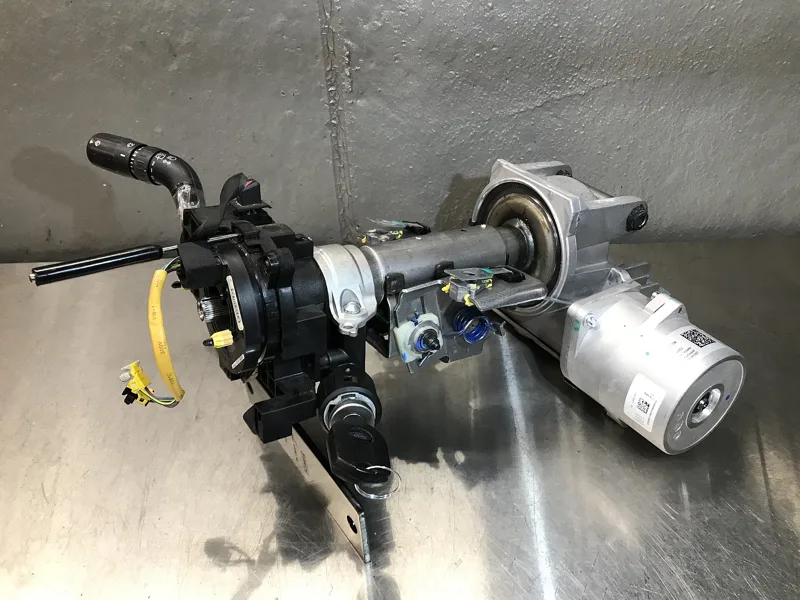
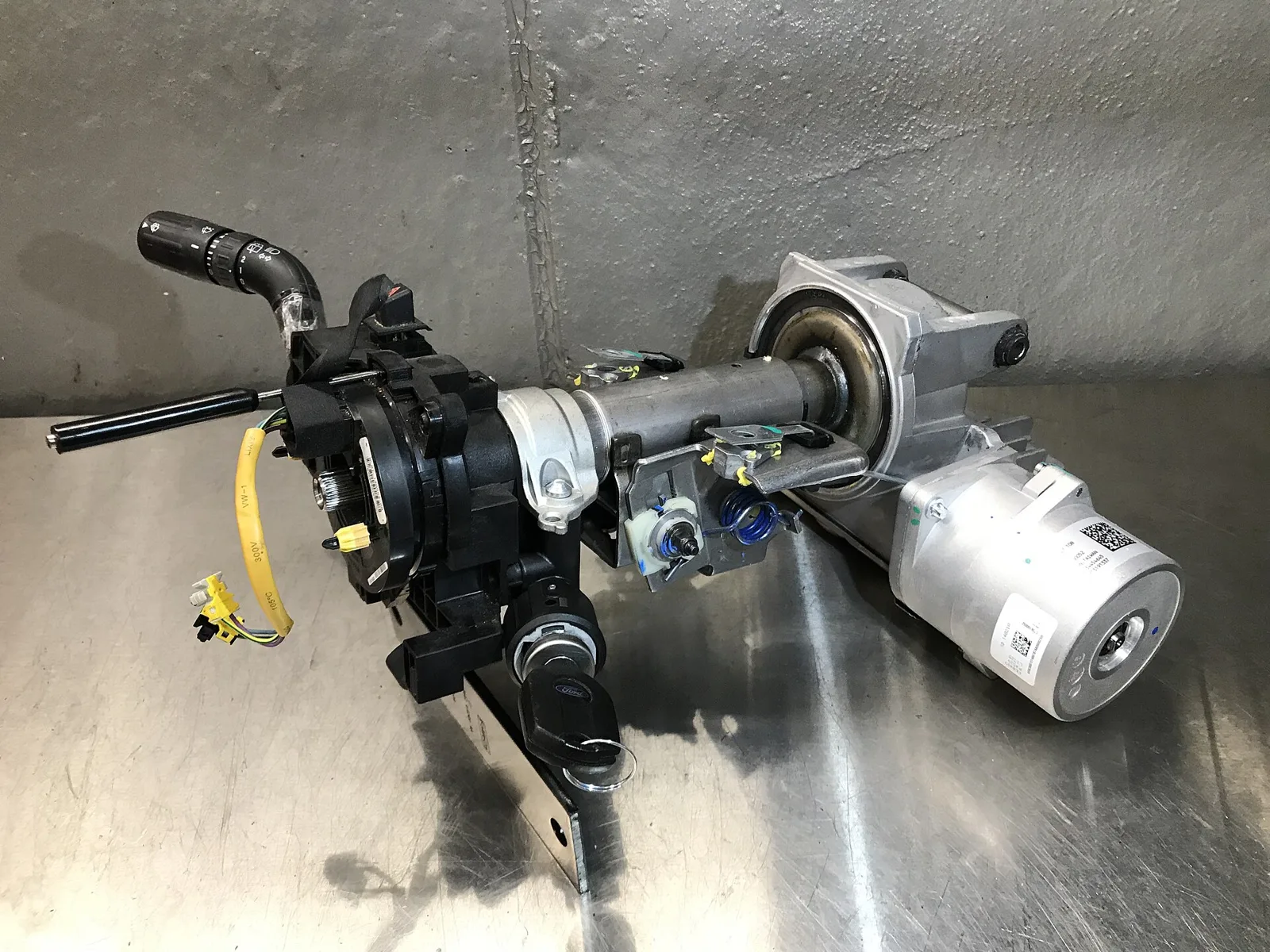
The steering wheel sits on a column connected to rods, pivots and gears. Those parts convert the rotation of the wheel into the sideways movement of the wheels. Helicopters work differently, using cyclic control to tilt the main rotor and an anti-torque control, often a tail rotor, to counter the spin.
Other arrangements turn up on less common vehicles. Tiller steering and rear-wheel steering appear on some machines, and tracked vehicles such as bulldozers and tanks use differential steering, where the tracks run at different speeds or in opposite directions.
Rack and pinion gave drivers a direct feel, and steer-by-wire may remove the link altogether.
How does a car steering mechanism work?
The main job of a car's steering is to point the wheels in the right direction, and it does that through linkages, rods, pivots and gears. Each wheel pivots about an axis set ahead of its contact patch, a layout called caster. That geometry tends to make the steering self-centring, so the car wants to return to a straight path once the driver lets go.
In a turn the inner wheel follows a tighter path than the outer one, and a single toe setting cannot suit both straight running and cornering. Steering linkages therefore usually follow a version of Ackermann geometry, which arranges the wheels so that each one turns through the right angle. Camber, the angle of the wheel in the vertical plane, also changes how the steering feels, and the tyres play a part too.
Steering effort and speed are often described in terms of lock-to-lock, which counts how many full 360-degree turns the wheel makes from one mechanical stop to the other. That figure tells a driver how quickly the car changes direction, and it is set by the mechanism's gearing.
What steering mechanisms are used?
| Mechanism | How it works | Typical use |
|---|---|---|
| Rack and pinion | A pinion gear on the wheel shaft moves a toothed rack that steers the wheels through tie rods | Most modern cars |
| Recirculating ball | A screw and nut run on recirculating balls, with a sector gear moving the pitman arm | Trucks and utility vehicles |
| Worm and sector | A worm drives a sector gear, with rollers or pins reducing friction | Older cars such as the Ford Falcon of the 1960s |
| Cable and bellcrank | Direct linkage or cables steer the wheels | Toys, go-karts and home-built vehicles |
Why did rack and pinion replace recirculating ball?
Rack and pinion converts the circular motion of the steering wheel into linear motion at the rack, which then moves the wheels through tie rods and a steering knuckle. Its great advantage is a direct feel, letting the driver sense the road and control the car with more precision. BMW adopted rack and pinion in the 1930s, and European makers followed, with US manufacturers arriving later with the 1974 Ford Pinto.
Recirculating ball had its own strengths. It gives more mechanical advantage, which suited larger and heavier vehicles, and it is still used on trucks where robustness and maintainability matter more than feel. Its weakness is a perceptible dead spot on centre, where a small turn of the wheel does not move the wheels. That can be adjusted for wear, but it cannot be eliminated without causing excessive internal forces.
Older designs also used the worm and sector, which appeared on Willys and Chrysler vehicles and on the Ford Falcon in the 1960s. The shift to rack and pinion was not strict, and some British sports cars of the mid-1950s already used it, while some German carmakers kept recirculating ball into the early 1990s.
How does power steering assist the driver?
Power steering uses an external energy source to help swivel the road wheels. It became necessary as cars grew heavier, moved to front-wheel drive and adopted wider, larger tyres. Most systems are hydraulic or electric, and the same vehicle can carry a hybrid of the two. Some form of mechanical linkage always remains as a fail-safe.
A hydraulic power steering system uses pressure from an engine-driven pump to assist the wheel. Electric power steering is more efficient, because the motor only works when the wheel turns, while the hydraulic pump runs constantly. Electric assistance is also easy to tune for vehicle type, road speed and driver preference, and it removes the hazard of leaking fluid.
Hydraulic assistance stops when the engine stops, which leaves the driver fighting the weight of the system as well as the wheel. Electric assistance is not lost in the same way. Speed-sensitive systems go a step further by reducing assistance as speed rises, a feature first seen on the Citroen SM and its DIRAVI system in 1970, and used on the Tesla Cybertruck in 2023.
Which cars steer their rear wheels?
Four-wheel steering improves response, helps stability at high speed and tightens the turning circle at low speed. In active systems a computer and actuators steer the rear wheels, and at low speed they turn opposite to the fronts. At higher speeds they turn with the fronts, helping the car change lanes with less yaw.
Mazda was an early pioneer, showing electronic four-wheel steering on the 1984 Mazda MX-02 concept, and then offering the system on the 626 and MX6 in 1988. The Peugeot 405 Turbo 16 was the first rally car to use the technology, debuting at the 1988 Pikes Peak hill climb. Honda offered mechanical four-wheel steering on the Prelude from 1987, later upgrading to electronic control.
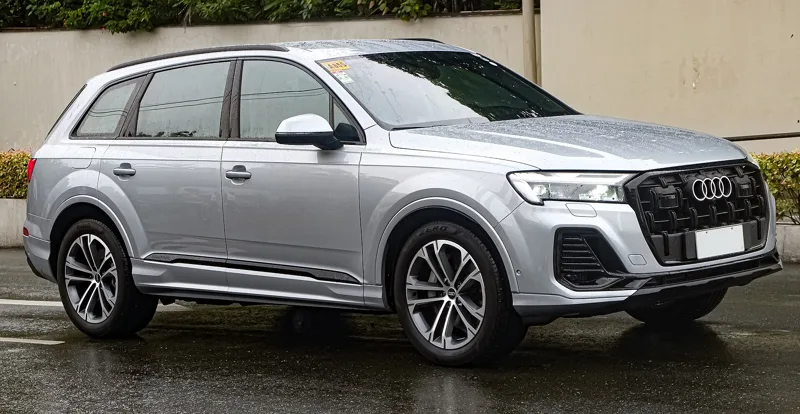
Other manufacturers followed. BMW offered Integral Active Steering on the 7 Series in 2001, and Renault introduced its 4control system in 2009 on the Laguna GT. Porsche made four-wheel steering standard on the 911 Turbo in 2013, and the Audi Q7 offered a system from its 2014 launch. Ferrari and Lamborghini adopted it in 2016-17 on models including the F12tdf and Aventador S. General Motors ended its Quadrasteer system after the 2005 model year, because of high cost and low demand.
What are the other steering arrangements?
Crab steering is a special form of active four-wheel steering in which all wheels turn in the same direction and by the same angle. It lets a vehicle travel straight at an angle, which is useful when changing lanes at speed, moving loads with a reach truck or filming with a camera dolly.
Passive rear steering uses the lateral forces in a corner, together with suspension geometry and bushings, to steer the rear wheels slightly inward. That improves stability through a turn, and the effect exists on almost every suspension in some form. Articulated steering takes a different route, splitting the vehicle with a vertical hinge and using hydraulic cylinders to change the angle between the halves. Articulated haulers are prized for their off-road performance.
Some vehicles steer only with the rear wheels. Fork lift trucks, camera dollies, early payloaders, Buckminster Fuller's Dymaxion car and the ThrustSSC all used this approach. Rear-only steering is useful for tight manoeuvring, but naive designs tend to oversteer and become unstable at speed, so it is usually confined to slower vehicles.
What is steer-by-wire?
Steer-by-wire replaces the mechanical link between steering wheel and road wheels with electronic signals and actuators. Its goal is to remove as many mechanical parts as possible, such as the steering shaft, column and gear reduction. The first production car to offer steer-by-wire without a column was the Nissan Infiniti Q50 in 2013, which later continued on the QX50, QX55 and Q60 coupe.
The benefits are practical. Without a column the cabin can be redesigned more freely, the engine bay gains space, and the steering can be built as a single modular unit. Steering response and feel can be adjusted in software. Because there is no mechanical link to the wheel, a frontal crash is less likely to drive the wheel into the driver.
Several battery electric vehicles of the 2020s offer steer-by-wire with no column, including the Canoo Lifestyle Vehicle, the Lexus RZ 450e, the Toyota bZ4X and the Tesla Cybertruck. Lotus, Peugeot and Mercedes-Benz planned to bring steer-by-wire cars in the late 2020s.
How do steering columns protect drivers?
Traditional cars use a collapsible steering column that gives way in a heavy frontal impact, along with airbags as standard. Older non-collapsible columns often impaled drivers, particularly when the steering box or rack sat in front of the front axle line. Many modern steering boxes and racks now sit behind the front axle, at the back of the crumple zone.
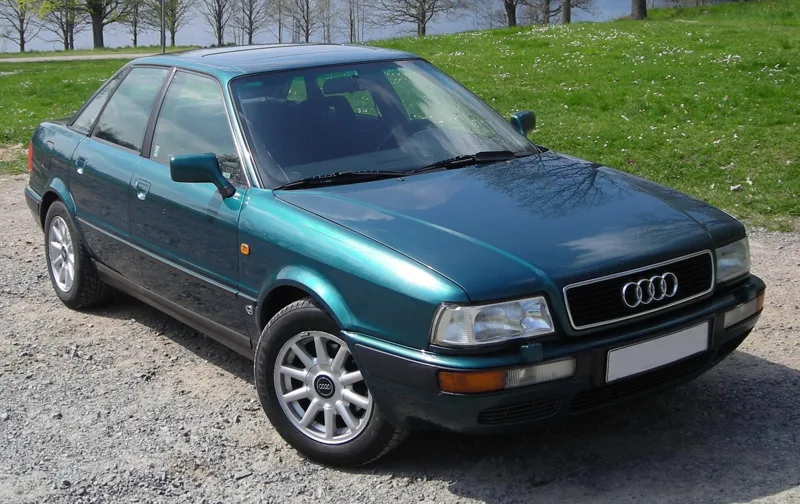
Bela Barenyi invented the collapsible column, and it arrived with crumple zones on the 1959 Mercedes-Benz W111 Fintail. The feature first appeared on General Motors cars after an extensive public lobbying campaign led by Ralph Nader, and Ford began installing collapsible columns in 1968. Audi once used a retractable steering wheel and seat belt tensioning system called procon-ten, but that was later dropped in favour of airbags and pyrotechnic belt pre-tensioners.
How are steering systems regulated?
Vehicle steering is covered by UNECE regulation 79 in the European Union, Russia and Japan. In the United States, Federal Motor Vehicle Safety Standards 203 and 204 deal with driver impact from the steering control system, and 49 Code of Federal Regulations 393.209 covers steering wheel systems. Those rules shape how steering is designed and tested, rather than how it works day to day.
North America allows hands-off level-2 systems, and General Motors' Super Cruise is one example. Those designs raise warnings when the driver stops paying visual attention. European hands-on systems behave differently. Under UNECE regulation 79 they require a driver to hold the wheel, and if both hands come off, an optical warning appears after 15 seconds and an acoustic warning follows 15 seconds later. Assisted steering then switches off after a further 30 seconds.
In the United Kingdom drivers must control the vehicle at all times. The Highway Code tells drivers to keep both hands on the wheel where possible, and to follow the manufacturer's instructions for any driver assistance system.
How do bicycles and boats steer?
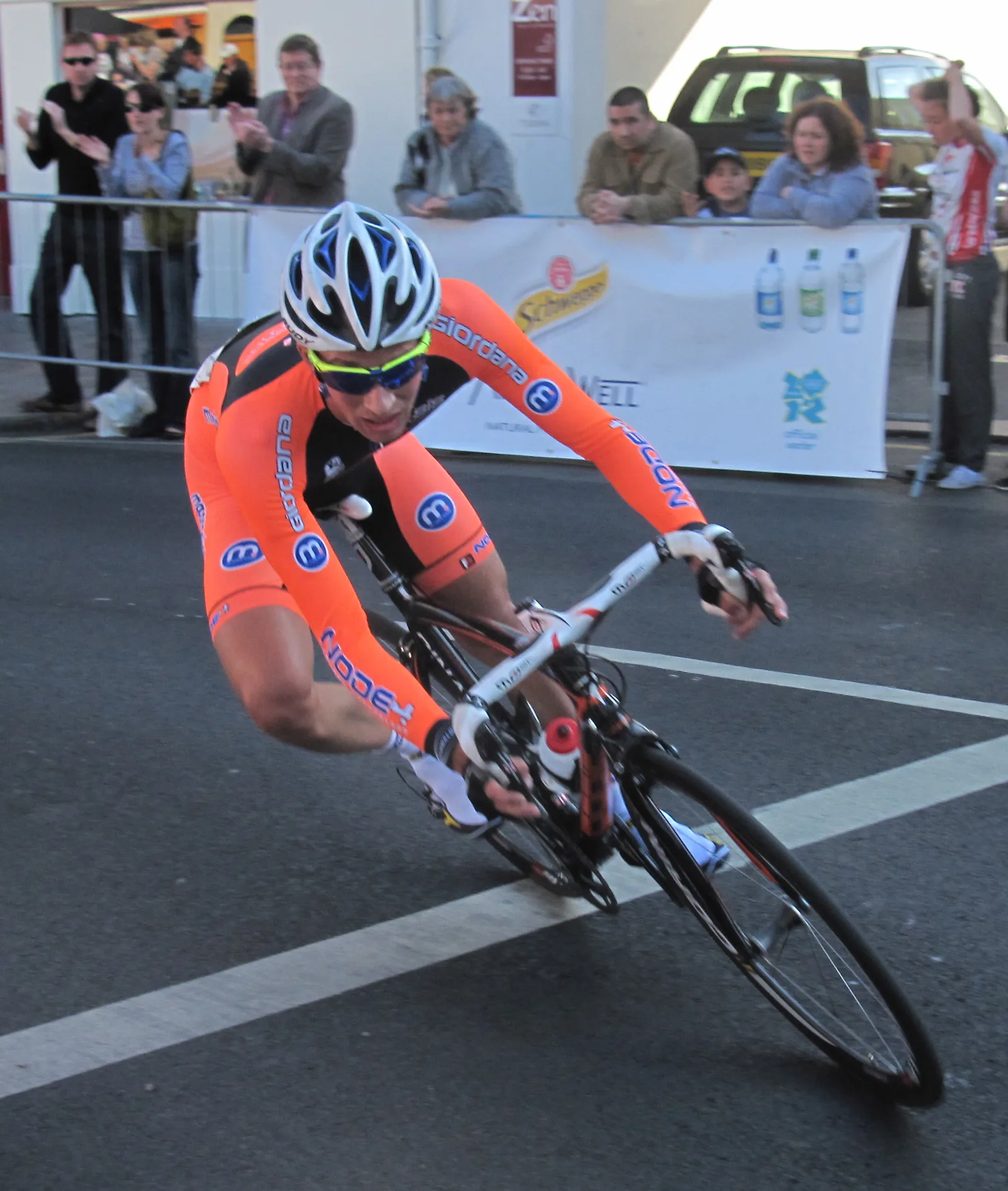
Bicycles steer in two ways at once: the rider turns the handlebar, and the rider leans the frame. Turning the bars rotates the front wheel relative to the rear, and friction at the contact patch supplies the lateral force. Leaning moves the rider and bike away from the ground contact line, and gravity then pulls the machine into the turn.
Motorcycles add countersteering. A rider briefly turns the bars the opposite way to lean the machine into a corner, which is almost unnoticeable at walking pace but large and deliberate at speed. Tilting three-wheelers use similar techniques, while rigid three-wheelers steer more like cars and may need differentials.
Ships and boats are usually steered with a rudder, and the rudder only works when water flows over it. A vessel that is not moving through the water, or cannot move its rudder, is said to have lost steerage and no longer responds to the helm. Outboards steer by rotating the whole drive unit, while diesel-electric ships may use azimuth thrusters. Jet skis steer by shifting weight and vectoring their water jet.