How Unsafe at Any Speed took on General Motors, why the rear-engined Corvair became its best-known case, and what the 1972 government tests said about it.
Ralph Nader argued in his 1965 book that car makers resisted safety features and spent little on safety, using the rear-engined Chevrolet Corvair as his lead case. GM harassed him, Congress passed the 1966 federal vehicle safety act, and a 1972 government report cleared the early Corvair.
In March 1966 the president of General Motors, James Roche, stood before a United States Senate subcommittee and apologised to a young lawyer. The lawyer was Ralph Nader, the occasion was a campaign of harassment aimed at him, and the cause was a book called Unsafe at Any Speed.
What did Ralph Nader argue in Unsafe at Any Speed?
Nader's central claim was that car makers resisted fitting safety features such as seat belts and were generally unwilling to spend money on safety. Published in 1965 under the subtitle The Designed-In Dangers of the American Automobile, the book drew on material from industry insiders and became a non-fiction best seller in 1966.
Born in Winsted, Connecticut, on 27 February 1934, Nader was the son of Lebanese immigrants, and he studied at Princeton and then Harvard Law School, graduating in 1958. He was admitted to the bar in 1959 and practised in Hartford, and in 1964 moved to Washington as a consultant to Daniel Patrick Moynihan, then an Assistant Secretary of Labor. He had quickly developed an interest in vehicle designs that raised the odds of crashes and deaths. For the book he read through the case files of over a hundred suits that were waiting to be heard against the Corvair.
Cosmetic changes added about $700 to a new car, Nader said, while safety got about twenty-three cents.
What else was in the book besides the Corvair?
The Corvair filled the first chapter, but the book ranged much wider. Across eight chapters it covered glare from glossy dashboards, confusing gear selectors, what happens to a body inside a crashing car, air pollution, engineers' priorities, styling, and the habit of blaming the driver.
Chapter two went after details that sound small until you imagine them at speed. Chrome and glossy enamel on dashboards could throw sunlight or oncoming headlights into the driver's eyes, a hazard Nader said was well known in the industry. Early automatic gearboxes from General Motors, Packard and Borg-Warner laid out the selector as P N D L R, which put Reverse next to Low. Because it was hard to tell by feel which one the lever was in, drivers who wanted Reverse could shoot forwards, while others who wanted Low went too far and rammed walls or buildings. The Powerglide automatic that Chevrolet fitted to the Corvair ran R N D L, and Ford was the first to adopt P R N D L, which eventually became the pattern for every automatic.
Chapter three dealt with what Nader called the second collision, the moment when a person's body hits the inside of the car after the car has hit something else. He argued that designers already had much of the knowledge they needed by the early 1960s and largely ignored it, and he discussed the steering assembly, instrument panel, windshield, restraints and passenger compartment, from door strength to roll-over bars. A reinforcement for doors came to be nicknamed the Nader bolt. Chapter four turned to smog, with a particular look at Los Angeles.
The next three chapters were about money and attitude. Detroit's engineers, Nader said, were reluctant to push for safety for fear of scaring buyers or making cars dearer. He set annual cosmetic changes at an average of about $700 on the price of a new car, which is equivalent to $7,200 in 2025, against roughly twenty-three cents per car spent on safety, or $2.35 in 2025. He picked at 1950s styling too, arguing that sled-runner bumpers and sloping grilles raised the potential for pressing a pedestrian down and under the car. Chapter seven took apart the road-safety slogan of the Three E's, Engineering, Enforcement and Education, which the book says the industry invented in the 1920s to draw attention from the vehicle itself. It noted that some cars left the factory on tyres that could not carry a fully loaded vehicle, and that in 1965 the federal government set aside 320 million dollars for highway beautification and just $500,000 for highway safety. The closing chapter argued that government should force the industry to pay more attention.
What was the Chevrolet Corvair?
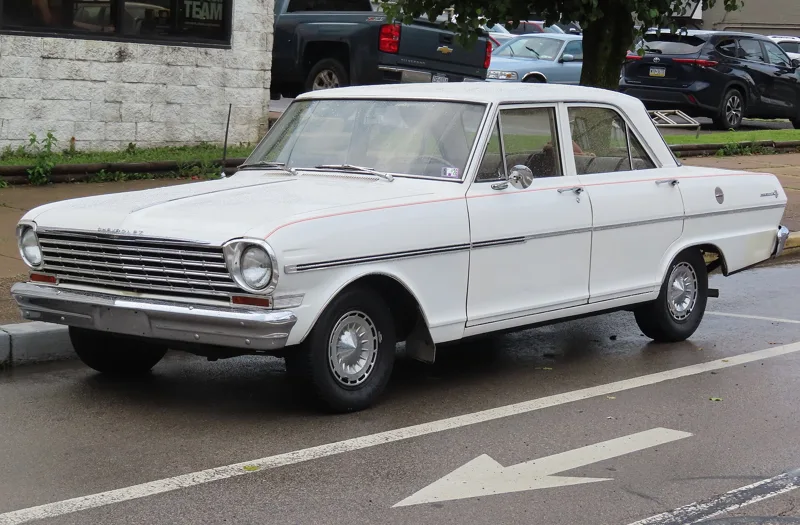
The Corvair was a rear-engined, air-cooled compact built by Chevrolet over two generations, from the 1960 to the 1969 model years. It was a response to the rising popularity of small, fuel-efficient cars, notably the Volkswagen Beetle, and 1,835,170 were built in all.
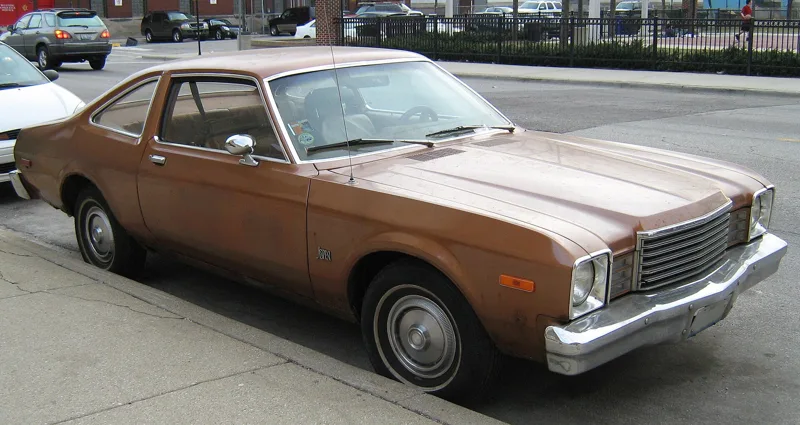
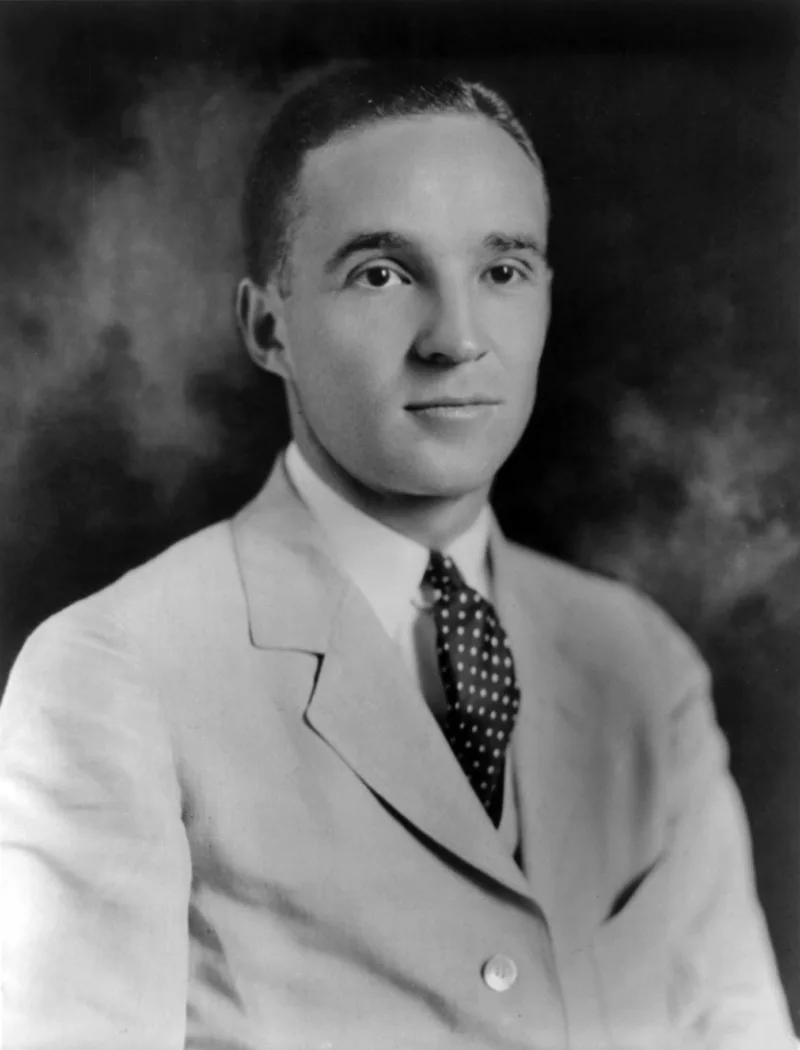
Ford and Chrysler answered the small-car trend with the Falcon and the Valiant, scaled-down versions of conventional cars with inline six-cylinder engines and bodies about 20% smaller than their full-size cousins. General Motors went another way. Ed Cole, who became general manager of Chevrolet in July 1956, was behind the Corvair, which carried an air-cooled, horizontally opposed flat-six with many aluminium parts, mounted at the back and sending power to the rear wheels via a compact transaxle. It had independent suspension at all four corners, unibody construction, wider low-profile tyres on wider wheels, and clean, boxy styling with no tail fins and no grille.
Production began in July 1959 at Willow Run, and the official launch came on 2 October that year. Chevrolet priced the car under $2,000 as an economy compact, and the first 500 Series sedan listed at $2,038. The original engine was an 80 hp (60 kW; 81 PS) 140 cubic inch (2.3 litre) flat-six, later enlarged, with a turbocharged Corsa version offering 180 hp (134 kW; 182 PS) in 1965 and 1966.
The reception was warm. Time put Cole and the 1960 Corvair on its cover and Motor Trend named it Car of the Year for 1960. Chevrolet sold 26,000 in the first two days, taking more than 35% of the 75,000 Chevrolets sold across those two days. New-car faults followed, among them a fan belt that popped off its pulleys, carburettor icing, fuel economy that sometimes ran well under 20 mpg, and a petrol-burning heater. Then the Monza trim, with bucket seats and a four-speed floor shift, changed the car's character: nearly 110,000 Monza club coupes were built in 1961, and magazines sometimes called the model the poor man's Porsche. More than 200,000 Corvairs were sold in each of the first six model years.
Why was the Corvair's rear engine and suspension controversial?
Nader's attack centred on the early cars, built from 1960 to 1963, which used a swing-axle rear suspension. According to the book, that layout could tuck under in certain circumstances, with the rear wheels folding beneath the car.
The book also described a tyre-pressure problem. Chevrolet specified 15 psi at the front and 26 psi at the rear when the tyres were cold, and 18 and 30 psi when hot. If an owner inflated all four equally, as was normal practice for every other car of the day, the result was dangerous oversteer, meaning the tail of the car lost grip before the front. The pressures were outside the tolerances recommended by tyre makers, and Nader said owners and salespeople were not properly warned. He also pointed to the Tire and Rim Association's standards, under which those pressures overloaded the front tyres whenever two or more people were on board.
The sharpest detail in the chapter involves a mechanic. George Caramagna, who worked on the suspension, proposed fitting a stabiliser bar, also called an anti-roll bar, and GM management overruled him. Leaving it out saved money, and the pressure differential was the workaround. An unadvertised at-cost option, number 696, did give buyers stiffer springs and dampers, a front anti-roll bar and rear-axle rebound straps.
| Model years | Rear suspension | Anti-roll protection |
|---|---|---|
| 1960 to 1963 | Swing axle, prone to tuck-under | No standard front bar; option 696 at cost |
| 1964 | Modified, with transverse-mounted rear spring | Front anti-roll bar fitted as standard |
| 1965 onwards | Redesigned four-link independent system holding wheel camber constant | Tuck-under tendency eliminated |
How did General Motors respond to Nader?
The book sold at once, and GM tried to discredit its author. It tapped his telephone looking for damaging material and, when that produced nothing, arranged for women to approach him in the hope of catching him in a compromising situation. A court description of the campaign also lists interviews with his acquaintances, surveillance in public places and threatening phone calls.
Nader, working as an unpaid consultant to Senator Abe Ribicoff, told the senator he thought he was being followed. Ribicoff convened an inquiry, and Roche admitted under oath that GM had engaged a private detective agency to look into Nader. Roche apologised to the Senate subcommittee on 22 March 1966.
Nader sued GM for invasion of privacy in November 1966 and received $425,000, which he used to found an advocacy organisation.
Some people inside GM took his side. John DeLorean, a former executive and general manager of Chevrolet, wrote in his 1979 book that he thought the criticisms were valid in light of the rigidity and short-sightedness of GM's corporate culture. Author Mike Knepper, in The Corvair Affair of 1982, argued instead that executives never meant the harassment to go so far and wanted only routine background on a critic, and that the investigators' brief swelled as it passed along, like a game of telephone.
How did Unsafe at Any Speed change car safety regulation?
A year after the book appeared, Congress passed the National Traffic and Motor Vehicle Safety Act without a single dissenting vote. Senate hearings prompted by it led to the United States Department of Transportation in 1966 and to the forerunners of the National Highway Traffic Safety Administration in 1970. Seat-belt laws followed in 49 states, all but New Hampshire.
The House Speaker, John William McCormack, credited the law to one man with a crusading spirit who believed he could make a difference. Nader did not stop there. In 1968 he gathered seven volunteer law students, whom the Washington press corps nicknamed Nader's Raiders, and sent them to look into the Federal Trade Commission. Their report called the agency ineffective and passive, an American Bar Association investigation followed, and Richard Nixon revitalised the body. Public Citizen came in 1971, and the Center for Auto Safety went on to publish an annual consumer guide, The Car Book, for 40 years. Two of his most notable targets were the Corvair and the Ford Pinto, and his lobbying helped bring about both the Environmental Protection Agency and the Clean Air Act.
Was Nader right about the Corvair?
The answer from the government's own testing was no, at least for the early cars. In 1971 the National Highway Traffic Safety Administration compared a 1963 Corvair with a Ford Falcon, a Plymouth Valiant, a Volkswagen Beetle and a Renault Dauphine, plus a second-generation Corvair with revised suspension. A panel of three independent engineers reviewed the work and concluded that the 1960 to 1963 Corvair compared favourably with the other cars, with no abnormal potential for loss of control or rollover. The Department of Transportation issued the findings on 12 August 1972, more than three years after production had ended. Texas A&M University is also credited with carrying out the work for the agency.
Critics added to that. The economist Thomas Sowell contended that Nader dismissed the trade-off between safety and affordability, and that he failed to mention how far death rates per 100 million passenger miles had fallen, from 17.9 in 1925 to 5.5 in 1965. Journalist David E. Davis wrote in 2009 that Nader had concentrated on the Corvair while ignoring other swing-axle cars from Porsche, Mercedes-Benz and Volkswagen. Yet shortly before the 1972 report, Nader's Center for Auto Safety put out a book attacking the Beetle, titled Small - On Safety. In 2005 the conservative publication Human Events gave the book an honorable mention when ranking the most harmful books of the 19th and 20th centuries.
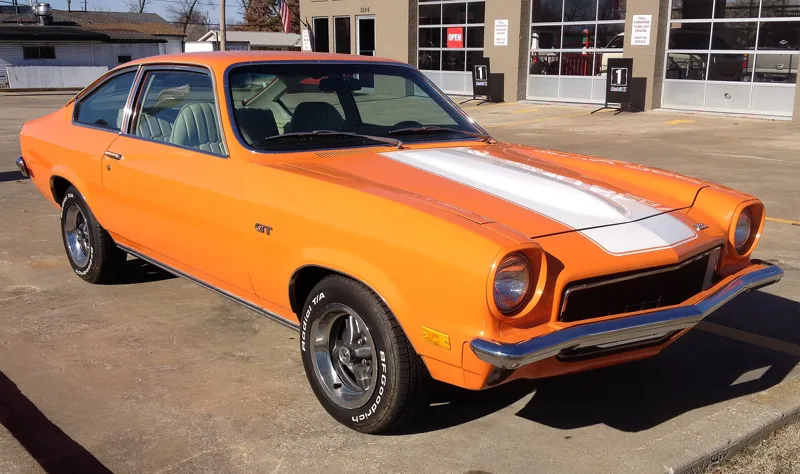
The Corvair itself kept selling to the end of the decade. Chevrolet replaced it in 1970 with the more conventional Vega, a car aimed at the Beetle and at imports from Japan like the Datsun 510.
Where the argument went next
The book still gets cited as a pattern for later fights. It addressed what Nader saw as the car industry's lobbying against new safety features, which resurfaced in the 1990s over mandatory airbags in the United States and again when the European Automobile Manufacturers Association sought to hold back crash testing across the European Union.
Nader himself moved into politics. He made four runs at the presidency: for the Green Party in 1996 and 2000, then as an independent in 2004 and 2008. In 2000 he won nearly three million votes. A documentary on his life, An Unreasonable Man, debuted at the Sundance Film Festival in 2006.