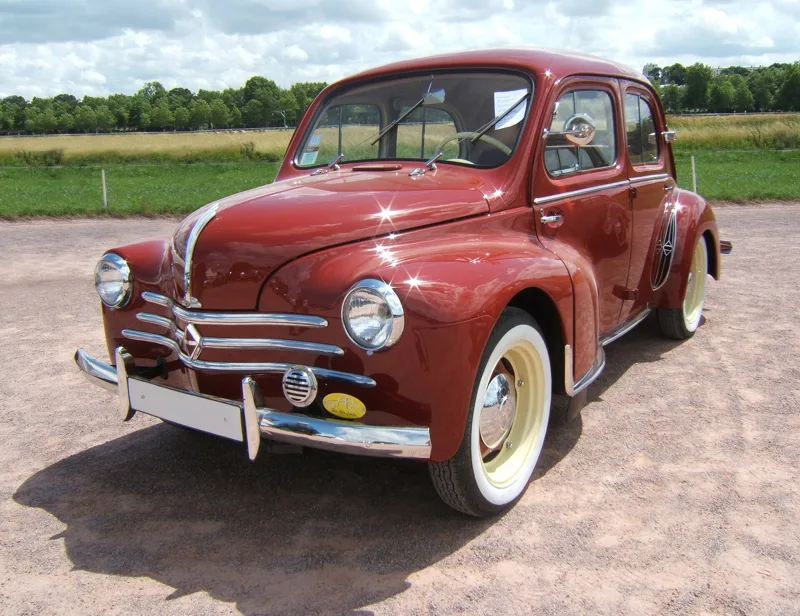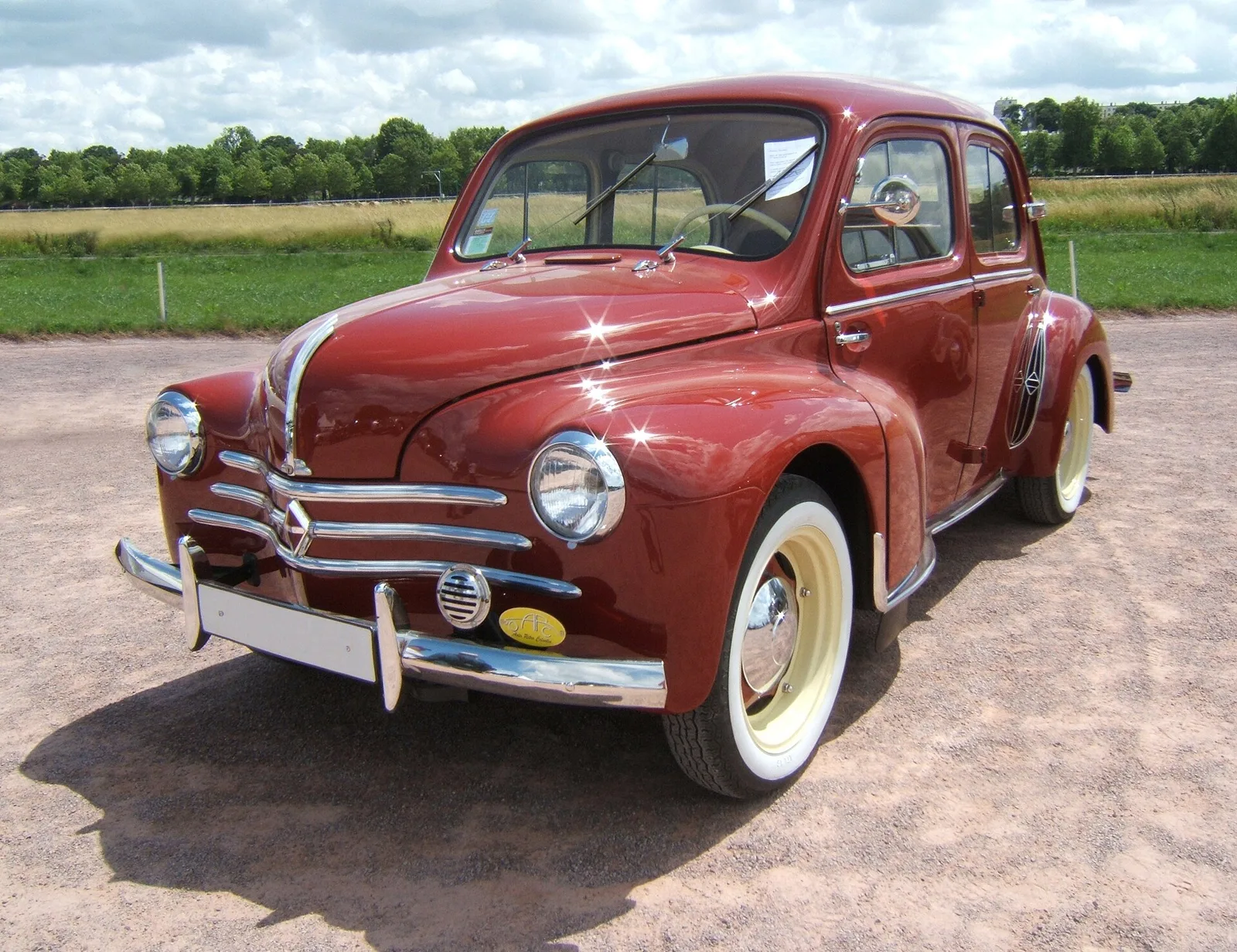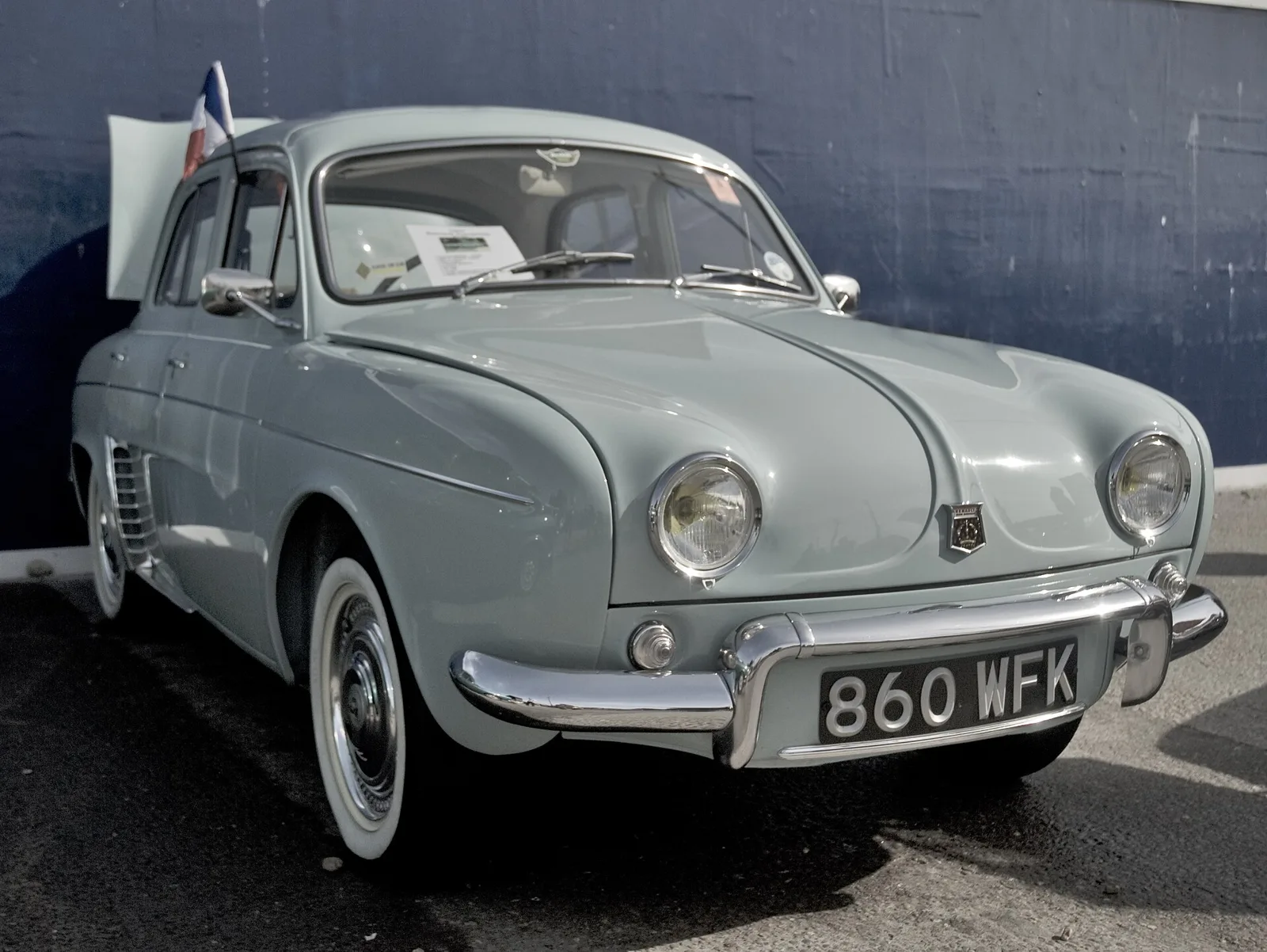
Renault's 1956 four-door rear-engined economy car reached more than two million units and was built under licence across four continents.
The Renault Dauphine was a rear-engined four-door economy sedan sold from 1956 to 1967, powered by an 845 cc four-cylinder engine. Renault built more than two million of them, and licensed plants in several countries made many more, so it became one of the defining economy cars of its period.
The Renault Dauphine was a rear-engined, rear-wheel-drive four-door sedan that Renault sold as an economy car from 1956 to 1967. Alongside the Citroen 2CV, the Volkswagen Beetle, the Morris Minor, the Mini and the Fiat 600, it helped define the modern European economy car. More than two million were manufactured, and many more were built under licence in other countries.
Why did Renault develop the Dauphine?
Renault's chairman Pierre Lefaucheux kept the company in car manufacturing even when the postwar French ministry wanted it to concentrate on trucks. His success with the 4CV, which passed 500,000 units by 1954, convinced him that French buyers would soon need something bigger for their rising living standards.
The Dauphine was conceived in a conversation between Lefaucheux and the engineer Fernand Picard. They agreed that the 4CV suited its time, but that a larger car would be needed as the French autoroute network grew. Engineering began in 1949 under the internal name Project 109.
A 1951 survey set the design targets. The car needed a top speed of 110 km/h (68 mph), seats for four and fuel use below 7 L/100 km (40 mpg-imp; 34 mpg-US). The same survey found that women held stronger views on car colours than on the cars themselves, a finding that later shaped the Dauphine's palette.
A rear-engined economy sedan that reached two million units and started Renault's export ambitions.
How did the Dauphine move from prototype to production?
Engineers finished a one-eighth scale clay model within the first year, then built a full-size clay model and wooden interior mock-ups. The first metal prototype was tested in secret at night, beginning on July 24, 1952 at Lardy, where the team also measured speed, braking, fuel use and durability.
By August 1953 an almond-green prototype had been delivered to Madrid for dry-condition testing. It covered 2,200 km (1,400 mi) with only five flat tyres and a generator failure. Lefaucheux then ordered a direct test against a Volkswagen Beetle, which exposed high noise levels, weak ventilation and too little engine capacity.
The original four-cylinder engine displaced 748 cc, which the team considered too small. Increasing the bore to 58 mm lifted the capacity to 845 cc, and the car picked up the informal name 5CV. A second series of prototypes incorporated the updates in 1954, and older prototypes were used for crash testing.
Lefaucheux did not live to see production. He died on February 11, 1955, when his Renault Fregate rolled on an icy road. The Flins factory was renamed in his honour, and Pierre Dreyfus took over the project. Across all testing the team covered more than two million kilometres, from Norway's Arctic Circle to Sicily.
How did the Dauphine get its name?
Renault considered calling the car Corvette, but the Chevrolet Corvette made that name risky because of a possible clash with General Motors. The team chose a name that tied the car to the earlier 4CV, which had helped rebuild French industry after the war.
The final name came from a dinner at Port-Royal, where a guest remarked that the 4CV ruled the road and any newcomer had to be the Dauphine. The word is the feminine form of the French title for the heir to the throne.
How was the Dauphine's engine and transmission set up?
The Dauphine used an enlarged version of the 4CV's water-cooled Ventoux engine, with capacity rising from 760 cc to 845 cc. Power climbed from 19-32 hp (14-24 kW), and engine cooling came from air intakes behind each rear door and a vented rear panel.
The car was 12 in (300 mm) longer than its predecessor and used a monocoque body with longitudinal box sections and cross-bracing. The rear-hinged doors of the 4CV were dropped in favour of conventional front-hinged doors that opened from the normal side.
Renault offered a three-speed manual with synchromesh on second and third gear, and first gear gained synchromesh in October 1961. A semi-automatic clutch arrived in 1957, followed in 1963 by a Jaeger electro-mechanical automatic controlled by five dash-mounted push-buttons.
How did the Dauphine's rear suspension behave?
The front suspension used coil springs and wishbones, with an anti-roll bar and rack-and-pinion steering. The rear was a high-pivot swing axle with coil springs and telescopic dampers mounted atop the swing tubes, which Renault called trumpet casings.
About 61 percent of the car's weight sat over the rear wheels. The swing axle could allow large camber changes in fast corners, leading to oversteer. Renault countered this with a front anti-roll bar and a tyre pressure difference, but owners could undo the benefit by over-inflating the front tyres.
In 1960 Renault revised the car with extra rubber springs at the front and auxiliary air springs at the rear. Marketed as Aerostable, the system gave the rear wheels a little negative camber and more cornering grip.
How did the Dauphine look and feel inside?
The styling was a scaled-down version of the Fregate, and Renault asked Luigi Segre of Ghia for help in June 1953, especially with the engine air intakes at the rear doors. The boot lid hinged at the front and carried the headlamps, opening onto a 7 cu ft (200 dm3) luggage area.
Inside, the car had adjustable front bucket seats, a rear bench, a heater and a painted dashboard matching the body colour. Twin open bins took the place of glove boxes, and the car offered a choice of two horns, one for town and one for country.
Who chose the Dauphine's colours?
The textile artist Paule Marrot joined the Dauphine team at Lefaucheux's invitation, after a letter complaining that postwar Paris cars were a dull parade. She set up a laboratory to test fabric and paint wear, and proposed brighter body and interior colours.
Her palette included Rouge Montijo, Jaune Bahamas, Bleu Hoggar and Blanc Reja, and her team developed complementary fabrics for the seats and door panels. Marrot also designed the three dolphins over a crown emblem, which appeared on the steering wheel and bonnet throughout production.
Which versions of the Dauphine did Renault sell?
The Ondine was an upmarket version introduced in 1961 and offered for two years, with a four-speed gearbox. The Gordini variants were tuned by Amedee Gordini to 37 hp (27.2 kW), and four-wheel disc brakes arrived from 1964.
The 1093 was a factory racing model, with 2,140 cars homologated. Tuned to 55 hp (41 kW) with a twin-barrel carburettor and a four-speed gearbox, it could reach 140 km/h (87 mph). Those cars were painted white with two thin blue stripes running down the bonnet, roof and boot.
Renault also sold a Brazilian simplified model called the Teimoso from 1965. The Caravelle and Floride were two-door coupe and convertible versions built on the same platform.
How was the Dauphine built around the world?
Renault built the Dauphine at its Flins factory, with a car leaving the line every 20 to 30 seconds. Engines came from the Ile Seguin plant at Billancourt, which could produce one engine every 28 seconds. The Dauphine was also built under licence across the world.
In Argentina IKA built 97,209 Dauphines and Gordinis, and in Brazil Willys built 74,627 cars. Alfa Romeo built the Dauphine at its Portello plant near Milan from 1959 to 1964, and Italy as a whole produced 73,000 under licence. In Spain FASA built 125,912 cars, and Renault Australia assembled the model at Somerton in Victoria.
How did the Dauphine sell in the United States?
The Dauphine became the fastest-growing import in the United States in 1958, and US sales reached 28,000 in 1957, 57,000 in 1958 and 102,000 in 1959. Renault built a network of 16 US distributors and 410 dealers, and it even ran its own shipping company to carry the cars across the Atlantic.
The success did not last. Bernard Hanon, an internal agent who later became chairman, sent a warning report to the New York office, but it was filed away. Thousands of unordered cars ended up sitting at ports, and sales had fallen to 12,106 by 1966.
In a 1959 survey, 85.4 percent of owners rated the car excellent, and only 0.7 percent rated it poor. Breakdowns affected just 5.4 percent of owners, a figure that made the early US experience look promising before corrosion and the car's other faults caught up with it.
How did critics and buyers judge the Dauphine?
Reviews were mixed from the start. The Motor, writing in 1957, described it as the most attractive small four-seater on sale, while Popular Science in 1958 praised the engine but listed a long set of annoyances, from the reach of the shift lever to the lack of door hold-opens.
Road and Track found the Gordini peevish when it tested the car in 1962, recording 0 to 60 mph in 22.3 seconds and a top speed of 80 mph (129 km/h). In 1969 Motor Trend warned that the rear end could turn skittish at high speed and demanded skilled control.
Later critics were harsher. In a 2000 survey, Car Talk ranked the Dauphine ninth among the worst cars of the millennium, and Time magazine included it among the 50 worst cars of all time in 2007. Yet the car kept a loyal following, and a Texas mechanic drove his 1959 example to Alaska in 2010.
Did the Dauphine win races?
Yes. A factory team of five cars filled the first four class positions at the 1956 Mille Miglia, and the model also won the Tour de Corse that year. It also won the 1958 Monte Carlo Rally, the 1959 Rallye Cote d'Ivoire and the 1962 Tour de Corse in its 1093 form.
In Argentina the car won the Class B title in the Turismo Nacional touring championship between 1963 and 1971. It also took part in the 1966 Trans-American Sedan Championship, which gave the model a presence in American racing.
What are the Renault Dauphine specifications?
| Specification | Detail |
|---|---|
| Built | 1956 to 1967 |
| Layout | Rear-engined, rear-wheel drive, four-door sedan |
| Engine | 845 cc water-cooled four-cylinder, 19-32 hp (14-24 kW) |
| Gearbox | Three-speed manual; Ferlec and Jaeger automatic options |
| Trunk | 7 cu ft (200 dm3) |
| Weight over rear wheels | 61 percent |
| Gordini | 37 hp (27.2 kW), four-speed gearbox |
| 1093 racer | 55 hp (41 kW), 2,140 homologated |
| Total built | 2,150,738 cars |