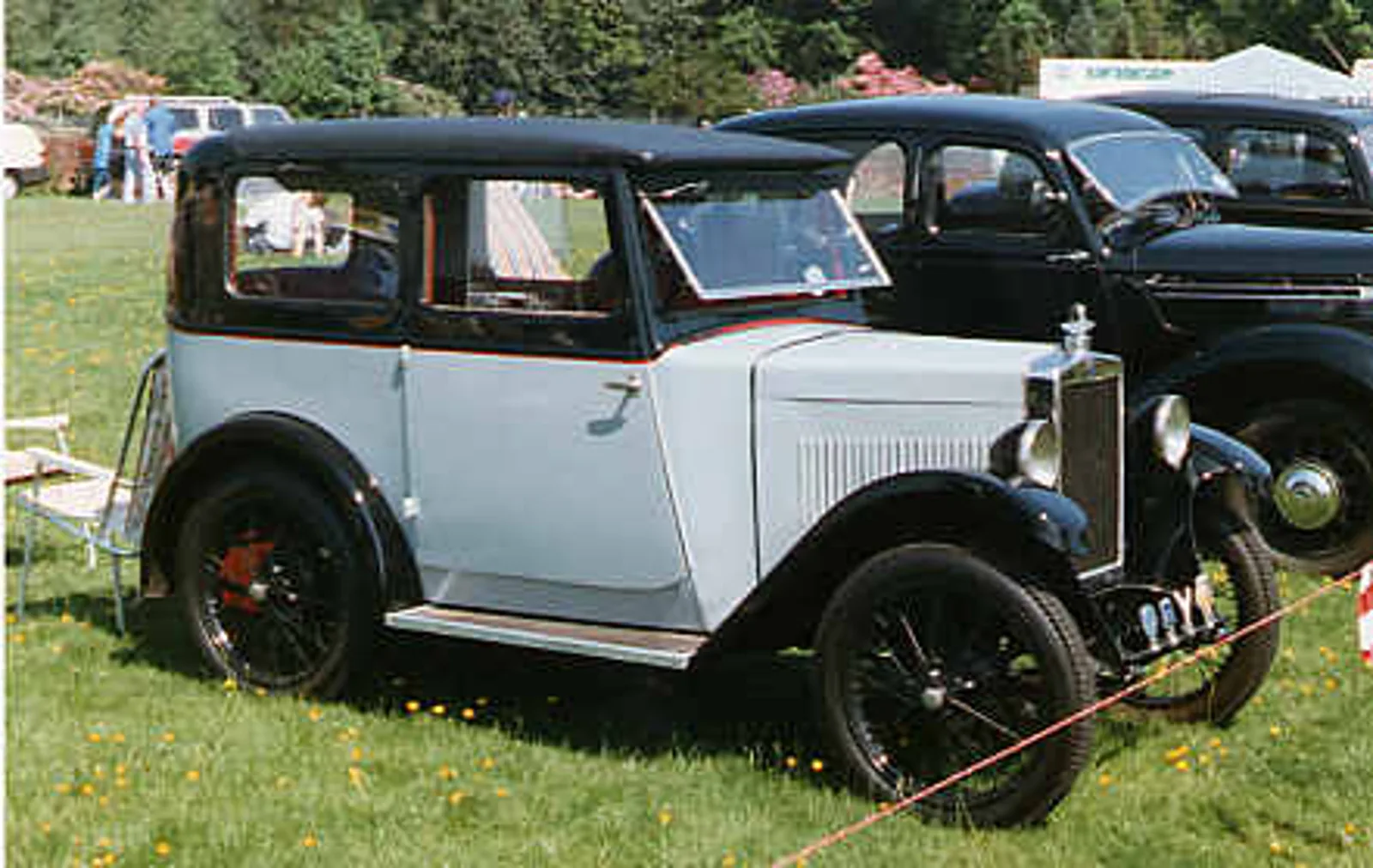
A four-seat car from Morris Motors with a Wolseley-designed engine, fabric and steel bodies, and a stripped two-seater priced at 100 pounds.
The Morris Minor of 1928 was a small four-seat car from Morris Motors Limited, built until 1934 with an 847 cc engine. William Morris developed it to challenge the Austin Seven, and the cheapest two-seater sold for 100 pounds in its stripped form.
The Morris Minor was a small four-seat car that Morris Motors Limited built from 1928 to 1934. William Morris created it to challenge the Austin Seven, using a Wolseley-designed engine and a chassis from his Morris Commercial Cars works. The name returned in 1948 for a separate car designed by Issigonis, which falls outside this story.
Why did William Morris build a small car?
William Morris wanted a share of the small-car market that Herbert Austin's Seven had opened after 1922. His Oxford and Cowley had held 41 per cent of the 1925 private car market, but sales began slowing in 1926. A new look for those models and an expanded range revived the company, and a small car was the next step.
Morris had the money to move. Selling and listing preference shares in his business brought him millions. He then bought Wolseley, the company founded by Herbert Austin, which had been Britain's largest car manufacturer only a few years earlier.
Wolseley's design engineers joined the team at Morris Commercial Cars, and Morris already had surplus production facilities. The car was more complex than the Austin Seven, yet little time went on development, and it was on the market before the middle of 1928.
A small four-seater that let William Morris take on Austin's Seven with Wolseley engineering.
What did the first Morris Minor cost?
When Morris advertised its prices on 1 September 1928, a chassis cost 100 pounds and the tourer with leather trim cost 125 pounds. A fabric saloon with sliding windows was 135 pounds, while Triplex glass all round lifted it to 141.10.0 pounds.
The tourer was advertised with leather trim, but the cars actually had Rexine instead. Fitting a Triplex screen raised the tourer's price to 127 pounds.
The Minor launched on 11 October 1928 at London's 22nd Olympia Motor Show. Morris displayed a four-seat tourer and a four-seat saloon, both with two doors. The Times ran a long report in December 1928 after its motoring correspondent drove the fabric saloon. The reviewer liked the general control and said the car never felt very small.
How did the first engine work?
The first engine was an 847 cc overhead-camshaft unit designed by Wolseley, which William Morris then owned personally. It used a single SU carburettor, coil ignition and a 6 volt electrical system. It produced 15 kW (20 bhp) at 4000 rpm, enough for a top speed of 88 km/h (55 mph).
The design followed a Wolseley SOHC front camshaft drive concept. Every car from 1928 to 1930 used this engine, and it stayed in the more expensive Minors until 1932.
Why did the side-valve engine replace the overhead-camshaft unit?
The overhead-camshaft engine proved expensive to make, and the Wolseley design suffered from oil getting into the dynamo. Morris engineers therefore devised a simpler side-valve valve train for the same block. That unit produced 14 kW (19 bhp) at 4000 rpm, close to the power of the original.
Percy Rose, who had designed the chassis, led the in-house engineers at Morris Commercial Cars. The side-valve engine entered production in late 1930 at the former Wolseley works at Adderley Park, where the young Leonard Lord oversaw production.
The side-valve unit first powered the lower-priced cars, beginning with the 100 pound car, and it remained in production until 1934.
What was the Minor's chassis made from?
The chassis was built from channel-section steel and rode on half-elliptic springs. Cable-operated brakes worked on all four wheels, and the 26-inch wire wheels carried 3.50-inch section tyres. By December, the test car had 27 x 4.00-inch tyres.
The chassis came from Morris Commercial Cars in Birmingham, a firm that had been known as E G Wrigley and Company. It had been a component supplier to Morris, and Morris bought it after it fell into receivership and renamed it. Wrigley's had re-equipped its works for a major mass-produced car project that collapsed at the last minute.
Final assembly stayed at Cowley, outside Oxford, which was the company's main plant. The chassis and running gear, however, were designed in Birmingham.
What equipment did the early Minor have?
The early Minor included a suction-operated automatic screen wiper, a driving mirror, shock absorbers at both ends and full-width bumpers. Its instruments included a speedometer and petrol gauge, and it had an electric horn. Triplex safety glass was available at extra cost.
- Suction-operated automatic screen wiper
- Driving mirror and electric horn
- Shock absorbers at both back and front
- Full-width bumpers at each end
- Speedometer and petrol gauge
- Triplex safety glass at extra cost
How did the Minor compare with the Austin Seven?
Morris said his price would not be higher than the Austin Seven's, and Herbert Austin replied that the public would decide between the two cars. The contest was public from the start, with the first detailed description of the new Morris released on 26 May 1928.
Austin said the two companies were on the best of terms, and that he had been aware of Morris's plan for weeks. The press release gave the engine dimensions of 56 x 76 and a capacity of 748 cc.
The hydraulic brakes on the Family Eight and the later four-door cars set them apart from the Austin Seven, which still had cable brakes. Cable brakes had also been fitted to the early Minor.
What bodies did the Minor come in?
The Minor launched with a two-door fabric saloon and a four-seat tourer, and up to a dozen body styles were used during production. Steel-panelled saloons with a folding sunshine roof arrived in August 1929, costing 9 pounds more than the fabric car.
A big part of the car's success was that its bodies were full-sized cars in miniature. Two-door cars were described as chummy, because the close quarters meant unavoidable personal contact.
The 1929 steel-panelled cars had rear-hinged doors whose forward ends sloped towards the bottom, which gave room to get in and out. A 5-cwt van joined the range in 1930 and was displayed at the 1929 Motor Transport Show as Morris's smallest van.
In August 1930 a semi-sports two-seater arrived with a hood and side screens. Built for two adults plus luggage, it undercut every other model in the range by 5 pounds.
Fabric bodies used so much wadding to smooth their corners that birds learned to peck through the fabric for nesting felt.
What changed when the Family Eight arrived in 1931?
In August 1931 the overhead-camshaft car was renamed the Morris Family Eight, with a 7 ft 7 inches wheelbase. It was a four-door saloon fitted with hydraulic brakes. The name Minor stayed with the side-valve cars.
The Family Eight received a new radiator shape, and the fuel tank moved from the scuttle area to the rear of the car. Its body had a rounder look and a sloping screen, which reduced air resistance at speed.
Family Eight prices were listed as follows.
- Four-door saloon with sliding head: 152.10.0 pounds
- Sports coupe with sliding head, later the Special Coupe: 175 pounds
- Chassis only: 115 pounds
The side-valve cars, now called Morris Minors, kept their own identity. Their range included a 100 pound two-seater, a 115 pound tourer and a saloon at 112.10.0 pounds.
How did the 100 pound two-seater come about?
Just before Christmas 1930, Sir William Morris announced a car to sell for 100 pounds. The Minor S.V. two-seater had a coachbuilt body with steel panels on a wood frame, and its side-valve engine kept running costs low. It was priced exactly 25 per cent below the overhead-camshaft cars.
The body was built with few bright parts, which cut the polishing a car needed. Decarbonisation and valve adjustment were very simple, which helped keep the costs down. Within a few months, two-door saloons with the side-valve engine were in production as well.
The side-valve saloon was tested on the road and exceeded 50 mph. The tester noticed some wheel bounce that wasted power in standing-start runs, and suggested a rest pedal beside the accelerator.
What did the 1933 Minor offer?
By the end of August 1933, all Morris cars had dipping headlights and direction indicators as standard. The 100 pound car's price rose that same month, which made the cheapest Minor a little dearer.
A two-door saloon on the original wheelbase was tested in November 1933. The tester found it narrow in the beam but roomy enough, and said it was designed to carry three adults or two adults and two children.
How many Morris Minors were built?
Morris built 39,087 overhead-camshaft cars and 47,231 side-valve cars. The side-valve engine was therefore the more common of the two, and the table below sets out the core figures.
The Morris Eight replaced the Minor and the Family Saloon in August 1934. It came with a new body and a 918 cc engine, and it ended the Minor line of this 1928 design.
How did the press and public react?
The Times motoring correspondent gave the fabric saloon a favourable test in December 1928, praising its general control. A period cartoon showed three street boys arguing over whether the parked car was an Austin, a Morris, or a thing with pedals.
Herbert Austin kept a friendly public tone throughout the rivalry. Morris had promised that his car would not cost more than the Austin Seven, and the public was left to judge the two.
What came after the 1928 Minor?
The Minor ended in 1934, when the Morris Eight took its place with a fresh body and the 918 cc engine. The Morris Minor name returned in 1948, when it was given to an Issigonis-designed car. That later model is a separate story from this 1928 design.
What are the Morris Minor specifications?
| Specification | Detail |
|---|---|
| Production years | 1928 to 1934, Morris Motors Limited |
| Engine, overhead camshaft | 847 cc; 15 kW (20 bhp) at 4000 rpm |
| Engine, side valve | 14 kW (19 bhp) at 4000 rpm, from late 1930 |
| Top speed, first car | 88 km/h (55 mph) quoted |
| Side-valve on test | Exceeded 50 mph |
| Electrical system | 6 volt |
| Wheels and tyres | 26-inch wire wheels, 3.50-inch section tyres |
| Brakes | Cable-operated on four wheels; hydraulic on the Family Eight and four-door cars |
| Two-seater price | 100 pounds |
| Production | 39,087 overhead-camshaft cars; 47,231 side-valve cars |
| Family Eight wheelbase | 7 ft 7 inches |