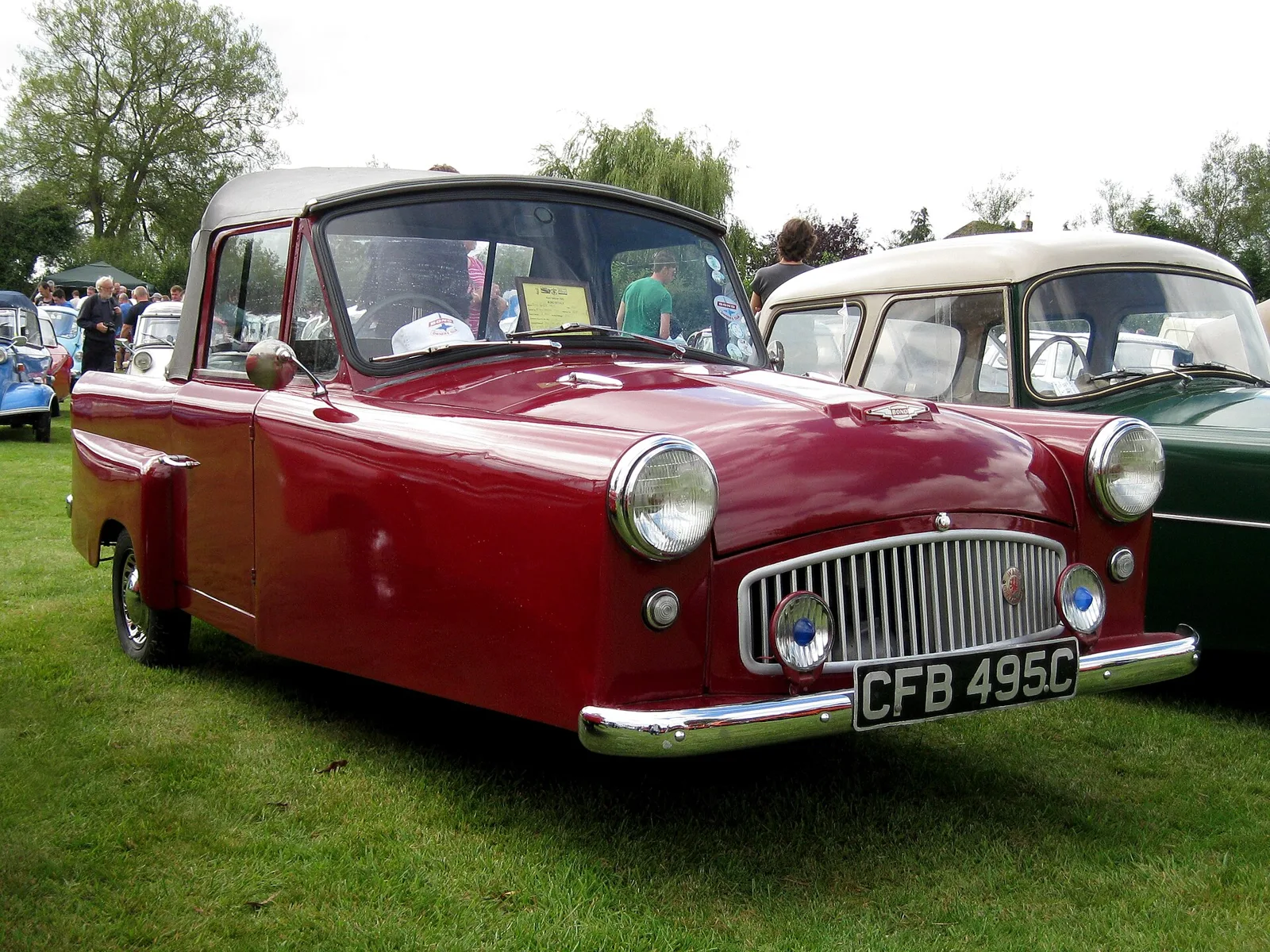
Built in Preston from 1949 to 1966, the three-wheeled Bond Minicar rode a motorcycle engine, benefited from a tax loophole and sold 24,482 examples before the line closed.
The Bond Minicar was a three-wheeled economy microcar built by Sharp's Commercials in Preston from 1949 to 1966. Designed by Lawrie Bond, it came as a convertible, van and estate, and its tax position made it popular in Britain. Total production reached 24,482.
The Bond Minicar was a series of economical three-wheeled microcars built by Sharp's Commercials in Preston, Lancashire, between 1949 and 1966. It began as a prototype by Lawrie Bond, and the British tax system turned a small car into a popular seller. The car went through seven marks, and 24,482 were built before the line closed.
Where did the Bond Minicar come from?
The Minicar grew out of a prototype by Lawrie Bond, an engineer from Preston who had worked as an aeronautical designer for Blackburn Aircraft during the war. Bond revealed the prototype to the press in early 1948 as a short-radius runabout for shopping and calls within a 20-30-mile radius.
The prototype was fitted with a 125 cc Villiers two-stroke and a three-speed gearbox. It weighed 195 pounds (88 kg) dry and was expected to cruise at about 30 mph (48 km/h). Bond had already built a series of small racing cars at Longridge, and the prototype was made at his premises in Berry Lane.
Bond needed a factory that could support mass production. Sharp's Commercials, which the Ministry of Supply had contracted to rebuild military vehicles, would not rent out its plant, but it agreed to build the car. Once mass production started, Bond sold the design and manufacturing rights to the company.
Three wheels, a motorcycle engine and a tax position that favoured them made the Minicar a British success.
Why was a three-wheeler so attractive in Britain?
Its three-wheel layout brought a lower rate of purchase tax, reduced vehicle excise duty and cheaper insurance than comparable four-wheel cars. Its light weight and lack of reverse gear also meant it could be driven on a motorcycle licence, and that tax position drove much of its early popularity.
The tax gap closed quickly. In April 1962 the purchase tax on four-wheeled cars fell from 55 percent to 45 percent, and in November 1962 it dropped again to 25 percent, the same rate as three-wheelers. At the point of sale some three-wheelers now cost more than four-wheeled cars such as the Mini.
Tom Gratrix, who ran Sharp's, wrote to the Chancellor of the Exchequer warning of 300 redundancies and possibly the closure of the factory unless three-wheelers received the same cut. No cut came, sales fell rapidly, and the final Minicar was produced in 1966.
What did the first Minicar look like and weigh?
The Mark A was austere and simple, and it was promoted as the most economical car in the world. It had no doors, because its bodysides were low enough to step over, and the windscreen was made from Perspex. Its alloy bodywork was so light that one person could lift the entire rear end off the ground.
The car was claimed to weigh 308 pounds (140 kg) all-in, or 285 pounds (129 kg) dry. Its main body used 18 swg sheet with a 14 swg main bulkhead, and the bonnet and rear mudguard arches were pressed as separate panels. Some early cars also used steel chassis members, and the Minicar was among the first British cars to use fibreglass body panels.
The interior had a single bench seat and a small open luggage bay behind it, plus a hood that folded down and had detachable sidescreens. The headlights were separate units mounted on the sides, and their output was so low that one description called them more of a glimmer than a beam.
How did the Minicar drive and steer?
The engine, gearbox and front wheel formed a single unit that the steering wheel could turn up to 90 degrees either side of straight ahead. That let the car turn within its own length. The early Villiers 10D was an air-cooled 122 cc two-stroke that gave 5 bhp (4 kW; 5 PS) at 4,400 rpm.
The three-speed gearbox had no reverse, because the engine was a motorcycle unit. Reversing later became possible on models fitted with a Dynastart reversing unit, and an optional hand-cranked lever could be operated from the driving seat for manoeuvres.
Steering used bobbin and cable until rack and pinion arrived in October 1950. The front suspension was a trailing link with a single coil spring, and the rear wheels carried drum brakes operated by cables and rods.
How did the Deluxe and the early upgrades differ?
In December 1949 a Deluxe joined the range with a Villiers 6E 197 cc engine producing 8 bhp (6 kW; 8 PS). It also had a spare wheel, a single wing mirror and an electric Lucas wiper, which damaged the Perspex windscreen until Triplex safety glass arrived with the Mark B in 1951.
Sharp's upgraded the car continually, often through kits that let owners update older cars. The Deluxe was distinguished mainly by its mechanical detail rather than by luxury.
The Motor tested a Deluxe in 1949 with only the driver aboard. It reached 43.3 mph (69.7 km/h), took 13.6 seconds to go from 0 to 30 mph (48 km/h) and managed 72 mpg-imp (3.9 L/100 km; 60 mpg-US). The test car cost GBP 262 including taxes.
What did the Mark B and its commercial spin-offs bring?
The Mark B arrived in July 1951 with coil-sprung independent rear suspension, a Triplex windscreen and rear suspension designed largely by Granville Bradshaw. Externally it was only subtly different, with slightly smaller but wider rear mudguards and a larger storage area behind the rear seats.
The Sharp's Commercial 3 Cwt, shown in November 1951, was an open-top industrial vehicle with an Indian Brave 248 cc side valve engine. It never reached production, but its ideas fed the Minitruck and Minivan of 1952.
The Minitruck was a pickup that claimed a load capacity of 3 cwt and 24 cu ft (0.68 m3). The Minivan had an enclosed aluminium compartment behind the driver and a side-hinged rear door. A later Family Safety Saloon added side windows and two hammock-style seats, although its numbers were never recorded separately.
Total Mark B output was 1,414 vehicles, including 240 Minitrucks and 84 Minivans.
What changed with the Mark C and Mark D?
The Mark C appeared in 1952 with longer front wings, a lower and rounder grille and a more defined bumper. Its rear suspension moved to Flexitor units from George Spencer Moulton, and the engine sat in a steel cradle, a redesign that answered a regular source of failures on the earlier cars.
Flexitor units used bonded rubber in torsion, giving about 3 in (76 mm) of vertical movement for each independent rear axle. Fibreglass rear wings arrived in January 1953, and fibreglass bonnets followed in December 1954. The side door became standard on the Mark C after appearing on some Mark B cars.
Villiers replaced the 6E engine with the 8E in June 1953, lifting output to 9 bhp (7 kW; 9 PS). The Mark D followed in May 1956 with the 9E engine, which produced 8.4 bhp (6 kW; 9 PS) at 4,000 rpm, a 12 volt electrical system and a four-plate clutch.
The Mark D cruised at around 45 mph (72 km/h) and had a top speed of 51 mph (82 km/h). Deluxe models gained the SIBA Dynastart, and ground clearance fell to 6.5 in (170 mm) from the Mark C's 7 in (180 mm).
What was special about the Mark E and the Preston By-pass?
The Mark E was announced on 31 October 1956 as a radical departure, with semi-monocoque construction and full-height doors on both sides. Its prototype wheelbase was 12 in (300 mm) longer, which made it liable to overturn, so the production car used a shorter wheelbase and a wider track when customers received it in December 1957.
The production Mark E had its rear wings flared outward to cover the extra track width, and its engine became the Villiers 9E/4S with a four-speed gearbox. The maximum speed was around 50 mph (80 km/h). A Saloon Coupe with a full-length fibreglass roof followed in May 1958.
Three Mark E cars were the first to use the Preston By-pass, the country's first motorway, on its opening day, 5 December 1958. The plan had two cars hold up the traffic while a third overtook, but the Bond beat the camera crew to the bridge. The route is now part of the M6, and the BBC's Inside Out recreated the event for the motorway's 50th anniversary in 2008.
Why did the Mark F and Mark G bring a new look?
The Mark F was launched at the November 1958 London Motorcycle show with a 247 cc Villiers 31A engine producing 12 bhp (9 kW; 12 PS) at 4,500 rpm. Its top speed was 55 mph (89 km/h), and fuel use came to 60 mpg-imp (4.7 L/100 km; 50 mpg-US), while it could climb a 28 percent gradient without a struggle.
A Bond Ranger light van arrived in March 1960 with a single driver's seat to boost load capacity. Records list 39 as vans rather than Rangers. Single-seat three-wheelers like this could be driven on learner L-plates without a driving test, which made them attractive to some buyers.
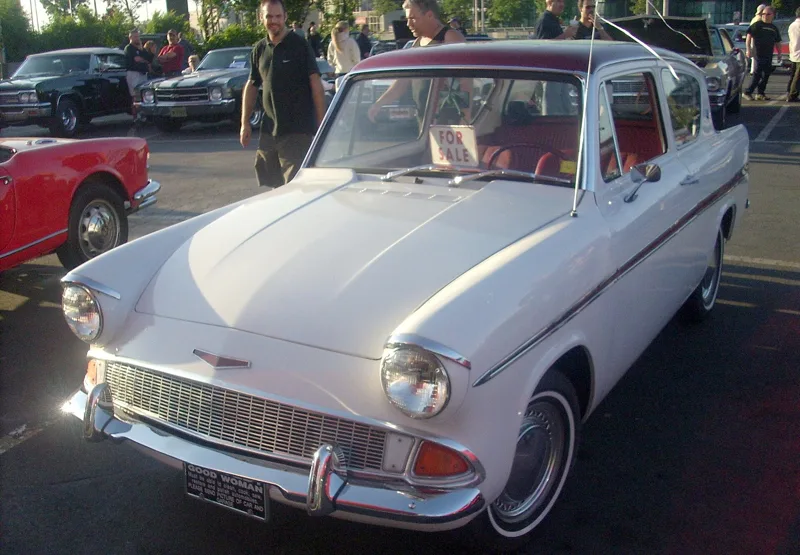
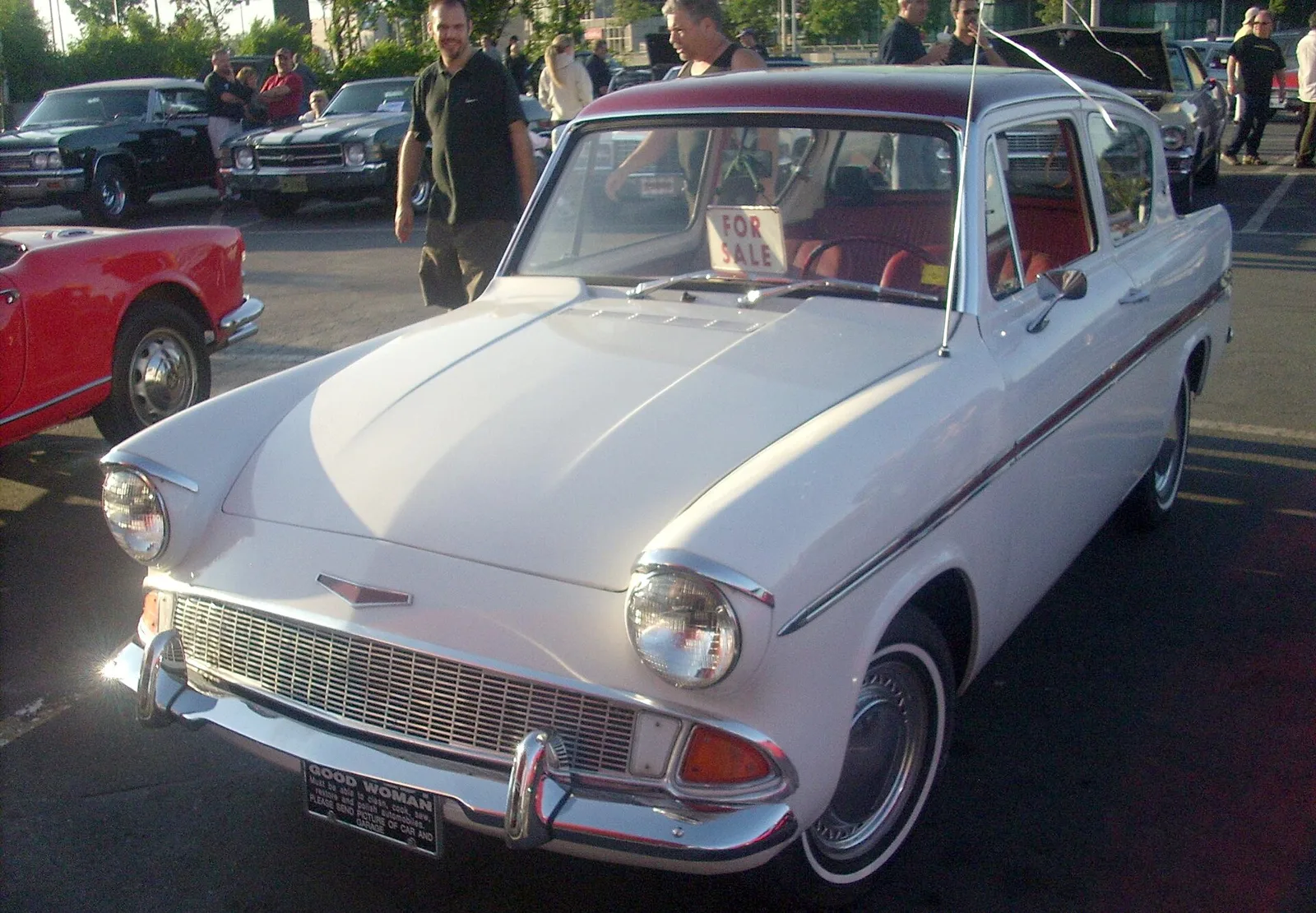
The Mark G began production in August 1961 with a new fibreglass roof, a backward-slanted rear window of the type popularised by the Ford Anglia, new doors and a windscreen with opening quarter lights. The new Villiers Mk 35A produced 11.5 bhp (9 kW; 12 PS) at 4,500 rpm.
Rear suspension was revised with trailing arms and Armstrong dampers, and a Lockheed semi-hydraulic system braked all three wheels. The Mark G also brought a bench rear seat sized for two adults, lockable doors and wind-up windows.
How did the Minicar end in the 1960s?
Public response at the 1962 Motorcycle show stayed encouraging, but the purchase tax changes narrowed the price gap with other small cars. Production was scaled back in November 1962 with job losses, although the Mark G Ranger and Estate arrived in May and June 1962 to keep the range going.
From March 1963 a choice of engines was offered. The Villiers 4T, a 249 cc twin developed for Bond, made 14.6 bhp (11 kW; 15 PS) at 5,500 rpm. It took the car to just over 60 mph (97 km/h) and returned 58 mpg-imp (4.9 L/100 km; 48 mpg-US). Saloons received an opening boot from April 1964.
In October 1964 a two-seat economy Mark G Tourer arrived to stem falling sales. Saloon production ended in October 1965 and Tourer production in December 1965, while the Ranger and Estate finished in April 1966. The last Minicar was an Estate painted only in primer, built in November 1966.
Bond Minicar specifications at a glance
| Specification | Mark A (1949) | Mark F (1958) | Mark G (1961) |
|---|---|---|---|
| Engine | Villiers 10D 122 cc two-stroke | Villiers 31A 247 cc | Villiers Mk 35A; 4T 249 cc option |
| Output | 5 bhp (4 kW; 5 PS) at 4,400 rpm | 12 bhp (9 kW; 12 PS) at 4,500 rpm | 11.5 bhp (9 kW; 12 PS) at 4,500 rpm |
| Top speed | Not recorded | 55 mph (89 km/h) | Just over 60 mph (97 km/h) with 4T |
| Fuel use | 97 mpg-imp (2.9 L/100 km; 81 mpg-US) on a test run | 60 mpg-imp (4.7 L/100 km; 50 mpg-US) | 58 mpg-imp (4.9 L/100 km; 48 mpg-US) with 4T |
| Reverse gear | None | Optional | Not recorded |
| Weight | 308 pounds (140 kg) all-in | Not recorded | Not recorded |