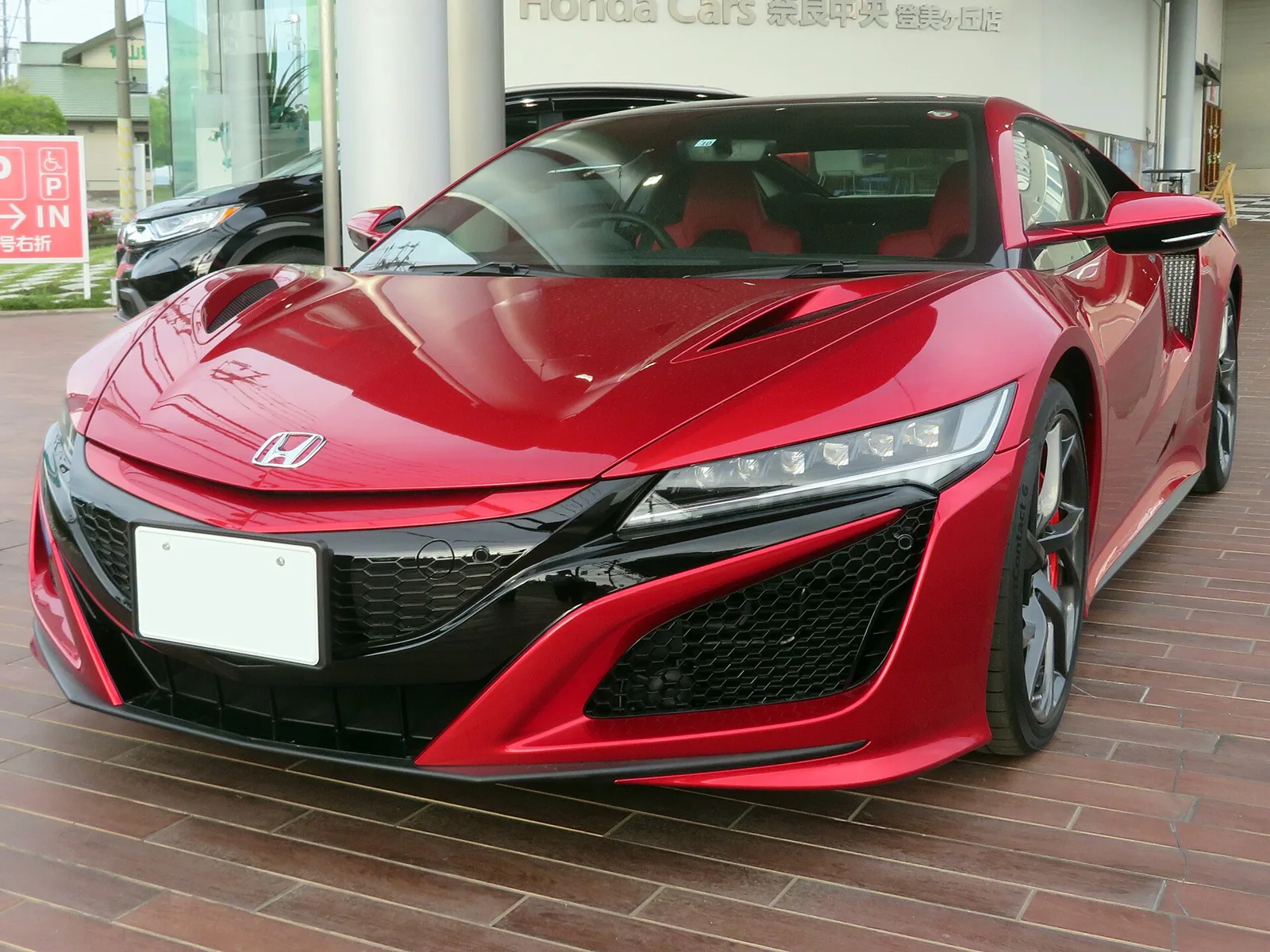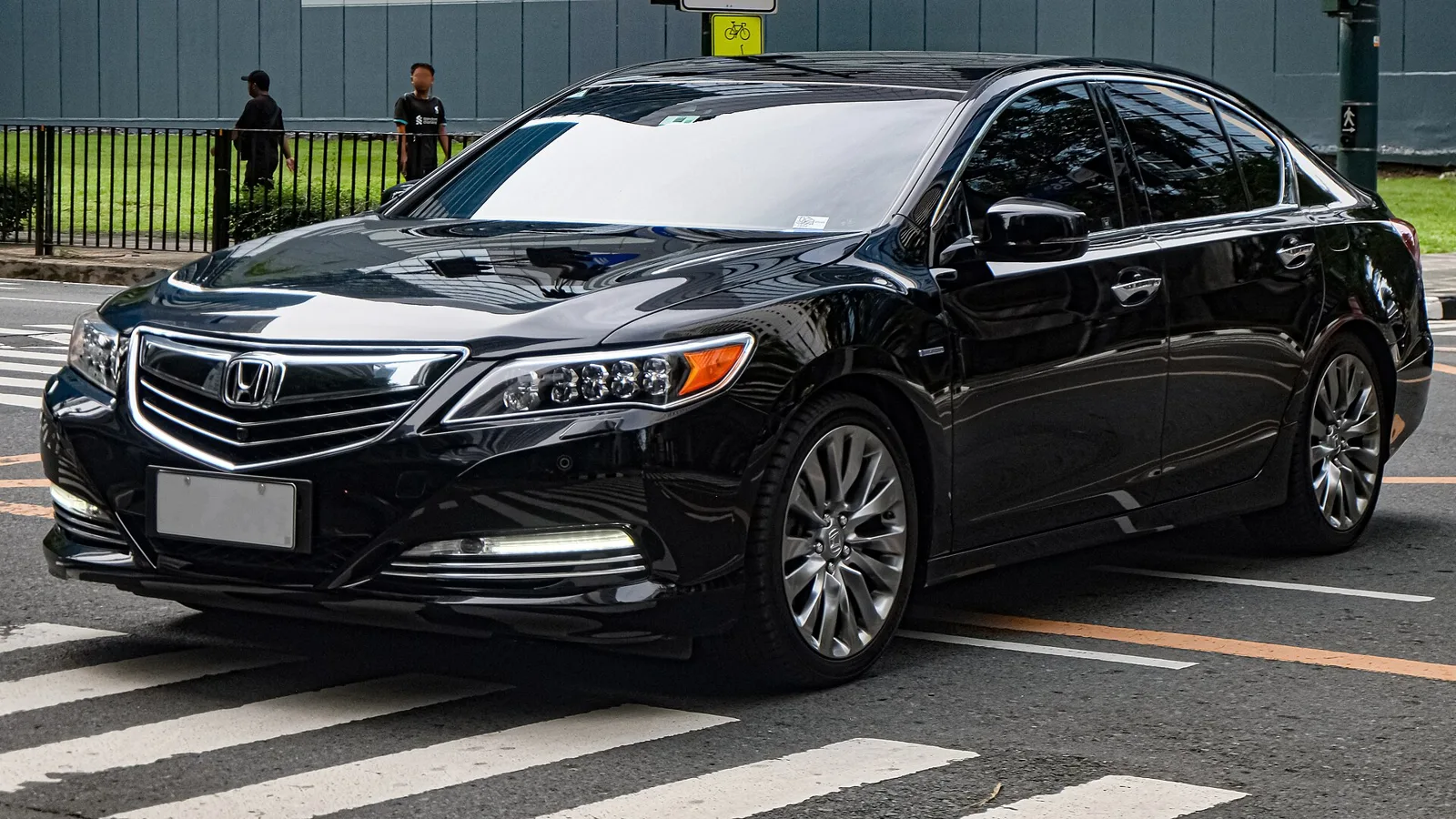
A front-drive luxury sedan born from a Rover partnership, with a turbocharged Wing Turbo, all-wheel drive in its fourth generation and an end with no successor.
The Honda Legend was Honda's V6 flagship from 1985 to 2021. It began as a joint project with Rover, sold in America as the Acura RL and RLX, and ended in 2021 when the Sayama plant closed with no successor planned.
The Honda Legend was a line of V6-powered executive cars that Honda built from 1985 to 2021 as its flagship. The same car was sold in North America as the Acura Legend, and later as the RL and RLX, from 1986 until 2020. It was front-wheel drive for most of its life, and it was known for a number of engineering firsts.
This guide covers the joint project with Austin Rover that began the car, the Japanese size strategy, the first generation's engines and the Wing Turbo, the European and UK builds, the second generation and its Daewoo spin-off, the third and fourth generations with all-wheel drive, the fifth generation, the Acura years and the closure of the Sayama plant.
Where did the Honda Legend come from?
The Legend was a V6 executive car that Honda introduced to Japan on 22 October 1985. It was the first production Honda offered with only a single overhead cam V6 across the world. It sat above the Honda Accord in the company's range.
The car came from a joint venture with the British company Austin Rover Group, known as Project XX. It began in November 1981 with a letter of intent between the two companies, and the project was codenamed HX. The aim was to replace the Rover SD1 and give Honda a luxury car for the Japanese, European and North American markets.
A front-drive V6 flagship born from a Rover partnership, which later gained all-wheel drive and ended with no successor.
Why was the Legend built with Rover?
The Legend was a joint project with Rover because the British maker had a long reputation for luxury cars, shown by the Rover P5 and P6. Rover also wanted a return to the United States, where it had sold few cars in earlier years, and the Sterling model that came from the same partnership was part of that plan.
Development was split between Rover's Canley plant in Coventry and Honda's development centre in Tochigi Prefecture. Design work was concluded in 1982, and a design patent was filed at the Japan Patent Office on 27 September 1982 and registered in 1984.
The partners agreed that Legends would be built at Cowley for the British market. Few UK-built cars passed Honda's quality control, and many were used as in-plant transport. In total only 4,409 Legends were made in the UK, from 1986 until 1988, and all US-market Legends came from Japan.
How was the Legend positioned in Japan?
Honda wanted a premium sedan above the Accord that would appeal to older, wealthy buyers who had traditionally chosen the Toyota Crown, Mazda Luce and Nissan Cedric and Gloria. In 1981 it had launched a luxury Accord called the Vigor, but it wanted a larger and more exclusive car with dimensions close to those rivals.
Almost every feature regarded as luxury was standard, so the only real choice was between a manual and an automatic transmission. The Legend was front-wheel drive, while its Japanese rivals were rear-wheel drive. Honda argued that this layout gave a low bonnet, a flat floor, a roomy cabin and better traction than a rear-drive layout could manage.
The front-heavy weight distribution of 63/37 front to rear was similar to the NSU Ro 80, and the ride was tuned for comfort rather than for sporting drivers. Japanese rules on vehicle size and tax made the smaller car important, so the 2.0-litre version was slightly narrower, at 1,695 mm (66.7 in), with a bumper design that reduced its size.
What engines and trims did the first Legend have?
The Japanese car came in three trims. The V6Xi used a 2.5 L C25A V6, while the V6Gi and V6Zi used the smaller 2.0 L C20A V6. The V6Gi matched the V6Xi for equipment, while the V6Zi had less content and a lower price. Fuel was delivered by Honda's PGM-FI injection, and the smaller engine had a variable length intake manifold.
For model year 1988 the larger engine was enlarged to a 2.7-litre C27A, which also gained a variable length intake manifold. Buyers could choose a four-speed automatic with a computer-controlled lock-up torque converter or a five-speed manual transaxle.
The Legend was also a showcase for technology. It had a driver airbag, speed-sensitive power-assisted rack-and-pinion steering, anti-lock brakes and seat belt pre-tensioners. It was also the first front-wheel drive car to use traction control, and it was designed with computer simulation based on NASTRAN, a stress analysis program created by NASA.
The car reached a drag coefficient of 0.32 and an interior noise level of 63 dB at 100 km/h (62.1 mph) in fifth gear with a manual gearbox. Triple seals around the door openings helped keep the cabin quiet.
What was the Wing Turbo?
In October 1988 Honda gave the C20A V6 in the KA5 series a variable geometry turbocharger and called the result the Wing Turbo. The turbo was added to address the modest power of the older engine, with boost building to as much as 450 mmHg (8.7 psi), and a water-cooled intercooler sitting between the cylinder banks.
The engine produced 140 kW (190 PS; 188 bhp) net at 6000 rpm and 24.6 kg-m (241 Nm; 178 lb-ft) of torque at 3,500 rpm. The turbo was not fitted mainly for power. Honda designed it to improve fuel efficiency and cut emissions, because Japanese owners paid tax on emissions.
The movable vanes were controlled by an eight-bit computer that also managed fuel injection. On idle and steady cruising the vanes stayed open, and under full acceleration they closed to speed up boost. The Wing Turbo had no conventional wastegate, and it was offered only in Japan with the more compact sedan body.
The Wing Turbo was made for just two years, and it was automatic only, because it was fitted above the automatic transaxle. Its development fed into the VTEC C30A V6 used in the 1990 Honda NSX, so the engine had a lasting influence beyond the Legend.
How did the Legend do in Europe and the UK?
The European Legend arrived for the 1987 model year, and it was almost identical in equipment and dimensions to the North American car. It had one trim, the V6-2.5i, and very few options beyond transmission choice and air conditioning.
European buyers could add a Special Equipment Pack that included cruise control, aluminium alloy wheels, a power-lumbar driver seat, adjustable rear headrests and a four-speaker stereo by Philips. The UK-built run totalled 4,409 cars.
What changed with the Legend coupe?
The Legend Coupe arrived on 6 February 1987 with a larger 2.7-litre V6 featuring a variable intake system for more torque. It also had a rear double wishbone suspension, which the sedan did not receive until the 1989 model year. The Japanese coupe was longer and wider than the sedan, which raised its tax liability, but it still had a wheelbase 2.2 in (56 mm) shorter.
The Exclusive trim arrived in the 1988 model year with genuine wood trim, automatic headlights and headlight washers, separate rear climate control and power folding mirrors. A restyle of the interior followed on 14 October 1988 to sharpen the car's look against the Nissan and Toyota upmarket sedans.
What did the second-generation Legend change?
The second generation arrived on 24 October 1990 as a sedan and a coupe. Japan called it the Super Legend, because the car now used a much larger 3.2-litre C32A V6, which was the only engine on offer. The Type I engine made 215 PS (158 kW; 212 bhp), and the Type II made 235 PS (173 kW; 232 bhp) with the Touring system.
The car benefited from research for Honda's mid-engined NSX sports car, and the Legend became a test platform for NSX technology. The engine sat longitudinally behind the front axle, which Honda called a front-wheel-drive midship layout. Weight distribution was 60/40 front to rear. Honda also added a passenger airbag and used offset collision testing.
Trim levels were renamed Alpha for the top grade and Beta for the lower grade. Alpha cars had ABS, leather or wool moquette upholstery, projector headlights and dual-zone air conditioning. In September 1992 the Alpha became the Touring Series, with the Honda Progressive Damper suspension and 16-inch wheels.
Why was the Legend built in South Korea?
The second-generation Legend was also built by Daewoo in South Korea from 1994 to 1999 as the Daewoo Arcadia, replacing the Daewoo Imperial. Honda had a loose alliance with Daewoo at the time, and the Arcadia was essentially a base-level Legend.
At launch the Arcadia had a 220-horsepower 3.2-litre V6 and a starting price of 41.9 million won, which made it a large car for Korea. Standard safety kit included ABS, dual airbags and pre-tensioners. When Daewoo acquired SsangYong, the Arcadia gave way to the larger Chairman, a rebadged SsangYong, and the last Arcadias were sold off at lower prices.
What was the third-generation Legend?
The third generation arrived on 26 October 1995 with a 3.5-litre V6 still rated at 215 PS (158.1 kW; 212.1 bhp). It kept the front-wheel drive layout. Honda pointed to its wheelbase and length, which were close to the Infiniti Q45 and the Lexus LS, to argue that a V8 was not needed for a premium car.
The Exclusive trim returned as the upper grade, while the Euro was the standard car with more performance-tuned suspension. A transponder key was offered, and cabin air filters became standard. Internavi, Honda's internet-based navigation system, arrived on Japanese cars with this generation.
A minor restyle came on 21 September 1998, and side airbags became standard alongside the front airbags. The engine met California LEV requirements on 24 September 1999, and a 2003 update added maple wood trim and electro-luminescent instruments. The coupe was dropped in the United States, where Acura offered the CL two-door instead.
What changed with the fourth-generation Legend?
The fourth generation launched on 7 October 2004 and was shorter and swoopier than its predecessor. It won Japan's Car of the Year for 2004-2005, the fourth time in five years Honda had taken the award. Its reduced size recalled the first generation's appeal as a top-level sedan with its own character.
Honda answered demands for a rear-drive V8 car with Super Handling All-Wheel Drive, known as SH-AWD. Only that powertrain was offered in this generation, and it was paired with the new J35A 3.5-litre V6. The V6 moved from a 90 degree layout to 60 degrees, and VTEC improved efficiency. In Japan the engine produced 300 PS (221 kW; 296 bhp).
A mild restyle on 15 September 2005 added a rear backup camera. The 2009 model year brought mid-model changes, including Lane Keeping Assistance and Intelligent Night Vision with pedestrian detection, plus a pop-up bonnet to soften pedestrian impacts.
How did the Legend perform in North America?
In the United States the car sold as the Acura RL, and the second-generation 2005 RL made Car and Driver's Ten Best list. The SH-AWD system won praise from Popular Science and CNET, and rivals from Audi and BMW later built their own torque-vectoring all-wheel drive systems.
Sales did not meet expectations, though. In the first six months of 2010 Acura sold only 872 RLs, compared with 5,650 Lexus LS and 6,602 Infiniti M sedans. Enthusiasts said the RL lacked the V8 and rear-wheel drive of its larger rivals, and its launch price in Canada, $69,500 CAD, was seen as high for a six-cylinder car.
What did the fifth generation bring?
The fifth generation was unveiled in Japan on 10 November 2014 and went on sale on 20 February 2015. It was nearly identical to the Acura RLX and was available only as a Sport Hybrid. A facelift followed on 2 October 2017, with a longer body that reached 5,032 mm, the longest Honda or Acura sedan to date.
In March 2021 Honda began lease sales in Japan of a new Legend with Honda SENSING Elite, which included Traffic Jam Pilot, a Level 3 conditional automated driving function. The North American RLX ended in 2020 after low sales, and no direct successor was planned.
How did the Legend end?
Honda announced in June 2012 that the Legend and Inspire would stop production at the Sayama plant in Saitama, Japan. In June 2021 the company said the plant that built the Legend would close at the end of 2021, and the car would have no successor. The Accord then became the largest Honda sedan again.
What are the Honda Legend specifications?
| Specification | Detail |
|---|---|
| Production | 1985 to 2021; Acura versions 1986 to 2020 |
| First generation V6 | 2.5 L C25A (V6Xi) or 2.0 L C20A (V6Gi, V6Zi) |
| From model year 1988 | 2.7 L C27A V6 with variable length intake |
| Wing Turbo | 140 kW (190 PS; 188 bhp) at 6000 rpm; 24.6 kg-m (241 Nm; 178 lb-ft) at 3,500 rpm |
| Coupe engine | 2.7 L V6 with variable intake, from 6 February 1987 |
| Second generation V6 | 3.2 L C32A; Type I 215 PS (158 kW; 212 bhp); Type II 235 PS (173 kW; 232 bhp) |
| Second generation weight split | 60/40 front to rear |
| Third generation V6 | 3.5 L, 215 PS (158.1 kW; 212.1 bhp) |
| Third generation wheelbase | 2,830 mm (111.4 in); length 5,056 mm (199.1 in) |
| Fourth generation V6 | 3.5 L J35A, 300 PS (221 kW; 296 bhp), 60 degree layout |
| Fifth generation | Sport Hybrid only; length 5,032 mm after facelift |
| Drag coefficient | 0.32, first generation |
| Interior noise | 63 dB at 100 km/h (62.1 mph), fifth gear, manual |
| UK production | 4,409 cars from 1986 to 1988 at Cowley |