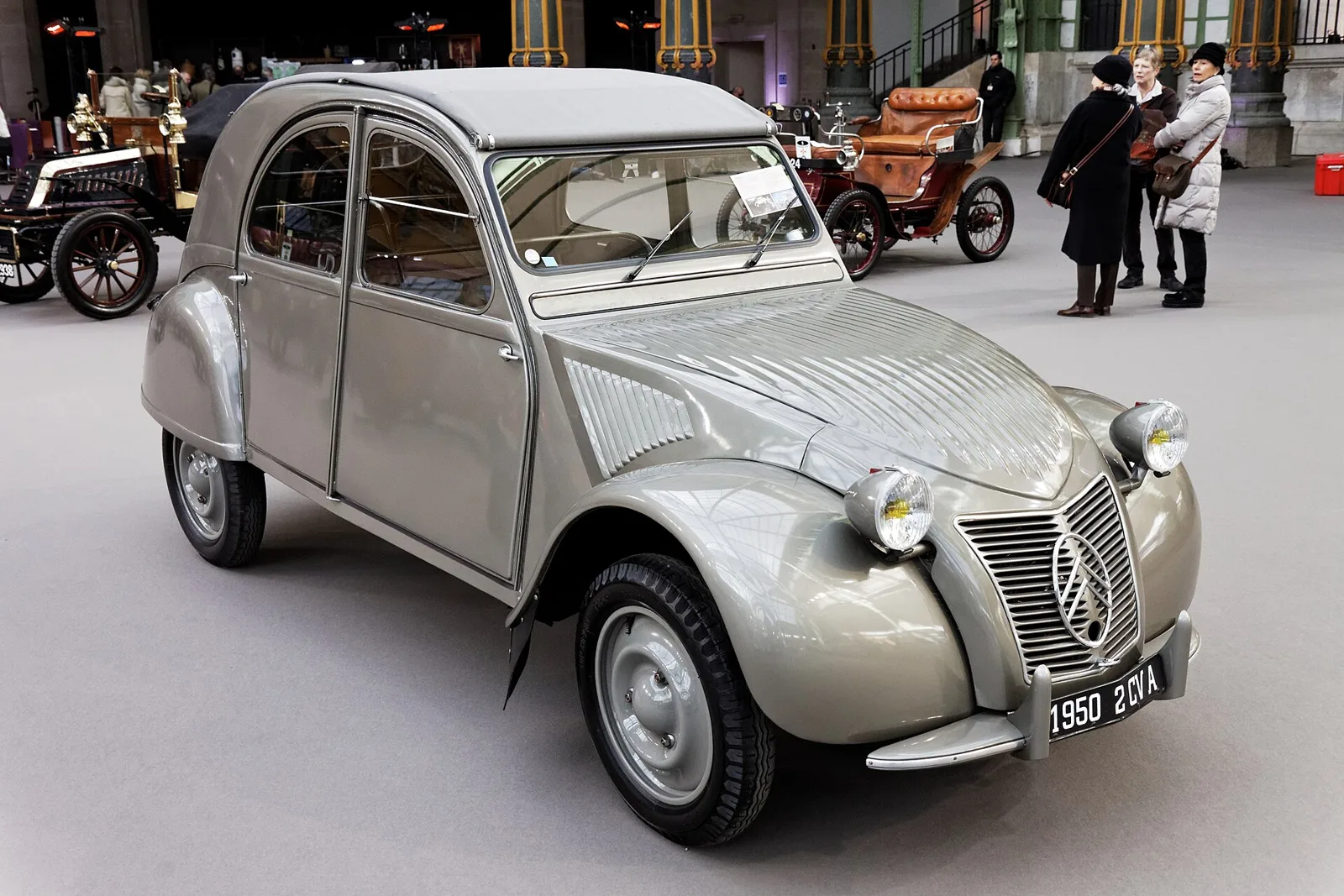
Built as a rugged, minimal car for rural French families, the 2CV ran from 1948 to 1990 and turned its odd looks into a lasting cult following.
The Citroen 2CV was a French economy car built from 1948 to 1990, with an air-cooled flat-twin engine driving the front wheels. Citroen built more than 3.8 million of them, and including the vans and related models of the A-Series family, output passed 9 million.
The Citroen 2CV was an air-cooled, front-wheel-drive car that Citroen sold from 1948 to 1990. Designed for rural French buyers, it paired minimal engineering with a remarkably soft ride, and it grew into one of the most recognisable classics in Europe.
Why was the 2CV designed?
Michelin took over the bankrupt Citroen in 1934 and commissioned a survey of rural motoring needs. The brief asked for a cheap, rugged vehicle that could carry 50 kg (110 lb) of goods to market at 50 km/h (30 mph) and use no more than 3 L/100 km (95 mpg-imp; 80 mpg-US) of fuel.
Pierre-Jules Boulanger, Citroen's vice-president for engineering, passed the brief to a design team working in secret. The project was called TPV, short for Toute Petite Voiture, and it began in 1936.
One design test became part of the car's folklore. The 2CV had to cross a freshly ploughed field with a basket of eggs on the passenger seat and arrive with every egg intact.
An umbrella on four wheels, built to cross a ploughed field without breaking the eggs.
When was the 2CV approved for sale?
The car was approved for the French market on 28 August 1939, and brochures were printed for the Paris show that October. France declared war on 3 September 1939, and the planned launch was abandoned as the country moved into the conflict.
The design was not ready to go on sale until after the war. The team reworked the mechanicals, moving from a water-cooled twin to an air-cooled unit, and the production car finally reached the Paris Salon in October 1948.
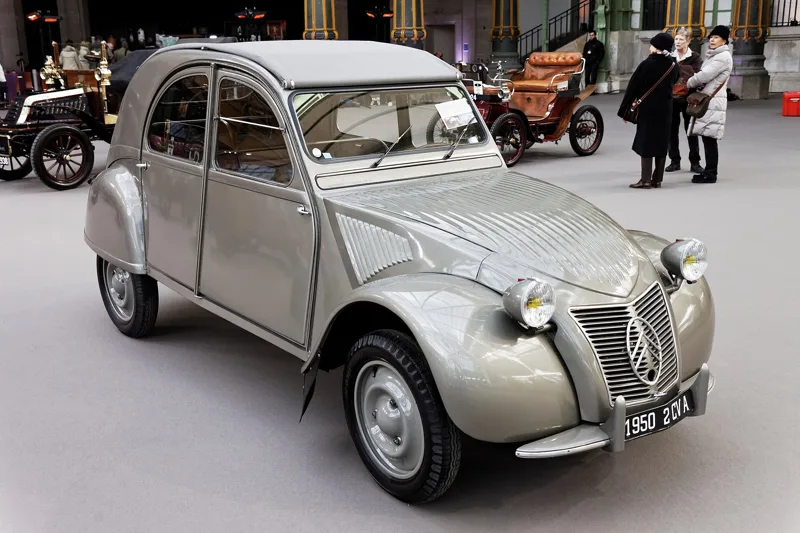
The Paris unveiling took place on 7 October 1948, and the car on display was almost identical to the first type A sold the following year.
Who designed the engine and the body?
Walter Becchia designed the air-cooled flat-twin, and Flaminio Bertoni restyled the body in 1944. The result was a thin steel shell bolted to a platform chassis, with a fixed-profile convertible roof that rolled back over the cabin.
The engine started life at 375 cc and 6.6 kW (9 hp). It had no radiator, water pump, thermostat or coolant, so there were fewer parts to fail and little to maintain beyond oil and air.
The roof was a full-width canvas sunroof, and until 1955 it stretched over the boot. Citroen's engineers gave the body a drag coefficient of Cd=0.51, which was typical for cars of the period.
Michelin's new radial tyres were fitted from the start, a notable choice for a budget car. The wheelbase measured 2,400 mm (94.5 in), the same as the Volkswagen Beetle, and the doors, bonnet and wings were designed to be removed or replaced with ease.
How did the suspension give such a soft ride?
Interconnected suspension cylinders linked the front and rear wheels on each side, so one wheel rising over a bump moved the rear wheel down. The system gave a soft ride with long travel and kept the body level over rough ground. It also coped with extra loads without much change in handling, which mattered for farm use.
The front wheels were fitted with a large caster angle, which kept the car stable on uneven roads. The springs were arranged so that the car could carry a full load without the ride becoming harsh.
Front disc brakes did not arrive until October 1981. Those brakes used a green mineral fluid, LHM, which must never be mixed with standard brake fluid, so owners had to pay attention to the system's specific needs.
How fast was the 2CV?
The 1948 model took 42.4 seconds to cover 0-40 km/h and had a top speed of 64 km/h (40 mph). Its top speed rose to 80 km/h (50 mph) in 1955, reached 100 km/h (62 mph) by 1970 and hit 115 km/h (71 mph) by 1981.
Performance was never the point of the car, and the press often joked about it. The early car produced 9 hp and carried only one tail light, while its four-speed manual gearbox was unusual for an economy car of its era.
Competition versions proved more capable. Racing 2CVs were tuned to around 33 kW (45 hp) and raced in endurance events, where the engine's robustness counted for more than outright speed.
Long-distance rallies became a big part of the 2CV's later image. In 1970 a group of 500 2CVs covered 16,500 km (10,300 miles) on the Paris to Kabul route, and in 1971 the Paris to Persepolis run covered 13,500 km (8,400 miles) with 500 cars.
The 1973 Raid Afrique sent 60 2CVs across 8,000 km (5,000 miles) of African terrain, from Abidjan to Tunis. Customers who bought a new car could take part in these events with a special overland kit, which kept the car's reputation for toughness alive.
How many 2CVs were built?
More than 3.8 million 2CVs were built from 1948 to 1990. Adding derivatives such as the vans, the wider A-Series total passed 9 million. Output peaked at 163,143 cars in 1974 before falling away through the 1980s.
Demand was strong in the early years. Production rose from 876 units in 1949 to 6,196 in 1950, and by the end of 1951 the total stood at 16,288. The waiting list grew to five years in the early 1950s before the factory caught up.
By 1980 output had dropped to 89,994, and by 1983 it was down to 59,673. The French factory at Levallois-Perret built its last 2CV on 25 February 1988, closing a production run that had lasted 40 years in France.
Production continued in Portugal, where Mangualde built the final car on 27 July 1990. Mangualde made 42,365 cars in the two years after French production stopped, closing the model's long life.
Where else was the 2CV built?
Citroen built the 2CV at plants in several countries. Tomos built it under licence at Koper from 1959 to 1985, and Argentina produced 223,442 cars between 1959 and 1979 across the A-Series range.
Britain saw a small Citroen plant at Slough, where the Royal Navy ordered 65 pick-ups in 1959. The UK later became one of the strongest export markets for the car, helped by its membership of the EEC.
The Volkswagen Beetle sold 21 million units worldwide, so the 2CV was a strong seller without being the largest of its kind.
What were the main 2CV variants?
The 2CV family included the Ami four-door saloon from 1961, the Dyane hatchback from 1967 and the Mehari off-roader. The Sahara four-wheel-drive version used two engines, and 694 were built from 1958 to 1971.
The Dyane sold about 1.4 million units from 1967 to 1983, making it a successful sibling. It was designed to supersede the 2CV, but the older car outlived it by seven years.
The Bijou was a fibreglass coupe that did not sell well, and only 212 were built in Slough. The Dolly special edition arrived in March 1985, while the Charleston had appeared in October 1980 as a styled special.
The Mehari gained a 4x4 version from May 1979, and Tomos and other licensees built variants that suited local conditions. Each one kept the original chassis philosophy of simple, strong and easy to service.
How did critics and the public react?
Critics mocked the car's looks at first, but L. J. K. Setright called its minimalism a success as a car. Autocar praised the ingenuity of the design in 1953, and the press began to take the machine more seriously over time.
Jasper Carrott joked about the car in the UK, and nicknames such as Flying Dustbin, Tin Snail and Tortoise stuck. The jokes helped turn the car into a character in its own right.
The car's quirks became a selling point in their own right, and enthusiasts still race them today. The Classic 2CV Racing Club keeps a circuit racing series popular in the UK, where cars of this type line up each season.
The car gained cult status, and in 1981 the James Bond film For Your Eyes Only featured a yellow 2CV6. A 2CV 007 special edition followed the film, with fake bullet hole stickers on the doors.
The 2CV outlived the Dyane by seven years, and 3,025 remained in service in the UK as of October 2016. That long tail of loyal owners is a big part of the car's reputation today.
How reliable was the engine?
Citroen tested the engines by running them at full speed for 1,000 hours at a time, a load far beyond what an owner would ever ask. The design aimed for simplicity, with few moving parts and no coolant system to maintain or repair.
The oil cooler sits behind the fan and is unregulated, so the oil temperature rises and falls with the weather, road speed and engine load. The engine did not need a thermostat to protect it in hot or cold conditions.
Hand-cranking was built in. The jack handle could double as a starting handle through dogs on the front of the crankshaft, a feature that stayed on the car until production ended in 1990.
How did the gearbox and controls work?
The 2CV used a four-speed manual gearbox that was advanced for a cheap car of its time. Its gearstick came out of the dashboard with first gear back on the left and reverse opposite it, so the most-used gears sat in pairs for quick changes.
Fourth gear was reached by twisting the lever to the right from third, which made the layout unusual even among French cars. Owners quickly learned the pattern, and the gearbox became part of the car's character.
The dashboard was equally spare. Early cars carried only a speedometer and an ammeter, and the fuel level was checked with a dipstick under the filler cap rather than a gauge.
What are the Citroen 2CV specifications?
The table below sets out the key figures for the launch car and the later 602 cc engine. Metric values come first, with imperial figures in brackets where they are known. The rows also give the year where a figure changed during production.
| Specification | Detail |
|---|---|
| Type | Air-cooled front-wheel-drive economy car |
| Launch engine | 375 cc flat-twin, 6.6 kW (9 hp) |
| Later engine | 602 cc, 29 hp (21.3 kW) from 1979 |
| Top speed, 1948 | 64 km/h (40 mph) |
| Top speed, 1981 | 115 km/h (71 mph) |
| 0-40 km/h, 1948 | 42.4 seconds |
| Gearbox | Four-speed manual |
| Wheelbase | 2,400 mm (94.5 in) |
| Drag coefficient | Cd=0.51 |
| Front brakes | Discs from October 1981 |
| Total built | More than 3.8 million, 1948 to 1990 |
Frequently asked questions
When did the 2CV leave production?
The last 2CV was built at the Mangualde plant in Portugal, which finished the car on 27 July 1990. Production ran from the first cars of 1948 until that final build.
What happened to the sunroof?
The canvas roof rolled back completely, and until 1955 it covered the boot. That gave the car its fixed-profile convertible shape, with the body and doors remaining in place.
When did the 2CV get front disc brakes?
Front disc brakes arrived in October 1981. The change was a major update for a car whose brakes had been a drum design for most of its life.
What was the design fuel target?
The brief aimed for 3 L/100 km (95 mpg-imp; 80 mpg-US), which reflected how central low running costs were to the car's purpose.