A refused million-dollar salary, a brand named after a dead president, a rear-engined Corvair and a bet on the Rambler: four American car executives and what each actually did.
Edsel Ford, Charles Nash, Ed Cole and George Romney ran or shaped American car companies. Ford led Ford Motor Company from 1919 to 1943, Nash led General Motors and then founded Nash Motors, Cole led GM from 1967 to 1974, and Romney led American Motors from 1954 to 1962.
In 1916 William Durant offered Charles Nash a salary of 1 million dollars a year to stay at General Motors. Nash called it more than a man was worth and resigned on 1 June. That August he bought the company that made the Rambler. It is hard to find a cleaner example of a car executive walking away from money to build something of his own, and the story did not end there: the Rambler name was still the one on which George Romney staked American Motors four decades later.
Who were Edsel Ford, Charles Nash, Ed Cole and George Romney?
Each ran or shaped a major American car company at a different time, and they cross paths more than the dates suggest. Nash worked for Durant at Buick and General Motors before founding his own firm. Romney joined Nash-Kelvinator and went on to lead its successor. Cole spent his whole career inside General Motors. Edsel Ford, the son of the founder, spent his inside Ford.
| Executive | Company | Top job | Best-known decision |
|---|---|---|---|
| Edsel Ford | Ford Motor Company | President, 1919 to 1943 | Pushing the Model A through in 1927 |
| Charles Nash | General Motors, then Nash Motors | GM president from 1912; Nash Motors from 1916 | Refusing a 1 million dollar salary to build his own firm |
| Ed Cole | General Motors | President, 1967 to 1974 | Backing the small-block V8 and the Corvair |
| George Romney | American Motors | Chairman and president, 1954 to 1962 | Betting the company on the compact Rambler |
Nash called a 1 million dollar salary more than a man was worth, and went off to buy the maker of the Rambler.
What did Edsel Ford do at Ford?
Edsel Ford was born on 6 November 1893, the only child of Henry Ford and Clara Jane Bryant Ford, and grew up tinkering with cars beside his father. He became president of the Ford Motor Company in 1919 and held the post until he died in 1943.
The difficulty was the founder. Edsel wanted cars with more flair than the Model T, and for years Henry Ford overruled him. He found other outlets. In 1922 he bought the Lincoln Motor Company, he owned the first MG imported to the United States, and in 1932 he had Ford's first designer, Bob Gregorie, build him a boat-tailed aluminium speedster around the company's newest engine, a V8 that was the first cheap eight-cylinder. That car sold at auction at the Amelia Island Concours d'Elegance in 2016.
Dwindling market share eventually made a new model unavoidable, and in 1927 the Model A arrived. Henry Ford looked after mechanical quality while Edsel developed the body with the designer Jozsef Galamb, and he talked his father into mechanical brakes on all four wheels and a sliding-gear gearbox. The Model A sold almost five million in four years of production.
Edsel left a long list of lasting changes. Mercury was his creation, and he chose the name; the Lincoln-Zephyr and the Lincoln Continental were also his responsibility. He brought in hydraulic brakes and significantly strengthened Ford's overseas production. In aviation, he insisted that Ford should build aircraft over his father's early objections, and the company's success as a US Post Office airmail carrier looked like foresight once the Second World War came. At the Willow Run complex, where the B-24 was built, he set a goal of one bomber per hour.
His record is not without shadows. According to the author Max Wallace, letters from 1942 between Edsel and Maurice Dollfus, head of the French subsidiary Ford SAF, suggest that Edsel knew about and approved of the subsidiary's manufacturing work for the German military. He also sat on the board of American IG, the American arm of the German chemical group IG Farben.
Why does a failed car carry Edsel Ford's name?
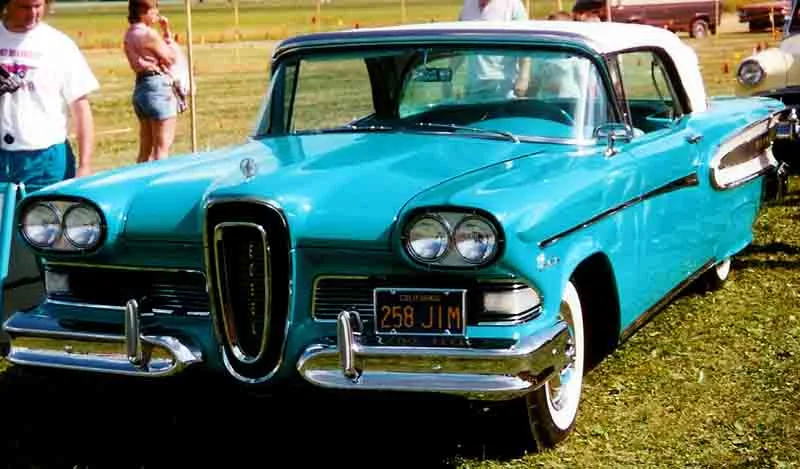
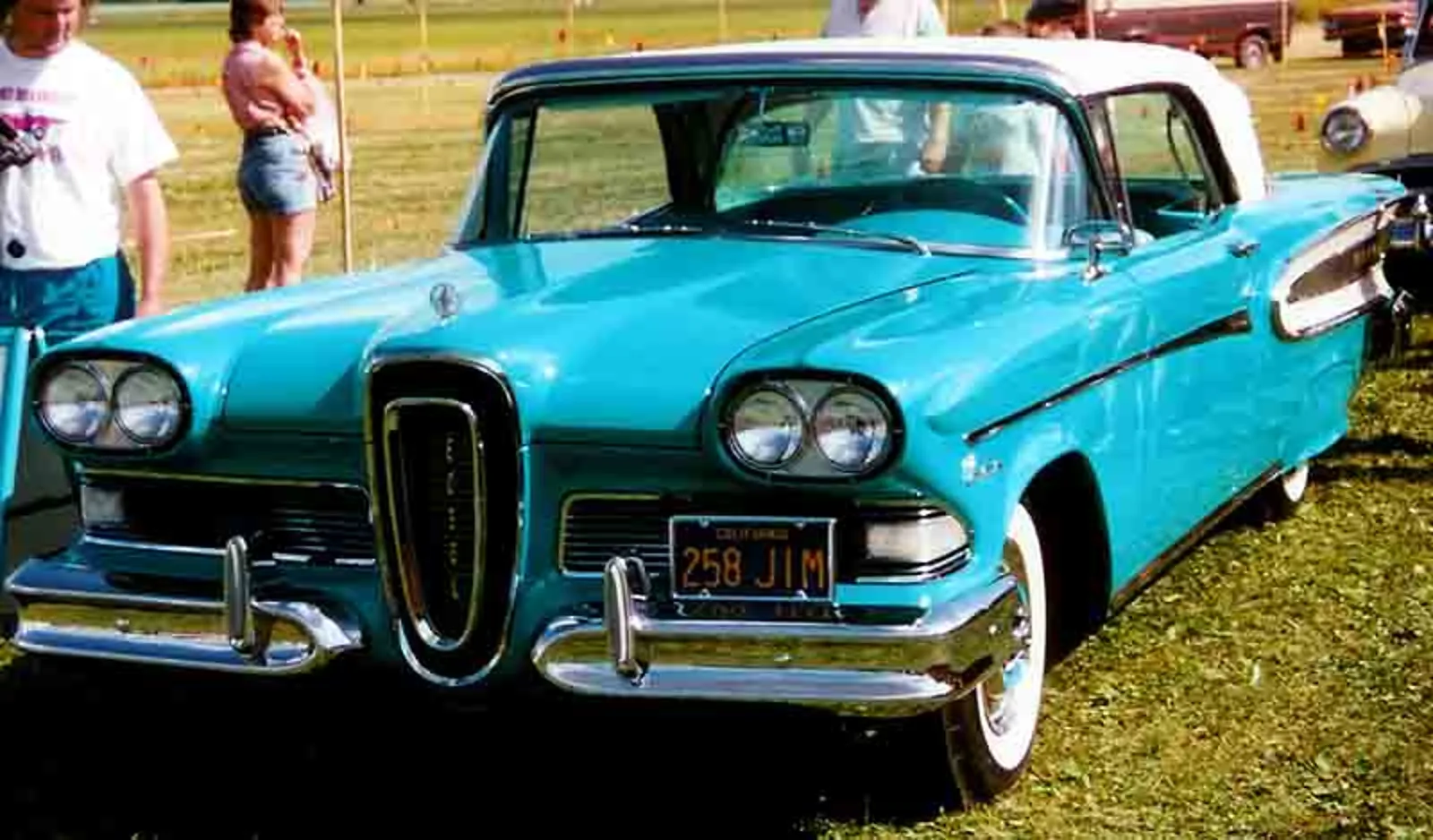
In September 1957, fourteen years after he died, Ford Motor Company unveiled a new division called Edsel. Its range ran from Citation and Corsair to Pacer, Ranger, Bermuda, Villager and Roundup. First-year sales were moderate. Ford's venture is now remembered as a major commercial failure, and the division was dropped soon after the 1960 models appeared. It tells you nothing about the man himself, who had been dead since 1943.
His other legacy is tangible. Heading the Detroit Arts Commission, he arranged the Diego Rivera murals at the Detroit Institute of Arts, and he helped finance Admiral Richard Byrd's polar flights and Antarctic expeditions, which named the Edsel Ford Range after him. Interstate 94 in the Detroit area is the Edsel Ford Freeway. He died aged 49 of stomach cancer, leaving his non-voting stock to the Ford Foundation. His father briefly took the presidency back, and Edsel's son Henry Ford II took over on 21 September 1945.
Who was Charles Nash, and how did he end up running General Motors?
Charles Nash was born on 28 January 1864 to a poor farming family in Illinois. His parents separated when he was six and a court order made him an indentured farmhand in Michigan until he turned 21, with only three months of schooling a year. At 12 he ran away and worked on farms for 8 dollars a month, then 12, learning carpentry on the way.
In 1890 William Durant hired him at the Flint Road Cart Company for 1 dollar a day, stuffing upholstery. Within six months he ran the factory. Within a decade he was vice president and general manager at Durant-Dort, the carriage maker, where he introduced the straight-line belt conveyor to carriage assembly. In 1897 he drove an early automobile and became interested in its commercial prospects.
By 1910 the carriage firm mostly built bodies for Buick, part of General Motors, which Durant had founded in 1908. Short of capital and management, Durant brought Nash into Buick to oversee production. Durant was not troubled that Nash lacked industry experience, since his talent was in organising people and efficient production lines. Nash became Buick vice-president on 13 December 1910 and in 1912 recruited Walter P. Chrysler from American Locomotive to run the works so he could concentrate on sales and suppliers.
Late in 1912 the General Motors board fired Durant, and on 19 November Nash was elected the company's fifth president, because the bankers who controlled the board trusted him. Durant's buying spree had left GM overextended, and there was doubt it could survive another five years. Nash cut unprofitable products, streamlined manufacturing and bought 51% of the axle maker Weston-Mott. Profits stood at 7.2 million dollars in 1914, doubled in 1915 and doubled again in 1916, when the company took in nearly 29 million. He merged three truck operations into one, set up the General Motors Export Company, moved the head office from New York to Detroit, and created a new purchasing office and an accounting office with standard procedures. He was reluctant to pay dividends, though.
By May 1916 Durant had regained control of the majority of the voting stock. He offered Nash a million dollars a year to remain. Nash resigned on 1 June.
How Nash Motors turned the Rambler into a car company
After the clash with Durant, Nash resolved never again to work for someone else. With the former GM executives James Storrow and Walter Chrysler, he tried to take over Packard, but its board declined. He then heard that the family behind Jeffery, a Kenosha, Wisconsin, firm, wanted to retire. The firm was best known for its Rambler cars. Nash bought it in August 1916 with a half-million-dollar down payment on a deal worth 5 million dollars, although some reports put the price at 9 million. The newly incorporated Nash Motors had capital stock of almost 24 million dollars on 29 July 1916, and Alfred P. Sloan was an early investor.
The company took the Nash name in 1917, and the 1917 Model 671 was the first car to carry it. A former GM engineer, Nils Wahlberg, developed new cars and engines for 1918. Sales reached 31,008 cars and trucks by 1919. Army contracts during the First World War made the firm one of the biggest truck producers in the country. In 1923 he added Mitchell Motors, from Racine, and in 1924 LaFayette Motors, from Milwaukee.
He was clear about what he could and could not do. By 1929 the Big Three controlled 75 percent of the market, and Nash Motors sat in fourth place after making 138,000 vehicles in 1928. He decided he could never match their variety, so he built profit on careful management, tight cost control and a single well-made car priced in the upper middle of the market, later adding a smaller, cheaper model called the Ajax. During the Depression, buyers liked Nash cars for their build quality, their durability and a luxurious look that did not cost much, and the 1932 Ambassador on a 142-inch (3,607 mm) wheelbase earned the nickname Kenosha Duesenbergs. Nash Motors was one of only two car firms making a profit then.
He gave up the presidency in 1932 but stayed as chairman, and in order to have George W. Mason as executive vice president he bought Kelvinator, the refrigerator maker. The 1937 merger produced Nash-Kelvinator. He died in 1948, aged 84, with an estate worth about 50 million dollars, and liked to call himself a common cuss. He is remembered for building smaller, more economical, affordable cars for the middle class.
What did Ed Cole build at General Motors?
Edward Nicholas Cole was born on 17 September 1909 in Marne, Michigan, and raised on a dairy farm, where as a boy he made radio sets at home and sold them. He joined the General Motors Institute in 1930. At Cadillac he co-led, with Harry Barr, the team that developed the 1949 Cadillac V8.
In 1952 he was named chief engineer of the Chevrolet Division, and his most important task was a new engine to sit alongside the Blue Flame straight-six. That became the Chevrolet small-block V8, a huge success that stayed in production for decades. He also worked with Zora Arkus-Duntov to rescue the weak early Corvettes. As general manager of Chevrolet from 1956 he directed development of the Corvair, a compact with a rear-engine, rear-wheel-drive layout whose strong early sales put him on the cover of Time on 5 October 1959.
Promotion came fast: head of the GM car and truck group in 1961, executive vice-president in 1965 and president in 1967, a post he kept until 1974. His determination to get advanced engineering to the production line produced aluminium engines in both the Corvair and the Vega, GM's first subcompact four-passenger car. The Vega had a troubled launch tied up with a damaging 1970 dispute between GM and the United Auto Workers. That same year, Cole ordered engine compression ratios cut, expecting tighter regulations. He oversaw the move away from leaded gasoline and had GM ready for catalytic converters in 1975. He also championed air bags and GM's rotary engine.
Cole retired from GM in 1974 and became chairman and chief executive of Checker Motors. He died on 2 May 1977, aged 67, when he became disoriented flying his twin-engine Beagle B.206 in fog and rain near Kalamazoo. He entered the Automotive Hall of Fame in 1977 and the Corvette Hall of Fame in 1998.
How George Romney rescued American Motors with the Rambler
George Romney was born on 8 July 1907 into a family living in Mormon colonies in Mexico, which fled the Mexican Revolution in 1912. He attended four colleges without graduating from any. In 1939 he moved to Detroit to join the American Automobile Manufacturers Association, where he was the chief spokesman for the car industry during the Second World War and headed an arrangement by which companies shared production improvements.
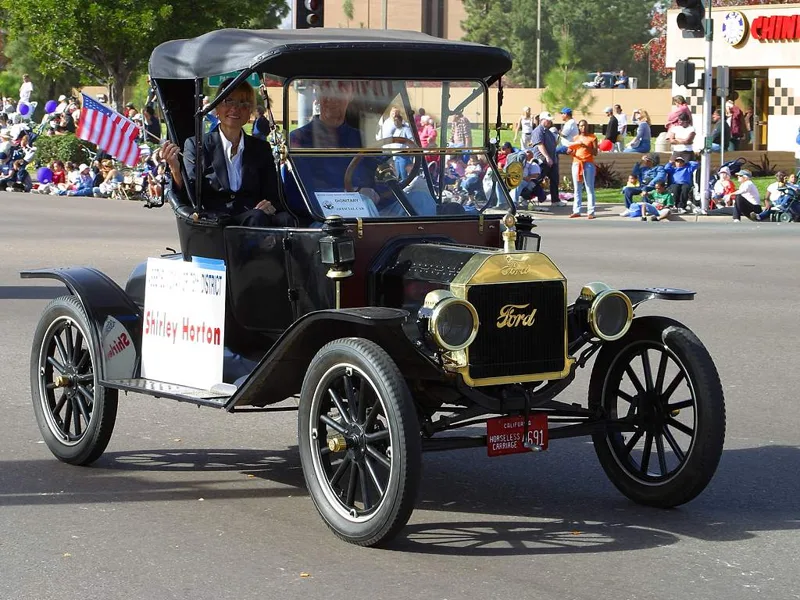
He joined Nash-Kelvinator in 1948 and took charge in 1954 of its successor, American Motors, as chief executive, and served as chairman and president until 1962. The company was struggling. Romney turned it around by putting every effort into the compact Rambler, a name Nash had inherited when it bought the Jeffery company in 1916. He mocked the Big Three's products as gas-guzzling dinosaurs, and he was among the first business leaders to become a high-profile media figure.
From cars he went into politics, winning the Michigan governorship in 1962 and serving from 1963 to 1969, and then ran the Department of Housing and Urban Development as secretary from 1969 to 1973. His son is Mitt Romney.
What links the four men
Two threads run through the careers. One is the small, economical car. Nash is remembered for building smaller, affordable cars for the middle class, and Romney's rescue of American Motors rested on a compact, while Cole directed GM's Corvair and its first subcompact. The other is open conflict: Edsel Ford with his father over the Model T, Nash with Durant over General Motors, and Romney with the Big Three over their cars.
How each is remembered
The Edsel and Eleanor Ford House, the Fords' home at Gaukler Point in Grosse Pointe Shores, Michigan, is open to the public on 87 acres (35.2 ha) beside Lake St. Clair, with tours, classes and events, and is on the National Register of Historic Places. Cole's name sits in two halls of fame, and the Edward N. Cole Canoe Base honours his work for Scouting. Nash's legacy is the lean operation he ran: closely scheduled production, small inventories and flexibility in a turbulent market.