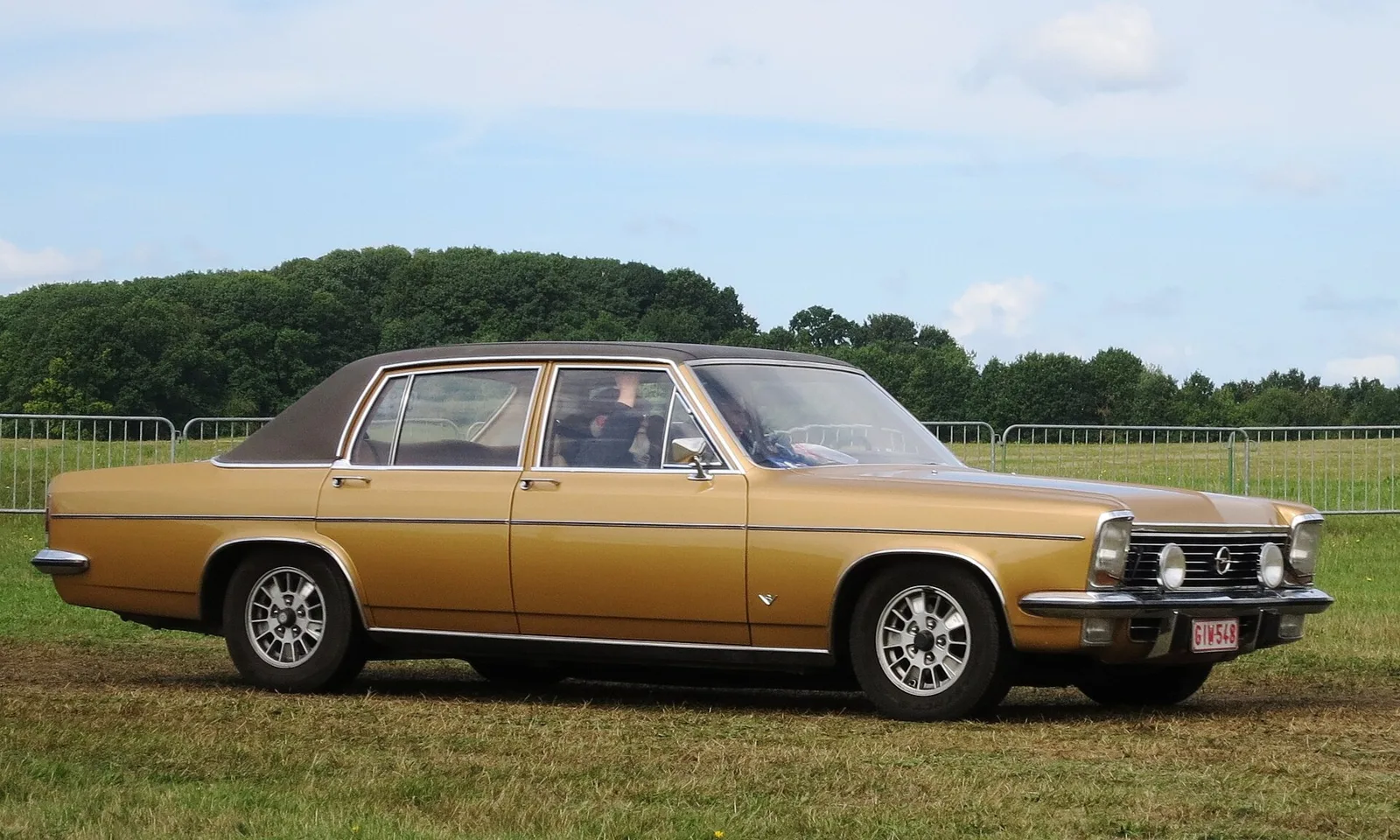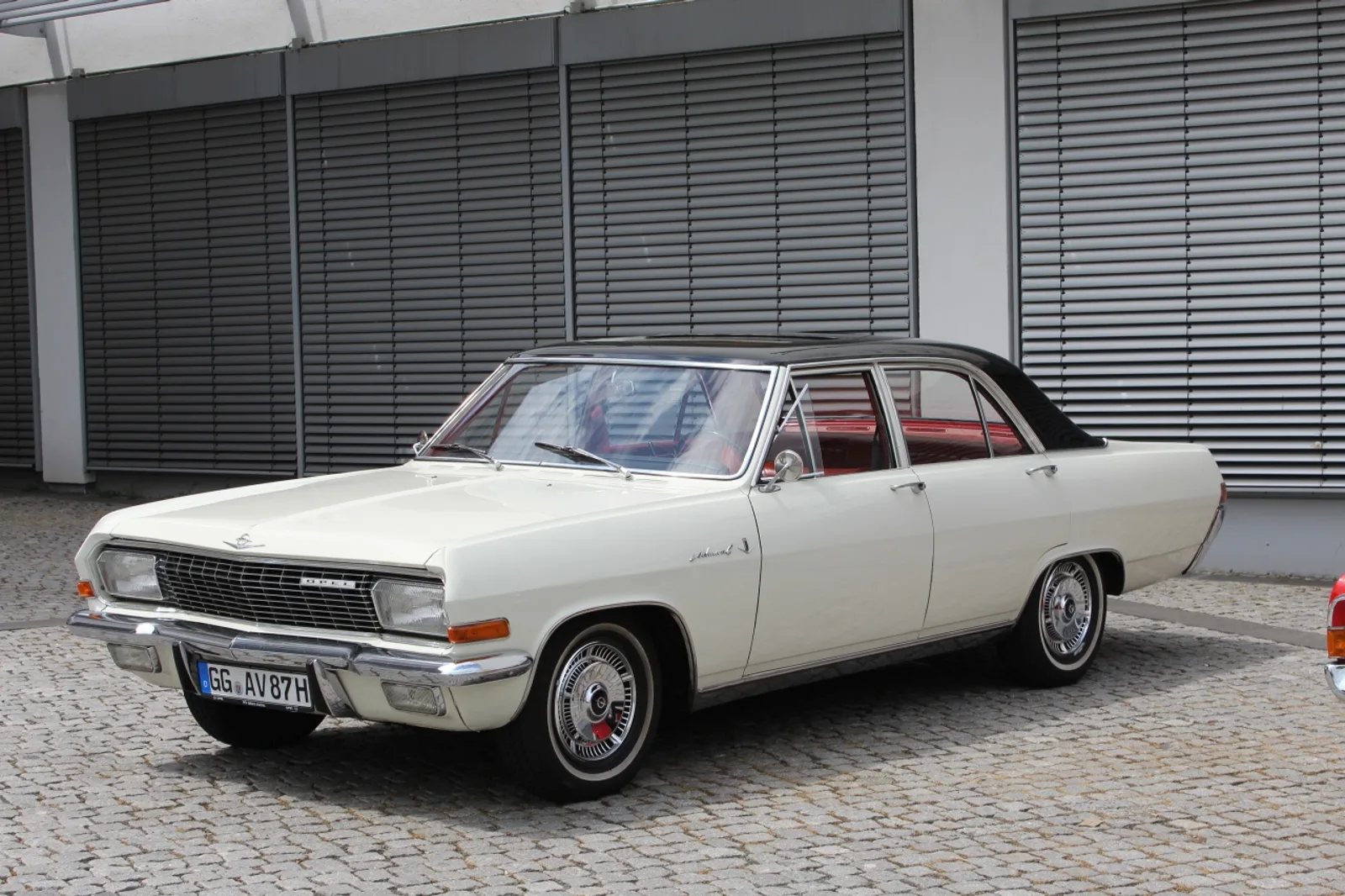
Kapitan, Admiral and Diplomat from 1964 to 1968: upper-class Opels with Chevrolet V8 power, a Karmann coupe and a 5.4-litre fix for early engine trouble.
Kapitan, Admiral and Diplomat, known together as KAD A, were upper-class Opel saloons built in Ruesselsheim from 1964 to 1968. Carrying American styling and Chevrolet V8 engines, they did not win over German buyers and were replaced by the KAD B in 1969.
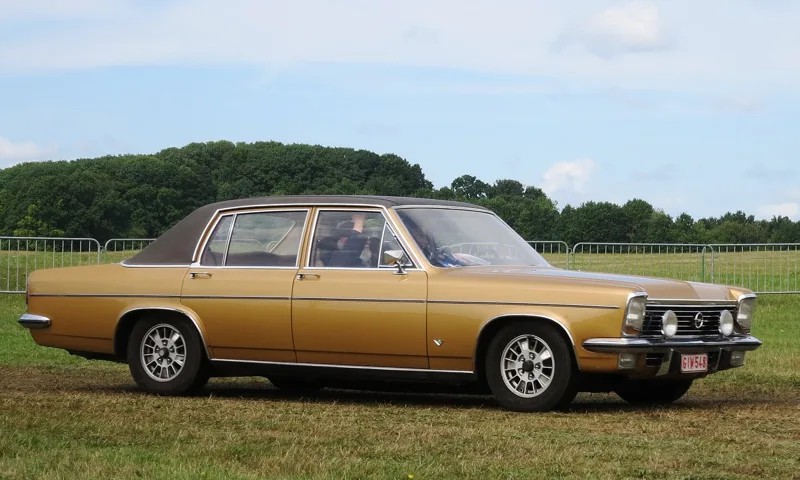
From spring 1964 to autumn 1968 Opel offered three upper-class saloons, the Kapitan, the Admiral and the Diplomat, known as KAD A. Built in Ruesselsheim under the ownership of General Motors, they carried American styling and engines, and they were replaced in 1969 by the KAD B.
How did the KAD A range fit into Opel's line-up?
The three models stepped up in price and equipment. The Kapitan was the entry point, the Admiral sat above it as a better-equipped version, and the Diplomat was the flagship with a firmer chassis and standard V8 engines. Opel marketed the trio as The big three from Ruesselsheim.
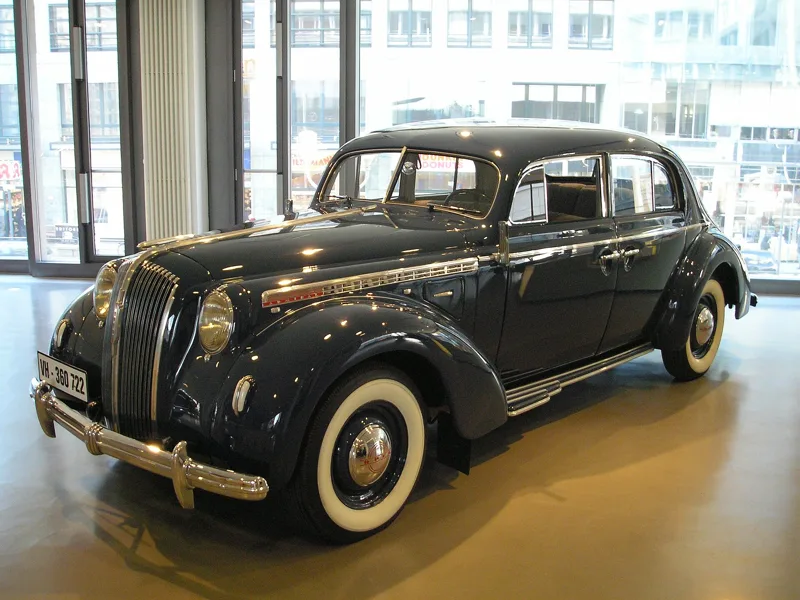
The Admiral name came from a pre-war model that was in production from spring 1937 until autumn 1939. The Admiral was, in effect, the L version of the Kapitan, just as the Kapitan P had been the L of its line before it.
The KAD B arrived in spring 1969 with slightly smaller and smoother bodies. GM's transatlantic influence was plain on both series and never won the hoped-for response from buyers in Germany and across Europe.
Chevrolet V8 power and American styling, sold to German buyers who wanted something else.
What did the Kapitan A offer?
A horizontal emphasis marked the Kapitan A's radiator grille, less chrome trim than its siblings and, at first, a 2.6-litre six-cylinder engine producing 73.5 kW (100 PS; 99 hp). From September 1965 it switched to the new 2.8-litre CIH six, which made 92 kW (125 PS; 123 hp).
A Kapitan V8 arrived in September 1965 too, with a 4.6-litre Chevrolet engine producing 140 kW (190 PS; 188 hp). Just 113 of them were made. Austria received a 2.5-litre version rated 82.5 kW (112 PS; 111 hp) for tax reasons.
The Kapitan A was the last Opel passenger car with a front bench seat for six, and that was a selling point at the time. In September 1967 its name shifted onto the front wings, and side protection strips were added. The Opel name had moved into the radiator grille in 1965.
A total of 24,249 Kapitan A were built between February 1964 and November 1968, and 15,030 of them had the 2.6-litre engine, which was sold until August 1965.
What made the Admiral A different?
The Admiral A was an upgraded Kapitan with a lattice-style grille, chrome-edged wheel arches and standard features such as a dimming interior mirror, two front seats and a centre console. Buyers favoured it above the rest of the series: 55,876 were built from April 1964 to November 1968.
Power steering was an option. From March 1965 the Admiral V8 used the 4.6-litre Chevrolet engine and took the car, heavier than 1.5 tonnes, to 100 km/h from rest in close to ten seconds, and gave it 200 km/h (124 mph) at the top end.
Few buyers took it. Sales were thin: 623 cars left the factory, priced at DM 15,950 (around EUR 40,900 once adjusted for inflation), roughly DM 3,750 above the six-cylinder model.
From September 1965 the Opel lettering left the front wings and the name appeared in the grille instead. In September 1967 the Admiral script migrated forward to the front wings, and a chrome side protection strip was added.
Why was the Diplomat A the flagship?
The Diplomat was the only KAD A model offered exclusively with eight-cylinder engines, all from Chevrolet. It had a reinforced chassis, 15-inch belted tyres, a brake pressure regulator at the rear and standard power steering, while its interior added a vinyl roof, a large centre console and veneer trim.
Two exhaust outlets, one on each side beneath the rear panel, marked every V8 of the series. The Diplomat carried its model lettering on the front wings from day one, and it had electric windows front and rear as standard, a rare feature even in the upper class.
The 4.6-litre V8 of 4,638 cc (283 cu in) came from General Motors with a two-speed Powerglide automatic. From September 1966 the saloon could also be ordered with the bigger 5.4-litre unit, rated 169 kW (230 PS; 227 hp), for about DM 960 extra. That version carried a 5.4 badge on the boot lid instead of the V8 emblem.
Early reviews were warm. In 1965 Auto, Motor und Sport wrote that the Diplomat matched its American siblings for comfort and set new standards for Europe. The 4.6-litre V8 proved unable to take sustained full throttle on German motorways, and the 5.4-litre engine of 1965 was the remedy.
Did the Diplomat coupe succeed?
Not really. The Diplomat coupe was the crown of the Opel range, but Karmann built only 347 between February 1965 and July 1967, and sales fell short of expectations. It used only the 5.4-litre engine, which later powered the Diplomat B, and most cars left the factory without a vinyl roof.
Prices reached DM 25,500 at first and DM 26,000 from 18 April 1966, with leather upholstery adding DM 1,500. That placed the coupe above sporting rivals such as the Mercedes 280 SL and the Porsche 911.
The coupe was developed at Karmann's plants in Rheine and Osnabrueck under Johannes Beeskow, and Karmann also built it in Osnabrueck. A convertible on the coupe base was built there for the IAA 1965, but it was not counted among the coupe output.
How was the KAD A built?
The KAD A used a new self-supporting body whose styling was based on the Chevrolet Nova, with prismatic-lens rectangular headlights and optional wide-beam fog lights under the bumper. It sat on a conventional chassis with a rigid rear axle and coil-sprung independent front suspension.
Germans often found the styling too American. The body types were the four-door notchback, the two-door coupe and a few one-offs, including a long-wheelbase car built by Vogt Autotechnik in Unterschneidheim, a firm that no longer exists.
The Kapitan and Admiral used long two-leaf springs at the rear and the Diplomat a three-leaf spring. All KAD models had dual-circuit brakes with front discs and a brake booster.
Which engines did the KAD A use?
The base engine was the 2.6-litre six, a development of the 1937 Opel Super 6 unit with four main bearings and a side camshaft. Power stood at 73.5 kW (100 PS; 99 hp), reached at 4,600 rpm, while torque of 181 Nm (133 lb ft) peaked at 2,400 rpm.
Hydraulic tappets, which needed no valve clearance checks, were a first for Opel and appeared in this engine. The upper class wanted more, so the CIH six arrived in September 1965 with seven main bearings, an overhead camshaft and a register carburettor. Its 2.8 HL version from 1967 used two Zenith carburettors for 103 kW (140 PS; 138 hp).
The V8s came from Chevrolet and were the first eight-cylinder engines in the range since the Opel Regent of the late 1920s. V8 engines were also fitted in small numbers to the Kapitan and Admiral from 1965. Torque in the 4.6-litre was roughly 256 lb ft (347 Nm) at 3,000 rpm. The 5.4-litre, at 169 kW (230 PS; 227 hp), was a modified version of the 327 cubic-inch small block from the Corvette, adapted for racing.
The larger displacement mainly helped acceleration rather than top speed: the 4.6-litre Diplomat reached 200 km/h and the 5.4-litre 206 km/h. The V8s ran up heavy fuel bills. Consumption could rise above 20 l/100 km in fast or short-distance driving, which hurt the reputation of the KAD A, especially the Diplomat.
How did the gearboxes work?
Six-cylinder cars came with a four-speed column shift as standard, while a centre lever or the two-speed Powerglide automatic cost extra. Every V8 came with an automatic, and the Diplomat had its centre selector as standard too.
The two-speed Powerglide was a step back from the three-speed Hydramatic of the earlier P(L) 2.6. It probably met the needs of the big eights, though it was entirely inadequate for the smaller sixes. A four-speed manual V8 was advertised at 210 km/h (130 mph), but only a few test cars were built, because the clutch and gearbox were overstressed. A few examples still reached private owners.
Why did the KAD A fail to win over German buyers?
The KAD A combined American looks, American engines and early reliability problems, and buyers in Germany and Europe did not respond as Opel had hoped. Heat trouble and fuel consumption in the V8s dented the Diplomat's reputation the most.
Opel built 89,277 KAD cars between 1964 and 1968. The Diplomat's reputation suffered first from the Chevrolet V8's heat tolerance on German motorways, which the 5.4-litre engine of 1965 was meant to correct.
Specifications at a glance
| Specification | Opel KAD A |
|---|---|
| Body | Four-door saloon, two-door coupe in Diplomat trim |
| Production | Spring 1964 to autumn 1968 |
| Six-cylinder engine | 2.6 litres, 73.5 kW (100 PS; 99 hp); 2.8 litres, 92 kW (125 PS; 123 hp) |
| V8 engines | 4.6 litres, 140 kW (190 PS; 188 hp); 5.4 litres, 169 kW (230 PS; 227 hp) |
| Top speed | 200 km/h (124 mph) with 4.6-litre V8; 206 km/h (128 mph) with 5.4-litre V8 |
| Fuel use | Above 20 l/100 km under fast or short-distance driving |
| Diplomat coupe price | DM 25,500, then DM 26,000 from 18 April 1966 |
| Total built | 89,277 KAD, 1964 to 1968 |