From the 1982 Corsa A and its Vauxhall Nova twin to the 2026 Corsa GSE, a supermini that outsold rivals across Europe and beyond.
Launched by Opel in September 1982, the Corsa is a supermini sold as the Vauxhall Corsa in Britain. In 1998 it became the world's best-selling car, and it went on through six generations, with the latest hot hatch revealed in 2026.
The Opel Corsa is a supermini that Opel has made since 1982, known as the Vauxhall Corsa in the United Kingdom. It became the world's best-selling car in 1998 with 910,839 sales, and it passed 18 million sold worldwide by 2007. Figures in this guide are given metric first, with imperial in brackets.
The Corsa's life spans six generations, from the 1982 Corsa A to the Corsa F and a 2026 hot hatch, and it has been sold under several badges, including Vauxhall, Chevrolet, Holden and Buick. The story also takes in an electric version, a van derivative and a series of performance models.
What is the Opel Corsa?
The Opel Corsa is a front-wheel-drive supermini that GM Europe created to enter a market where Opel and Vauxhall had no small car. It went on sale from September 1982 and was later sold through several brands. The car remained in production through several generations, each with its own engines and body changes.
The Corsa was GM Europe's entry into the supermini segment. The car followed the template set by established rivals, using a transverse engine and front-wheel drive, rather than the rear-drive layout of the older Kadett and Chevette.
The Corsa was not just a European car. In 1998 it was assembled on four continents and marketed under five different marques, which made it one of the most widely sold cars of its time.
A 1982 supermini that became the world's best-selling car in 1998 and has since gone through six generations and a 2026 hot hatch.
How did the Corsa A launch in 1982?
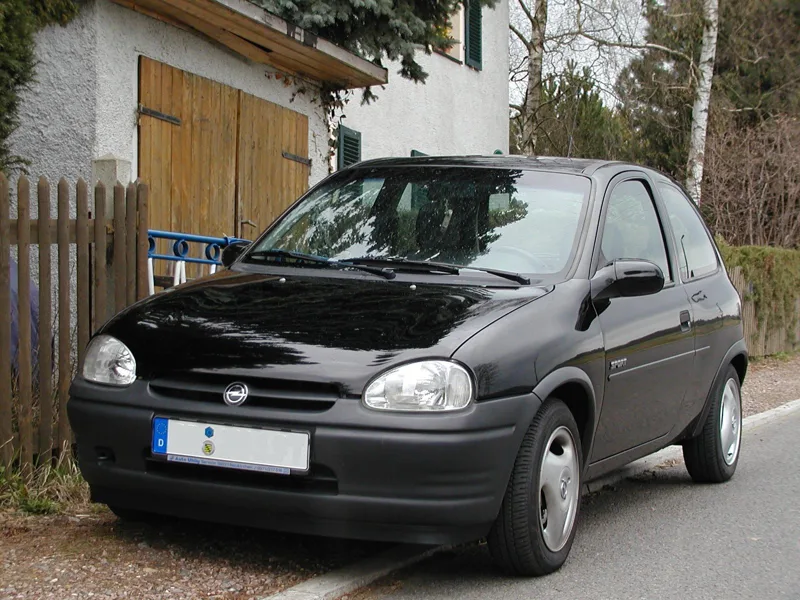
The Corsa A launched in September 1982, after a two-seat roadster concept had been shown as a teaser at Geneva. The first sales were in France, Italy and Spain, and the first cars were built in Zaragoza, Spain. Its General Motors internal code was the S-car, a name that had first been used for an abandoned supermini proposal.
The first cars were three-door hatchbacks and two-door saloons, and the company added four-door and five-door versions in 1984. In mainland Europe the saloons were sold as the Corsa TR until May 1985, and they had a traditional eggcrate grille instead of the hatchback's integrated bumper and grille.
The saloon was not a big seller across most of Europe, but it was popular in Spain and Portugal. The TR represented half of all Corsas sold in Spain, which showed how much the car depended on local tastes.
The trim range started with the base Corsa and moved up to the Luxus, the Berlina and the sporty SR. The SR had a rear spoiler, alloy wheels and checkered sport seats, and six years on the facelift brought LS, GL, GLS and GT models to the range.
Why was the Corsa sold as the Vauxhall Nova?
The Corsa A was sold in the United Kingdom as the Vauxhall Nova, which was chosen because the Corsa name sounded too close to coarser. The Nova launched in April 1983, after a seven-month union dispute in Britain over cars being built in Spain.
The Nova replaced the Chevette, which was older than most of its rivals. It gave Vauxhall a modern supermini to compete with the Ford Fiesta and the Austin Metro, and it sold strongly for a decade. Nearly 500,000 Novas were sold in Britain over ten years.
In its best year, 1989, the Nova sold more than 70,000 units and was one of Britain's leading small cars. The name ended in 1993, when the Corsa B arrived in Britain under the Corsa name, and the Vauxhall Nova became part of the car's history.
The Nova also appeared in motorsport, as the Vauxhall Nova Challenge ran in the British Rallycross Championship from 1990 to 1993. A 1987 television advert used the Ritchie Valens hit La Bamba over CGI footage of a Nova driving over traffic.
What engines did the Corsa A use?
At launch the range used three petrol units: a 1.0 litre rated 45 PS, a 1.2 litre at 55 PS and a 1.3 litre making 70 PS. Early engines were carburettored, and fuel injection arrived later on the larger units, but never on the 1.0 litre.
At the Frankfurt Motor Show in 1987 a 1.5 L turbodiesel from Isuzu, rated 67 PS, joined the range. The GSi arrived in the same year with a 1.6 L fuel-injected engine making 101 PS (74 kW), and its mapping was carried out by the tuner Irmscher.
A 1985 Sport model was built to homologate the car for British rallying. It had a higher output for its class, with 93 hp and a top speed of 112 mph (180 km/h), and it was a rare car for enthusiasts to seek out.
The 1.0 litre engine was dropped in 1992 because the older Opel OHV unit could not meet the Euro 1 emissions standard. That change marked the end of the Corsa A's engine line-up.
How did the Corsa B spread around the world?
The Corsa B was unveiled in April 1993, and in the United Kingdom the Nova name was dropped in favour of Corsa. Holden launched it in Australia in May 1994 as the Barina, and the car became the first Spanish-built car to sell in significant numbers in that market.
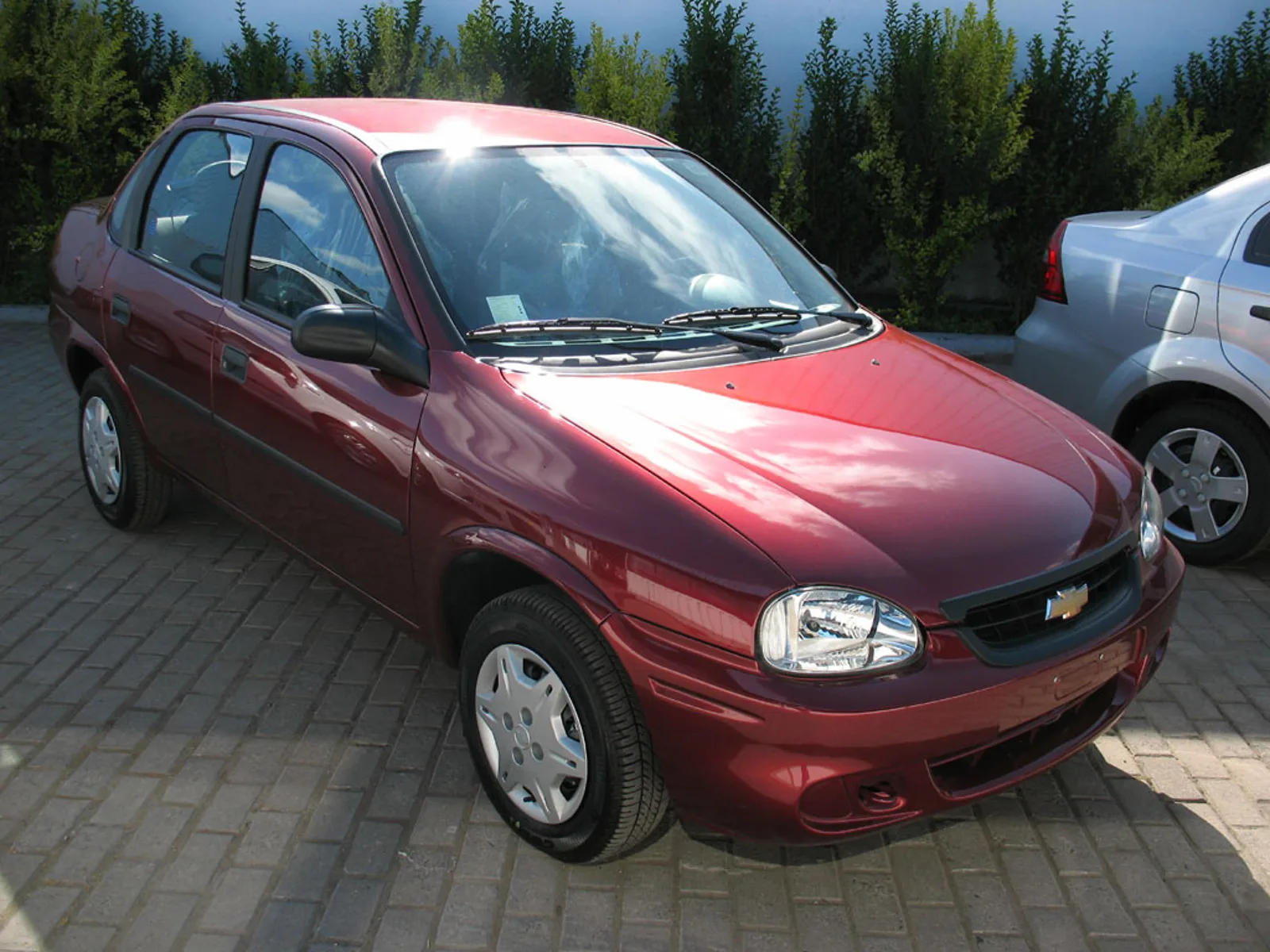
Unlike the Corsa A, the Corsa B had no saloon for the European market, but a saloon was designed in Brazil for Latin America, where saloons were preferred. The car also went into production in South Africa and India, with estate, van and pickup versions available in various markets.
China built saloons and estates as the Buick Sail and Sail S-RV from June 2001 to February 2005. Chile later sold the Chinese-built car as the Chevrolet Corsa Plus from September 2006, with a 1.6 L engine and standard airbags, anti-lock brakes and air conditioning.
Mexico sold the Corsa B from 1995 as the Chevrolet Chevy, which became a favourite among taxi drivers. The Chevy ended production in August 2011 after almost 18 years, because sales had fallen and the car did not meet new front airbag rules.
How well did the Corsa C sell?
The Corsa C was revealed in 1999 and introduced in Europe in October 2000, using the Gamma chassis that General Motors intended for other models. The chassis also led to the Opel Meriva, a mini MPV, which came out in 2002.
In Britain the Corsa C was a huge success, and it was the most popular supermini and the second most popular car overall in 2002, 2003 and 2004. It was Britain's best-selling supermini in 2005, but the Ford Fiesta overtook it in 2006, the final year of production.
The Corsa C also reached Australia, where it won the 2001 Car of the Year title from Wheels. Holden dropped it in December 2005 as a cost-cutting measure and replaced it with the Daewoo Kalos, rebadged as the Holden Barina, which critics found much weaker.
What did the Corsa D change?
The Corsa D used a new version of the SCCS platform, shared with the Fiat Grande Punto. Opel released the first official pictures in May 2006, and the car came as both a three-door and a five-door.
In the United Kingdom, What Car? named the Corsa D its 2007 Car of the Year. The car also placed second in the European Car of the Year vote for 2007, behind only the Ford S-Max.
A 1.25 CDTI diesel from Fiat, rated 70 PS, arrived from 2003 in the Corsa C, and the Corsa D ran diesel engines from 75 PS to 125 PS. A mid-2007 update brought the 1.3 CDTI to 119 g/km of CO2, which made it cheap to tax in Britain.
The Corsa D was also briefly sold in Australia under the Opel badge, but Opel announced it was ceasing operations there less than a year later. Opel also withdrew from Japan in December 2006, after the Yanase-sold Vita had ended in April 2004.
What was the Corsa OPC?
The Corsa OPC arrived in 2007 with a 1.6 turbo engine making 192 PS (141 kW; 189 hp) and 230 Nm of torque, which rose to 266 Nm on overboost. It reached 0-100 km/h in 7.2 seconds and had a top speed of 225 km/h (140 mph). Recaro seats and a sporting steering wheel set the interior apart.
The 2011 Nurburgring Edition tuned the same engine to 210 PS and 250 Nm, with 280 Nm available on overboost. Its 0-100 km/h time was 6.8 seconds, the top speed was 230 km/h (143 mph), and the package added Brembo brakes, Bilstein suspension and a mechanical limited-slip differential.
In Britain the performance model was called the Vauxhall VXR. Only the Mini Cooper JCW shared the Nurburgring Edition's limited-slip differential in its segment, which made the Corsa a rare choice in the supermini class.
What did the Corsa E add?
The Corsa E debuted at the 2014 Paris Motor Show with an all-new interior, while the underlying chassis and body structure carried over from the Corsa D. Its engines were a new 1.0 litre three-cylinder turbo, a 1.2 litre petrol unit and a 1.4 litre petrol engine.
The 1.0 three-cylinder came with 90 PS or 115 PS, both offering 170 Nm of torque, with a six-speed manual and an optional six-speed automatic. Start/stop technology was standard, and in three-door form the lower-powered model could go below 100 g/km of CO2.
The Corsa OPC returned in February 2015 with 207 PS from its 1.6 turbo and 280 Nm on overboost. It went from 0-100 km/h in 6.8 seconds and reached 230 km/h (143 mph), while its sports chassis used Frequency Selective Damping to adapt to road conditions.
What is the Corsa-e?
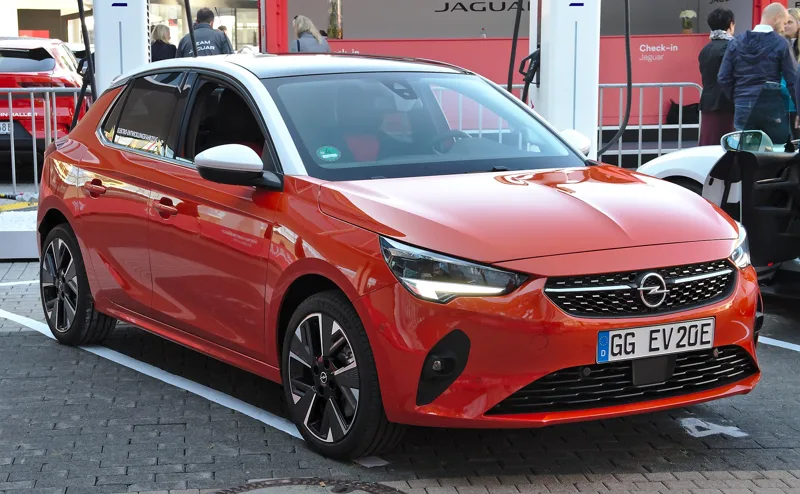
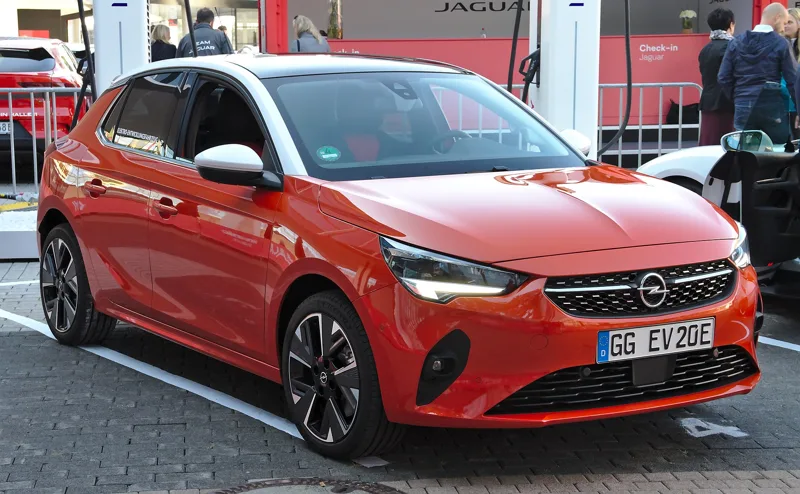
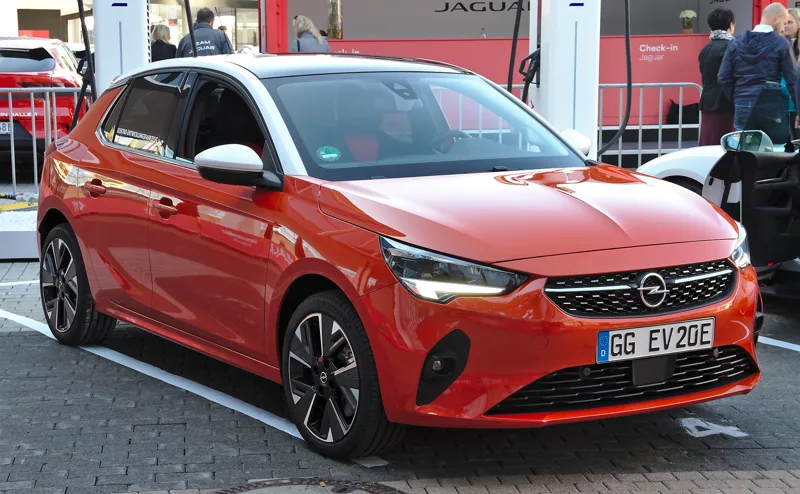
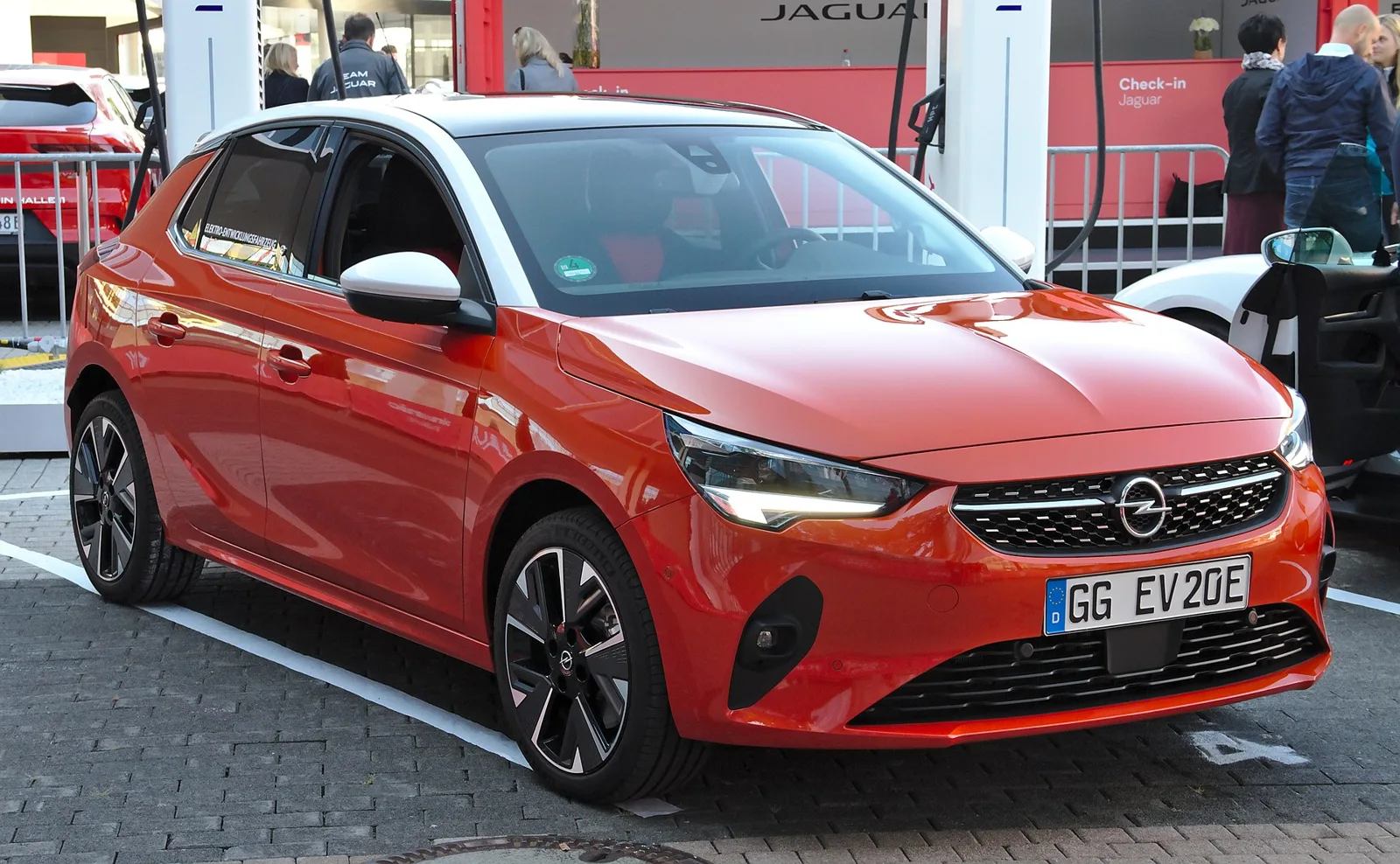
The Corsa-e was an all-electric version of the supermini, announced in December 2018 and delayed into 2020. It used the same drivetrain as the Peugeot e-208, with a 136 PS (100 kW; 134 hp) motor and 260 Nm of torque in its weaker form.
The Corsa-e had an estimated WLTP range of 330 km (210 mi) on a 50.0 kWh gross battery in the floor. A larger 54/51 kWh battery, available only with the stronger 156 PS motor, raised the claimed WLTP range to 429 km (267 mi).
The electric car was heavier than the petrol Corsa, with a base kerb weight of 1,455 kg, and its boot shrank from 309 to 267 litres. In the UK it started at GBP 30,665 before grants, and government grants cut that price to GBP 27,165.
What were the Corsa F and its facelifts?
The Corsa F was unveiled at the 2019 Frankfurt Motor Show. Its original project was cancelled after PSA Group bought Opel and Vauxhall, and development restarted on the PSA CMP platform, which made it the first Opel-Vauxhall model developed under PSA ownership.
The Corsa F used three-cylinder petrol engines and a 1.5 litre BlueHDi diesel. The base 1.2 three-cylinder made 75 bhp, and the turbo version with 99 bhp and 205 Nm was shared with Peugeot and Citroen models. The diesel produced 99 PS and 250 Nm.
The body used high-strength steels, and Opel claimed a total saving of 40 kg over the seventh-generation car. A facelift was unveiled on 24 May 2023, bringing a new front end, seats and updated technology, and in December 2023 48V mild-hybrid versions joined the line-up.
Which Corsas were recalled?
Opel recalled Corsas built in late 2019 because the steering column had not been made to specification, which could cause steering failure. A November 2020 recall covered cars built between March 2019 and February 2020, after a high-pressure fuel pump had not been tightened to the correct torque.
Earlier, GM do Brasil recalled 1.3 million Corsas built from 1994 to 1999, after a seat belt fastener fault could release in a crash. Two people were known to have died, and the recall shows how safety issues can affect a car built in large numbers.
The Latin American Corsa Classic, sold without airbags, received one star for adult occupants and one star for toddlers from Latin NCAP in 2011. The result is a reminder that the car's safety equipment varied widely by market.
What is the Corsa GSE?
The Corsa GSE is an Opel hot hatch that was teased on 24 February 2026, and it is believed to be the first Opel hot hatch since the OPC. It shares its platform with the current Corsa and the Mokka GSE, and it uses the same powertrain.
The GSE has 207 kW (278 hp) and 345 Nm, along with 18-inch three-spoke alloy wheels and upgraded Alcon brakes. It reaches 0-100 km/h in 5.5 seconds, which Opel says makes it the fastest production Opel to do so, and it is due to appear publicly at the Paris Motor Show in October 2026.
Final testing took place at the Nurburgring in late March 2026, after the car was first spotted on the road in early March. UK press material frames the car as a return to the sporty superminis Vauxhall used to build, citing the Nova GTE, Nova GSi, Corsa GSi and Corsa VXR.
How popular has the Corsa been in Britain?
The first Corsa sold in the United Kingdom on 2 April 1993, and sales had reached 1,371,573 within sixteen years. By 2018 there were 1,205,158 Corsas taxed and on the road, which placed the car third in popularity.
In 2021 the Corsa was the most popular car in the United Kingdom, with 40,914 new registrations, beating the Ford Fiesta by over 6,000. The Fiesta had held the crown for 12 successive years, and the Corsa went on to be named Britain's best-selling small car in the first quarter of 2026.
What are the Corsa generation specifications?
| Specification | Detail |
|---|---|
| Launch | September 1982 (Corsa A) |
| Launch engines (Corsa A) | 1.0 L 45 PS, 1.2 L 55 PS, 1.3 L 70 PS |
| GSi (1987) | 1.6 L fuel-injected, 101 PS (74 kW) |
| Corsa C diesel | 1.7 DTI Ecotec turbodiesel, 75 hp |
| Corsa OPC (2007) | 192 PS (141 kW; 189 hp), 230 Nm, 0-100 km/h in 7.2 seconds |
| OPC Nurburgring Edition (2011) | 210 PS, 250 Nm, 0-100 km/h in 6.8 seconds |
| Corsa E OPC (2015) | 207 PS, 280 Nm on overboost, 0-100 km/h in 6.8 seconds |
| Corsa F base petrol | 1.2 three-cylinder, 75 bhp |
| Corsa-e (2019) | 136 PS (100 kW; 134 hp), 260 Nm, 0-100 km/h in 8.1 seconds |
| Corsa-e range | 330 km (210 mi) WLTP on 50.0 kWh gross; 429 km (267 mi) with 54/51 kWh |
| Corsa GSE (2026) | 207 kW (278 hp), 345 Nm, 0-100 km/h in 5.5 seconds |