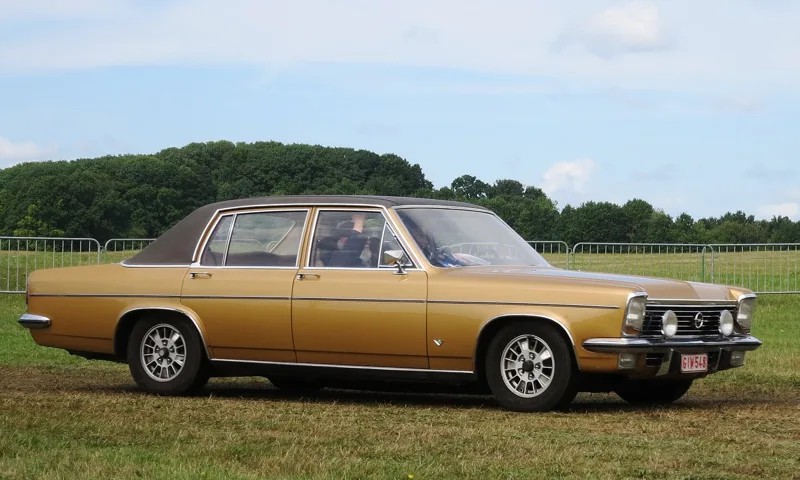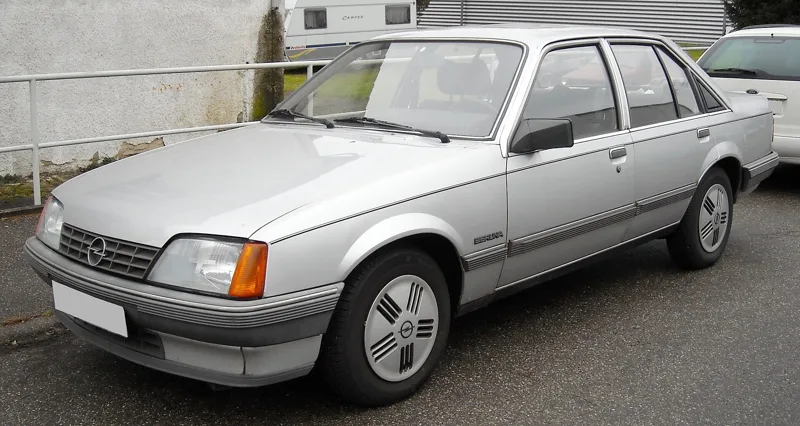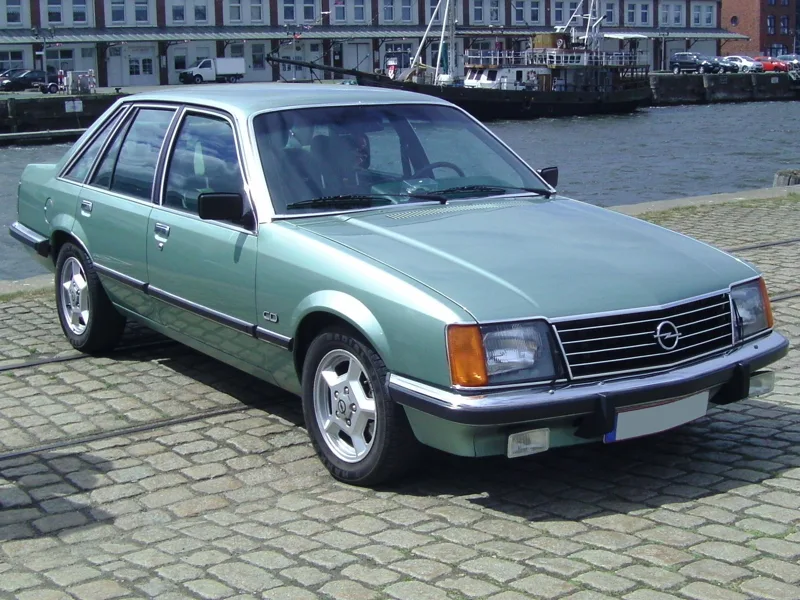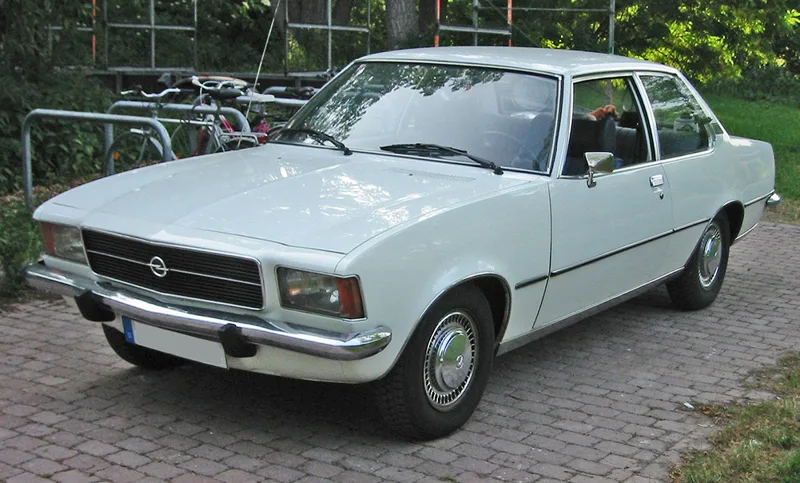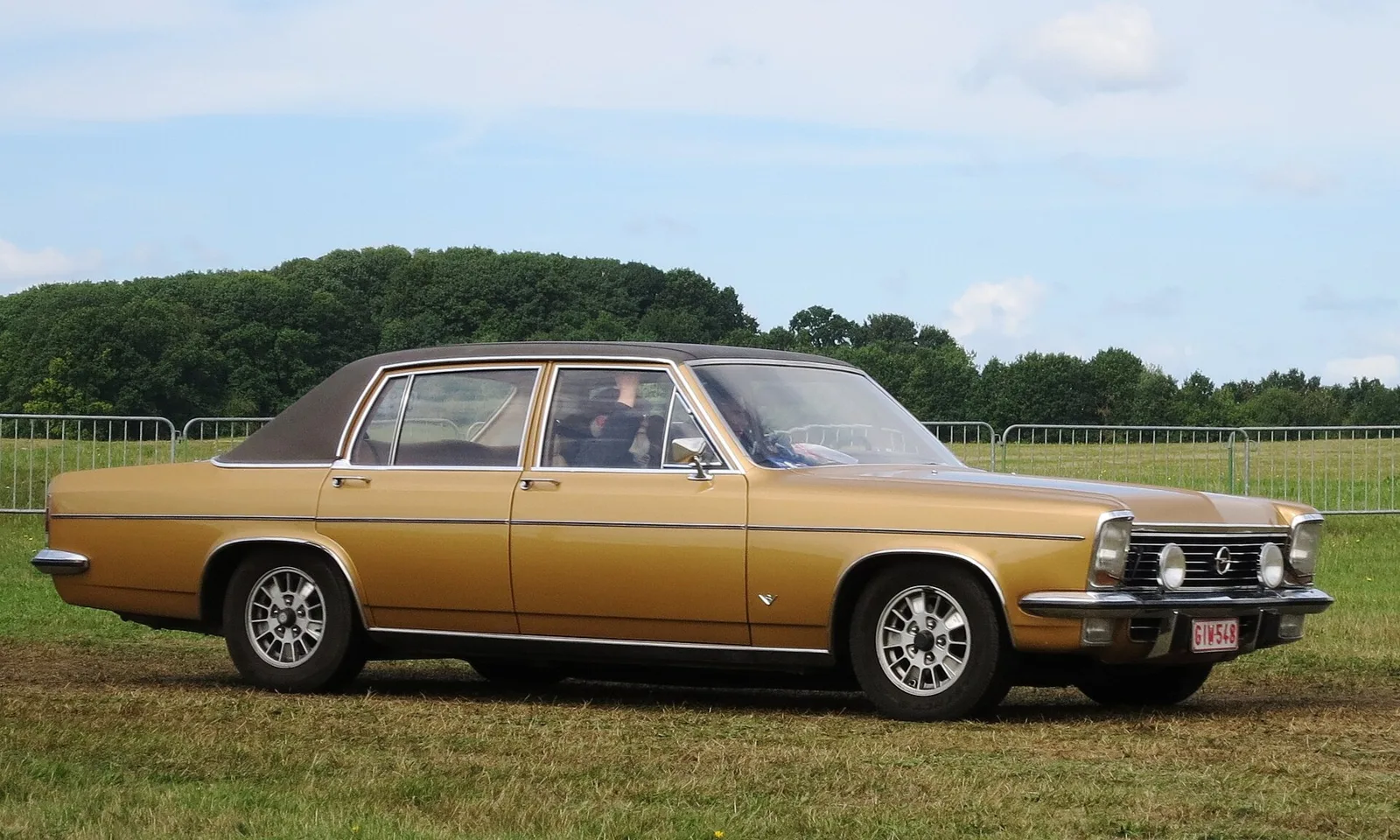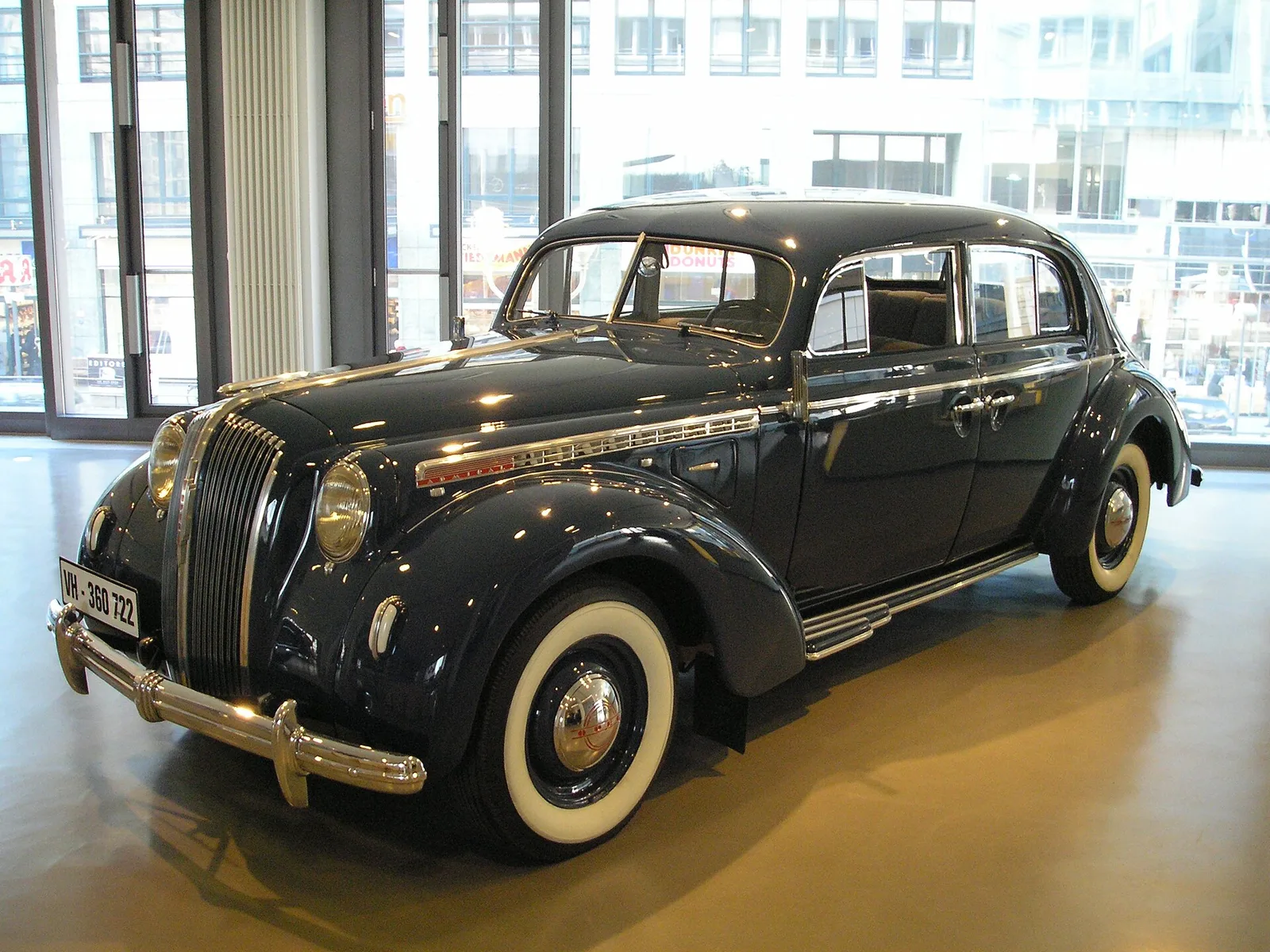
Opel's Admiral was a luxury car in two eras: a 3.5-litre straight-six built in the late 1930s, then a KAD-range saloon from 1964 to 1977.
Opel's Admiral appeared in two periods, 1937 to 1939 and 1964 to 1977. Its pre-war engine was a straight-six, while the 1960s cars were KAD-range saloons with V8 and fuel-injected options.
The Opel Admiral was a luxury car from the German maker Opel, built first from 1937 to 1939 and again from 1964 to 1977. The first era used a 3,626 cc straight-six on a separate chassis, while the second saw the Admiral as the middle model of Opel's KAD range. Both eras aimed at buyers who could afford a large, prestigious Opel.
What was the first Opel Admiral?
Opel introduced the first Admiral at the Berlin Motor Show in early 1937, but production did not begin until the end of that year. Only eight units were built in 1937. The model was an attempt to challenge the luxury cars of the 3.5-litre class from Horch, Mercedes-Benz and Maybach.
The Admiral was priced substantially below those premium rivals, even though it was similarly sized and powered. Its generously proportioned but technically straightforward chassis made it a favourite with builders of specialist car bodies.
Unlike the slightly smaller Opel Kapitan, which arrived at the end of 1938 with a unitary body, the Admiral kept a separate chassis. Specialists fitted it with a range of cabriolet and limousine bodies, and it also served as the base for ambulances.
A 3.5-litre luxury saloon that survived two eras, from a separate-chassis cabriolet base to a KAD-range Admiral with fuel injection.
How was the 1937 Admiral powered?
The car used a newly developed 3,626 cc straight-six engine. The maker quoted a maximum output of 75 PS (55 kW; 74 hp), and the standard bodied cars were given a claimed top speed of 132 km/h (82 mph). The same engine was shared with the 3.5-ton Opel Blitz truck, which was built at the company's commercial vehicle plant at Brandenburg an der Havel.
Its parts overlapped with the Chevrolet and Vauxhall-Bedford straight-sixes of the day, so many service items were interchangeable. The overlap came to light when vehicles were captured on both sides during the war.
What bodies did the first Admiral wear?
The basic Admiral was a four-door Limousine listed at 6,500 Reichsmark, a price regarded as very competitive. A four-door cabriolet was listed at 7,000 Reichsmark, and customers who wanted more style could choose a coachbuilt body.
Hebmuller of Wuppertal built a two-plus-two cabriolet listed at 8,450 Marks, along with a six-seat Pullman-Limousine with a lengthened passenger cabin listed at 8,580 Marks. Glaser of Dresden also built a two-plus-two cabriolet, which one commentator described as dignified.
The front end was similar to that of the American DeSoto Airflow, with a sloping grille and headlights set into the body.
How far could the first Admiral travel?
The 70-litre fuel tank gave the Admiral a range of nearly 400 km (250 miles) between refuelling stops, although the car consumed fuel at 18 L/100 km (16 mpg-imp; 13 mpg-US). The model's arrival coincided with Germany's first Autobahn construction boom, and the car was presented as a comfortable and rapid cruiser for the new roads.
How many first-era Admirals were built?
Between 1937 and 1939 Opel built 6,404 Admirals. Of those, 3,500 were four-door Limousine saloons, 2,314 were four-door cabriolets and 590 were bare chassis supplied for completion by independent coachbuilders. By one reckoning the Admiral captured about a quarter of the German luxury car market.
Production ended in October 1939. Manufacture stopped more abruptly than for some smaller Opels, since the military wanted every engine of that size for its trucks.
The army requisitioned many Admirals just before the outbreak of war, either as officers' staff cars or as ambulances and light trucks. With only a small number built, the first-generation Admiral is rare today.
What was the Admiral A of 1964?
In 1964 Opel introduced its KAD range, made up of the Kapitan, Admiral and Diplomat. The Admiral A was the middle model of that three-car range. The cars were first presented in February 1964, and volume production of the Admiral began in May 1964, while Chevrolet-powered V8 Diplomats started rolling off the line three months later.
The 1964 Admiral used a 2.6-litre straight-six overhead-valve engine producing 100 PS (74 kW; 99 hp), with a top speed of 158 km/h (98 mph). Its unusual feature was self-adjusting hydraulic tappets, and this engine was offered on the Admiral for its first year only.
How did the cam-in-head six change the Admiral?
From September 1965 Opel fitted a newly developed 2,784 cc straight-six cam-in-head engine producing 125 PS (92 kW; 123 hp). That gave a top speed of 170 km/h (106 mph). The unit was developed in parallel with a four-cylinder cam-in-head engine, which debuted in an upgraded Opel Rekord at the same time.
The cam-in-head layout had been developed by General Motors in Detroit. Its chain-driven camshaft operated the valves through rocker arms, because the camshaft sat too close to the cylinders to act on them directly. The low bonnet line it allowed suited the style-conscious product planners of the 1960s.
Did the Admiral A offer a V8 engine?
From March 1965 the Admiral could be ordered with the Chevrolet-sourced 4,638 cc V8, which had been fitted as standard to the Diplomat since August 1964. The V8 was offered only with GM's Powerglide automatic transmission. From September 1967 the same automatic was available on the six-cylinder cars as well.
A small number of Admirals were delivered to Austria with a 2,473 cc six, presumably to benefit from lower car tax rates. In September 1967 a twin-carburettor high-output version of the 2,784 cc six, called the HL, was offered for an extra 495 Marks. The V8 by comparison cost an additional 3,300 Marks and obliged the buyer to take the automatic.
How well did the Admiral A sell?
From 1964 to 1968 Opel produced 55,876 Admirals out of 89,277 KAD cars, making the Admiral the most popular of the trio by a wide margin. Only 377 Admiral A cars had the Austrian-market 2,473 cc engine, and only 623 came with the Chevrolet V8.
The 2.6-litre and 2.8-litre six-cylinder engined cars found 31,318 and 23,558 buyers respectively, powering more than 98 percent of Admiral A production.
What changed in the 1967 facelift?
The September 1967 update was slight. All KAD models received discreet rubbing strips below the doors, and the name badges on the front wings were rearranged so the modified cars could be identified.
The steering was also reworked. A revised ZF recirculating ball system was installed, along with a redesigned safety steering wheel fixed to a collapsible steering column.
What was the Admiral B?
The Admiral B was introduced at the Geneva Motor Show in March 1969, together with the new Kapitan and Diplomat. The Kapitan was discontinued after May 1970, while the Admiral and Diplomat remained in production until 1977. The smaller Opel Senator took over in 1978.
The new model shared the 2,845 mm (112.0 in) wheelbase of its predecessor. Its 4,907 mm (193.2 in) length was 31 mm (1.2 in) less than the Admiral A's. The styling had American flair inside and out, although the dashboard was less practical than it looked.
A De Dion rear axle gave the Admiral B much better road holding, but it raised build costs and cut the space available in the boot.
Which engines did the Admiral B use?
The Admiral B came with the 2,784 cc six-cylinder cam-in-head engine, rated at 132 PS (97 kW; 130 hp). Where twin downdraught carburettors were specified, the output rose to 145 PS (107 kW; 143 hp). A Bosch D-Jetronic injection system lifted the figure to 165 PS (121 kW; 163 hp).
Injection was new to Opel's option list, in line with other German makers. The fuel-injected Admiral was expensive compared with the simpler twin-carburettor car. The V8 was no longer offered in the Admiral and was confined to the Diplomat.
The manual four-speed carried over from the previous model. Automatic buyers no longer had to accept the General Motors two-speed Powerglide, because the Admiral B offered a three-speed Strasbourg automatic instead. From January 1972 the manual option was dropped on the fuel-injected Admiral E.
Through the 1970s Germany discouraged lead in road fuel, and the octane levels of normal and super petrol fell. Opel responded by reducing the compression ratios of all three versions of the six-cylinder engine, which cut the listed maximum outputs by between 3 and 5 PS.
Why did the Admiral B sales fall?
The Admiral B first sat in a three-car range alongside the cheaper Kapitan and the top-of-the-range Diplomat. When the Kapitan was withdrawn in May 1970, two less well-equipped Admiral versions were added to the range instead.
In 1969, its first year, Opel produced 9,399 Admiral B cars, which was more than half of the combined KAD output. The 1973 oil price shock knocked sales dramatically, and in 1974 Opel built only 1,168 Admirals out of 1,754 KAD models. Opel then prioritised new investment on cheaper types such as the Ascona.
Premium rivals outsold it. BMW returned to the six-cylinder sedan market in 1968 and had built 222,001 six-cylinder cars by 1977, while Mercedes-Benz built 280,473 six-cylinder S-Class models between 1972 and 1980.
Opel built 36,522 Admiral B models from 1969 to 1977, along with 4,976 Kapitan B models and 21,021 Diplomat B models. Even in the model's last year, 1977, 253 Admirals were produced.
What are the Opel Admiral specifications?
| Specification | Detail |
|---|---|
| Production eras | 1937 to 1939 and 1964 to 1977 |
| First-era engine | 3,626 cc straight-six, 75 PS (55 kW; 74 hp) |
| First-era top speed | 132 km/h (82 mph), claimed for standard bodied cars |
| First-era fuel tank | 70 L, nearly 400 km (250 miles) between stops |
| Admiral A (1964) engine | 2.6-litre straight-six, 100 PS (74 kW; 99 hp) |
| Admiral A (1965) engine | 2,784 cc cam-in-head six, 125 PS (92 kW; 123 hp) |
| Admiral A V8 | 4,638 cc Chevrolet V8 with Powerglide |
| Admiral B wheelbase | 2,845 mm (112.0 in) |
| Admiral B length | 4,907 mm (193.2 in) |
| Admiral B engine | 2,784 cc six, 132 PS (97 kW; 130 hp), up to 165 PS (121 kW; 163 hp) with injection |
| Production totals | 6,404 (1937 to 1939); 55,876 (Admiral A); 36,522 (Admiral B) |