The Kapitan, Admiral and Diplomat B saloons built from 1969 to 1977, with straight-six and V8 engines, a De Dion rear axle and an unusually long afterlife in special bodies.
Opel's Kapitan, Admiral and Diplomat B saloons were built from March 1969 to July 1977 with a 2.8-litre six or a Chevrolet V8. Their De Dion rear axle and four-door notchback bodies set them apart, and no direct successor followed.
The Opel Kapitan, Admiral and Diplomat B, known together as KAD B, were four-door notchback saloons built from March 1969 to July 1977. They used a 2.8-litre straight-six or a 5.4-litre Chevrolet V8, and some authors regard them as the last luxury-class Opels. Adam Opel AG sees the matter differently.
Where did the KAD B come from?
The KAD B followed the KAD A series, and it kept the same basic body shape. Opel was then part of General Motors. The model line was plainly tiered: the Kapitan was the simplest, the Admiral sat in the middle, and the Diplomat was the top car, which Opel also offered with a V8 from its sister brand Chevrolet.
The Kapitan name had been in use since 1938. In the B series it lasted only until May 1970, when the plainly equipped car was discontinued. The name disappeared from the range with it.
American-influenced styling won less favour in Germany than Opel hoped, and the Diplomat B is now rare and costly to keep.
How did the three models look?
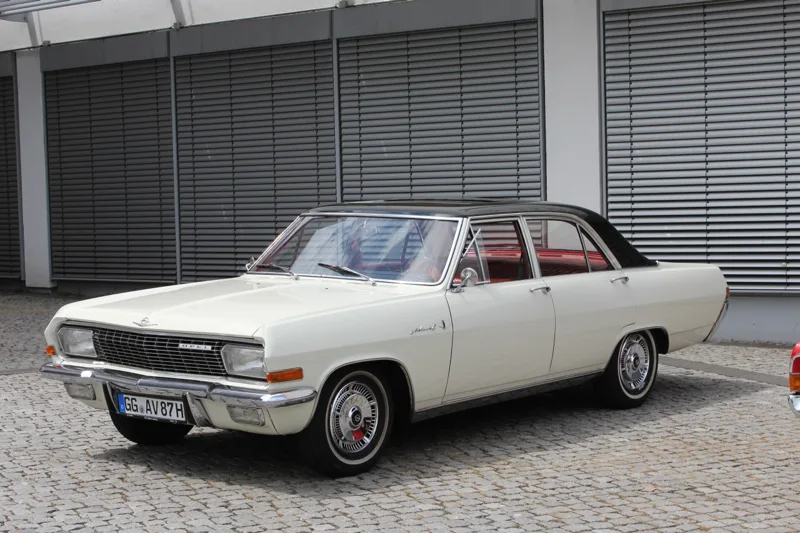
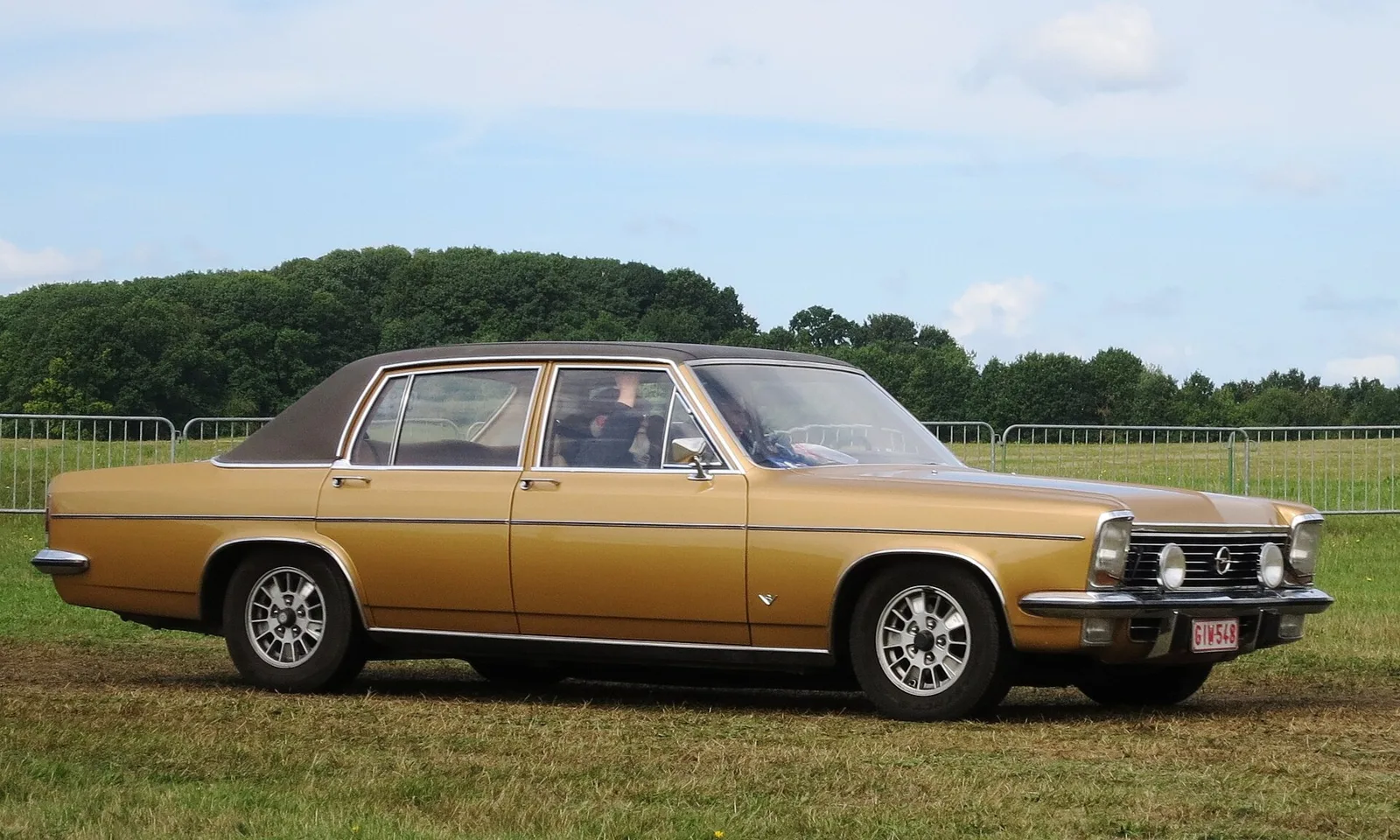
The new cars were a few centimetres shorter and narrower than the KAD A, with a smooth, massive body. Opel's design was more European than its predecessor's, but American influences remained clear, and they did not find the reception among German and European buyers that the company had hoped for.
The three models differed mainly in their lights. The Kapitan and Admiral kept broad rectangular headlamps set into the radiator grille, while the Diplomat had vertical headlamps. Modelled on the Mercedes-Benz W 111, the indicators were tucked behind almost square, domed lenses, while the headlamps sat in the slightly raised wings. The Diplomat's tail lamps were also smaller and narrower than those on the other two. All three had concealed windscreen wipers.
The series was also among the first in Germany to use galvanised body parts, a step intended to improve corrosion protection.
Why did the De Dion rear axle matter?
Every KAD B used a De Dion rear axle, an elaborate and costly layout. It weighed about 20 kg more than a simple rigid axle, but its unsprung masses were lower, which was meant to give good wheel control.
The layout was fitted across all three models.
Engine line-up and output
Pneumatic level control was available on all three models, and it raised the braked towing capacity to 2,000 kg.
The 2.8-litre straight-six was already known from the KAD A models.
| Model | Engine | Output |
|---|---|---|
| Kapitan B, one carburettor | 2.8-litre six | 97 kW (132 PS; 130 hp) |
| Kapitan B, two carburettors | 2.8-litre six | 107 kW (145 PS; 143 hp) |
| Admiral B | 2.8-litre six with D-Jetronic injection | 121 kW (165 PS; 162 hp) |
| Diplomat B | 2.8-litre six | 118 or 121 kW (160 or 165 PS; 158 or 162 hp) |
| Diplomat V8 | 5.4-litre Chevrolet V8 | 169 kW (230 PS; 227 hp) |
What safety equipment did the KAD B have?
The KAD B had crumple zones, a stable passenger cell and a generously padded interior, as well as a collapsible steering column, dual-circuit brakes with discs at the front, a servo and a load-sensitive brake limiter.
These items were listed as part of the range's safety equipment.
Which engine changes did the KAD B bring?
The 2.8-litre six received a modest power rise through changes to its carburettor and exhaust, as well as hydraulic tappets. A fuel injection system developed with Bosch became optional for the six.
The Admiral's injection gave it 121 kW (165 PS; 162 hp), and the Diplomat V8 used the Chevrolet unit with four internally ventilated disc brakes. The Diplomat V8 was also offered as a long version from mid-1973.
What changed on the Admiral and Diplomat through the 1970s?
In September 1972 the Admiral's radiator grille gained horizontal ribs and the Opel emblem. The dashboard was reworked in April 1976, with glare-free instruments, a four-spoke steering wheel and altered switches. Three Admiral variants, the S, H and E, offered automatic transmission and power steering until April 1976, when all versions were renamed Diplomat.
The Diplomat itself received a light update in September 1972, when the Opel emblem moved into the radiator grille. In early 1976 the Diplomat V8 gained light-alloy wheels, tinted glass and a windscreen-washer system for the headlamps.
How much did a Diplomat V8 cost?
In April 1970 a Diplomat V8 with three-speed automatic cost DM 21,556, which equals about 47,400 euros in inflation-adjusted terms. A Mercedes 300 SEL 3.5 with 147 kW (200 PS; 197 hp) and air suspension cost DM 29,637, or about 65,200 euros today. That made it more than 35 percent dearer.
Standard equipment included automatic transmission and power steering. Buyers could add air conditioning, an electric sunroof, leather upholstery, electric windows, mirrors adjustable from inside the car, H4 halogen headlamps and an electronic antenna built into the windscreen, which became standard on the Diplomat from summer 1971.
Which American cars did some Opel dealers sell?
Some Opel dealers used the favourable dollar exchange rate to sell American Chevrolet and Cadillac saloons imported from the USA. Although the cars were not Opels, they were sold through Opel dealerships. Those cars came from the same group, and they used the same units as the Opel models.
Because Opel, Chevrolet and Cadillac all belonged to General Motors, the imported cars and the Opel saloons shared identical units. Chevrolet was Opel's sister brand, and its V8 was the one the Diplomat used.
Why did production fall so sharply?
Opel's share of the luxury segment had been slipping since the mid-1960s, mainly to Mercedes-Benz and BMW. Mercedes-Benz introduced the new S-Class in 1972, and the first oil crisis of 1973 caused a further sharp drop. Production fell by 90 percent, from 17,777 cars in 1969 to 1,754 in 1974.
The KAD B series was discontinued in July 1977. There was no direct successor, and a project already under way was dropped.
How did the Senator and Monza relate to the KAD B?
The top model from April 1978 was the Senator, with its coupe version, the Monza. Both were much smaller than the Diplomat, and some authors place them in the upper mid-size class, although Adam Opel AG describes them differently.
Neither car was a like-for-like successor to the big saloon.
Did Opel use the KAD cars in rallying?
During Opel's works rally involvement of the 1970s there were three factory-supplied Admiral estates, which served the team as mechanics' and tyre-transport vehicles.
They appear in promotional films for the Opel Euro Dealer Team, which supported Walter Rohrl's campaign in the European Rally Championship. They wore the colours of the Ascona A racer. Whether they were factory or Vogt conversions is unclear.
Which special bodies were made on the KAD B?
Four Diplomat convertibles were built for VIP transport in 1971, with Carrozzeria Fissore and Karmann doing the work, and all four survive in good condition in private hands. Vogt in Bad Neuenahr built fastback saloons, with sloping rears and large tailgates, for ZDF outside-broadcast teams. Those had 850 litres of boot space and a gross weight of 2,105 kg (4,641 lb).
Vogt also built estates and hearses on the KAD base, as well as ambulances. The ambulances had their floor pans lengthened in Bad Neuenahr, and the bodies were then built by Miesen in Bonn. A six-door stretch limousine was built as a one-off because demand did not justify more.
Which concept cars were based on the KAD B?
Under Charles "Chuck" Jordan, Opel's design team came up with a two-door fastback with a low nose and a large glass tailgate. Its distinctive feature was a canopy hinged to lift up in place of conventional doors.
A working prototype with the Diplomat V8's drivetrain and chassis was built within a few months, and the coupe caused a sensation at the 1969 Frankfurt show. It is regarded as the concept forerunner of the Bitter CD. Chuck Jordan used the car privately for many years after the show.
Pietro Frua also designed a notchback coupe for the Frankfurt show of 1969, using the chassis and drivetrain of a Diplomat 2.8. The press nicknamed it the Glasomat, because it recalled Frua's earlier Glas V8. Only one example was built, and it still exists in Germany. A year later Frua produced, on behalf of Opel, a revised version of Jordan's coupe aimed at series production, shown in silver at the Paris Motor Show in 1970. Frua kept the basic layout but changed the beltline and the rear section, which received extra side windows, and the canopy gave way to conventional doors. Two of these were built, and both still exist.
Other makers used the KAD B as a base. Intermeccanica built 125 Indra cars in Italy from spring 1971 on the Diplomat V8. Some late Indra coupes were fitted with Ford drivetrains, just before output stopped in early 1975. From late summer 1973 Bitter, with support from Opel and Baur, built the Bitter CD with the Diplomat's 5.4-litre V8 and a fastback body with flip-up headlamps. Production reached 395 cars by the end of 1979.
How many KAD B cars are left?
Few KAD models survive, because sales were low and the cars passed to ever less careful owners over more than 45 years. Good restored examples are now sometimes traded for significantly more than Mercedes models, and spare parts for the large Opels are harder to find, which makes upkeep dearer. The Admiral and Diplomat survive in far greater numbers than the Kapitan, which is the rarest of the three.
Registrations in Germany on 1 January 2015, according to the Federal Motor Transport Authority, were 228 Admiral 2800 H, 341 Diplomat V8 and 111 further cars listed as Admiral 2800 H. Only a few Kapitan examples survive from the start of the range, which was always the rarest of the three.
Where did the KAD B appear in popular culture?
In an episode of the cartoon series SpongeBob SquarePants first broadcast in Germany on 4 October 2002, the German dub has the character Patrick ask whose white Opel Kapitan is still lit up. The English original describes a white sedan, which is the American term for a notchback saloon of the Kapitan's type.
In the series Der letzte Bulle, the lead character gets around in a green Diplomat B of 1972.