How a power source took the strain out of turning the wheel, from an 1876 experiment and a 1951 Chrysler to today's electric racks and steer-by-wire cars.
Power steering uses hydraulic or electric assistance to reduce the effort needed to turn the wheel. Hydraulic systems date to Francis W. Davis's 1926 demonstration and reached cars in 1951. Electric systems followed from 1988, and some modern cars use steer-by-wire with no mechanical link.
Power steering is a system that reduces the effort needed to turn a motor vehicle's steering wheel by using a power source to assist the steering. Hydraulic or electric actuators supply extra energy to the steering, so the driver can work far less hard at ordinary speeds and much less when parking or crawling. Many systems also add artificial feedback, so the wheel still tells the driver something about the road.
Where did power steering begin?
The earliest known example dates to 1876, when someone called Fitts apparently fitted power steering to a vehicle; little else is recorded about him. In 1903 a Columbia 5-ton truck used a separate electric motor to help the driver turn the front wheels. Robert E. Twyford of Pittsburgh included a mechanical power steering device in his 1900 patent for a four-wheel-drive system.
The first practical system came from Francis W. Davis, an engineer in the truck division of Pierce-Arrow, who demonstrated hydraulic assistance in 1926. General Motors judged his design too expensive to produce, so Davis joined Bendix, a parts maker for automakers. Wartime needs for armoured cars and tank-recovery vehicles increased the demand for easier steering.
Chrysler introduced the first commercially available passenger car power steering in 1951, on the Imperial under the name Hydraguide, and it drew on some of Davis's expired patents. General Motors followed in 1952 with a Cadillac whose system built on Davis's work from almost twenty years earlier. Charles F. Hammond of Detroit filed further improvement patents in Canada in 1958.
Power steering began as a way to make heavy vehicles manageable, and it now runs on wires.
Why did power steering spread so widely?
American manufacturers began offering the technology as optional or standard equipment in the mid-1950s. Today it is widely fitted around the world, because front-wheel drive, greater vehicle mass, cheaper assembly lines and wider tyres all increase the effort needed to steer. Heavier vehicles would be very hard to manoeuvre at low speeds, while very light cars may not need assistance at all.
Feel matters as much as effort. A 1999 study of real-world truck and car drivers found that they expect the feedback torque to increase with speed. Early power steering lacked that effect, and drivers disliked it for that reason.
How does hydraulic power steering work?
A hydraulic system multiplies the force applied to the steering wheel and sends it to the front road wheels. The pressure usually comes from a gerotor or rotary vane pump driven by the engine. A double-acting hydraulic cylinder pushes on the steering gear, and the steering wheel operates valves that control how much fluid reaches the cylinder. The harder the driver turns the wheel, the more fluid the valves admit, and the more force steers the wheels.
Many designs measure the driver's effort with a torsion bar at the bottom of the steering column. The bar is thin and flexible, while its lower end resists rotation, so it twists in proportion to the torque applied. The difference between the two ends of the bar moves a valve, and a greater twist gives more assistance. The system is designed so that a failed booster leaves the steering working, though the wheel feels heavier. Most cars use a mineral-oil fluid that is similar to, and sometimes the same as, automatic transmission fluid.
The pump is a positive-displacement type, so its flow rises with engine speed. That would make the steering too quick at high revs, so a restricting orifice and a flow-control valve send some of the output back to the reservoir. A pressure relief valve guards against dangerous pressure when the piston reaches the end of its stroke.
What is variable-assist steering?
Some hydraulic systems add an electronic control valve that lowers supply pressure as speed rises, giving light steering when parking and firmer feel on the road. Citroen invented a related approach in its DIRAVI system. There, the force that steers the wheels comes from the high-pressure hydraulic system and stays the same at any speed, while a separate hydraulic circuit pulls the wheel back toward the centre, with pressure rising in step with road speed. Citroen first fitted it to the SM in 1970, where it was known as VariPower in the UK and SpeedFeel in the United States.
What are electro-hydraulic systems?
Electro-hydraulic systems, sometimes called hybrid systems, keep the hydraulic assist but use a pump driven by an electric motor instead of a belt from the engine. Ford experimented with this in 1965, fitting a fleet of Mercury Park Lanes with two 5-inch rings in place of a large wheel, a fast 15:1 ratio and an electric pump in case the engine stalled. Subaru's XT6 of 1988 used an adaptive Cybrid system that changed assistance with speed.
Toyota's second-generation MR2 of 1990 used electro-hydraulic steering because its engine sat behind the driver, which avoided long hydraulic lines to the rack. Volkswagen's Golf Mk3 Ecomatic of 1994 had an electric pump, so steering still worked while the computer switched the engine off to save fuel.
| Type | Power source | Mechanical link |
|---|---|---|
| Hydraulic | Engine-driven pump | Direct link to the steering gear kept |
| Electro-hydraulic | Electric pump | Direct link kept |
| Electric (EPS) | Electric motor under control of an ECU | Mechanical backup retained |
| Steer-by-wire | Electrical power and data only | No mechanical connection |
How do electric power steering systems work?
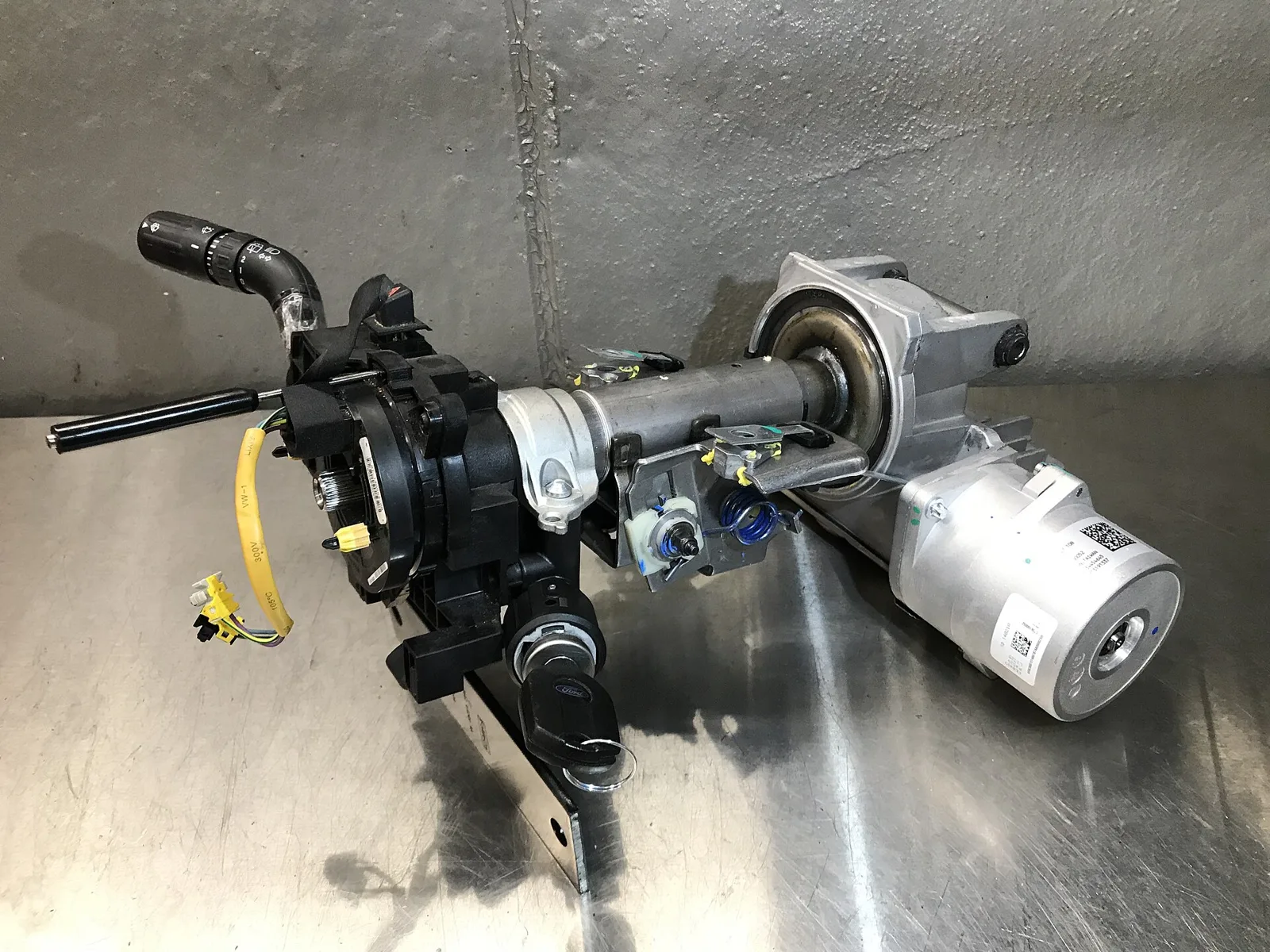
Electric power steering, often called EPS or motor-driven power steering, uses an electric motor and an electronic control unit instead of a hydraulic circuit. Sensors detect the position and torque in the steering column, and a computer applies assistance through the motor, which connects to either the steering gear or the column. Engineers can match the steering response to variable-rate and variable-damping suspension, tuning ride, handling and steering for each car.
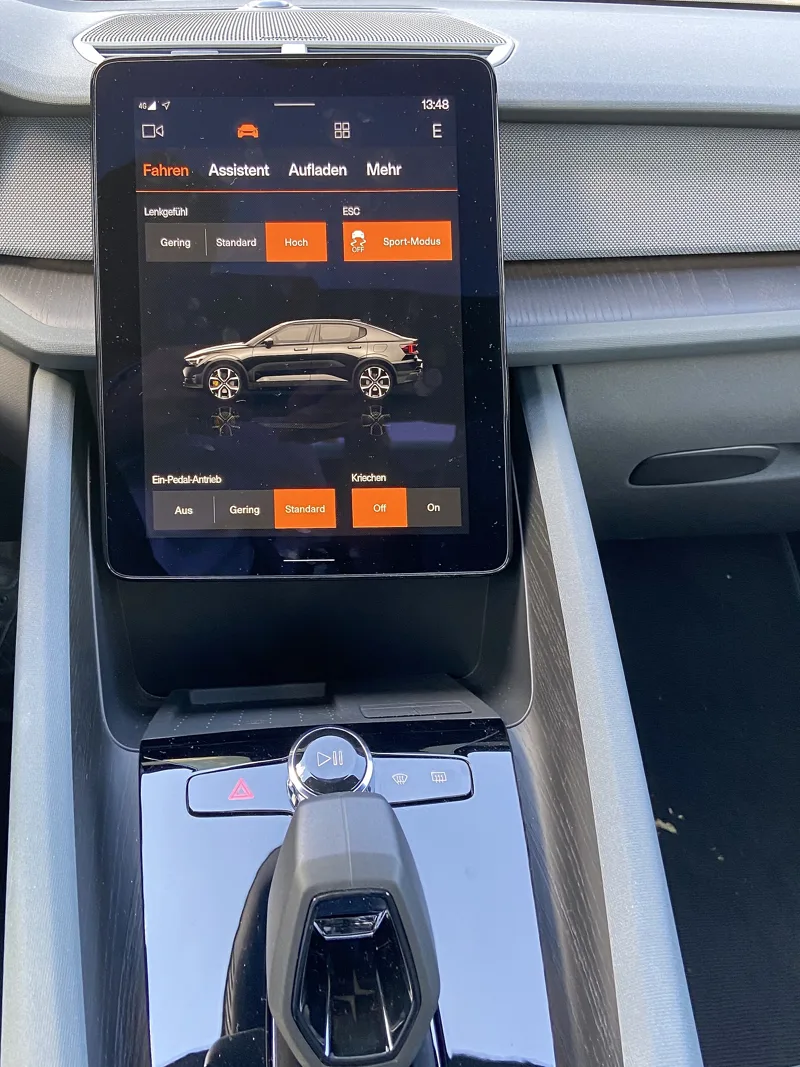
The same electronics allow driver-assistance features such as lane assist and wind drift correction. Fiat group cars let the driver choose between two assist curves with a button marked CITY. Most EPS systems vary the assist so that it is greatest at low speed and lighter at high speed. The mechanical linkage between the wheel and the steering gear stays in place as a backup, so a failure leaves the driver with heavy steering, much like a failed hydraulic system. The NHTSA has helped carmakers recall EPS systems prone to failure.
Electric systems save fuel because no belt-driven pump runs all the time, and they remove an engine accessory along with several high-pressure hoses. They also let electronic stability control vary assistance to help with corrective steering.
The technology has a long history. NSK put electric power steering for battery forklifts into use in 1986. The first electric system on a mass-produced passenger car appeared on the Suzuki Cervo in 1988, but other makers were slow to follow because the motor's inertia made steering feel unnatural. In 1990 the Honda NSX received a direct rack-assist system without a clutch, and brushless motors have since become the norm for rack-type systems. Other early adopters included the Honda Prelude, Subaru SVX, Toyota Prius and BMW Z4.
What is steer-by-wire?
Some power steering systems have no mechanical connection to the steering linkage. These are called drive-by-wire or steer-by-wire, by analogy with fly-by-wire in aviation, and the wire means electrical cables carrying power and data rather than thin cables of wire rope. The largest off-road construction vehicles use them. In 2023 Lexus introduced the RZ 450e with a steer-by-wire system that removes the mechanical link between the wheel and the road wheels, a notable advance for passenger cars.
Some construction vehicles use a different idea altogether. They have a two-part frame joined by a rugged hinge, and opposing hydraulic cylinders move the halves relative to each other so the axles turn out of parallel.
What is variable-ratio steering?
Variable-ratio systems change the steering ratio rather than the assist. In 2000 the Honda S2000 Type V introduced an electric variable gear ratio system, and in 2002 Toyota's Variable Gear Ratio Steering on the Lexus LX 470 combined the ratio change with electronic stability control. BMW's active steering on the 5 Series followed in 2003. These should not be confused with variable-assist steering, which varies torque, nor with non-linear designs such as Mercedes-Benz Direct-Steer, where the ratio changes only with steering angle.