How forward collision warning and automated emergency braking work, why the EU and Japan require them, and how makers from Honda to Volvo built their versions.
A collision avoidance system uses radar, cameras or lidar to detect an imminent crash, then warns the driver or brakes and steers automatically. Forward collision warning only alerts, while automated emergency braking acts on its own. Japan and the EU require AEB, and the US relies on carmaker agreements.
A collision avoidance system watches the road ahead and then warns the driver, brakes, steers or does all three to prevent a crash or reduce its severity. Also called a pre-crash or forward collision warning system, it is an advanced driver-assistance technology that is mandatory in some markets and optional in others. Its core job is to detect an impending impact sooner than most people can react.
How does a collision avoidance system detect danger?
In its basic form, a forward collision warning system monitors the car's own speed, the speed of the vehicle ahead and the distance between them. If the gap closes too quickly, it warns the driver before a crash becomes unavoidable.
The logic behind that warning is simple, but it depends on sensors that can see the road ahead accurately in real time.
Radar is the workhorse because it works in all weather. Some systems add lidar, a laser sensor, or cameras that use image recognition to detect an imminent crash. Manufacturers often combine these sensors in a single package.
Some systems use GPS to recognise fixed dangers such as approaching stop signs, using a location database. Pedestrian detection is also a common feature, and Euro NCAP has taken it into account in its ratings since 2016.
A collision avoidance system does not replace the driver, but it can react in the fraction of a second that a person needs to notice.
What is the difference between warning and braking?
Forward collision warning alerts the driver but does not brake by itself. Automated emergency braking, or AEB, goes further, because once an impending collision is detected, it can act without driver input by braking, steering or both. The distinction matters, since a warning relies on the driver responding in time.
Euro NCAP describes AEB as having three characteristics. The system is autonomous, meaning it acts independently of the driver. It is emergency, so it intervenes only in a critical situation. And it is braking, since it tries to avoid the accident by applying the brakes. Time-to-collision can be used to choose between braking and steering, and braking is the usual choice at low speeds.
Avoidance by steering is newer and mainly studied in research projects. It has real limitations, including over-dependence on lane markings, sensor limits and the interaction between the driver and the system.
Which regulations govern these systems?
The World Forum for Harmonization of Vehicle Regulations sets the definition of AEB, a term that some jurisdictions use for the same function. UN ECE Regulation 131 demands that a car detect a likely forward impact and use its brakes to slow down, so the crash is avoided or softened.
UN ECE Regulation 152 sets a deceleration figure of 5 metres per second squared for these systems.
Countries have adopted these rules at different speeds. Japan has required AEB since 2020, and the European Union has required it since 2022. Collision avoidance systems range from mandatory equipment in some countries to voluntary agreements in others, where carmakers have pledged to make such systems standard over time, as in the United States.
Other rules cover specific functions. UN ECE Regulation 79 describes the emergency steering function, which automatically activates the steering for a limited duration to avoid or reduce a collision. UN ECE Regulation 157 covers automated lane keeping systems, and the EU has not yet set a date for those.
What does an automated lane keeping system have to do?
Automated lane keeping systems deal with avoiding some collisions by defining an imminent collision risk as a situation that cannot be avoided by a braking demand of less than 5 m/s. In that case, the system performs an emergency manoeuvre designed to avoid or mitigate the collision, and it must not cause any collision that is reasonably foreseeable and preventable.
The rules set a demanding list of behaviours. The system must adapt speed to keep a safe distance from the vehicle in front, and it must be able to halt the car behind a parked vehicle, a stationary road user or a closed lane. It must also avoid a leading vehicle, a vehicle cutting in and an unobstructed pedestrian crossing in front of the car, up to its maximum operational speed.
Who supplies the sensors and braking parts?
Various vendors provide AEB components to automakers, and the global market is led by a small group of established companies. The main radar vendors include Bosch, Delphi, Denso, Mobileye, TRW and Continental. A single carmaker may source systems and sensors from several suppliers, so the same brand can offer very different levels of sophistication.
The frequency of false alerts can also differ from model to model and from trim level to trim level, depending on the camera and laser equipment installed. That variation is one reason why buyers should not assume every version of a name performs the same way. Adoption is uneven too. In the UK, one-quarter of new vehicles might have some kind of AEB system, while only 1% of previously sold cars might have it.
How did the leading makers build their systems?
Several makers published their milestones in detail, and the table below summarises the first step each one took in production cars. The entries run from 2003 to 2012. Each entry names the system, its launch year and the detail that marked it out from rivals.
| Maker | System | Year | Notable detail |
|---|---|---|---|
| Honda | Collision Mitigation Brake System (CMBS) | 2003 | First production system to provide automatic braking |
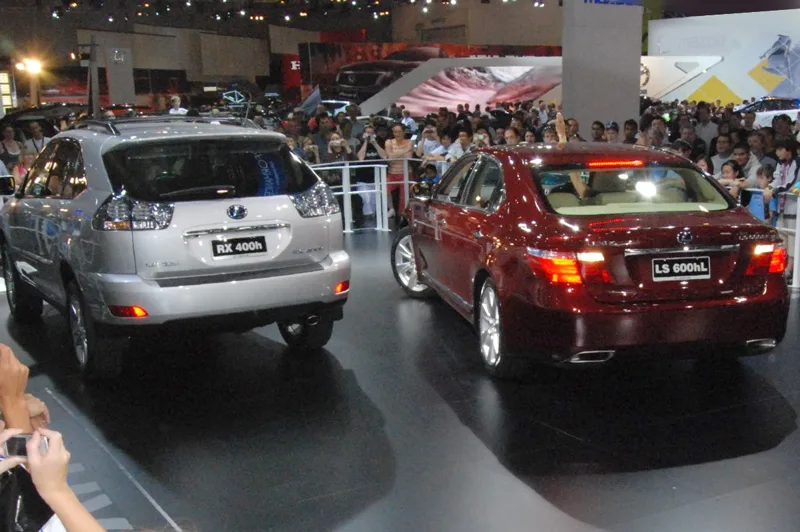
| Toyota | Pre-Collision System (PCS) | 2003 | First radar-guided forward-collision warning in the US, on the Lexus LS 430 |
| Subaru | EyeSight | 2008 | Stereo cameras, launched on Japanese-market Legacy models |
| Volvo | Collision Warning with Auto Brake | 2007 | Radar and camera fusion, with a head-up display warning |
| Mercedes-Benz | Pre-Safe Brake | 2009 | Full (100%) autonomous braking on the W212 E-Class |
| Audi | Pre sense | 2010 | Twin radar and monocular camera on the 2011 A8 |
| Ford | Active City Stop | 2012 | Windscreen-mounted lidar on the range-topping Focus Titanium |
Honda's system used three warning stages. The first gave audible and visual warnings to brake. If that was ignored, the E-Pretensioner tugged the shoulder belt two or three times as a tactile warning. If a collision was judged unavoidable, the seat belt slack was taken up and the brakes were applied automatically. Honda later launched Honda SENSING with the 2014 Legend, using a millimetre-wave radar and a monocular camera.
Honda SENSING 360 followed in 2021, using five millimetre-wave radar units and a front camera to reduce blind spots. Its features include front cross-traffic warning and lane change collision mitigation. In 2023, Honda SENSING 360+ added a driver monitoring camera and high-definition maps, and it can help stop the vehicle if the driver becomes unresponsive.
Toyota's Pre-Collision System began on the Harrier in February 2003. The Lexus LS 430 brought it to North America in September 2003, and Toyota later added a driver monitoring system that checks where the driver is looking. In 2017, Toyota sold more vehicles with collision warnings in the US model year than any other brand, a total of 1.4 million or 56% of its fleet.
How did Mercedes-Benz and Audi approach the problem?
Mercedes-Benz first showed its Pre-Safe system at the Paris Motor Show on the 2003 S-Class. It used electronic stability control sensors and brake assist sensors to tighten the seat belts, adjust seats, raise folded rear headrests and close the sunroof when a collision was likely, including a rollover.
In 2006, Mercedes added a radar-based collision warning to its Brake Assist BAS Plus.
The Pre-Safe Brake on the CL-Class C216 offered partial autonomous braking, at 40% or up to 0.4g deceleration, if the driver did not react to BAS Plus warnings. In 2009, the E-Class W212 brought full, 100% autonomous braking, with maximum force applied approximately 0.6 seconds before impact. Later versions added pedestrian detection that works up to 72 km/h (45 mph).
Audi's Pre sense system uses twin radar sensors and a monocular camera, and it was introduced in 2010 on the 2011 A8. Its Pre sense plus variant works in phases, starting with warnings, then light braking and partial braking at 3 m/s2. The fourth phase increases braking to 5 m/s2 and then applies full braking power roughly half a second before the projected impact.
What problems have affected these systems?
Some systems have drawn scrutiny. Nissan's collision avoidance systems on late-model Rogue vehicles came under investigation by the US National Highway Traffic Safety Administration over claims that they braked for no reason. Nissan handled the issue through technical service bulletins, which it described as a performance update.
At least three such bulletins since January 2019 pertained to reprogramming the radar control unit, and at least 553,860 cars from the 2017 and 2018 model years were potentially affected.
Volvo recalled 121,000 cars in March 2020 because the auto emergency braking might fail to detect an object, so it might not work as intended.
How are these systems rated and tested?
Euro NCAP and the other rating bodies now take autonomous emergency braking into account in their New Car Assessment Programme. Euro NCAP began assessing AEB city and AEB interurban in 2014, added AEB pedestrian and AEB cyclist assessments in 2018, and has taken pedestrians into account in the AEB rating since 2016.
The Australasian body ANCAP has also provided assessments for AEB city, AEB interurban, AEB pedestrian and cyclist since 2018.
What do these systems cost?
Many vehicles now have AEB fitted as standard, but it is not available on every car. When it is offered as an option, the price in the UK can range from 180 pounds for AEB city only to 1300 pounds for regular AEB. The cost depends partly on whether other safety systems are already installed.
The sensing hardware behind adaptive cruise control and forward collision warning suits AEB well, and it is often a precondition for it. That overlap explains why AEB often appears as part of a wider package rather than as a stand-alone extra.
How do aviation and maritime systems compare?
In aviation, two related systems matter most: the Traffic Collision Avoidance System, known as TCAS, and its successor ACAS X. Both are designed to detect and prevent mid-air collisions. They rely on transponder signals and predictive algorithms to give pilots resolution advisories, and they are standard in most commercial aircraft.
In the maritime domain, collision avoidance technology is increasingly integrated into commercial and recreational vessels. Watchit offers a navigation safety product that applies artificial intelligence to readings from GPS, compass, sonar, wind and speed sensors, and it produces audio and visual alerts in real time. Its alert zones adapt to the vessel's speed and direction. These domain-specific systems share the goals of automotive collision avoidance, which is to support human awareness and reaction time.