Ultrasonic echoes, a camera view and electric power steering do the work. Toyota's first production system arrived on a Japanese Prius in 2003.
Automatic parking uses bumper sensors, cameras or radar to find a gap, then controls steering and speed to guide the car in. Toyota's Intelligent Parking Assist reached the Japanese Prius in 2003 and the Lexus LS in 2006. Valet systems that park without a driver aboard have followed since 2015.
The first mass-market car that could steer itself into a parking space went on sale in Japan in 2003, and it had a blind spot that is slightly alarming in hindsight: early versions of the technology struggled to pick out cats, baby prams and pedestrians. Two decades on, self parking cars are a common option, and a handful of makers now let the driver step out and send the car off alone.
Automatic parking steers by sonar echoes, camera views and a computer that plans the wheel movements in advance. Toyota's Intelligent Parking Assist turned that mix into a production feature, and the driver, even so, still has jobs to do.
What automatic parking actually does
Automatic parking is a system that takes over the awkward part of a journey: moving a car from the traffic lane into a bay. It can handle parallel, perpendicular and angle spaces. The system works the steering and the speed together, and it watches the surroundings as it goes so the path stays clear of anything solid.
The purpose is comfort and safety in tight places, where a driver needs plenty of attention and experience to steer well. Such systems have been shown to reduce the stress people feel when parallel parking or backing into a garage. Pulling out is covered too: the car finds room to move inside its space, lines itself up at the rear of the gap, and swings back into the lane.
A car cannot step sideways into a space, which is why parking is hard for a driver and for a computer.
Why a car cannot simply slide into a space
A supermarket trolley can be nudged sideways. A car cannot. It has a small set of commands, chiefly steering angle and speed, but more numbers are needed to describe where it is and which way it faces. Engineers call a machine with fewer controls than coordinates a nonholonomic system, and the practical result is that a car cannot step straight to the position it wants. It has to get there by a planned sequence of movements.
That is the whole reason parallel parking is a skill. The software solves it by planning the steering and speed profiles first, then shaping the path of the vehicle to fit the space. It computes the controls in real time as the car moves, drawing on servo data from the vehicle and range readings from outside. Different spaces produce different path shapes.
How does self parking work? The sensors behind it
A parking system has to sense an obstacle before it can avoid one. The common method uses sensors on the front and rear bumpers that behave a little like a bat: each sends out a signal, listens for the reflection, and works out the distance to whatever it hit from the time of flight.
Some systems add cameras, including all-round views stitched into a single picture, or radar. These measure the size of a gap and the distance from the kerb, which the bumper sensors alone cannot do so easily.
Toyota's version shows how the pieces connect. Sonar sensors sit on the front and rear bumpers, and two more watch from the front fenders. All of them feed a central processor, which also takes the picture from the reversing camera. The same processor already works out steering angles for ordinary parking, so the automatic version is an extension of it.
Intelligent parking assist, and where it started
Toyota's Intelligent Parking Assist System, sold in the United States under the name Advanced Parking Guidance System on Lexus models, was the first production automatic parking system. Toyota developed it in 1999, initially for Japanese hybrid Prius and Lexus models. The first version reached customers on the Prius sold in Japan in 2003.
That original system was built for reverse parallel parking. Cameras at the front and rear and sensors in similar places fed a dashboard picture of the lot. The driver nudged a box with arrows until it sat over the space, pressed Set, and the system took the steering.
It was far from perfect. Detection of small or soft obstacles was patchy, and in a space that was too small the system kept flashing warnings, leaving the driver to sort things out. Toyota worked through the list. In 2005 an upgrade added recognition of painted parking stripes. A version in 2006 brought integration with the parking sensors and colour displays showing whether the space was big enough.
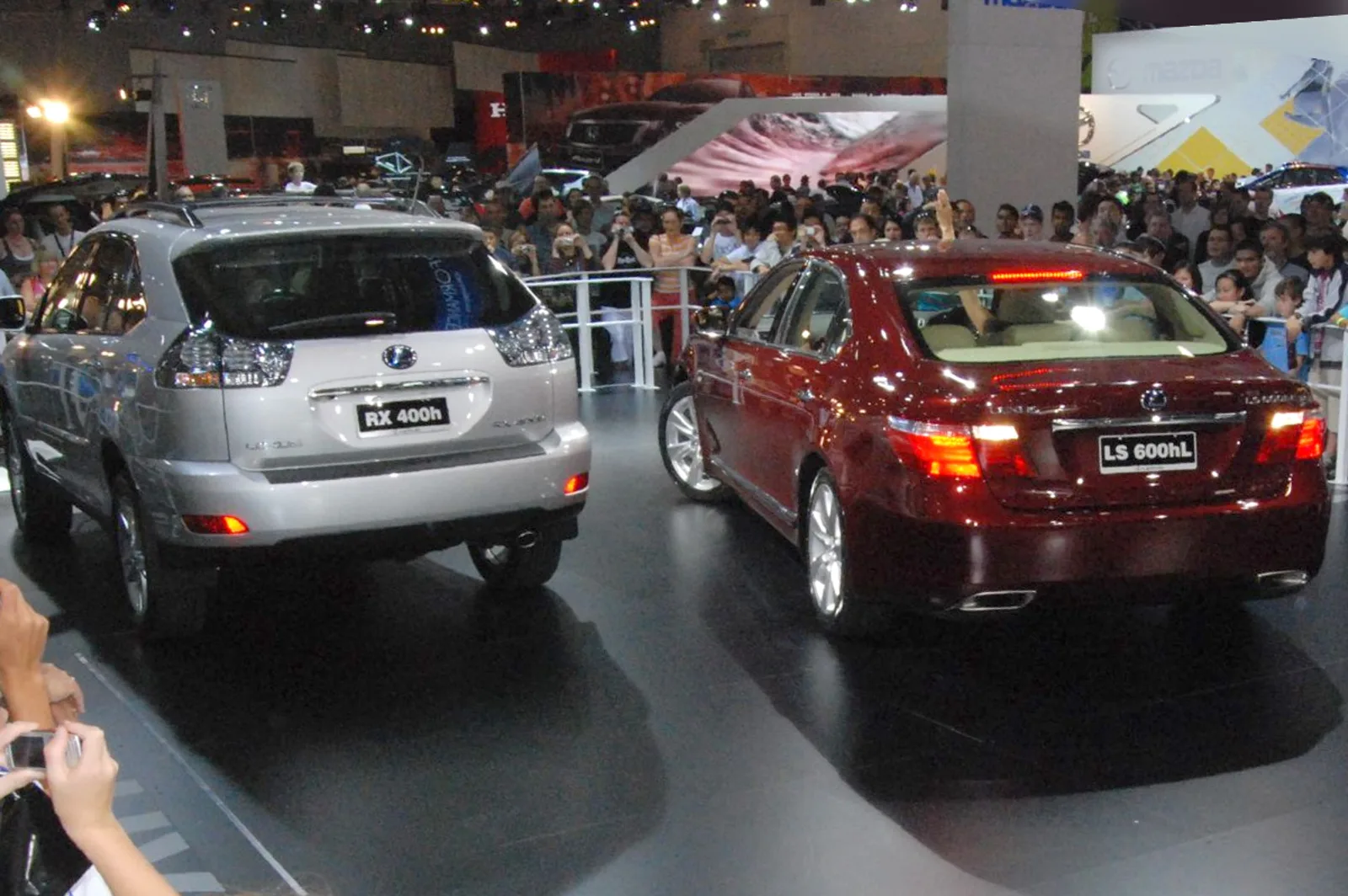
That 2006 version was also the first to appear outside Japan, on the redesigned Lexus LS. The system reached the American Prius with the third generation in 2009. In Asia and Europe the feature is marketed as Intelligent Park Assist System for both Lexus and Toyota.
Steps in a park assist routine
Toyota's routine runs in these steps.
- The driver stops alongside the space and creeps forward until the rear bumper has passed the rear wheel of the car parked ahead of the gap.
- Shifting into reverse switches on the camera and shows the rear view on the dash screen.
- The driver presses the parallel park guidance button. A grid appears with green or red lines, a flag marking the corner of the space and adjustment arrows.
- If the box sits correctly on the space and the lines are green, the space is big enough. If the box is misplaced or the lines are red, the driver moves it with the arrows until it turns green.
- The driver presses OK, lifts both hands off the wheel and keeps a foot on the brake. Releasing the brake slowly lets the car reverse while it steers itself into the space.
- When a voice announces that the guidance is finished, the driver selects drive and adjusts the position if needed.
Reverse parking works almost identically, except that the rear of the car must face the space so the camera can see it, and the screen adds a rotation selection.
The central processor works out the best steering angles and passes them to the electric power steering. The driver keeps the last word, though. Touching the wheel or pressing the brake firmly cancels the manoeuvre, and the system switches itself off if the car exceeds a set speed. The driver, not the computer, is also responsible for checking that the box on the screen matches the real space.
Timeline of the main automatic parking systems
| Year | Maker | System or model | What it did |
|---|---|---|---|
| 2003 | Toyota | Intelligent Parking Assist, Prius (Japan) | Reverse parallel parking |
| 2006 | Lexus | LS self-parking system | Parallel and angle parking |
| 2009 | Ford | Active Park Assist, starting with Lincoln | Parallel parking |
| 2010 | BMW | Parking assistant, 5 Series | Parallel parking |
| 2013 | Holden | Commodore (VF) | Parallel and 90-degree parking, standard across the range |
| 2014 | Jeep | ParkSense, Cherokee | Parallel and perpendicular parking |
| 2015 | Chrysler | ParkSense, 200 sedan | Offered in a safety package |
Who followed Toyota into automatic parking
Ford brought Active Park Assist to its Lincoln models in 2009, and BMW introduced a parking assistant on the redesigned 5 Series in 2010. By 2012 several makers were developing their own versions. Ford and Lincoln had the feature on the Focus, Fusion, Escape, Explorer and Flex and on the Lincoln MKS and MKT. Toyota and Lexus had it on the Prius V Five and the LS460 range, BMW on the sixth-generation 3 Series, and Audi on the A6. Mercedes-Benz offered its Parktronic system across a spread of models, from the C-Class to the S-Class and several SUVs.
Holden went further than most with the 2013 Commodore (VF), where automatic parallel and 90-degree parking was standard on every car in the range. Jeep followed in 2014 with ParkSense on the Cherokee, and Chrysler offered it on the 2015 200.
BMW also showed a different idea in 2014: an i3 whose parking assistant could be started from a smartwatch.
Automated valet parking: the car parks without you
The next step takes the driver out of the car altogether. Under the name automated valet parking, a car can park itself in certain car parks or garages with nobody aboard.
Bosch announced plans in 2015 for a fully driverless version. The driver leaves the car and starts the manoeuvre from a smartphone, and the system works out the route while monitoring what is around it. Other makers have since added limited versions of their own. Tesla added Smart Summon as part of its Autopilot features in 2019. Mercedes-Benz brought in Intelligent Park Pilot on the S-Class in 2020, co-developed with Bosch and tested at Stuttgart Airport, and later showed it on the EQS in Los Angeles. Audi said in 2021 that it was working on its own system, and in February 2023 BMW announced a partnership with Valeo to develop one.
What self parking means for someone buying or driving a car
The reaction when the feature reached the United States in 2006 was loud. Demonstrations ran on everything from cable news to The Oprah Winfrey Show, and Lexus built two advertisements around it, including one in which a driver parks between two stacks of glasses. Magazine verdicts were split. A CNBC video found the system worked quite effectively with a first-time user, while a video from Automobile Magazine argued that the touchscreen made parking harder. Opinions ranged from useful to impractical depending on the space and the driver.
Rivals could not resist a dig. Audi sold its 2007 A4 as the luxury car for people who can park themselves, and a Hyundai advertisement for the 2007 Azera conceded the Lexus's style and class before arguing the saving would pay for a valet.
For a buyer, the practical points are plain. The driver still checks the space, keeps a foot ready for the brake and can override the car at any moment. The reward is less stress in tight places.
There are open questions too. As these systems spread, concerns about safety, accessibility and privacy have grown, and so has the matter of who is liable when a computer is doing the steering. Some argue for shared liability between users and developers, so that makers are pushed to improve safety without leaving the customer carrying an unfair burden.
What comes after self-parking?
The direction is toward cars that need no driver at the kerb. Valet parking is still being built out, with plans from Bosch, Audi and a BMW and Valeo partnership announced between 2015 and 2023.
Researchers are also reconsidering the mechanics. Volkswagen proposed four-wheel steering for sideways movement on its IRVW Futura concept in 1992, though no commercial version was ever offered. The German Aerospace Center's ROboMObil electric vehicle revisits the idea: it stops in front of an empty space and turns its four wheels through a right angle, leaving rubber marks on the road, ready to move sideways.
Articulated vehicles, which need to avoid jackknifing, are being handled with artificial intelligence methods called adaptive neuro fuzzy inference systems and fuzzy C-means.