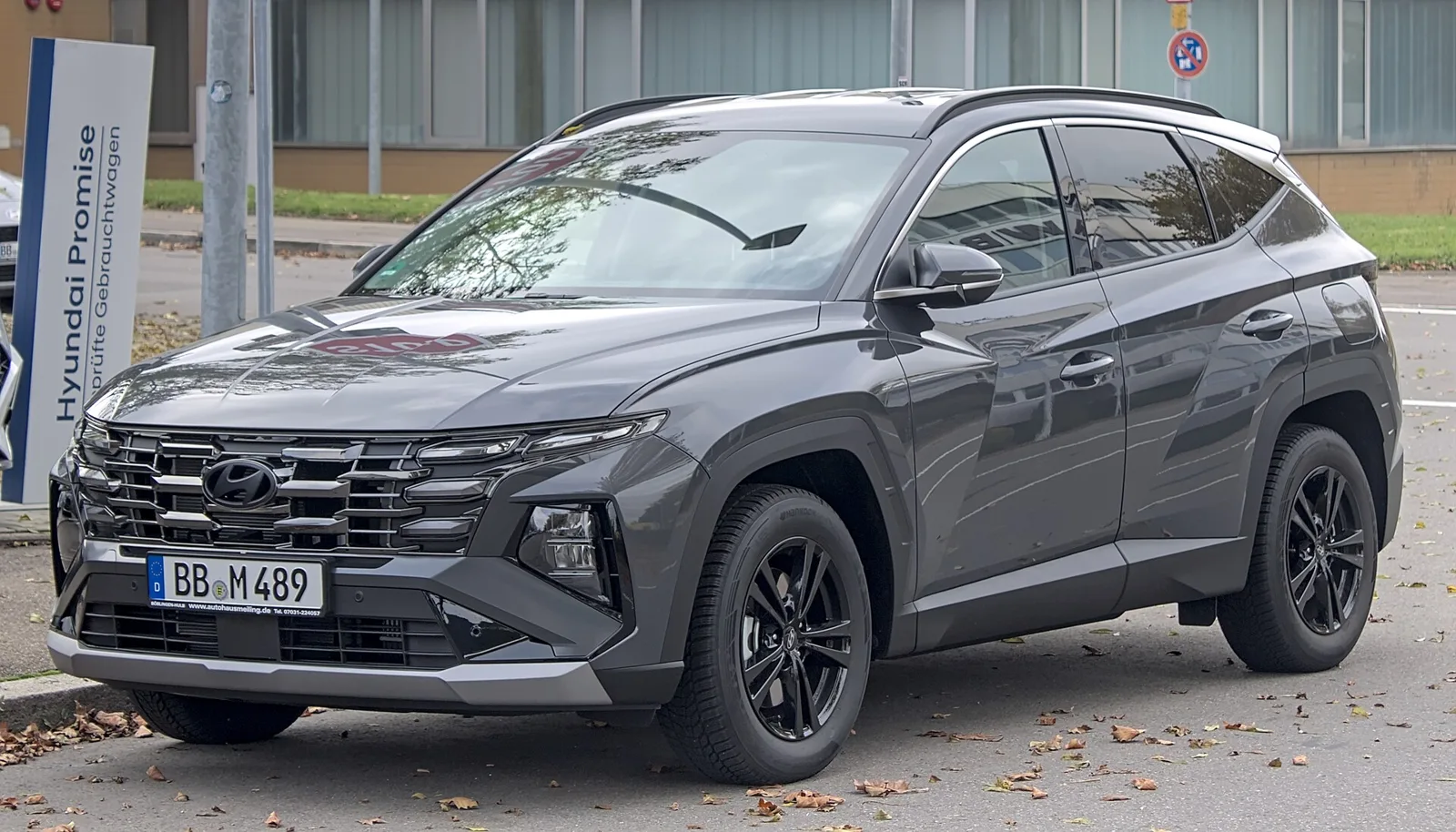
A Seoul-based group that began with a Ford-linked compact, grew into a global volume brand and now sells electric cars under the Ioniq name.
Hyundai is a South Korean carmaker founded in 1967 that sells cars in 193 countries. Its group includes Kia and the Genesis luxury division, and it sold about 4.14 million vehicles worldwide in 2025. Its Ulsan plant has an annual capacity of 1.52 million units.
Hyundai has grown from a 1967 South Korean start-up into one of the largest car groups on earth. Its path has run through a Ford-linked compact, a Mitsubishi-powered first car, a takeover of Kia and a long push to win back buyers on quality.
When was Hyundai founded and by whom?
Hyundai Motor Company was established in 1967 in South Korea, with Chung Se-yung, the brother of Chung Ju-yung. Chung Ju-yung had founded Hyundai Engineering and Construction in 1947. The car company later became the core of the Hyundai Motor Group, which now includes Kia and Genesis.
Chung Ju-yung led the group for decades before his son took over the chairmanship. Euisun Chung was inaugurated as the new chairman on 14 October 2020, and his father became honorary chairman.
Hyundai's founders built the group around construction before turning to manufacturing. That industrial background gave the company deep know-how when it moved into cars, and it later supported large plants, research centres and a global dealer network.
A carmaker that rebuilt its reputation through quality, a long warranty and a steady climb toward global scale.
How did the Pony start Hyundai's car business?
The company's early car work began with the Cortina, released in cooperation with Ford Motor Company in 1968. When Hyundai decided to develop its own car, it hired George Turnbull in February 1974. He had been at Austin Morris and brought in a team of British engineers to build the Pony.
The Pony arrived in 1975 as the first South Korean car, with styling by Giorgio Giugiaro of Italdesign and powertrain technology from Mitsubishi Motors. Exports began the following year to Ecuador, and soon reached the Benelux countries.
The British market opened in 1982, when Hyundai sold 2993 cars in its first year there. The Pony's export success showed that a low-priced car from a new maker could find buyers far from home.
Overseas expansion was central to the early strategy. The company learned to adapt its products for foreign buyers, and that experience prepared it for the larger markets it would enter later that decade.
When did Hyundai enter the United States?
Hyundai began selling cars in the United States on 20 February 1986 with the Excel. That first year produced 168,882 sales, a record for any car brand in its first year in the market. Early reliability problems soon damaged the reputation, and sales fell sharply.
Cost-cutting had made the Excel less reliable, and many dealerships either profited from repairs or gave up on the model. The brand's image in the US suffered badly, and it took a long campaign to recover.
Recovery depended on reinvestment rather than promotion alone. In 1991 the company built its own transmission and an in-house petrol unit, the Alpha, which gave it more control over quality.
How did Hyundai repair its quality reputation?
Hyundai invested heavily in quality, design, manufacturing and long-term research. It added a 10-year or 100,000-mile (160,000 km) warranty for cars sold in the United States. By 2004 the company ranked second in initial quality in J.D. Power's North American survey.
The overhaul began in 1998, when Hyundai set out to establish itself as a world-class brand. The changes were slow, but they laid the groundwork for the later growth in the American market.
Design investment followed. Hyundai opened a design centre in Fountain Valley, California, in 1990, and the work there fed models that later sold strongly in North America.
What did the Kia takeover change?
In 1998, after a shake-up in the South Korean car industry, Hyundai acquired the majority of rival Kia Motors. The move followed overambitious expansion and the Asian financial crisis, which had hit the sector hard. The deal reshaped the Korean industry and gave the group a second brand with its own following.
Today Hyundai owns 33.88 percent of Kia Corporation, and the three brands together make up the Hyundai Motor Group. Kia and Hyundai share platforms and engineering across many models, which lets the group spread development costs widely.
The group's structure has given the company scale in purchasing, research and export logistics, which helps it compete on price and volume. That scale has become essential as rivals in China and elsewhere have grown stronger.
Where does Hyundai build its cars?
The Ulsan plant in South Korea is the centre of the group's production, with an annual completed-vehicle capacity of 1.52 million units and around 31,000 workers. Hyundai also runs plants in the United States, India, the Czech Republic, Russia, China and Turkey.
The Alabama plant cost $1.7 billion, and it gave the company a large American manufacturing base. In India the company runs two plants with a combined annual capacity of 600,000 units, and the Czech plant at Nosovice has a capacity of 300,000 cars.
The Piracicaba plant in Brazil has a capacity of 180,000 cars per year, and it builds small cars for the Brazilian mass market. Hyundai's footprint now stretches across Asia, Europe, the Americas and Africa.
Hyundai's Brazilian operations also include a partner plant. Production with the local partner Caoa Group, at a plant in Anapolis, started with an earlier model and later added the Tucson.
How has Hyundai's design language evolved?
Hyundai's Fluidic Sculpture philosophy, inspired by nature, appeared in the early 2000s. In 2006 the company hired Thomas Burkle, who had previously worked for BMW, to head its design centre in Russelsheim, Germany. Later designs moved toward sharper, sportier forms.
The Sensuous Sportiness direction was announced in 2018 and first appeared at the Geneva show with the Le Fil Rouge concept. The design identity later won the Design Value Award 2020 from the Design Management Institute.
In 2024 the company showed the Art of Steel design language with the Intium hydrogen concept. A later concept followed in 2025 with sharper lines, and the grille of the 2022 NX4 Generation Tucson was the first to carry the new look.
What is the Ioniq brand?
Ioniq is Hyundai's electric sub-brand, launched in August 2020 and treated as a stand-alone brand alongside Genesis. It is built on the E-GMP platform, which underpins the Ioniq 5, Ioniq 6 and Ioniq 9. The name blends ion and unique, and it signals the company's focus on electrified cars.
The Ioniq 5 was the first E-GMP vehicle to reach the market. It charges from 10 to 80 percent in 18 minutes, uses 800 V charging with a 350-kW charger, and claims 480 km (298 mi) of range in its rear-wheel-drive 72.6 kWh form.
Hybrid technology has a long history at Hyundai as well. The Elantra HEV and Accent HEV were unveiled in 1999 and 2000, and mass production of hybrids began in 2008, using lithium polymer batteries rather than lithium-ion.
Electrified sales reached 961,812 vehicles in 2025, a rise of 27 percent. The Ioniq 9 is produced from 2025 at the Georgia plant in the US, which adds American capacity to the electric range.
The electric push reflects a wider shift in the company's strategy. The battery venture with LG Energy Solution in the US, formed in May 2023, shows how Hyundai intends to secure supply for its own vehicles.
How has Hyundai performed in motorsport?
Hyundai's rally squad entered the World Rally Championship in 2000 and has run in every season since 2014. Juha Kankkunen, a four-time world champion, was hired for 2002, and his fifth place in New Zealand was the team's best result.
Budget constraints hurt the programme, and in September 2003 Hyundai announced its withdrawal from the WRC. Hyundai Motorsport was founded in Alzenau in 2012 to manage the company's global racing activity.
Hyundai's motorsport story is one of returns and withdrawals rather than unbroken success, and the team's record reflects those stop-start years. The brand's presence in rallying has been tied to its wider marketing and engineering aims.
Hyundai also considered Formula One after a Korean Grand Prix was planned. The race was first held in 2010, but Hyundai did not enter.
What controversies has Hyundai faced?
The most serious case involved fuel economy. After an investigation, the EPA found that 35% of 2011-2013 Hyundai and Kia vehicles had inflated fuel economy figures, and penalties of $350 million followed in 2014. The group agreed to reimburse owners of the affected vehicles.
Other complaints included a Brazilian Veloster that delivered 121 CV (119 hp) instead of the advertised 140 CV. A theft vulnerability in certain US models that lacked immobilizers led to a settlement of about $200 million, which a judge rejected.
The theft trend, which followed a social media challenge, has led to eight fatalities, according to US authorities. The company has since introduced a free anti-theft software patch for eligible vehicles.
Hyundai and Kia both acknowledged the vulnerability. The response included steering wheel lock reimbursements for models that could not be upgraded, alongside the software patch.
How big is Hyundai today?
Hyundai sold about 4.14 million vehicles worldwide in 2025 and reported a record revenue of 186.3 trillion won, although operating profit fell to 11.47 trillion won. The group employs approximately 75,000 people and sells cars in 193 countries through 5,000 dealerships and showrooms.
The company ranked third worldwide for production as of November 2024. Its Ioniq and N sub-brands sit beside the Genesis luxury division, and the group continues to push electrification across its line-up.
Hyundai's rise has depended on a mix of compact cars, larger SUVs and a steady stream of electric models. Its move from low-cost imports to a global group with its own engines, plants and design identity is the central story of its growth.
What is Hyundai doing with hydrogen?
Hyundai has worked on fuel-cell technology since 1998 and launched the Nexo hydrogen crossover in March 2018. The commercial hydrogen push also includes the Xcient Fuel Cell truck, which pairs a 190 kW fuel cell with a 73 kW battery pack.
The Xcient Fuel Cell is described as the world's first production hydrogen fuel cell truck, and in 2020 Hyundai began delivering it to customers in Switzerland. Hydrogen was chosen there partly because hydropower can produce the fuel cleanly.
The Elec City FCEV bus is the hydrogen version of the city bus, with a 180 kW fuel cell and a 156 kW battery pack. The second-generation Nexo was unveiled in April 2025 in the same design language as the rest of the range.
What are the key Hyundai figures?
The table gathers the main dates and numbers that define the company, from the 1967 founding and the Ulsan plant to recent sales and revenue. Each row gives the figure for the milestone named in the left-hand column. Where a figure is a yearly total, the table gives the year alongside it.
| Specification | Detail |
|---|---|
| Founded | 1967, South Korea |
| Ulsan plant capacity | 1.52 million units a year |
| Sales in 2025 | About 4.14 million vehicles |
| US launch | Excel, 20 February 1986 |
| US sales in 1986 | 168,882 cars |
| Kia stake | 33.88 percent |
| Electrified sales in 2025 | 961,812 vehicles, up 27 percent |
| Employees | Approximately 75,000 worldwide |
| Markets | 193 countries, 5,000 dealerships and showrooms |
| Revenue in 2025 | 186.3 trillion won |
Frequently asked questions
Who leads Hyundai now?
Euisun Chung became chairman of the Hyundai Motor Group on 14 October 2020, and his father Chung Mong-koo became honorary chairman. Jose Munoz holds a global co-CEO role.
How many cars did Hyundai sell in 2011?
Hyundai sold 4.05 million cars worldwide in 2011, which placed the group fourth among the world's automakers behind GM, Volkswagen and Toyota.
Is Hyundai still in rallying?
Hyundai returned to the World Rally Championship in 2014 and has competed in every season since then.
What happened with the corruption case?
Chung Mong-koo was arrested in 2006 and charged with embezzlement of 100 billion won (US$106 million). Kim Dong-jin then replaced him as head of the company.
_Facelift_IMG_2344.jpg)