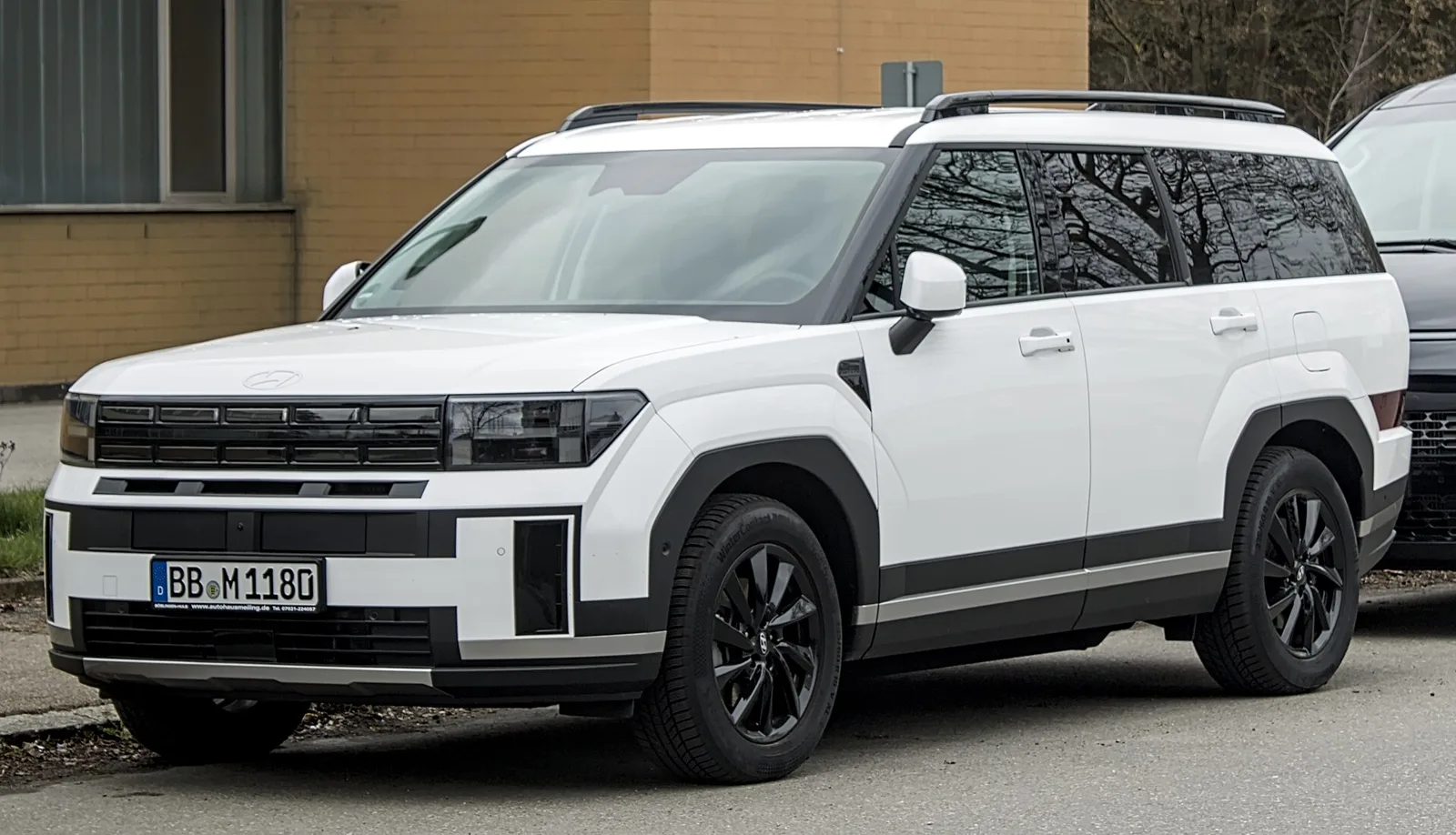
Hyundai's first SUV, named after a New Mexico city, grew from a compact crossover into a three-row family vehicle and then into hybrid power across five generations.
The Hyundai Santa Fe is a crossover SUV built by Hyundai since 2000 across five generations. It began as the company's first SUV, grew into a three-row family vehicle, and moved to hybrid power, with the fifth generation launched in 2023.
Since 2000 Hyundai has built the Santa Fe across five generations, all as crossover SUVs, with a shift from petrol-only to hybrid power. It was the company's first SUV, and it moved from a compact body to a mid-size and then a three-row family vehicle before adopting hybrid power.
Where did the Santa Fe name come from?
The name comes from the city of Santa Fe in New Mexico, and the vehicle arrived as the 2001 model year. It was part of Hyundai's restructuring programme in the late 1990s, and American buyers took to it quickly, which made it an important step in the company's recovery.
The first generation was sold as a compact SUV. Once the Tucson arrived in 2004 to take the compact role, the Santa Fe was repositioned into the mid-size class with its second generation in 2005.
Front-wheel drive or all-wheel drive has been available in every generation, which gave buyers in different climates a real choice of traction systems. That flexibility remained a constant through the model's long development.
Hyundai's first SUV grew from a compact crossover into a hybrid three-row family car across five generations.
What did the first generation offer?
The base North American engine was a 2.4 L four, offered with either a five-speed manual or a four-speed automatic. The transmission choice therefore depended on the buyer's own priorities and budget. A 2,656 cc Delta V6 offered more power but was available only with the automatic.
Traction control was an extra on the V6, and four-wheel drive could be specified, with front-wheel drive as the default setup. Diesel buyers outside the United States could have a turbo unit of 2.0 L with common-rail injection, while Australian cars arrived in November 2000 with a 2,656 cc V6 and four-speed automatic only.
In 2003 Hyundai added a 3.5 L V6 to North American models, paired with computer-controlled all-wheel drive and a five-speed automatic. That year also brought a Monsoon sound system to the mid-level GLS and a six-disc changer to the top LX.
How did the first generation change over its life?
From April 2002 combination head and torso airbags mounted in the seats protected the front occupants as standard. A mid-year change that May increased the fuel tank from 64 to 71 L and added a sunroof option, while chrome door handles replaced the matte grey ones.
The 2005 model year brought the final facelift, with changes to the grille, tail lights, rear bumper and instrument cluster. The base model was dropped at that point to make way for the Tucson, and Australian cars gained body-coloured bumpers from 2005 onward.
In Europe a new 2.2 L diesel and an updated 2.7-litre petrol V6 arrived with the 2006 model in April of that year.
Was the Santa Fe built in China?
Yes. A joint venture with the Chinese company Hawtai Motor began in 2002 and built the first generation, which was marketed as the Shengdafei. Hawtai also sold a Santa Fe C9 under its own brand name from 2009, using a 1.8 L turbocharged four acquired from Rover.
The partnership ended in 2010, and production of the first-generation model ended in 2015. Those years show how the car spread beyond the Korean and American plants that built most of the early Santa Fes.
What was the second generation like?
The second generation reached South Korea in late 2005, and its North American debut came at the 2006 Detroit auto show. The first US car rolled off the Montgomery, Alabama line on 18 April 2006, sharing that line with the Sonata.
The redesign moved away from the first car's eccentric styling towards a more modern appearance. The manual gearbox returned, but only with the 2,656 cc V6, while the 3,342 cc V6 was fitted as standard to the SE and Limited, paired with a five-speed automatic.
Electronic stability control, side-curtain airbags for every row, a tyre pressure monitor and anti-lock brakes were all standard. The third row was an option that let the car seat seven, and LATCH child seat anchors were also included as standard equipment.
The second generation earned the 2008 Consumer Reports top pick. Its 2010 refresh brought a new grille, a 2.4 L four and a 3.5 L V6, and the car moved to Kia's West Point, Georgia plant on 1 September 2010 to free capacity at Montgomery.
How did the second-generation all-wheel drive work?
The four-wheel drive system was a Borg-Warner torque management device that sent power to the wheels with the most grip. If the front wheels slipped slightly, 10% of the torque moved to the rear axle, and if they slipped badly, 50% did.
That arrangement reduced body lean in turns compared with the first generation. Hyundai also reported lower road and wind noise, and the new car's shingled head restraints improved rear visibility.
What was the third generation?
The third-generation redesign launched on 14 February 2012 and was shown to the public in New York on 4 April. It came in two wheelbases, a shorter five-seat Sport and a long-wheelbase version that offered three rows of seats. Its two body lengths gave buyers a choice between a two-row and a three-row car.
In North America the shorter car was badged Santa Fe Sport, while elsewhere it kept the plain Santa Fe name, with a 2.4 L petrol engine rated at 190 horsepower and a 2.0 L turbo rated at 264 hp. Both used a six-speed automatic, and front-wheel drive was standard.
The long-wheelbase version debuted in South Korea as the Maxcruz on 7 March 2013. In North America it used a 3.3 L V6 with 290 hp (294 PS; 216 kW), and it was renamed the Santa Fe XL when the fourth generation arrived.
What did the fourth generation change?
Hyundai introduced the fourth generation in South Korea on 21 February 2018, with the Geneva Motor Show following that March. The short model grew by 80 mm in length and 65 mm in wheelbase, which gave second-row passengers more legroom.
Cargo room was 547 litres with the third row folded and 1,625 litres with the second and third rows down. The car also gained a self-load-levelling suspension option, and Hyundai said high-tensile steel made up a larger share of its structure than on any earlier model.
Hybrid and plug-in hybrid versions arrived from 2020, using a 1.6 L turbocharged petrol engine with an electric motor. A facelift followed in June 2020 for the 2021 model year, with T-shaped LED lights and a 10.25-inch touchscreen.
What is the fifth-generation Santa Fe?
Hyundai announced the fifth generation on 17 July 2023 and unveiled it on 10 August 2023. Developed under the MX5 codename, it adopted a boxy design aimed at buyers who enjoy an outdoor lifestyle, and its drag coefficient fell to 0.29 from 0.33.
The new car is 55 mm longer than its predecessor with the same width, and its wheelbase of 2,815 mm (110.8 in) is 50 mm longer. Petrol versions offer 1,075 mm (42.3 in) of second-row legroom, while cargo capacity is quoted at 725 litres.
Diesel engines were dropped from this generation, and so was the V6 petrol that had been offered in markets such as Australia. The line-up now centres on a 2.5 L petrol, a 2.5 L turbo petrol, a 1.6 L turbo hybrid and a 1.6 L turbo plug-in hybrid.
Where is the fifth generation sold?
The fifth generation reached Europe in the first half of 2024 with hybrid powertrains only, and it offers front-wheel and all-wheel drive. North American production remains at the Hyundai plant in Montgomery, Alabama, and the car went on sale there in March 2024.
Australia launched the fifth generation on 8 May 2024, with the 1.6 L hybrid in three trims and all-wheel drive standard on most of them. New Zealand followed on 3 July 2024, and the hybrid has since spread across much of Asia and Latin America.
What safety record does the Santa Fe have?
The second generation earned an IIHS Top Safety Pick award and a maximum five-star NHTSA rating, and Insure.com ranked it among its 20 cheapest 2009 models to insure. Low premiums often signal a safe design, which helped the model appeal to family buyers.
The 2025 model year earned the IIHS Top Safety Pick+ award. Hyundai had also recalled almost 200,000 vehicles from the 2007 to 2009 model years over a passenger airbag issue, which a software update fixed.
What are the Hyundai Santa Fe specifications?
The table covers the figures that change most between generations. Metric values come first, and where a figure applies to one market or variant only, the table says so. The rows below pick out the figures that changed most between generations.
| Specification | Detail |
|---|---|
| Generations | Five, from 2000 onward |
| First-year engine (North America) | 2.4 L four-cylinder, or 2,656 cc V6 (automatic only) |
| Third-generation short model | 2.4 L, 190 hp; 2.0 L turbo, 264 hp |
| Long-wheelbase V6 | 3.3 L, 290 hp (294 PS; 216 kW) |
| Fourth-generation length increase | 80 mm (3.1 in) longer than the third-generation short model |
| Fourth-generation cargo (third row folded) | 547 litres (19.3 cu ft) |
| Fifth-generation wheelbase | 2,815 mm (110.8 in) |
| Fifth-generation drag coefficient | 0.29 (0.33 previous) |
| Fifth-generation cargo | 725 litres |
What is inside the fifth-generation Santa Fe?
Hyundai moved the shift lever to the steering column in the fifth generation. That freed the centre console for wireless charging on two pads, plus a pair of cupholders, which changed how the cabin is used day to day. Those touches made the interior feel more modern than the models that preceded it.
A Panoramic Curved Display merges the 12.3-inch digital instrument cluster with the infotainment screen into one curved unit. The tailgate struts were repositioned to open wider, which pushed the taillights lower, while the previous generation's architecture and major suspension components were kept.
How did Asian markets get the Santa Fe?
Malaysia received the fourth generation as an imported model in May 2019, and locally assembled facelifted cars followed on 6 September 2024. Pakistan imported the model in February 2019 before local assembly began in October 2023. Local assembly in several of these markets reflected Hyundai's wider regional plans.
The Philippines launched its facelifted car on 20 June 2022, and Vietnam introduced the facelift on 17 May 2021. Thailand's fourth-generation Santa Fe arrived on 29 November 2023 as an import from Malaysia, and Indonesia began local assembly of the fifth generation on 25 October 2024.
Frequently asked questions
Was the Santa Fe ever a seven-seater?
Yes. The long-wheelbase versions offered three rows of seats, and the second generation could be ordered with a third row that let the car seat seven.
Did the Santa Fe ever use a diesel?
Yes, in the first, second and fourth generations. The fifth generation dropped diesel engines entirely.
Was the Santa Fe ever sold as a hybrid?
Yes. A Blue Hybrid paired a petrol engine with a 30 kW electric motor in the second generation, and hybrids returned from 2020 in the fourth generation and continued in the fifth.
What replaced the Santa Fe XL?
The Palisade replaced the Santa Fe XL in North America in 2019, while the short model had already become the Santa Fe Sport in that market.
_IMG_5295.jpg)