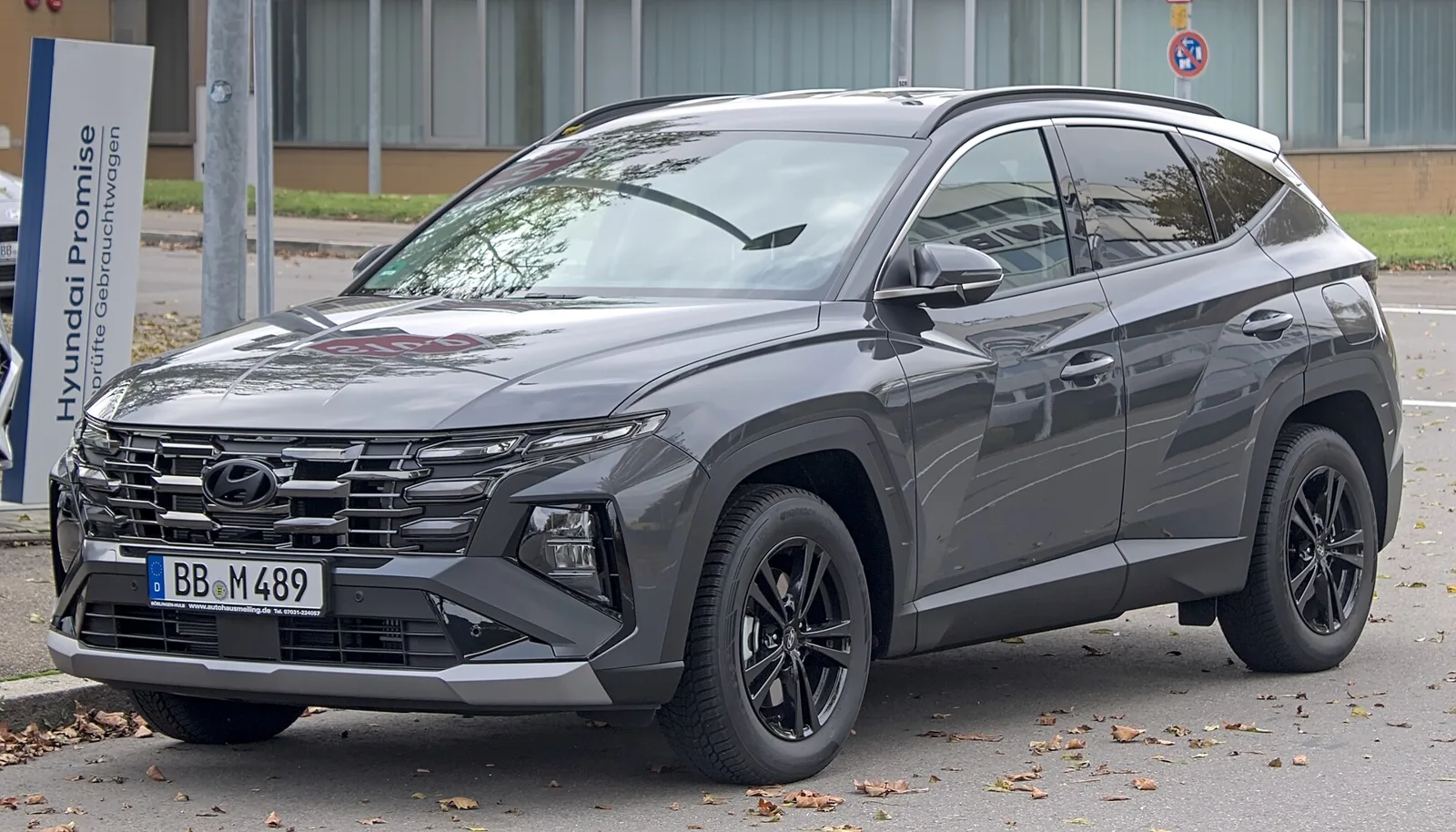
Named after a city in Arizona, the Tucson grew from a 2004 compact SUV into Hyundai's best seller, with more than 7 million units sold.
Hyundai's Tucson is a compact crossover SUV first launched in 2004 and named after Tucson, Arizona. It has been built in five generations, shares its origins with the Kia Sportage and has sold more than 7 million units. The fifth generation was revealed in August 2026.
The Hyundai Tucson is a compact crossover SUV that Hyundai has built since 2004, named after the city of Tucson in Arizona. It has grown into the best-selling Hyundai model, with more than 7 million units sold worldwide. This guide follows its five generations, the Kia Sportage link and the fifth-generation car revealed in 2026.
When did the Hyundai Tucson start?
The first Tucson launched in 2004, after its name was announced in November 2003. It was positioned as a smaller alternative to the Santa Fe and shared an Elantra-based platform with the second-generation Kia Sportage. Hyundai and Kia developed the Tucson alongside each other from the start.
Its name comes from Tucson, Arizona, in the United States. The name stuck in most markets, although a few used local names for the second generation.
Japan sold the car as the Hyundai JM until November 2009. Brazil produced Tucsons from October 2009 until the second half of 2018, which shows how the model was built for several different regional markets.
Europe accounts for 1.4 million of the total sales, which makes the Tucson a major European seller for Hyundai. Its position as the brand's best-seller rests on that spread across regions.
Named after an Arizona city and sold in millions, the Tucson has been Hyundai's workhorse for two decades.
What changed in the second generation?
The second generation arrived in 2009 as the ix35 in Europe, Australia and China, while North America kept the Tucson name. It was penned by Cha Il-Hoei in 2007 under the guidance of Thomas Burkle at Hyundai's Russelsheim design studio in Germany.
The development programme ran for 36 months and cost 280 billion won, approximately US$225 million. Hyundai described its styling as fluidic sculpture, a language that gave the car sweeping coupe-like lines and a more premium feel than its predecessor.
In North America the second-generation car used a 2.0-litre petrol engine producing 165 hp (167 PS; 123 kW), with a 2.4-litre option producing 176 hp (178 PS; 131 kW) that offered similar power to the earlier V6 with better economy.
The model also earned recognition for its safety. The IIHS named the second generation a Top Safety Pick in 2010, and a later facelift updated the look in several markets without changing the platform.
What did the third generation bring?
The third generation was revealed at Geneva on 3 March 2015 and arrived as a 2016 model year. It was 65 mm (2.6 in) bigger in length and 30 mm (1.2 in) broader than the outgoing car, with a wheelbase that grew by 30 mm (1.2 in). Seats-up cargo capacity grew from 465 to 513 litres.
Hyundai dropped the ix35 nameplate from this generation onward, reverting to Tucson globally. The change simplified the range and gave the car one name across most of its markets.
Safety technologies became more common, with lane departure warning, blind spot detection and automatic braking for pedestrians and cars offered. A dual-clutch automatic and Hyundai's torque vectoring system, Active Cornering Control, were also available.
Australia revealed the third generation in August 2015. Launch models used two petrol engines and one diesel, along with manual, six-speed automatic and seven-speed dual-clutch transmissions, which gave buyers a wide choice of drivetrains.
The 2019 facelift brought a new cascade grille, reshaped hood and tailgate, and a new dash with a high-mounted head unit. In North America the manual and dual-clutch options were dropped in favour of the six-speed Shiftronic automatic.
What changed with the fourth-generation Tucson?
The fourth generation was revealed on 15 September 2020 on a shortened version of Hyundai's N3 platform, which it shares with the larger Santa Fe. It came in two wheelbases: 2,680 mm (105.5 in) short and 2,755 mm (108.5 in) long, with the long version used for most regions.
Its design brief included bulging fenders, angled wheel arches, a level roofline and short overhangs. The interior featured a hoodless digital instrument cluster, a four-spoke steering wheel and dual 10.25 in touchscreens stacked vertically.
The long-wheelbase body offered 1,096 L (38.7 cu ft) of usable cargo space. North American cars used a 2.5-litre petrol engine rated at 187 hp (190 PS; 139 kW), and a hybrid variant combining a 1.6-litre turbo petrol engine with an electric motor was added later.
Australia launched the fourth-generation model on 26 April 2021 with three trim levels. Three powertrain options were offered at first, and a later facelift dropped the diesel and added a hybrid all-wheel drive system.
China marketed the long-wheelbase model as the Tucson L to set it apart from the older car. European versions remained shorter and were built at Hyundai's Czech plant, which made them a different proposition from the North American long-wheelbase cars.
Is there a fifth-generation Tucson?
Yes. Hyundai revealed the fifth generation on 19 August 2026, with a boxy design under its Art of Steel language, split headlights and prominent fender flares. It grows in every dimension, and an XRT variant with more rugged styling has been confirmed.
Second-row headroom rises by 29 mm (1.1 in), and the rear doors open to 83 degrees, up from 73. A 17-inch central display runs Hyundai's Pleos Connect software, which takes over most of the infotainment functions.
The fifth generation continues the approach of the fourth, with a long and practical body and a focus on interior space. The XRT variant adds a more rugged look to the new body.
The new car shows how central the Tucson remains to Hyundai's line-up after more than two decades.
What are the Hyundai Tucson specifications?
The table below lists the main figures for the key generations and the Euro diesel, so each version keeps its own row. Values are quoted as published for each generation and market, rather than merged into one set of numbers.
Specifications vary widely by market because the engines and wheelbases differ. North American cars favoured the long wheelbase, while European cars were built on the shorter platform with a range of turbo petrol and diesel options.
| Specification | Detail |
|---|---|
| Type | Compact crossover SUV |
| Generations | Five: 2004, 2009, 2015, 2020, 2026 |
| Sales | Over 7 million units since 2004 |
| Fourth-generation wheelbase | 2,680 mm (105.5 in) short; 2,755 mm (108.5 in) long |
| Fourth-generation cargo | 1,096 L (38.7 cu ft) |
| Second-generation 2.0 petrol | 165 hp (167 PS; 123 kW) |
| Second-generation 2.4 petrol | 176 hp (178 PS; 131 kW) |
| Fourth-generation 2.5 petrol | 187 hp (190 PS; 139 kW) |
| Fourth-generation hybrid system | 226 hp (229 PS; 169 kW) |
| Plug-in hybrid battery | 13.8 kWh, 51 km (32 mi) zero-emission range |
| Euro diesel economy | 6.5 l/100 km (36.2 mpg-US) |
| Fifth-generation headroom gain | 29 mm (1.1 in) |
| Fifth-generation rear door angle | 83 degrees, up from 73 |
| Fifth-generation central display | 17-inch |
Where was the Tucson built?
Production has moved between several plants as the model changed. Early cars were made in South Korea, and later European models came from Hyundai's Czech plant, which built the shorter-wheelbase version for the region. The location of production has shaped the model's regional character.
In the United States, Hyundai produced the car at its Alabama plant from early in the fourth generation's life. The same plant also builds other Hyundai models, including the Elantra and Sonata.
Mexico later became another source for the North American market, with production at Kia's plant. Changes in US import tariffs led Hyundai to send some Mexican-built export models to Canada instead.
What engines has the Tucson used?
The Tucson has used a range of petrol and diesel engines, with turbocharged units and mild hybrid systems appearing as the generations progressed. Diesel options were dropped from some markets as demand shifted. Each powertrain was tuned for the market it was sold in.
In North America the fourth generation used a 2.5-litre four with 187 hp (190 PS; 139 kW). The hybrid combined a 1.6-litre turbo engine with an electric motor for a 226 hp (229 PS; 169 kW) system output.
The plug-in hybrid used a 13.8 kWh battery and offered 51 km (32 mi) of zero-emission range, giving the Tucson a route into electric driving without a full battery-electric body.
What trims and features did the Tucson offer?
The Tucson's trim levels changed with each generation. In the United States the 2007 range used GLS, SE and Limited trims, and later models added N Line and hybrid versions, with safety features becoming standard across the range. Those choices gave buyers a way to match the car to their budget.
Early American Tucsons had a standard specification of air conditioning, airbags, electronic stability control and alloy wheels. The SE added grey body cladding, while the Limited brought leather seating, automatic climate control and heated seats.
The 2014 model year upgraded the North American car with direct-injection Theta II engines, LED tail and headlights, and new alloy designs. Those changes improved power and emissions without altering the basic layout.
The 2019 facelift made the Driver Attention Warning, Lane Keeping Assist and Front Collision Avoidance Assist standard across all North American trims. In Europe the N Line trim arrived in early 2019, and hybrid and plug-in hybrid versions gave buyers electrified choices in the fourth generation.
How does the Tucson compare with the Sportage?
The Tucson and the Kia Sportage have been developed alongside each other since the first generation, sharing platforms and engines. That relationship lets both brands spread development costs while offering slightly different styling and equipment. The two models have followed similar development paths, which is why they share so much engineering.
The second-generation car was sold as the ix35 in several markets, which kept it visually distinct from the Sportage. Hyundai later returned to the Tucson name across most markets, and the shared engineering continued behind the scenes.
Buyers choosing between the two cars often weigh styling, interior layout and dealer support rather than mechanical differences, because the basic architecture is so similar.
Hyundai's production choices have been shaped by trade and tariff decisions, and the company has moved some export volumes between plants to respond. For buyers, the practical effect is that the same name can refer to cars built in several countries.
Across its generations the Tucson has been offered with front-wheel drive or all-wheel drive, with the all-wheel drive option becoming widely available in later models. That choice let buyers match the car to snow, rough roads or everyday city driving.
Frequently asked questions
What was the Tucson FCEV?
The Tucson FCEV was a hydrogen fuel cell test car unveiled at the 2005 Los Angeles Auto Show. It used an 80 kW electric motor from Enova Systems and had a range of 300 km (186.4 mi) with a top speed of 150 km/h (93 mph).
Is the Tucson sold in India?
Hyundai discontinued the Tucson in India in November 2025 due to poor sales. The car had been offered there in petrol and diesel forms since the fourth generation arrived.
How safe was the first Tucson?
The first-generation car earned four stars for adult occupants, three for toddlers and one for pedestrians from Euro NCAP in 2006. Those ratings reflected its standard European configuration rather than any later update.
What is the Tucson BLK Edition?
Hyundai Australia announced the BLK Edition in August 2026, a variant with blacked-out exterior trim. It is imported from Vietnam rather than South Korea, which gives the Australian market extra production capacity.
_Facelift_IMG_2344.jpg)