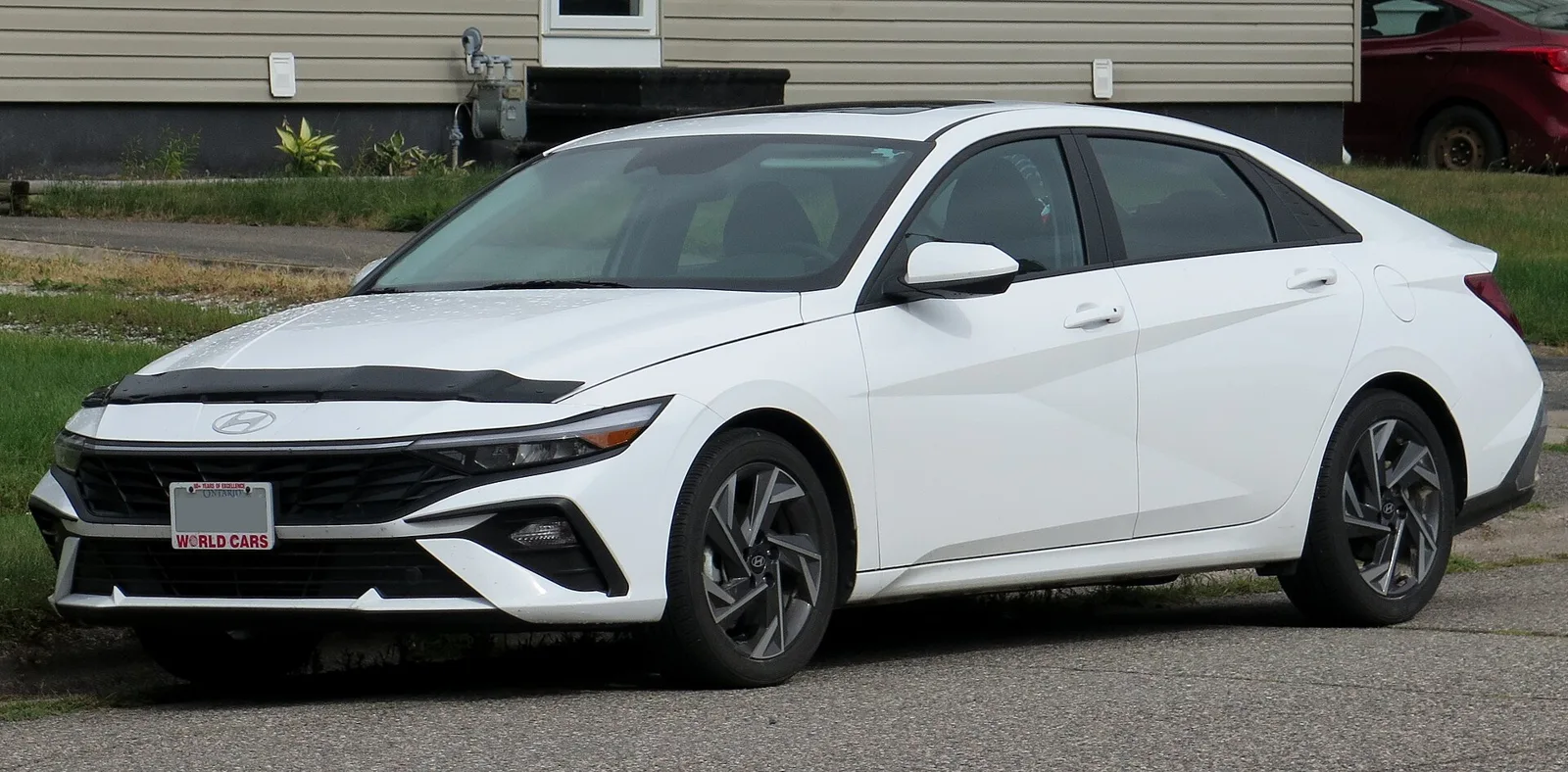
From a Mitsubishi-powered 1990 model to a hybrid and N performance range, the Elantra has been Hyundai's compact workhorse across eight generations.
The Hyundai Elantra is a compact car that Hyundai has built since 1990, sold as the Avante in South Korea. Its eight generations have moved from a Mitsubishi-engined first model to hybrid and Elantra N performance versions. Its name has changed by market, but it has stayed a core compact for Hyundai.
The Hyundai Elantra, sold in South Korea as the Avante, has been a compact car from Hyundai since 1990. Eight generations on, it has moved from a Mitsubishi-powered first model to a sharper sedan line with hybrid and performance versions.
Why does the car have two names?
In South Korea the first generation sold as the Elantra, but from the second generation the Korean models took the Avante name, while the Elantra name stayed on export models. The Avante name was rarely used abroad because it sounded too close to Audi's Avant, which was used for station wagons.
Singapore was the one export market that used the Avante name as of 2018. Elsewhere the Elantra name ruled, and the name was rarely seen abroad.
A compact sedan that changed names on its way from Korea to the world, and grew into a hybrid and N performance family.
Where did the Lantra name come from?
In Australia and parts of Europe the Elantra was first marketed as the Lantra. The name change was needed because of the similarly named Elante trim on the Mitsubishi Magna in Australia and the Lotus Elan in Europe. Both rivals had strong claims to the names.
Once Mitsubishi dropped the Elante trim and Lotus stopped building the Elan, Hyundai standardized the Elantra name for Australia and Europe in 2001, with the third generation.
What was the first generation?
Codenamed J1, the car went on sale in October 1990 and was refreshed mid-cycle in 1993. It reached Europe in the spring of 1991 and replaced the Stellar, which had been offered in few markets. That car was the first to carry the name into the wider world.
The first car ran a Mitsubishi design, a 1.6 L (1595 cc) straight-four producing 113 PS (83 kW) at 6000 rpm. Its price was considerably lower than rivals such as the Ford Sierra and the Vauxhall Cavalier and Opel Vectra, which made it a value choice.
The 1993 facelift brought new head and taillights, ABS, front airbags and a 1.8 L inline-four with 135 PS (99 kW), which took over from the twin-cam 1.6 in most markets.
How did the second generation change the car?
The second generation, codenamed RD or J2, launched in March 1995 as a sedan, with a station wagon six months later. Korean buyers got it as the Avante, while Australia and parts of Europe kept the Lantra name. The wagon was a natural fit for family buyers.
Chief designer Choi Jong-min said the grilleless organic design drew on Korean blue and white pottery. The suspension used MacPherson struts up front, with a multi-link rear axle carrying coil springs.
Korean buyers could choose the Avante with 1.5 Alpha II or 1.8 Beta engines, rated at 107 and 138 PS, or 79 and 101 kW, respectively. The car was positioned for a more affluent buyer than the older Elantra, and the more powerful engines reflected that aim.
The 1998 facelift
February 1998 brought a new grille, revised bumpers and reworked head and taillights. In South Korea the refreshed car was sold as the New Avante.
A new 2.0 L engine became available in most export markets, replacing the earlier 1.8 with 139 PS DIN (102 kW). In Australia the GLS was an upgrade on the GL with the 2.0 engine and velour trim.
Third-generation body changes
An all-new model, codenamed XD, launched in 2000. The station wagon was dropped in favour of a five-door Liftback, and the Lantra name was retired in Europe and Australia.
From the 2001 model year, American cars got front and front-side airbags, air conditioning and power locks, windows and steering as standard.
What was the 2004 refresh?
In 2004 all models were refreshed under the XD2 code, with new headlights and taillights, a new grille, updated bumpers and a redesigned dashboard. The GLS was the base model, and the GT was the top trim with a stiffer suspension and leather seats.
Horsepower improved from 135 to 138 hp, mainly through continuously variable valve timing added in 2004.
Third-generation economy
Powertrain design was broadly unchanged from the second generation, yet manual cars saw better fuel economy, and the Elantra was listed by the EPA as a mid-size car because of its spacious interior.
The car was also built in China by Beijing Hyundai, where a version served as a taxi in Beijing from 2005 until 2020.
Why did the fourth generation matter?
The HD sedan first appeared at the 2006 New York show, aimed at the next model year. In South Korea it was again sold as the Avante, and its rounded, jelly bean-like design was a clear break from the past.
The fourth generation offered a 1.6 Gamma unit alongside a 2.0 L Beta II four-cylinder, and a 1.6 L turbodiesel. A five-speed manual came as standard, and a four-speed automatic was the option. The diesel gave buyers another option for economy.
The fifth generation's performance
The fifth generation, codenamed MD, UD and JK, first appeared in April 2010 at the Busan show. The US car used a new 1.8 L Nu engine, and its drag coefficient of 0.28 helped the economy.
US sales reached 186,361 units in 2011, up 41% on the year before. At the 2012 Detroit Auto Show the car took the North American title, ahead of the Ford Focus and Volkswagen Passat.
The car also won the South African title for 2012 and the Philippine Car of the Year title, the first Korean maker to win that award in the Philippines.
The Coupe and Langdong
A coupe based on the sedan debuted for the 2013 model year, with a sharper look than the saloon. The coupe left the US range following the 2014 model year because of poor sales.
The Elantra Langdong was a longer version for China, released in August 2012. It was 4 cm (1.6 in) longer than the Elantra sold in other markets, and its front grille became a chrome wing shape.
What was the Elantra Hybrid?
The LPI Hybrid went on sale in South Korea in July 2009 as the Avante LPI Hybrid. It paired a 1.6 L Gamma engine with a CVT and a 15 kW (20 hp) motor, and it ran on liquefied petroleum gas.
Later hybrids used a 1.6-litre petrol engine with a 34 kW electric motor and a 1.3 kWh lithium-ion battery. The battery sits under the rear seats, and the car returns 54 mpg-US with 139 hp. The battery sits low in the body, which helps balance the car and keeps the cabin space intact.
In China the plug-in version arrived in August 2019 as the Elantra Lingdong PHEV, a model built by Beijing Hyundai with a restyled front bumper.
How did the sixth generation look?
In September 2015 the sixth generation went on sale in Korea under the Avante badge. It was more conservative in shape, with a sloped fastback roofline and fewer curves than the car it replaced. The redesign kept the cabin roomy, which was a clear priority.
North America first saw the car at the Los Angeles show in November 2015, went on sale in January 2016, and was classed as a mid-size sedan by the EPA. Its interior space was the main reason for that classification.
The sixth generation gained a Sport model part-way through its run, with a turbocharged 1.6 L engine making 201 hp (150 kW).
What was the Elantra N?
The Elantra N, also known as the Avante N, was announced in July 2021 as the performance model under Hyundai's N sub-brand. It uses a 2.0-litre turbocharged four that Hyundai rates at 276 hp (206 kW). It is the model that brought Hyundai's N brand into the compact sedan class.
The N uses a torque-vectoring limited-slip differential, and its curb weight of 3,186 pounds (1,445 kg). Its brakes and tyres were upgraded over the standard car. Car and Driver recorded 4.8 seconds from 0 to 60 mph, with the quarter mile falling in 13.4 seconds. The N is aimed at drivers who want a performance sedan without moving up to a larger model.
The seventh generation's arrival
The seventh generation (CN7) debuted in West Hollywood on 17 March 2020. It introduced Hyundai's Parametric Dynamics design language, with longer and wider proportions and a fastback-style rear.
The car went on sale in the US and Canada in late 2020 for the 2021 model year, and it took the North American award for 2021 as well.
In Australia the seventh generation was badged as the i30 Sedan, so Hyundai could combine its sales with the popular i30 hatchback.
The N Line
The Elantra N Line is a sporty take on the seventh generation. The engine is a turbocharged 1.6-litre petrol unit, mated to a six-speed manual or a seven-speed dual-clutch depending on the market.
It gives buyers a way into Hyundai's N range, with N Line styling and chassis upgrades.
The 2023 facelift
The refreshed Avante reached the public in South Korea on 27 February 2023. The North American Elantra followed on 30 August 2023, with petrol, hybrid and N variants.
The facelift added a curved display screen made of two panels under a single pane of glass, and rear side-impact airbags became standard.
The eighth generation's debut
The eighth-generation Elantra, codenamed CN8, was unveiled on 26 June 2026 at the Busan International Mobility Show in South Korea. The reveal came at the press day of the show, and the Korean launch was set for later in the year. It has a larger body and a redesigned interior with Hyundai's Pleos Connect infotainment system.
Hyundai announced petrol and hybrid variants at launch, with the hybrid using a reworked petrol-electric unit of 1.6 litres.
Motorsport
The Elantra N1 Cup is an improved Elantra N for Hyundai's one-make series, the Hyundai N Festival. It has 35 more hp than the Elantra N, a wider body kit and a swan-neck rear wing. Drivers in China also compete in the Hyundai N Cup with it.
The N1 TC Evo debuted in the 2025 TC America Series season, with wider fenders and larger wheels.
What are the Hyundai Elantra specifications?
The table lists the core details for each generation, including the codename, launch year, main engine and the electrified and performance variants. Where a detail applies only to one generation or market, the table says so, so readers can compare the generations directly.
| Generation | Codename and launch | Main engine |
|---|---|---|
| First | J1, October 1990 | 1.6 L (1595 cc) straight-four, 113 PS (83 kW) |
| Second | RD or J2, March 1995 | 1.5 Alpha II and 1.8 Beta engines |
| Third | XD, 2000 | 1.6, 1.8 and 2.0 L petrol engines |
| Fourth | HD, 2006 | 1.6 Gamma and 2.0 L Beta II petrol |
| Fifth | MD, UD and JK, April 2010 | 1.8 L Nu in the US |
| Sixth | AD, September 2015 | 2.0 L Nu I4, 147 hp (110 kW) |
| Seventh | CN7, unveiled 17 March 2020 | 1.6 L petrol and hybrid options |
| Eighth | CN8, unveiled 26 June 2026 | Updated 2.0 L petrol and 1.6 L hybrid |