Where the gear stick sits, how its shift pattern keeps reverse safe, and why carmakers are replacing the lever with buttons, dials and paddles.
The gear stick is the lever a driver moves to pick gears, mounted on the transmission. Manuals pair it with a clutch pedal, while automatics call the equivalent lever a selector. Carmakers are now swapping levers for buttons, rotary knobs or electronic selectors.
A gear stick is the metal lever that a driver uses to select gears, attached to the transmission of a car. In a manual it works together with a clutch pedal, while in an automatic the same kind of lever is called a gear selector. Modern designs are moving away from the traditional lever, but its shape and layout still shape how most drivers think about changing gear.
What is a gear stick?
A gear stick, also written gearstick, is also called a gear lever, gearshift or shifter, depending on the country. Formally it is a transmission lever. The term mostly refers to the shift lever of a manual transmission. In an automatic, a similar lever is known as a gear selector, because it chooses a drive mode rather than a specific ratio.
In a manual car the driver normally changes gear with the left foot pressing the clutch pedal, which disconnects the engine from the drivetrain and wheels. Automatic cars, including those with hydraulic torque converters, automated manuals, older clutchless semi-automatics and continuously variable transmissions, do not need a physical clutch pedal at all.
The gear stick is a lever that has outlived its mechanical reasons for existing, and its replacements are only just catching up.
Which vehicles need a clutch pedal with a gear stick?
Only manual cars and their close relatives require a clutch pedal. Clutchless semi-automatics such as the VW Autostick removed the pedal but kept the mechanical principles of a manual gearbox. The distinction matters because it decides what the driver must do with the left foot, and it explains why many drivers call any gear lever a stick shift.
Automatics offer a different experience. Their lever selects drive modes, and the transmission chooses the ratio. Some automatics add extra controls around the lever for sport or economy settings, which change how readily the car shifts up.
Where are gear sticks mounted?
Gear sticks are most commonly found between the front seats. They may sit on the centre console, sometimes quite far up the dashboard, on the transmission tunnel or directly on the floor. A console shifter is one where the floor mechanism is bolted to the transmission tunnel, with the centre console covering the assembly.
Some vehicles use a column shift, where the lever sits on the steering column. Column shifts were common in North American cars and sit in a different plane from floor shifters, so they need more complicated linkages. Their great advantage was that they allowed a full-width bench-type front seat. Column shifts have since fallen out of favour, though they remain on many North American pickups, vans and emergency vehicles. The Ford Crown Victoria kept one too.
Other designs are rarer. The Citroen 2CV and Renault 4 used a dashboard-mounted shift, while the Bentley Mark VI and the Riley Pathfinder placed the lever beside the right-hand driver's door. Left-hand drive versions of those cars received a column shift instead. Some modern sports cars replace the lever entirely with paddles on the steering column, and Formula 1 cars once hid the stick behind the steering wheel.
How does the gear knob work?
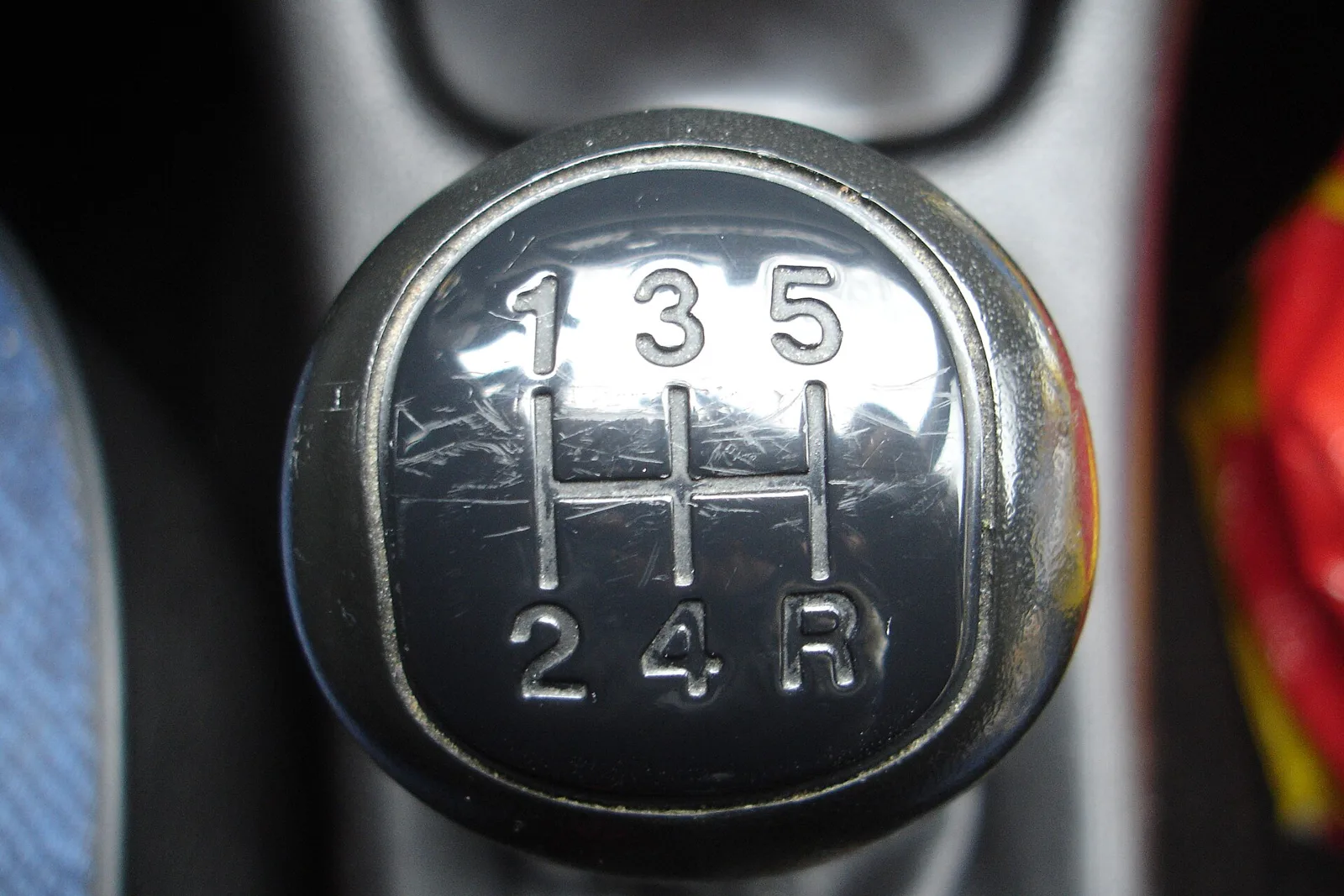
The gear knob forms the handle at the top of the stick, and it is made from materials such as aluminium, plastic, leather, wood or carbon fibre. Most knobs show the shift pattern, so a driver can see which position selects which gear. Some older manual knobs carried an overdrive switch, and some automatic knobs carry a switch for sports mode or to turn overdrive off. Those switches sometimes appear on the console or on steering column stalks instead.
Gearbox terms have their own shorthand. A manual column shifter with three forward speeds is called three on the tree, while a floor shifter with four forward speeds is called four-on-the-floor. The lowest ratio in a gearbox, set well below a typical first gear, is often called a granny gear.
Why does the clutch need to be pressed before starting?
Starting the car in gear with the clutch engaged can make it lurch forwards or backwards. The starter motor alone produces enough torque to move the whole vehicle, which can be dangerous if the parking brake is not firmly applied. It can also damage the starter and the drivetrain. For that reason novice drivers are taught to rock the gear knob from side to side to confirm that the gearbox is in neutral before starting.
Modern cars go further and require the clutch pedal to be pressed before the starter will engage. Some vehicles have a button that disables that requirement while it is held, for rare cases where starting in gear is necessary. The override is also useful in very cold weather or with a weak battery, because it avoids asking the starter to turn a gearbox full of cold, thick oil.
What are the secondary gear levers?
Conventional four-wheel drive vehicles often carry one or more extra shift levers. They engage a low-ratio gearbox for tough terrain, a transfer case that switches between two- and four-wheel drive, or differential locks. Some newer vehicles combine the controls for the low-ratio gearbox and transfer case into a single lever with positions labelled 2H, 4H and 4L.
The Land Rover Freelander introduced a button on its gear stick for Hill Descent Control. The system uses the brakes to mimic the effect of a low-ratio gearbox on steep descents.
How does a manual shift pattern work?
In a typical manual car first gear sits to the left and forward. Trucks and some sports cars often use a dog-leg arrangement, placing first gear left and rearward. Springs return the stick to its central position, and reverse is usually placed where it is least likely to be engaged by accident.
A manual with five forward gears therefore has seven possible positions, the five forward gears, reverse and a central neutral. Carmakers protect reverse in different ways. Some use a special button, while Nissan requires the lever to be lifted, Volkswagen requires it to be pressed down, and BMW requires extra force. Where reverse sits directly below fifth, a mechanical lockout stops the driver selecting it except from neutral, so someone used to a six-speed gearbox cannot slip into reverse by mistake.
Some transmissions add an electronic safeguard that blocks first or sometimes second gear when the vehicle is moving fast enough to push the engine past its maximum rpm. The safeguard protects the engine from damage that a wrong selection could cause.
How do automatic gear patterns differ?
Automatics traditionally use a straight P-R-N-D gate, with Park at the front, topmost position. Park locks the transmission mechanically with a parking pawl, Reverse and Neutral do what their names suggest, and Drive gives fully automatic operation in every gear. Many gates add a manual override, with numbered positions such as P-R-N-D-3-2-1 that stop the transmission from shifting above the selected gear.
Several Japanese makers, including Honda, Toyota, Subaru and Lexus, replace the numbered positions with a single L, which holds the transmission in whatever lower ratio is needed for climbing steep grades or heavy acceleration. Jaguar pioneered the J-gate, in which some gears sit on the left arm and some on the right, with a sideways movement at the rear. The Range Rover of 1995, in its second generation, used an H-gate. Its two parallel PRND gates served high range and low range.
Manumatics such as Alfa Romeo's Sportronic and Porsche's Tiptronic keep an automatic pattern on one side of the selector and add a longitudinal gate on the other. Pushing the lever forward and back moves the gears up or down, which can help in snow or dirt where starting from second gear is useful.
| Pattern | Layout | Typical example |
|---|---|---|
| Manual H-pattern | First gear to the left and forward, reverse protected | Most manual passenger cars |
| Dog-leg | First gear to the left and rearward | Many trucks and some sports cars |
| P-R-N-D gate | Straight row with Park at the front | Traditional automatics |
| J-gate | Gears on left and right arms with a sideways rear movement | Pioneered by Jaguar |
| H-gate | Two parallel PRND gates for high and low range | Second-generation Range Rover from 1995 |
| Plus and minus gate | Forward and back movement changes gears up or down | Alfa Romeo Sportronic and Porsche Tiptronic |
Has the gear stick been replaced by electronics?
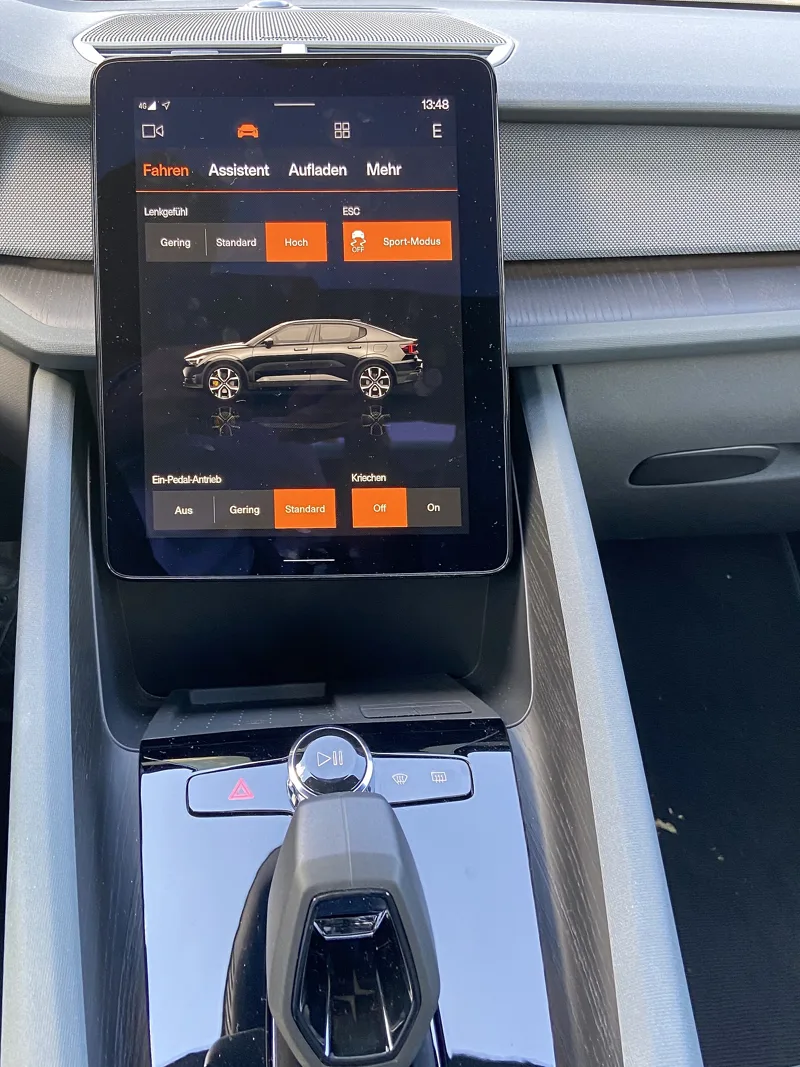
Shift-by-wire has changed the gear stick. Computer-controlled transmissions no longer need a mechanical connection to the gearbox, so the stick can be much smaller. Electric cars usually have no real gearbox and use a drive selector with Drive, Neutral and Reverse. Some add a B position to engage regenerative braking, and most also have a separate button for Park.
Makers now choose from several alternatives. Some use buttons, and Jaguar, Land Rover and Ford have adopted rotary knobs. Audi, BMW and the Lincoln Continental use a miniaturized stick on the centre console. Tesla uses a stalk on the steering column. The idea is not entirely new. Japanese finger shift revives an approach from the 1950s, when the Chrysler PowerFlite and the Packard Touchbutton Ultramatic offered push-button control.
What makes a shift knob special?
A shift knob is the physical interface between the stick and the driver's hand. It can be made from plastics or from precious metals, and it comes in many shapes, sizes and weights. Original equipment knobs are generally spherical and often resemble a chess pawn when fitted to the stick. Beneath them is usually a plain rod of machined aluminium or steel, with the knob threaded or fitted onto its end.
Aftermarket makers have multiplied the choices in recent years, from cheap plastics to diamond-studded white gold. The knob's main job remains the ergonomic one, because it is the part of the gearbox that the driver touches most often.