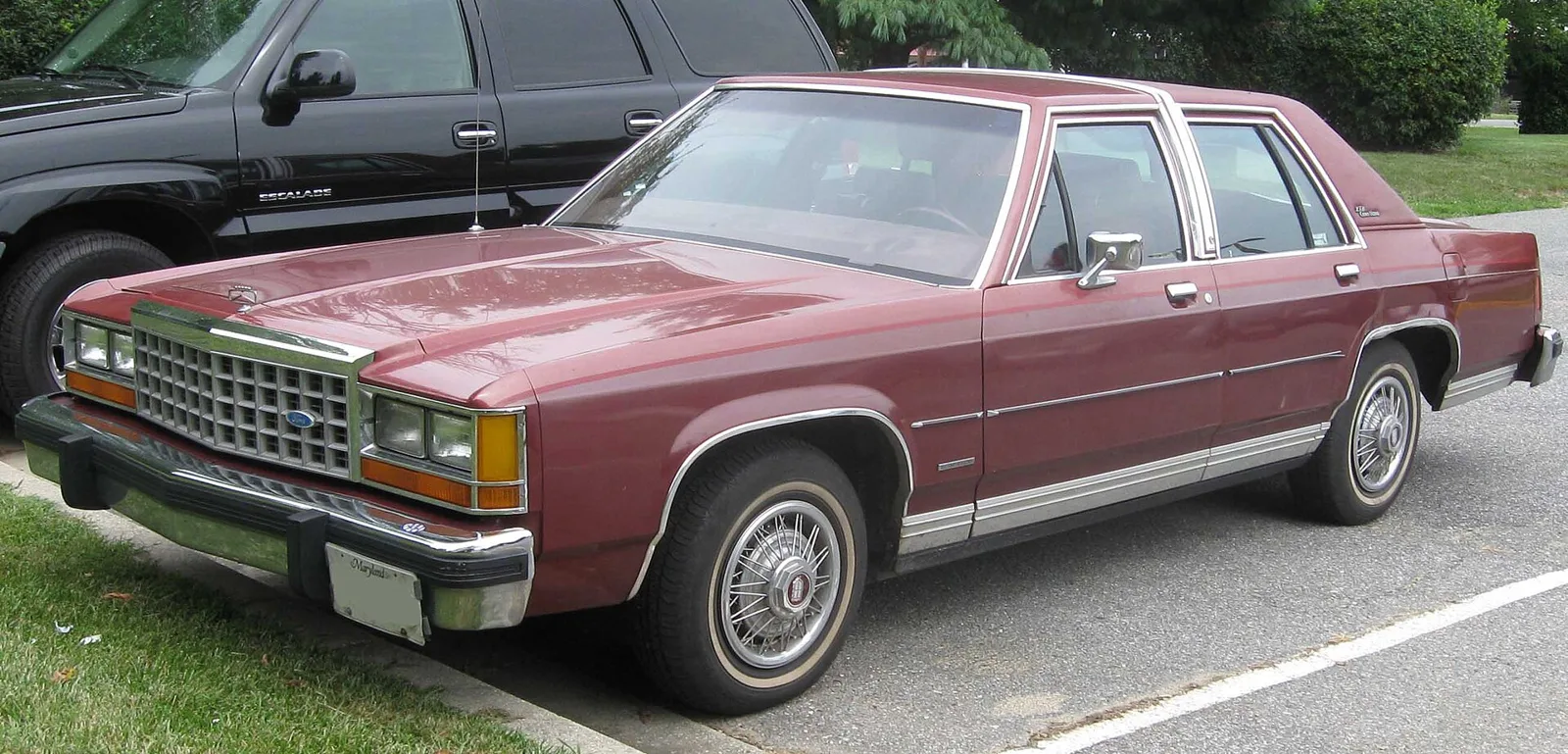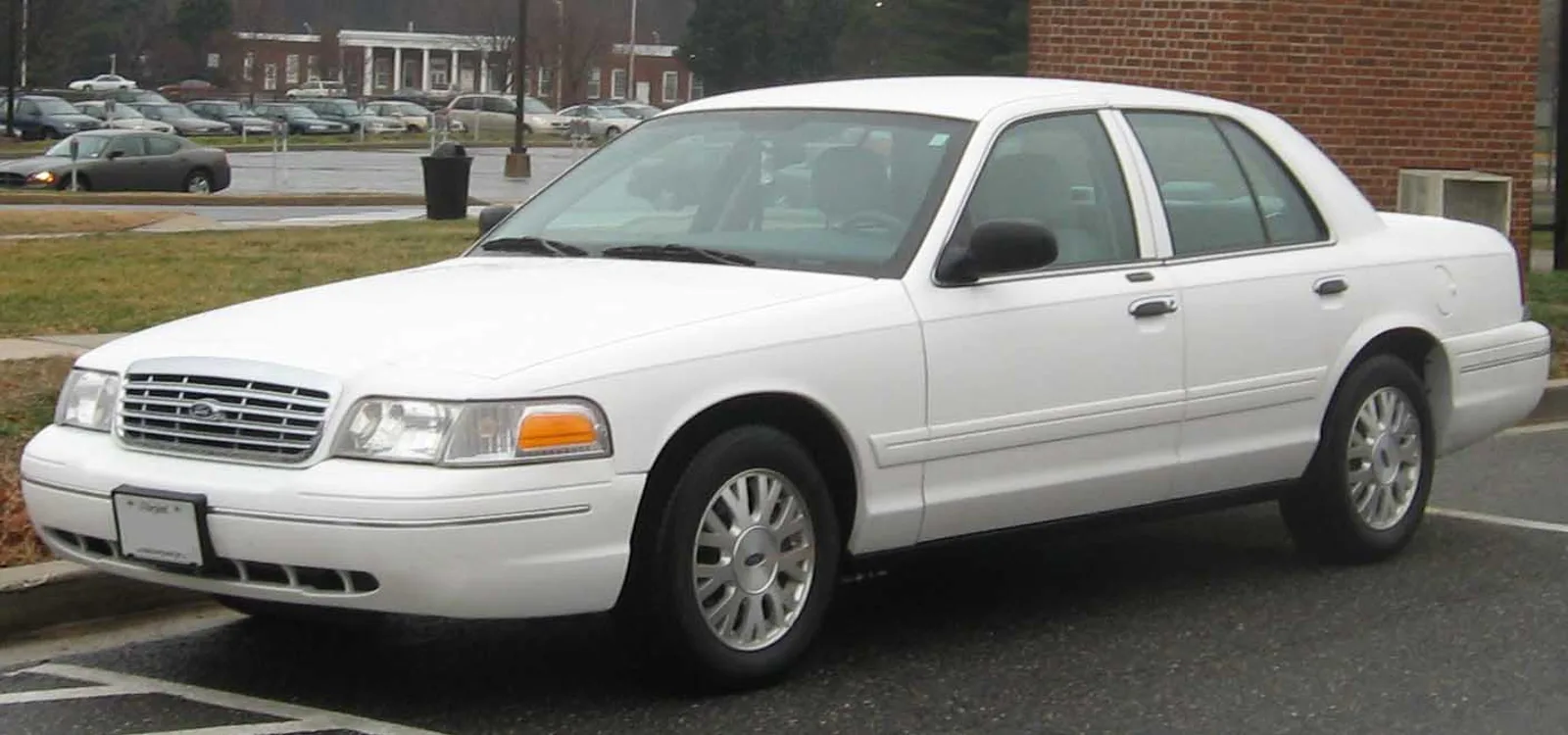
A rear-drive, body-on-frame full-size sedan from 1992 to 2011, the Crown Vic outlived most of its rivals and became the default police and taxi car across North America.
The Ford Crown Victoria was a rear-drive, body-on-frame full-size sedan built from 1992 to 2011 on the Panther platform. Over 1.5 million cars were made at St. Thomas, and the Police Interceptor version became the most popular police car in the United States.
The Ford Crown Victoria was a full-size sedan made by Ford from the 1992 to 2012 model years, in two generations. It rode on the rear-wheel drive Panther platform and was the largest sedan Ford sold in North America, above the Taurus. Its most famous role was as the Police Interceptor, the car that became ubiquitous with law enforcement.
When was the Ford Crown Victoria built?
The first generation was codenamed EN53, and development started in the first quarter of 1987. The car was unveiled on November 28, 1990, and production began in January 1991 as a 1992 model, with its launch on March 21, 1991.
The second generation sales began on 26 December 1997, and a chassis redesign for the 2003 model year followed in April 2002. Production of the Crown Victoria officially ended on September 15, 2011, when a white LX rolled off the line.
Ford stopped taking new orders in April 2011, and a short run of 2012 models for the Middle East followed in August 2011. Those cars were the final vehicles built at the St. Thomas plant.
Rear-drive, body-on-frame and built for fleets, the Crown Vic became the car police and cab drivers trusted most.
Where did the Crown Victoria name come from?
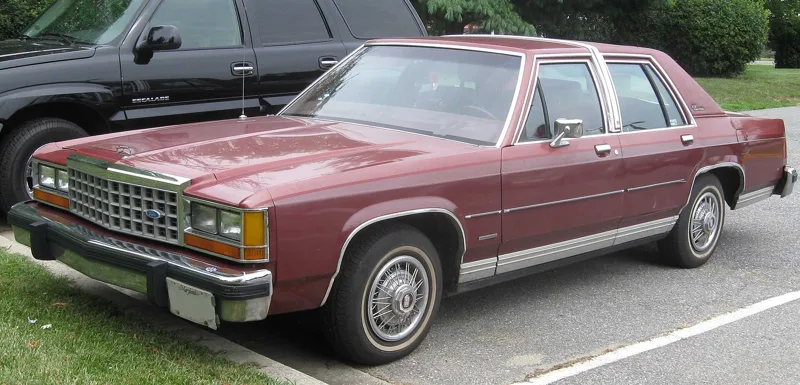
Ford used the Crown Victoria nameplate on two earlier cars, both flagship models of their full-size ranges. From 1955 to 1956 it denoted a premium two-door Fairlane, with a B-pillar roofline and a stainless steel band crowning the roof.
For 1980 the nameplate returned as the top trim of the LTD sedans, and it became a stand-alone model line in 1983. The LTD name was then shifted to the midsize segment, and the LTD Crown Victoria marked the final use of the LTD nameplate in North America after 1991.
Ford of Australia produced its own LTD as a flagship model from 1973 until 2007, because neither Mercury nor Lincoln was officially sold there. The Australian car was a separate project.
How did the first-generation Crown Victoria look and drive?
The first-generation car kept the previous chassis but gained a major exterior redesign to match the 1991 Chevrolet Caprice, its chief competitor. Ford reduced the drag coefficient from 0.42 to 0.34, close to the 0.32 of the Taurus, which gave the car its wedge-shaped aero look.
Jack Telnack, Ford's vice president of design, led the aero look that the Taurus had pioneered. Critics and buyers split over the Crown Victoria's no-grille front, so Ford revised the exterior for 1993 with a grille and a red reflector strip on the trunk lid.
The 1995 midcycle redesign brought a six-slot grille in place of the egg-crate design, wider taillamps and a new dashboard that was shared with the Grand Marquis. The 1996 model year removed the Crown Victoria fender script.
The Touring Sedan was a one-year model in 1992, with heavier-duty suspension, wider tyres, rear air springs, no speed limiter and a 210 hp dual-exhaust 4.6-litre V8. It was a performance flagship in an otherwise family-oriented range.
What engine and brakes did the first generation use?
The redesign introduced the Modular V8, a 4.6-litre SOHC engine that first appeared in the 1991 Lincoln Town Car. It replaced an overhead-valve 302 cubic inch V8 and was lighter, while producing 40 more horsepower in single-exhaust form.
Four-wheel disc brakes were a rare feature for the Crown Victoria, since they were otherwise seen only on the Lincoln Mark VII, the Taurus SHO and the Escort GT. Anti-lock brakes and low-speed traction control became popular options, and for 1997 the handling and steering were updated.
The four-speed overdrive automatic was replaced by the electronically controlled AOD-E in 1993, and then by the heavier-duty 4R70W for 1995, a unit already used in the Lincoln Mark VIII.
What changed in the second-generation Crown Victoria?
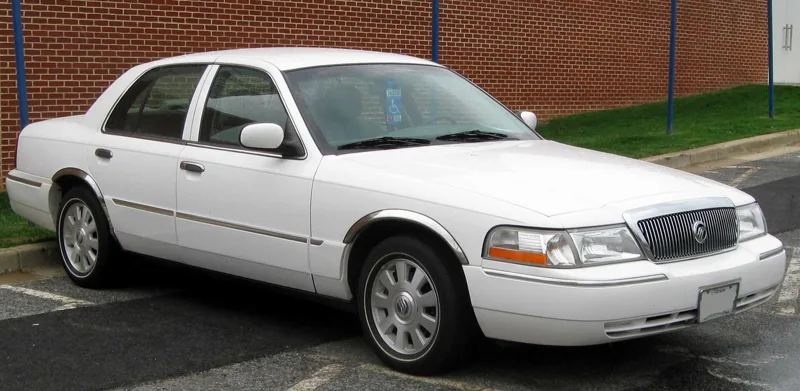
The second generation borrowed much of its exterior from the Mercury Grand Marquis. Ford hoped the change would win over buyers and let the two cars share more parts. The car's sales had struggled to match its Mercury twin, which had outsold it.
The redesigned car adopted the formal notch-back roofline of the Grand Marquis and lost its rear C-pillar windows. The large tail lamp units sat at the corners of the body, and the car used considerably less chrome than its Mercury counterpart.
Inside, the seats were revised and the chrome on the column shifter and turn signal switch was removed. Ford's Securi-Lock anti-theft system became standard, and a two-spoke steering wheel replaced the four-spoke design.
The mid-decade changes included a 2005 passenger weight sensor that could switch the passenger airbag on or off, and a factory sunroof for LX models. In 2006 a tachometer became standard, making the Crown Victoria the last Ford without one.
How was the 2003 Crown Victoria re-engineered?
For the 2003 model year Ford re-engineered the Panther platform for the first time since its introduction in 1979. The exterior stayed the same, but a fully boxed, hydro-formed frame with an aluminium cross-member raised torsional rigidity by 24% and resistance to vertical bending by 20%.
The car also received speed-sensitive rack-and-pinion power steering in place of the long-running recirculating ball system. The suspension was revamped with aluminium front lower control arms, coil-over front shocks and mono-tube rear shocks mounted on the outside of the frame rails.
Power rose to 224 hp, or 239 hp on dual-exhaust cars, after a knock sensor and revised tuning. Police models reached 250 hp in 2004, and these were the final increases for retail and non-police fleet cars.
Midway through the 2003 model year Ford introduced cost-cutting across the Panther range, estimated to save US$4,000,000 a year in production costs. The de-contented cars are often called 2003 Job #2 or 2003.5 models.
Which trims and packages did the Crown Victoria offer?
The car was sold in base and LX trims, with the LX forming the majority of non-fleet sales. The Handling and Performance Package, option code 41G, carried over from the first generation and added dual exhaust, shorter rear gears and upgraded suspension.
The LX Sport appeared in 2001 as a counterpart to the Mercury Grand Marquis LSE. It gained monochromatic trim on select colours, 17-inch Sport wheels and a floor-mounted shifter, and 14,777 units were produced over the model run.
A long-wheelbase version arrived in 2002 with a six-inch extension to a 120.7-inch wheelbase. Its extra length went to the rear seat, and it was sold for taxi and livery fleets in the United States, with heavy-duty springs and auxiliary oil coolers.
Why was the Police Interceptor so popular?
The police version was marketed as the P71 until 1999, when it became the Police Interceptor and received its own rear badging. Interceptors had heavy-duty suspension, larger brakes, a bigger alternator and a shorter rear gear ratio.
They also had a re-tuned engine computer, steering without variable assist and an external engine oil-to-water cooler. Most cars wore black exterior trim and black steel wheels, while the Street Appearance Package added chrome for a more ordinary look.
During its production run the Police Interceptor became the most popular police vehicle in the United States and became ubiquitous with law enforcement. Ford replaced it with the Police Interceptor Sedan and Utility, both heavy-duty variants of the Taurus and Explorer.
The Los Angeles Sheriff's Department still had over 400 CVPIs in service as of December 2023, after ordering 600 units just before new orders ceased in 2011. The final Police Interceptor was purchased by the Kansas Highway Patrol.
Where else was the Crown Victoria sold?
Canada received the Crown Victoria through 1999, after which the Mercury Grand Marquis took the retail role. The Crown Victoria was restricted to fleet sales in Canada, mostly Police Interceptors, and the lack of stability control stopped official sales after the 2011 model year.
The Gulf Cooperation Council states were the only retail market for the car after 2008. Five versions were sold there, including a long-wheelbase retail model, and GCC cars were covered by a warranty of 5 years or 200,000 kilometers (125,000 miles).
GCC cars had a 40/20/40 bench seat, a metric instrument panel and a true dual exhaust. A 2008 Special Edition cost about KWD 6,000, roughly US$22,000, and it was available in black only in Kuwait.
What safety issues affected the Crown Victoria?
Reports that the Crown Victoria was prone to rear-collision fires combined three factors: police fleets relied on it, officers often parked close to traffic, and impacting vehicles were often travelling near the speed limit. Installers who drilled through the package tray could also puncture the fuel tank.
Ford offered an aftermarket shield and a recall kit with Kevlar shields and a trunk liner. For 2005 and newer Police Interceptors an optional onboard fire-suppression system was offered, although Ford noted several system limitations.
Ford faced court cases over the fires but has never been found liable in a Crown Victoria accident. In September 2013 it recalled 370,000 vehicles built between 2005 and 2011 for possible steering shaft corrosion.
A 2017 recall covered about 313,000 2003 to 2005 models because the solder joints on the light control module could crack and interrupt headlamp power. A 1996 to 2001 intake manifold made by DuPont also caused coolant leaks, and Ford settled a class action over it in late 2005.
Why did production of the Crown Victoria end?
Ford's Way Forward plan of 2006 moved the St. Thomas Assembly Plant to a single daily production shift to cut costs. Ford then announced in 2009 that the plant would close in 2011, as demand for full-size cars fell during the industry crisis.
Electronic stability control became federally mandated for 2012 models in the US and Canada, and the Crown Victoria did not have it. The entire 2012 batch was exported to the Middle East, and the car ended production as the last Panther platform vehicle.
Taxi fleets and police forces mourned the end of the model. New York City chose a purpose-built Nissan NV200 minivan as the successor to its yellow cab fleet in May 2011, after comparing proposals from several automakers, including the Ford Transit Connect.
What are the Ford Crown Victoria specifications?
The table lists the main figures for the two generations. Where a figure applies only to the Police Interceptor, the GCC market or the long-wheelbase car, the table says so.
| Specification | Detail |
|---|---|
| Model years | 1992 to 2012, two generations |
| Platform | Panther, rear-wheel drive, body-on-frame |
| First generation | EN53, unveiled November 28, 1990; drag coefficient 0.34 |
| Second generation | EN114, sales from 26 December 1997 |
| Engine | 4.6 L Modular SOHC V8 |
| Power, 1998 | 200 hp; 215 hp with dual exhaust |
| Power, 2003 | 224 hp; 239 hp with dual exhaust; 250 hp for police models in 2004 |
| Chassis rigidity, 2003 | Torsional rigidity up 24%; vertical bending up 20% |
| Long wheelbase | 120.7-inch wheelbase |
| Built at | St. Thomas Assembly, Southwold, Ontario |
| Total from St. Thomas | Over 1.5 million, 1991 to 2011 |
| Final car | White LX, September 15, 2011 |
Frequently asked questions
What was the Crown Victoria's transmission?
The first generation used the four-speed overdrive AOD automatic, which was replaced by the AOD-E in 1993 and by the heavier-duty 4R70W for 1995. The second generation moved to the 4R70E in 2005, and a revised 4R75E became standard in 2006.
Was the Crown Victoria ever sold in a long-wheelbase form?
Yes. The stretched body gave the rear seat more room, and the taxi-oriented version carried heavy-duty front springs, shocks and a rear stabiliser bar. Long-wheelbase cars were also offered for retail sale in the GCC export market.
Did Ford ever admit fault in the fuel tank fires?
Ford contested liability in the numerous court cases, and it has never been held responsible for a Crown Victoria accident. It did offer an aftermarket shield and a recall kit to help prevent punctures from equipment and trunk items.
What replaced the Crown Victoria in police use?
Ford did not directly replace the Crown Victoria. The full-size Taurus became the next basis for Ford police cars, and the Police Interceptor Sedan and Utility were tougher versions built on the Taurus and Explorer, with the Interceptor name carried over.