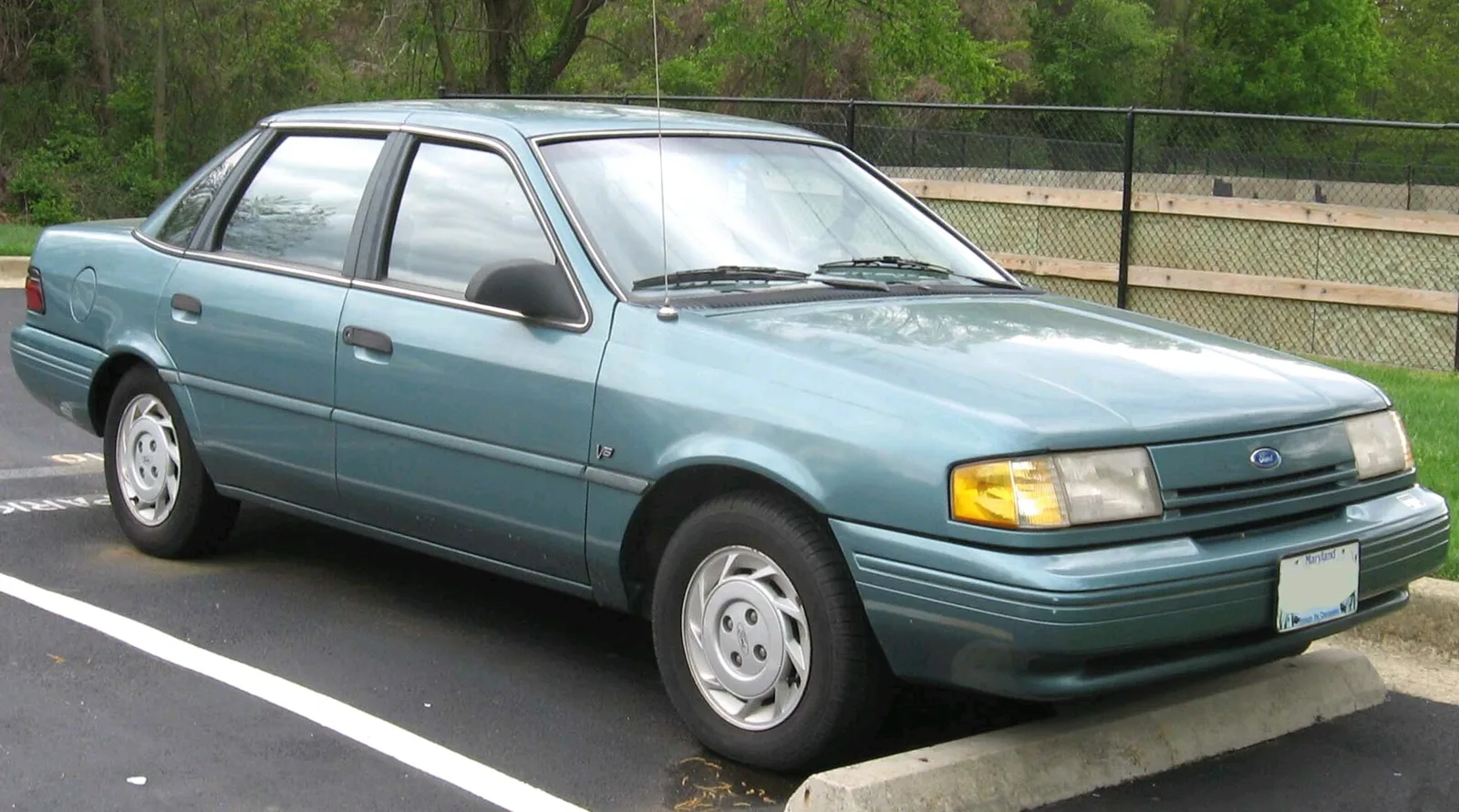
Built from 1984 to 1994 with a Mercury Topaz twin, the Tempo brought front-wheel drive, a driver's airbag and a wind-tunnel shape to Ford's compact range.
The Ford Tempo was a front-drive compact sold from 1984 to 1994 as a coupe and sedan, with a Mercury Topaz twin. It took its chassis from the Escort, pioneered an early driver's airbag and gave way to the Mondeo-based Contour.
The Ford Tempo was a front-wheel drive compact that Ford built from the 1984 to 1994 model years. It replaced the Fairmont, took its chassis from the Escort and was sold as the Mercury Topaz in Lincoln-Mercury showrooms. It was also the first Ford sedan line with an aerodynamic exterior, and the first American car to offer a driver's side airbag as an option.
What was the Ford Tempo?
The Ford Tempo was Ford's fourth generation of compact cars in North America, and it marked both a downsizing and the switch to front-wheel drive. It was sold as a two-door coupe and a four-door sedan for its whole production run, and the Mercury Topaz was its divisional counterpart.
Ford sold the Tempo from 1984 to 1994, and the four-door sedan was replaced for 1995 by the Contour and Mercury Mystique. The two-door Tempo was never directly replaced.
A front-drive compact with a wind-tunnel shape, an early airbag and a Mercury twin, built until a Mondeo-based replacement arrived.
Why did Ford build a front-drive compact?
In the late 1970s Ford began planning to replace its compact rear-drive Fairmont and Mercury Zephyr with a smaller front-drive car. The new compact was expected to compete with General Motors' X-Body, but it ended up closer to GM's J-cars. The project's chief development engineer was Ed Cascardo.
The Tempo's chassis and powertrain drew on the Escort, and it shared some parts with the first North American Escort. Its wheelbase was stretched by 5.7 in (145 mm) over the Escort, and the bodies were new. Switching to front-wheel drive freed interior space that a driveshaft and rear differential would otherwise have taken.
The car was also downsized from the Fairmont. It was shortened by 17 inches, narrowed by nearly three inches and cut by more than six inches in wheelbase.
How was the Tempo shaped in the wind tunnel?
Wind tunnel testing began in December 1978. More than 450 hours of testing produced over 950 design changes. The windshield was inclined at 60 degrees, and the door frames wrapped into the roofline.
The backlights were also laid down at 60 degrees, and the rear deck was raised. Viewed from the side, the raised trunk gave a wedge stance that was most striking on the two-door coupe. The two-door reached a drag coefficient of 0.36, equal to that of the aero Thunderbird, while the four-door managed 0.37.
The front grille was laid back and the wheels were pushed out to the corners of the body, which reduced turbulence. The rear track was widened too. Each change was aimed at cutting drag and improving fuel economy.
What engines and gearboxes did the Tempo use?
The Tempo's four-cylinder was the 2.3 L High Swirl Combustion engine, known as HSC. It had a cast iron block and head, a single cam in the block and two pushrod valves per cylinder. A High Specific Output version, the HSO, produced 100 hp (75 kW).
The base gearbox was a four-speed IB4 manual, which Ford grouped into its Fuel Saver powertrain. Buyers could add a five-speed MTX-III manual or a three-speed FLC automatic. In late 1985 the five-speed became standard, and its shift pattern moved from a dog-leg to an H-pattern.
From 1984 to 1986 Mazda's four-cylinder RF diesel was offered, a 2.0 L unit paired only with the five-speed manual. In 1992 the 3.0 L Vulcan V6 from the Taurus and Sable became an option, though it needed a new water pump and a more restrictive exhaust that cut peak power.
Did the Tempo offer all-wheel drive?
Yes, from 1987 to 1991. The Tempo and Topaz were the first Ford production passenger sedans with four-wheel drive, even though the company had tested prototypes on other models before. The system was a part-time design meant for slippery roads, not for serious off-road work.
A rocker switch on the dashboard engaged a clutch that sent power to a limited-slip rear differential through a new driveshaft, with no transfer case. The system added 105 lb (47.6 kg) and raised the ride height by just 0.5 in (13 mm). It was offered only with the HSO engine and the three-speed automatic.
In 1991 Ford started calling the system Four Wheel Drive rather than All Wheel Drive.
Was the Tempo the first car with a driver's airbag?
In early 1985 the Tempo became the first mass-produced American car with a driver-side airbag acting as a supplemental restraint. The Tempo had also been the first American car to offer one as an option.
In 1984 Ford signed a deal with the General Services Administration and the Department of Transportation for 5,000 airbag-fitted Tempos. Half also got a special windshield meant to limit facial cuts for occupants, and every car was among the first to carry the high-mounted brake light that the law made mandatory from 1986.
How did the Tempo sell at launch?
The first-generation Tempo and Topaz debuted for sale on 26 May 1983 as 1984 models, and Ford unveiled both lines on the deck of the USS Intrepid, a retired aircraft carrier in New York Harbor. Buyers took more than 107,000 two-door cars and over 295,000 four-door sedans in that first year.
The introductory 1984 model year ran for 16 months and saw 531,468 Tempo and Topaz sold combined, which remained the nameplate's best year. By 1986 the Tempo had passed the Hyundai Pony as Canada's top-selling new car.
An early advertisement showed a Tempo sedan performing a 360 degree loop on a stunt track. The car was securely attached to the track and was pulled through the shot rather than driving under its own power, which was a common approach for the era's ads.
What changed through the Tempo's life?
The Tempo changed in steps, with each model year bringing a few updates. The list below highlights the main ones.
- 1985: central fuel injection on the 2.3 L; the five-speed becomes standard; Sport GL launched.
- 1986: composite headlamps, full-width taillamps and a grille closer to the Taurus; GLX renamed LX.
- 1987: all-wheel drive introduced, and the Topaz XR5 sport coupe added.
- 1988: sedans redesigned and coupes facelifted, with more Taurus-like styling.
- 1992: mild restyle, the 3.0 L Vulcan V6 offered, and a tachometer reading up to 7,000 rpm.
- 1994: last year of the HSC engine, and the last Tempo built on May 20, 1994.
What trim levels did buyers get?
First-generation Tempos came as L, GL, GLX, LX and AWD, while the Topaz used L, GS, GS-AWD, LS, LS-AWD and the XR5 sport coupe. The GLX was dropped in favour of the LX from 1986 onward, and the first-generation AWD trim ran only for 1987.
The second generation simplified the range. The Tempo kept GL and LX, after the entry L was discontinued in 1991 and the GLS in 1992. The Topaz list ran from GS and LS to the XR5 coupe and the LTS sedan, which was the four-door equivalent of the XR5.
The 1992 model year was the only one when a speedometer reading to 120 mph was offered, and that applied only to the GLS, XR5 and LTS trims.
How did the Tempo sell in China and Mexico?
1992 was the year Ford first ran sales in China, and the Tempo was one of the models offered there beside the Taurus, Crown Victoria, Aerostar and Lincoln Town Car. The Chinese government bought more than 8,200 Tempos, and the first 3010 four-door sedans formed the largest single fleet order Ford had ever received.
The China revisions included metric instrument panels, a fuel system that handled leaded fuel, heavier suspension and heavier-grade wiring. The fleet cars were white GL-trim four-door sedans, and they were later sold to private owners.
Mexico built the Topaz from 1984 at Cuautitlan Assembly, and the Ghia arrived in 1991 with more luxurious trim. A Mexican-built Topaz cost about US$400 more than a better-equipped US model, because the plant had less automation.
What was the T-Drive experiment?
Late in the Tempo's life Ford used a modified car as a rolling testbed for a new layout it called T-Drive. The test car received a transverse DOHC straight-eight with a centre-mounted longitudinal transaxle, which made it rear-wheel drive. The estimated output was 215 to 225 hp (160 to 168 kW).
The T-Drive system was designed to fit 4, 6 and 8 cylinder engines of 2.0 L, 3.2 L and 4.0 L. In 1991 it was shown in two concepts, a Contour sedan and a Mystique minivan. The Tempo test car was shown briefly and never seen again, and T-Drive never went into production.
Why did the Tempo end when it did?
The Tempo had been a loss-maker for Ford for years by 1993. The incoming Contour was based on the European Mondeo, one of the most expensive cars in Ford's European range, and the price gap was obvious to buyers.
Ford failed to draw a clear line between the two cars, and many buyers assumed the Contour would be priced like the old Tempo. A range-topping 1994 Tempo LX with V6 cost about $12,900, while a base 1995 Contour GL with four-cylinder and manual cost $13,990, which caused some buyers real sticker shock.
The last Tempo rolled out of Oakville Assembly on May 20, 1994. Oakville was then retooled to build the Ford Windstar, while Kansas City Assembly and Cuautitlan Assembly took on the Contour and Mystique.
What were the Ford Tempo specifications?
The table gathers the core figures for the Tempo's main engines and body styles. Where a value belongs to one version only, the row says so.
| Specification | Detail |
|---|---|
| Model years | 1984 to 1994, two-door coupe and four-door sedan |
| Base engine | 2.3 L High Swirl Combustion four |
| HSO engine | 100 hp (75 kW) |
| Diesel (1984 to 1986) | Mazda-built 2.0 L, five-speed manual only |
| V6 (1992 on) | 3.0 L Vulcan V6 option |
| Drag coefficient | 0.36 two-door; 0.37 four-door |
| Wheelbase stretch over Escort | 5.7 in (145 mm) |
| Brakes | 9.3 in (236 mm) front discs; 8.0 in x 1.2 in (203 mm x 30 mm) rear drums |
| All-wheel drive (1987 to 1991) | Adds 105 lb (47.6 kg); ride height up 0.5 in (13 mm) |
| Last car built | 20 May 1994 at Oakville Assembly |
Frequently asked questions
What did the Tempo's Topaz twin look like?
The Mercury Topaz shared its doors with the Tempo, but it had a windowless C-pillar and a horizontal black grille that marked the debut of the Mercury emblem. It was offered in the same two body styles.
Did the Tempo have a turbocharged engine?
A turbocharged version of the four was said to be in development when the cars were released, but it never became available. A V6 was not under consideration at that point.
How long did the Tempo stay on sale?
The Tempo was sold from 1984 to 1994, covering every model year in that span. It was discontinued in 1994, and the Contour took over the four-door role for 1995.
Was the Tempo a sales success?
Yes. It stayed one of the best-selling cars in the US for its whole production run, and its introductory year was the strongest for the Tempo and Topaz combined.