How the rubber ring around a wheel carries weight, supplies grip and absorbs shock, and how one 1888 invention became the most common rubber product on the road.
A tyre is the pneumatic ring fitted to a wheel. It carries the vehicle's weight, grips the road and absorbs shock. Dunlop made the first practical version in 1888, and radial construction, developed by Michelin in 1946, is now standard on almost every car.
A tyre is the rubber ring fitted around a wheel's rim. It carries the vehicle's weight down to the road and supplies the grip that lets the car steer, brake and accelerate. Most modern tyres are pneumatic, holding compressed air that cushions bumps, and the practical version dates from Dunlop's work in 1888.
What does a tyre do on a vehicle?
A tyre passes the load from the axle through the wheel to the ground, and it grips whatever surface the wheel rolls over. Its air-filled body absorbs shock as the wheel meets bumps, while the tread supplies traction. Each tyre meets the road through a contact patch sized to the vehicle's weight, which spreads the load without crushing the surface.
The tread does the gripping and the body holds the air. Because air pressure does most of the cushioning, a punctured tyre collapses almost completely, which shows how little weight the sidewall itself supports.
A rubber ring that carries the weight, supplies the grip and absorbs the shock, and has changed little in principle since 1888.
How did the tyre develop from wooden wheels?
Early tyres were bands that protected the edges of wooden wheels. The first were leather bands in Sumer, and later bands were iron and then steel. They held the wheel together under load and cut wear on the timber, and they served carts and wagons for centuries.
Fitting an iron band was a skilled job. A wheelwright heated it in a forge until it expanded, dropped it over the wheel, then cooled it so the metal shrank and gripped the timber. In 1847 the Scottish inventor Robert William Thomson patented what appears to be a standard pneumatic tyre, but it never reached production.
Who made the first practical pneumatic tyre?
John Boyd Dunlop, a Scots-born owner of one of Ireland's most prosperous veterinary practices, made the first practical pneumatic tyre in 1888 on May Street in Belfast. He was trying to spare his 10-year-old son Johnnie the headaches caused by riding a tricycle over rough pavements. His doctor, Sir John Fagan, helped design the early tyres.
Cyclist Willie Hume won the tyre's first races in Ireland in 1889, then in England. The win proved the design, but in 1892 the courts declared Dunlop's patent invalid because Thomson had patented the idea earlier. Dunlop is still credited with showing that rubber could resist wear while keeping its resilience. His business partner Harvey du Cros and the inventor Charles Kingston Welch worked through the difficulties, and the firm later became Dunlop Rubber.
Two engineering advances made the tyre workable. Vulcanization, which uses sulfur to toughen natural rubber, was one. The clincher rim, which holds the tyre sideways against the wheel, was the other.
When did pneumatic tyres reach cars?
Michelin fitted the first pneumatic tyres to a car in 1895, on a machine called L'Eclair that competed in the Paris-Bordeaux-Paris race. Synthetic rubbers followed in the 1920s, when Bayer developed them in its laboratories. Rubber shortages in the United Kingdom during the Second World War led to research into substitutes such as leather, rayon and paper, but rubber remained the material of choice.
How did radial tyres replace bias tyres?
Radial tyres beat bias tyres on life, steering control and fuel economy, because their layered cords and stiff belts keep the tread stable. Michelin developed radial construction in 1946 and had bought the bankrupt Citroen company in 1934 to use the technology. Adoption spread quickly across Europe and Asia.
The United States was slower. Bias-ply tyres persisted there until Ford adopted radials in the early 1970s, after a 1968 article in Consumer Reports praised the design. By the 1980s radials held 100 percent of the North American market, and they are now the standard for almost every car tyre.
What are the main tyre construction types?
Radial tyres run their body plies straight across the tread, close to right angles to the centre line, with stabilising belts directly beneath the tread. The plies are nylon, polyester or steel, and the belts are steel, fibreglass or Kevlar. Bias tyres run their cords diagonally at 30 to 40 degrees to the direction of travel. They flex as a whole and suit rough ground, but they roll with more resistance and handle less precisely at speed.
A belted bias tyre adds stabiliser belts under the tread of a bias casing. Goodyear popularised the design with its Polyglas tyre. Tubeless tyres drop the separate inner tube, and airless tyres suit golf carts and utility vehicles where punctures are common.
Aircraft tyres can run above 1,400 kPa (14 bar; 200 psi), and some are filled with nitrogen so that oxygen cannot react with gases escaping from the inner liner. Light aircraft sometimes carry large, low-pressure tundra tyres for landing on unprepared wilderness strips.
What are tyres made from and where are they produced?
Modern tyres combine synthetic and natural rubber with fabric, steel wire, carbon black and chemical additives. The most common rubber is a styrene-butadiene copolymer, which pairs a grippy rubbery polymer with a stiff glassy one that keeps rolling losses low. About 450 factories around the world turn these materials into components, assemble them and cure the finished tyre.
Over 2.5 billion tyres are made each year. The US alone made almost 170 million in 2015. In 2011 Bridgestone made 190 million tyres, Michelin 184 million and Goodyear 181 million, a sign of how concentrated the industry is at the top.
What parts make up a tyre?
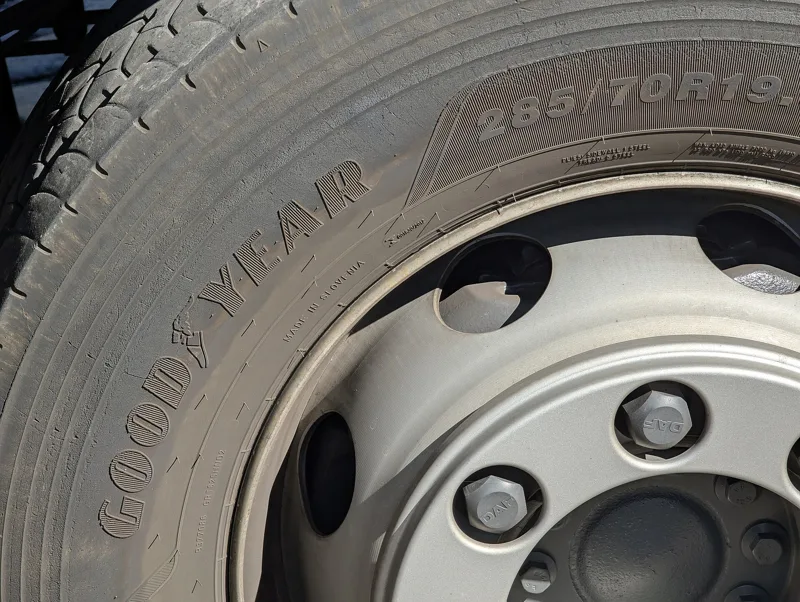
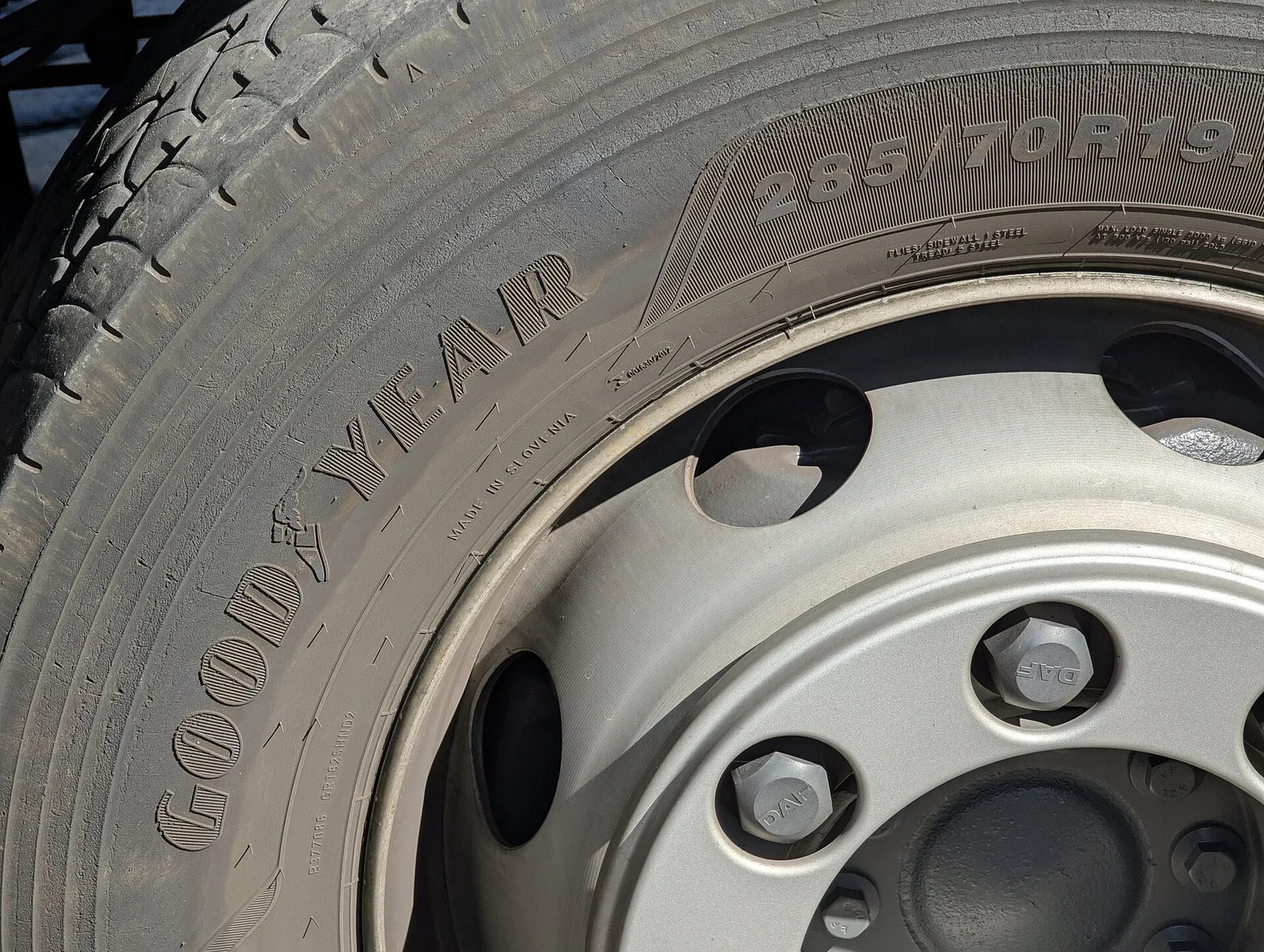
The main parts are the tread, bead, sidewall, shoulder and ply. The tread is the rubber surface that meets the road, and grooves run around it to channel water away. The bead seats against the rim on steel cables and seals in the air. The sidewall joins tread to bead and carries drive torque to the tread.
Wear bars sit at the base of the tread grooves. When the tread wears far enough for those bars to join across the lugs, the tyre has reached its wear limit, which is about 1.6 mm (0.063 in) of remaining depth.
Pattern and compound work together. Raising the share of rubber to groove area improves dry friction, which is why some Formula One tyres have no grooves at all. High-performance tyres use softer rubber for better grip, which wears faster, while mud and snow designs use larger, deeper slots to bite into soft surfaces.
Which types of tyre are there?
Passenger tyres range from winter and light truck designs through entry-level, sedan, sport and high-performance categories. Each trades grip, noise, durability and ride comfort differently. Snow tyres have larger, deeper gaps, and some carry studs for packed snow. All-season tyres carry a mud and snow rating, while all-terrain and mud-terrain tyres suit rough ground.
Run-flat tyres use stiff sidewalls to keep a car moving after a puncture, which removes the spare. Racing slicks have no tread, while rain tyres channel water out of the footprint. Heavy-duty truck and bus tyres are usually fitted in tandem on the drive axle. Aircraft tyres are small for the weight they carry, and they rely on the landing gear to absorb landing shock.
| Category | Rated load or speed | Notes |
|---|---|---|
| Passenger car, drive wheel | 250 to 500 kg (550 to 1,100 lb) | Light duty, ranked by speed rating |
| Light to medium truck or van | 500 to 1,500 kg (1,100 to 3,300 lb) | Light-to-medium duty |
| Heavy-duty truck or bus | 1,800 to 2,500 kg (4,000 to 5,500 lb) | Usually mounted in tandem |
| High-performance car | Speed rated up to 270 km/h (168 mph) | Harsher ride, shorter life |
| Ultra-high-performance car | Speed rated up to 299 km/h (186 mph) | Harsher ride, shorter life |
| Aircraft | Pressures over 1,400 kPa (14 bar; 200 psi) | Landing on paved surfaces |
How do tyres grip in rain, snow and ice?
In rain, a tyre can ride up on a film of water once standing water about 3 mm (0.12 in) deep builds up faster than the tread can clear it. That is hydroplaning, and it removes the friction needed to brake or corner. Grooves and sipes help water escape sideways.
Snow is different. The tread packs snow into its channels, and the compacted snow resists slipping, which is why deep, wide slots help. Ice sits close to its melting point and has a smooth surface, so its friction is low. Soft ground also loses strength when water or dryness weakens the soil.
Why does tyre pressure matter so much?
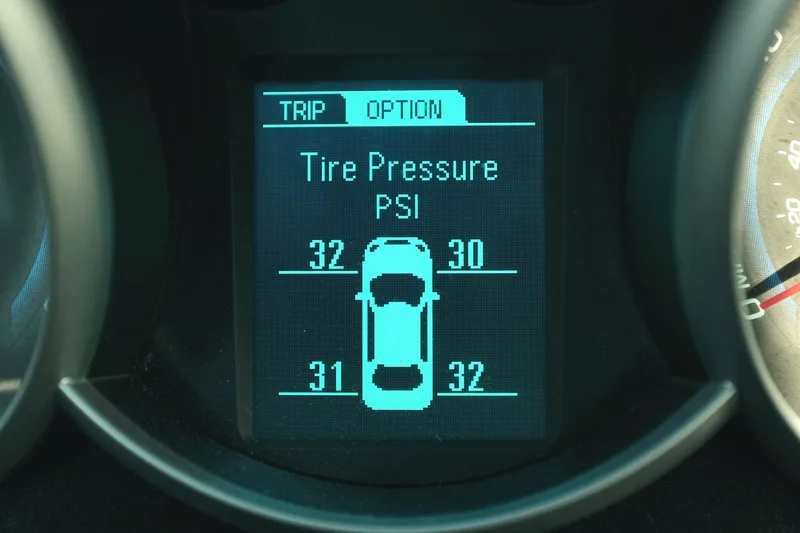
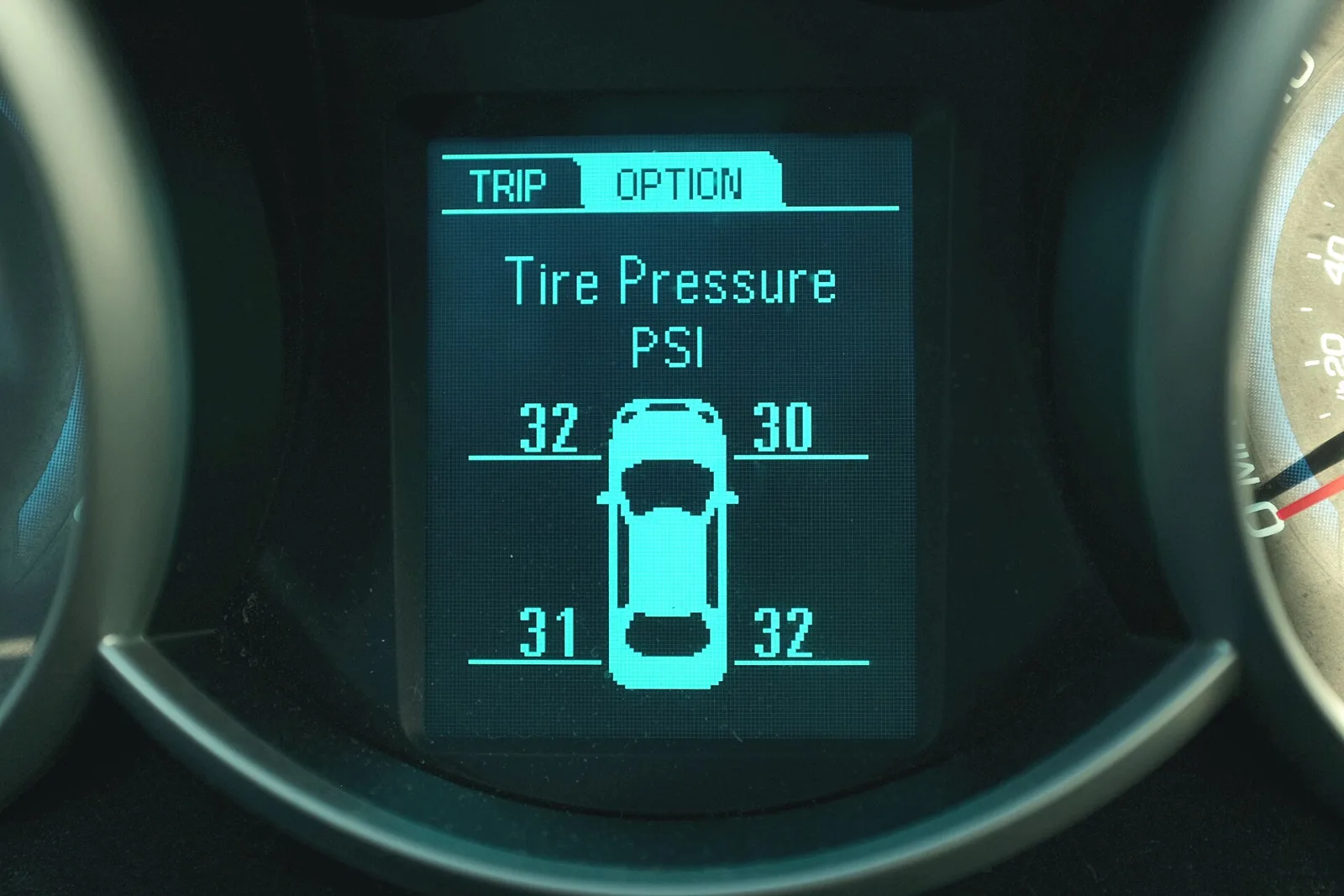
Pressure controls wear, rolling resistance and the size of the contact patch. Most passenger cars run best with cold pressures of 220 to 240 kPa (32 to 35 psi). Overinflation wears the centre of the tread, while underinflation makes the tread concave and overheats the tyre. Passenger vehicles lose roughly 5 to 15 percent of their fuel to rolling resistance, so the cost of poor pressure is real.
Tyre pressure monitoring systems are now required on most new passenger vehicles. They warn the driver when pressure falls below a set limit, using either a valve-stem sensor or a measurement of the tyre's changing size.
How are old tyres recycled?
Used tyres go to several uses. Shredded tyres become crumb rubber for asphalt and concrete, and rubber mulch softens playground falls. Pyrolysis heats whole or shredded tyres in an oxygen-free reactor, where the rubber breaks down into smaller molecules. Retreading gives a worn tyre a new tread on a sound casing, and a good casing can be retreaded more than once.
Landfill is poor value for tyres. Americans generate about 285 million scrap tyres a year, and each one holds a great deal of empty space that fills landfill quickly.
What environmental problems do tyres cause?
Tyre fires are hard to put out and release black smoke and hydrocarbons. Tyre chips used in landscaping can leach zinc at concentrations up to 2 percent by weight, enough to harm aquatic life. Tyres are also a major source of microplastics. A 2020 study found they made up 78 percent of the microplastic mass in the ocean.
One compound, 6PPD-quinone, enters stormwater through tyre wear and is toxic to coho salmon, brook trout and rainbow trout. Imperial College London researchers have warned that tyre wear chemicals and microplastics could have serious health and environmental effects.