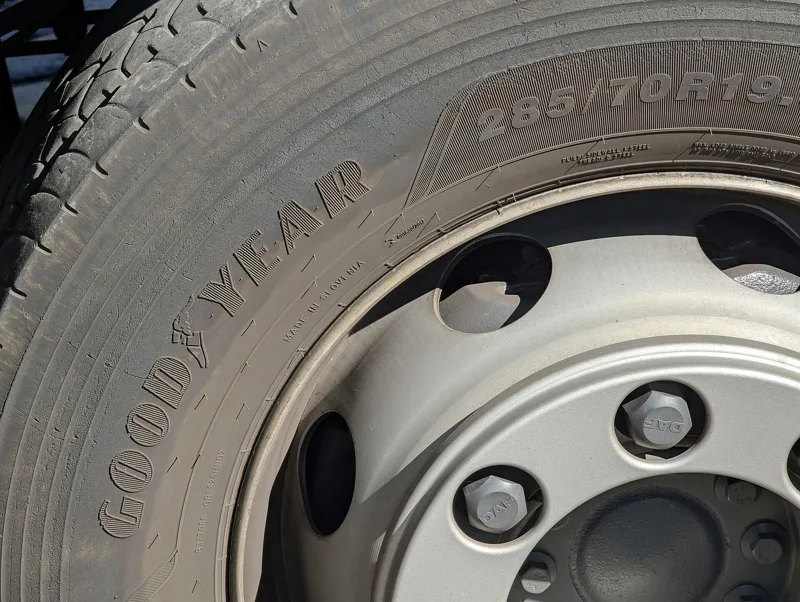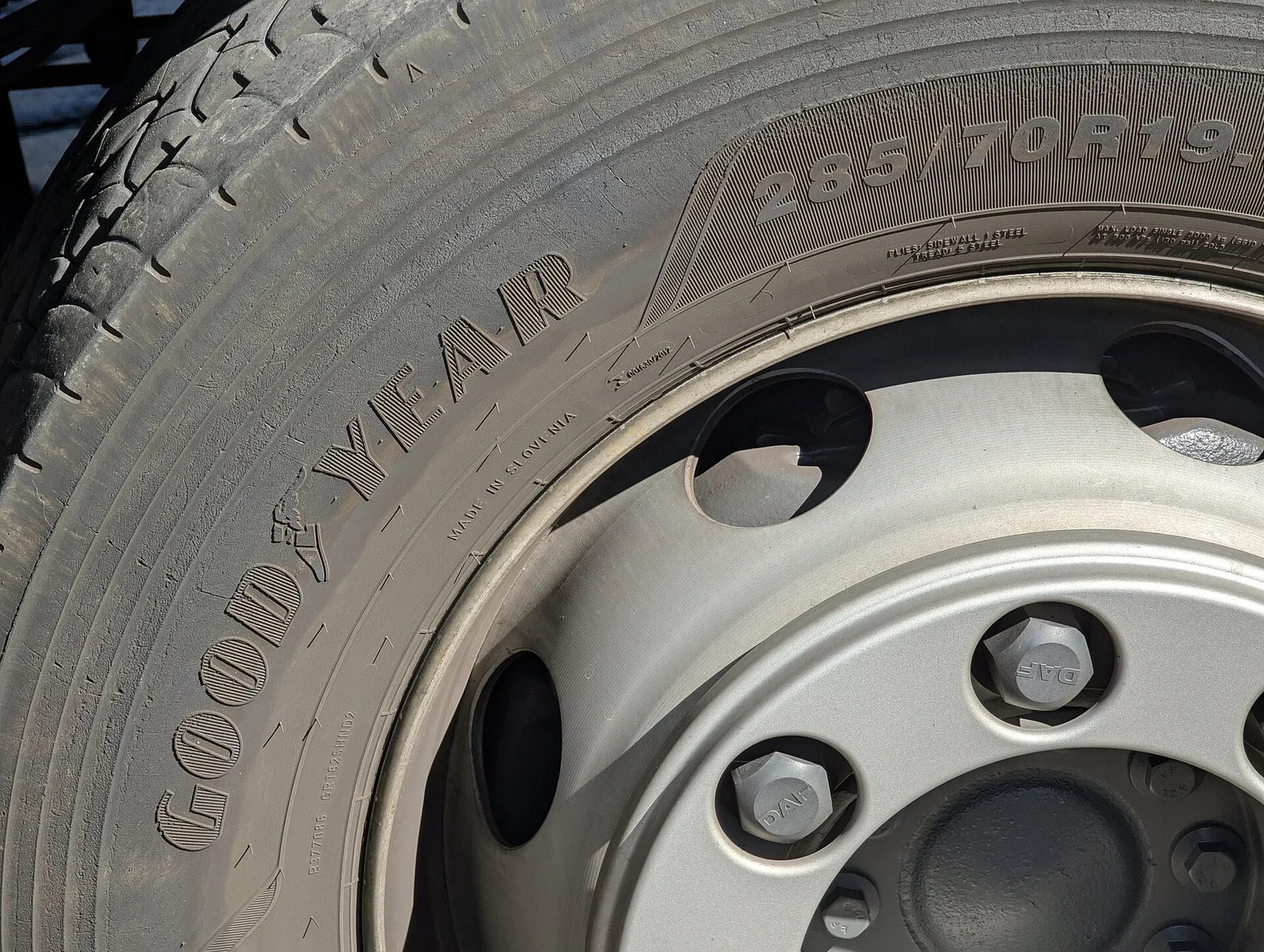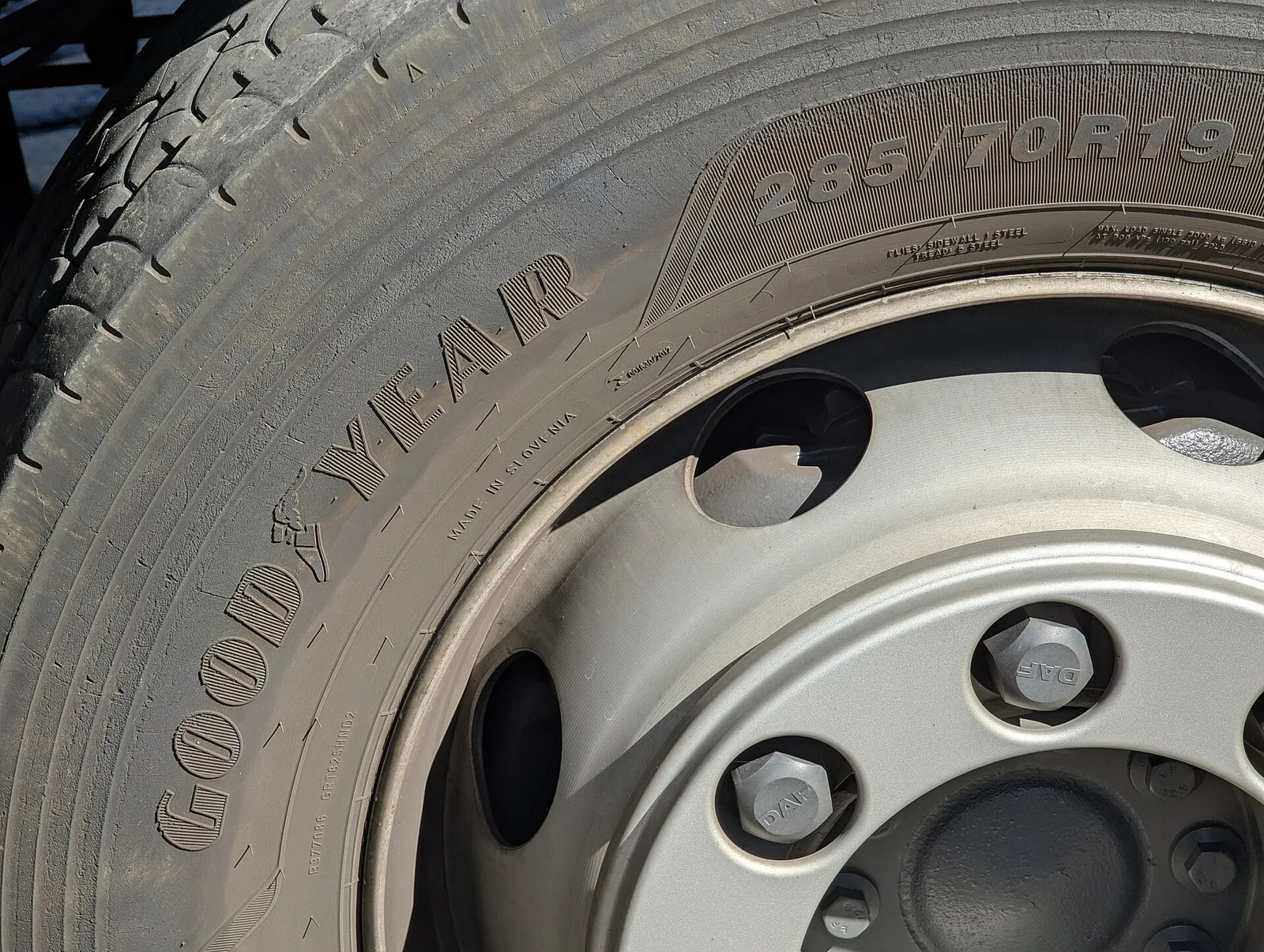
From 205/55 R16 to the four-digit build date, the letters and numbers moulded into every tyre.
The numbers on a tyre sidewall give its width in millimetres, how tall the sidewall is relative to that width, its construction type and the rim diameter in inches. A load index and speed letter come next, and the final four digits of the DOT code show the week and year it was made.
The most useful figure on a tyre is the one almost nobody reads: a four-digit stamp that gives the week and the year the rubber was made. Beside it sit the codes for size, load and speed.
What do the numbers and letters on a tyre sidewall actually tell you?
They describe the tyre's dimensions and its two most important limits: how much weight it can carry and how fast it may go. The codes are moulded into the rubber, and the inner face sometimes carries details that the outer face leaves out, or the reverse. Between them they hold everything a fitter needs.
The system has grown tangled with age. It mixes millimetres with inches, and extra letters and numbers have been bolted on over the years without much central planning. Most passenger car sizes follow either the P Metric scheme or the Metric scheme, which rests on ISO standards but should not be confused with the ISO metric system itself. Pickups and SUVs are sized by Light Truck Numeric or High Flotation rules, and heavy trucks have a scheme of their own.
Three bodies shape the numbers. ETRTO is the European Tyre and Rim Technical Organisation, TRA is the Tire and Rim Association, and JATMA is the Japan Automobile Tyre Manufacturers' Association. Their standards have evolved side by side and are largely interchangeable, although the load and inflation tables of each can differ a little for an identical size. Enforcement is a national matter. American enforcement falls partly to the Office of Vehicle Safety Compliance, a Department of Transportation unit that polices the Federal Motor Vehicle Safety Standard. Canada has its own rulebook, SOR 95-148.
The last four digits of the DOT code give the week and the year the tyre was made.
How do you read a tyre size like 205/55 R16?
Work left to right. The 205 is the nominal section width in millimetres and the 55 compares sidewall height with that width. The R says the tyre is radial, and the figure fused to it gives, in inches, the diameter of the rim it fits. A letter ahead of the width, such as P, can show the class of vehicle the tyre was designed for.
The optional class letter
A letter or two at the very start signals the intended use. The list is short:
- P for a passenger car
- LT for a light truck
- C for commercial trucks
- ST for a special trailer
- M/C for a motorcycle
- T for temporary use, a restricted-speed space-saver spare
A leading P tells you the load ratings follow TRA standards. Leave the letter off and the tyre conforms to ETRTO standards.
Section width
Three digits give the nominal section width, taken at the widest point from one outer sidewall to the other. The strip of rubber that actually meets the tarmac, the tread, is usually narrower than that figure. A slash then separates the width from what follows.
Aspect ratio
After the slash comes a two or three digit number: the height of the sidewall expressed as a percentage of the section width. In our example the sidewall is 55 per cent as tall as the tyre is wide. Leave the number out and 82 per cent is assumed. Anything larger than 200 is not a ratio at all but the diameter of the whole tyre in millimetres.
Construction letter
One or two optional letters describe how the fabric carcass is built. R means radial, B means a bias belt, where the sidewalls are made of the same material as the tread and the ride turns rigid, and D means diagonal. If no letter appears, the tyre is cross-ply. Older naming sometimes put a speed letter in front of the R, and that letter can be ignored, because the real speed rating comes at the end of the code.
Rim diameter
One or two digits give the diameter, in inches, of the rim the tyre is made to fit. Rare exceptions use millimetres, such as the 390 size, which means a rim of 390 mm, though few tyres are made to it now. Half-inch sizes exist too: many heavy transport trucks run 22.5-inch tyres.
The size says nothing about rim width. Permitted widths are set tyre by tyre in the TRA Yearbook or the manufacturer's own data, with no rule of thumb to fall back on, and a tyre run on a rim size or type its maker has not approved can fail and cause loss of vehicle control.
What do the load index and speed rating on a tyre mean?
They are the characters that trail the size, as in 100T on some tyres. The number is a load index that points to a table of the greatest load each tyre can carry at a given pressure. The letter is the speed symbol, the highest speed at which the tyre can carry its rated load without any part overheating.
Load index and load range
The load index is a two or three digit number. On its own it means little; you use it to look up a load and inflation chart. Tyres with a leading P are matched to the P Metric chart, and those without are matched to the Metric chart. In 100T, then, the 100 sends you to the standard load table and the T is the speed rating.
Sometimes a load range appears elsewhere on the sidewall, usually as two letters. LL means Light Load, SL means Standard Load and XL means Extra Load, which a tyre may spell out in full. If it is absent, you are looking at a Standard Load tyre. Together the load index and load range tell you the pressure required to carry a given weight.
Speed rating
The speed symbol is a single letter, or an A followed by one numeral. It describes steady running on smooth roads, and ratings of S and above come with a condition: the operating pressure has to be adjusted to match the figures in the rating table. A rating in parentheses, such as (W) or (Y), means the manufacturer set the maximum speed itself, and the load index is often tucked inside the brackets, as in (86Y).
The letters used before 1991
Until 1991 the speed code lived inside the size, ahead of the R, so a tyre of that era might read 205/55 ZR16 (an illustration of the layout rather than a particular product).
| Code | Maximum speed |
|---|---|
| ZR | Above 240 km/h (150 mph) |
| VR | Above 210 km/h (130 mph) |
| HR | Up to 210 km/h (130 mph) |
| SR | Up to 180 km/h (112 mph) |
What the law says about speed
In many countries the law demands that a tyre be both specified and fitted to beat the top speed of its car. Temporary spares are the exception. In some parts of the European Union a tyre unfit for a car's or motorcycle's top speed is illegal to mount at all. The sole carve-out is the M+S tyre, which needs a warning sticker stating the permitted maximum speed within clear sight of the driver.
Some manufacturers go the other way and fit a speed governor when a car is ordered on tyres rated below its potential top speed. Germany adds a twist: a lower rating may be mounted if the registration documents call for a very high one and the car, being short of power, cannot get near that speed. A formula then gives the correct rating.
For a sense of scale, high-performance tyres are rated for up to 270 km/h (168 mph), and ultra-high-performance tyres up to 299 km/h (186 mph). The price of that headroom is a harsher ride and shorter durability.
How do you find the date a tyre was made?
Look for the letters DOT and the long string that follows, often enclosed in an oval. The final four digits are the date, with the first pair giving the week and the second pair the year. A tyre whose code ends in 0422 was made in the fourth week of 2022, at the end of January.
The full DOT string is more than a calendar. Mandated by the US Department of Transportation but used worldwide, it helps identify tyres caught by a recall or approaching the end of their life because of age. Weeks are numbered 1 to 53 in line with ISO 8601, so 0121 means the first week of January 2021 and 0221 means the second.
Ahead of the date sit three more groups. The first three characters name the plant where the tyre was made and are assigned by NHTSA; tyres built before 2015 carried only two. Two digits then give a size code, which no one has standardised. WC, for instance, might stand for 205/55 R16 at one manufacturer and mean something else elsewhere. Finally, three or four optional digits record the tyre type, a code each maker devises for its own tracking of returns and quality control.
Tyres made before 2000 used only three digits for the date. A stamp reading 042 could therefore mean the fourth week of 1992, of 1982 or of an earlier decade, so a three-digit stamp cannot settle the age of an old tyre on its own.
What do the other marks on the sidewall mean?
Several more families of markings sit alongside the size and date. They cover wear and grip grades, winter capability, regulatory approval and the vehicle the tyre was first fitted to.
Grades and winter symbols
Wear, traction and temperature performance are shown under the Uniform Tire Quality Grading standard. Winter use has its own vocabulary: M+S for Mud and Snow, 3PMSF (the Three Peak Mountain Snow Flake) for severe snow and IGS for ice conditions. Studded tyres add the Cyrillic letter Sha, a pictogram standardised in 2022.
A tyre that has passed a specific winter traction test is entitled to show the snowflake symbol. Winter tyres are optimised for temperatures below 7 degrees C (45 degrees F), while all-season tyres are typically rated M+S, with tread gaps smaller than a snow tyre's and larger than a summer tyre's. They run quieter on clear roads and cope less well on snow or ice.
Approval and fitment marks
Road tyres sold in Europe from July 1997 onwards have to carry an E-mark. A capital E inside a circle signals UN Regulation 30, whereas a small e inside a box points to an EU directive, and that small e certifies the tyre meets Directive 92/23/EEC. The number beside it shows which country granted approval.
Car makers add marks of their own. An asterisk denotes original fitment for BMW-Mini, AO is Audi's code and AMx belongs to Aston Martin. Arrows show the rotation direction of a directional tread, while A/T flags an all-terrain tyre, BSW a black sidewall and BSL black serrated letters. E4 shows approval under ECE regulations, with the number indicating the approving country.
What do light truck tyre codes look like?
They change order. The letters LT come at the end rather than the beginning, and flotation sizes can be written in inches throughout. Two groups of numbers, as in 5.00-15, give the approximate width and then the rim diameter. Three groups, such as 26x12.00-12, give the tyre diameter, the width and the rim diameter.
Without a diameter, a width ending in zero (7.00, 10.50) implies a 92 per cent aspect ratio, and one that does not (7.05, 10.55) implies 82 per cent. Load index and speed rating may be optional for flotation sizes, but any tyre approved for street and highway use must have both. On these tyres the load range letter reflects the ply rating.
Where did the modern tyre come from?
The earliest tyres were bands of leather in Sumer, followed by iron, later steel, on wooden cart wheels. A wheelwright heated the band in a forge, set it over the wheel and quenched it so it shrank into a tight fit. Rubber tyres came much later, and the first were solid rather than inflated.
The first patent for a pneumatic tyre dates to 1847, lodged by the Scottish inventor Robert William Thomson, though it never reached production. The first practical version appeared in 1888 on May Street in Belfast, where John Boyd Dunlop built it to spare his 10-year-old son Johnnie the headaches that rough pavements gave him on a tricycle. Willie Hume won the first races on the new tyre in 1889. In 1892 Dunlop's own patent was declared invalid because of Thomson's earlier work.
Michelin made the first pneumatic tyres for automobiles in 1895, and used them on a car called L'Eclair in the Paris-Bordeaux-Paris race. The company then developed the radial method in 1946. Radials spread through Europe and Asia on the strength of better handling and fuel economy, while American builders clung to bias-ply construction until Ford adopted radials in the early 1970s, following a 1968 Consumer Reports article praising them. By the 1980s radials held 100 per cent of the North American market.
Inside a radial, the body ply cords run straight across from bead to bead, at roughly right angles to the centreline of the tread, with stabiliser belts directly beneath it. The plies are generally nylon, polyester or steel and the belts steel, fibreglass or Kevlar. Compared with a bias tyre, the footprint is wider and the sidewalls more flexible, which gives better grip in corners.
What should this change when you buy tyres?
Light-duty passenger tyres carry loads of 250 to 500 kg on a drive wheel.
Tyre type matters as much as size. Run-flat tyres use a stiff sidewall so the car can keep moving at reduced speed after a puncture, and so dispense with a spare. Race tyres come as street-legal DOT tyres, slicks and rain tyres, built for cornering and acceleration grip rather than longevity.
Where do the codes go next?
Electric cars are already pushing the system. They place unique demands on tyres through weight, which brings a new load index, plus higher torque and a need for lower rolling resistance.