A healthy tyre leaks about a tenth of its air a year, and the system that watches it works in one of two very different ways.
The correct tyre pressure is the cold figure on the car maker's placard and in the owner's manual. A TPMS warns when a tyre falls below it, either with a sensor in each wheel (direct) or by comparing wheel speeds in software (indirect), which needs a reset after checks.
A brand-new tyre with no puncture and a perfect fitting can still lose 10 percent or more of its pressure in a single year, just by leaking through the rubber.
What is the correct tyre pressure for my car?
The right figure is the one the car maker specifies. It sits in the owner's manual and on the tyre information placard, which is fixed to the door edge, door pillar, glovebox door or fuel filler flap depending on the car. It is a gauge pressure, quoted in psi, bar or kilopascals, so check which unit your gauge shows.
Behind that number is simple mechanics. A tyre passes the weight of the car down to the road, from axle to wheel to tarmac. The cushion of air inside is what absorbs shocks, and the patch of rubber touching the ground is sized to match the vehicle's weight. Change the air and you change how that patch behaves.
The placard figure also assumes the car is as the maker imagined it. Fit a tyre of a different size or load index, or change the load the car carries, and a fresh calculation is needed. For ordinary driving, the placard is the answer.
Natural leakage means a tyre drifts down even when nothing is wrong.
Why does cold tyre pressure matter?
Cold inflation pressure is the reading taken before the car has been driven and the tyres have warmed up. Driving heats the air inside, which raises the pressure, so a hot reading cannot be compared with the placard figure. That is why the manufacturer's number is always a cold one.
Time of day matters too. Daily temperature swings change tyre pressure appreciably, and the morning is usually the coldest part of the day, which makes it the best moment to measure. A tyre that meets the required pressure then will meet or exceed it through the rest of the day.
Seasons do the same thing on a bigger scale. A tyre that is properly inflated in summer is likely to be underinflated in winter, so the pressure should be checked whenever the local season changes.
Altitude changes the reading
Atmospheric pressure falls by about 0.5 psi for every 1000 feet of height (0.11 bar per kilometre). Take a car whose tyres were set near Denver, at 5,300 feet (1,600 metres), and drive it down to Los Angeles at 300 feet (90 metres). The air inside the tyre is the same, but the air outside pushes harder, so the gauge reads lower: the tyres could end up as much as 2.5 psi (0.2 bar) short of their setting. A significant change in altitude calls for a readjustment.
How do you check tyre pressure properly?
Measure with the tyres cold, ideally in the morning, compare the gauge reading with the placard, and top up or release air to match it. Repeat the check at each change of season and after any move to a very different altitude. Natural leakage means a tyre drifts down even when nothing is wrong.
That drift is easy to underestimate. Tyres leak air through ordinary use, not only when punctured, and a typical new, properly mounted tyre can lose 20 to 60 kPa (3 to 9 psi) over a year. That is roughly 10 percent of its starting pressure, or even more.
When the placard no longer fits
If the tyres or the load change, there are four ways to work out a new cold pressure. The first is a lookup in the tables of the European body ETRTO, the Tire and Rim Association or Japan's JATMA. It is the simplest method, though rounding errors can pile up.
The second is a simple ratio: take the weight on the tyre plus a 10 percent margin, then scale the maximum pressure by that load against the maximum load printed on the sidewall. It can come out slightly high. The third, a power rule, uses the same inputs with an exponent and can come out slightly low. The fourth, a stiffness model, draws on aspect ratio, section width and rim diameter, and is complex but gives the most accurate result. A pressure calculator saves the arithmetic.
These methods give the best figure for one tyre. Because a car has more than one, handling can be tuned from there: more pressure at the rear to correct understeer, more at the front to correct oversteer. Whatever the tuning, pressures should stay above the calculated cold figure and below the maximum cold pressure on the sidewall.
What happens if tyre pressure is too low or too high?
Too little pressure cuts fuel economy and performance, wears the edges of the tread faster, and can lead to overheating and early failure. Too much pressure brings discomfort, reduced performance and extra wear down the middle of the tread.
Braking distance and lateral stability both depend on pressures being kept at the manufacturer's specification. Extreme under-inflation can push a tyre into thermal and mechanical overload, where overheating ends in the sudden destruction of the tyre. Running even briefly on too little pressure also breaks down the casing and rules out a later retread.
Many drivers are in the wrong zone without knowing it. A 2001 study by the US National Highway Traffic Safety Administration found that 40 percent of passenger cars had at least one tyre under-inflated by 0.4 bar (6 psi) or more, and it identified under-inflation as the number one cause of tyre failure.
Money is part of the story. According to GITI, every 10 percent of under-inflation on each tyre costs 1 percent of fuel economy. The US Department of Transportation estimates that under-inflated tyres waste 2 billion US gallons (7,600,000 cubic metres) of fuel each year in the United States.
What does the tyre pressure warning light mean?
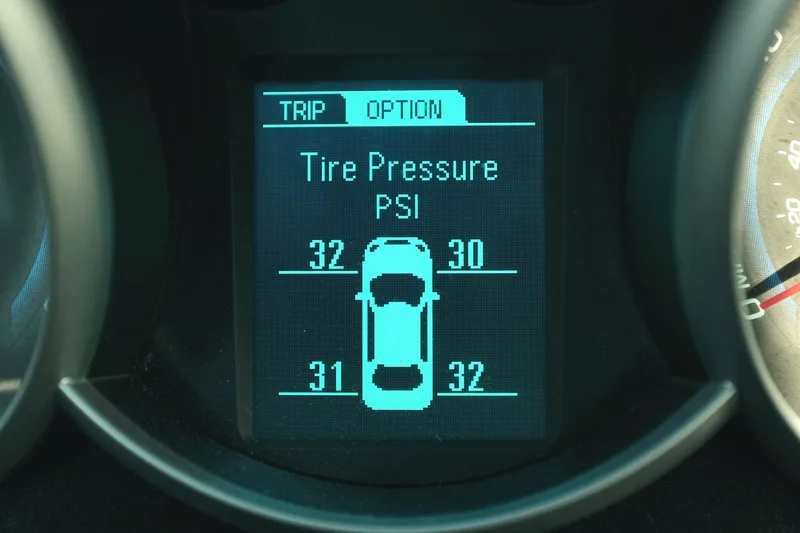
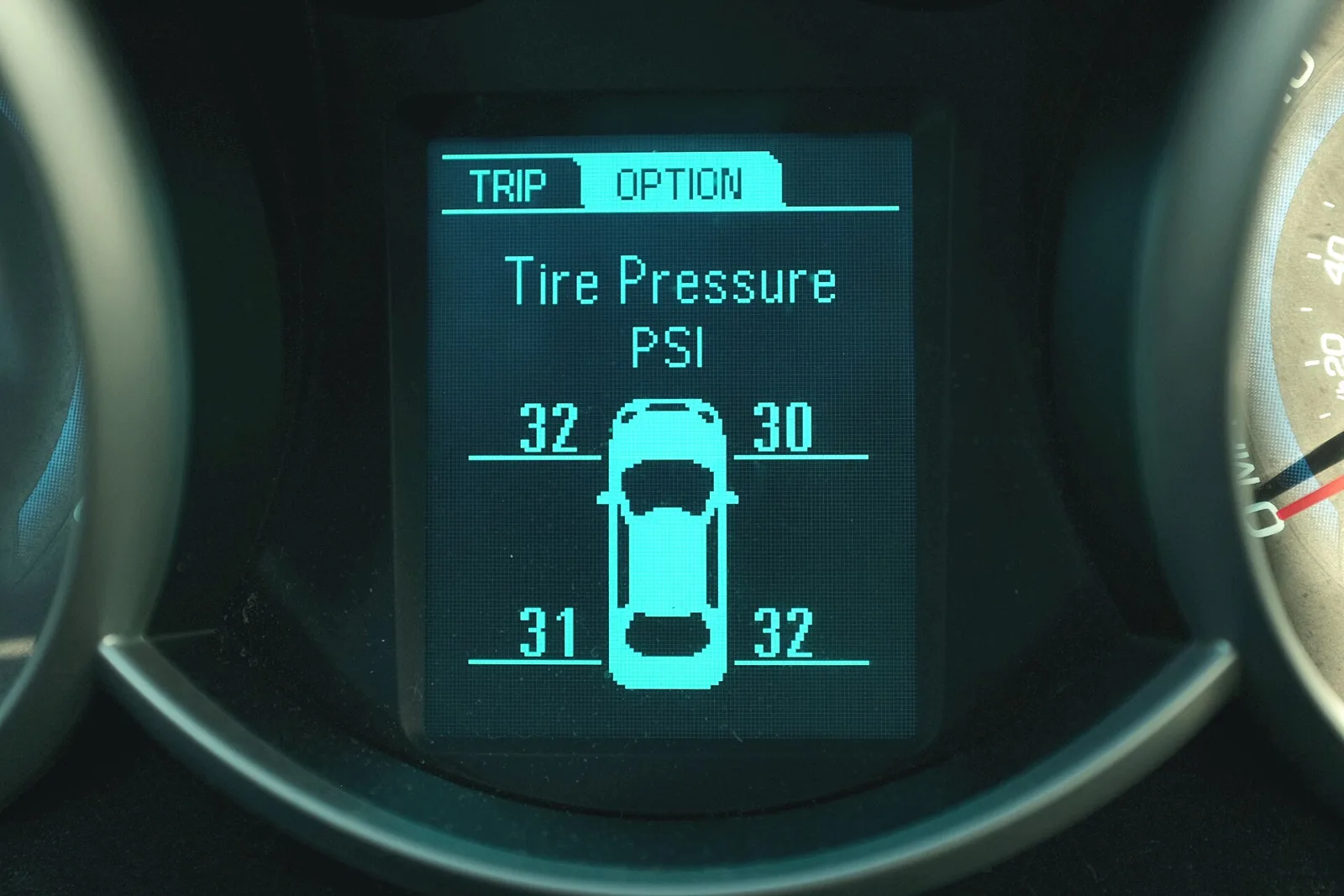
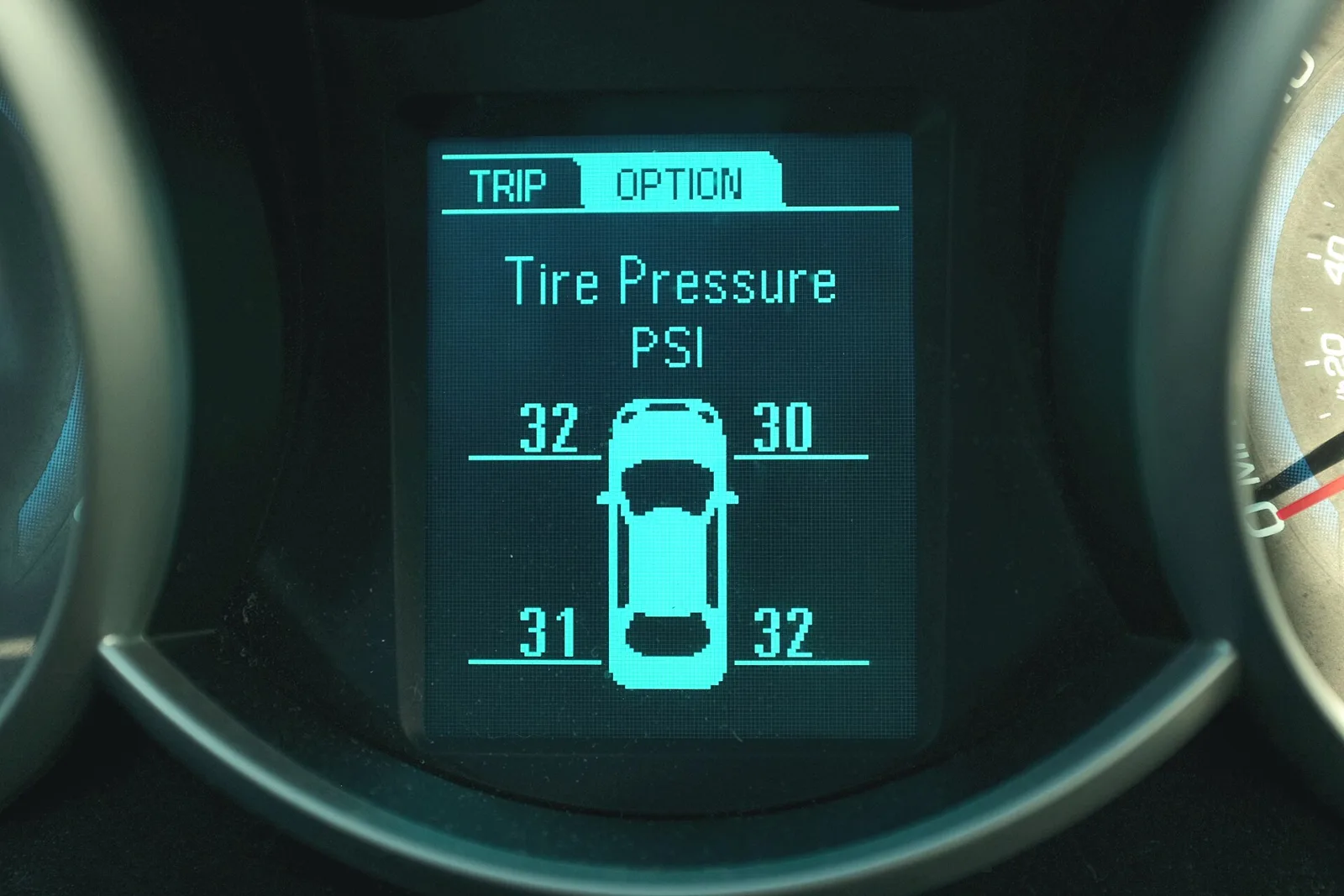
A tyre-pressure monitoring system, or TPMS, watches the air pressure inside the tyres and reports it as it happens. The report arrives on a dial, as a pictogram, or as a bare low-pressure lamp. The TPMS light is the car telling you that a tyre has dropped below where it should be.
The aim is to catch a hazardous tyre early, before it causes an accident, wastes fuel or wears out prematurely. Some systems are built in at the factory; others are fitted after the car enters use.
Two families exist, and they work in completely different ways. Direct systems measure pressure with hardware in the wheel. Indirect systems infer it from signals the car already has. The warning light looks the same either way, but what sits behind it does not.
Direct TPMS: a sensor in every wheel
In a direct system, a battery-powered pressure sensor, usually tucked inside the valve, sits at every wheel. It sends its reading to a central control unit, which passes it to the car's onboard computer. Some units also measure tyre temperature. The result is that under-inflation can be identified tyre by tyre.
The sensor is a small electronic package: a pressure sensor, an analogue-to-digital converter, a microcontroller, a system controller, an oscillator, a radio transmitter, a low-frequency receiver and a voltage regulator that manages the battery. Life is hard for it. It faces a hostile environment, and the battery limits how long it works.
Most factory-fitted sensors sit inside the rim with batteries that cannot be changed. A flat battery therefore means taking the tyre off the wheel. To save energy, many sensors stop transmitting when the car is parked, which also means a spare tyre goes unmonitored. Others use two-way communication to wake the sensor on demand. Sensors fixed to the outside of the wheel, as some aftermarket ones are, avoid the battery access problem but risk knocks, harsh fluids and theft.
A different approach powers the sensor wirelessly, in a way similar to how RFID tags are read. That removes the battery life problem, allows data to be sent up to 40 times a second, and cuts sensor weight, which matters in motorsport.
Indirect TPMS: reading the wheels' speed
An indirect system has no pressure sensors at all. Software estimates pressure by combining signals the car already produces, including wheel speeds, accelerometers and driveline data. The first generation relied on a neat piece of physics. A soft tyre sits a little lower and has a slightly smaller diameter, so it has to turn faster than its neighbours to cover the same road. The ABS and stability control wheel-speed sensors can spot that difference.
The second generation goes further. Through spectrum analysis of each wheel, it can detect under-inflation in up to all four tyres at once, which the first generation could not do. Manufacturers use their own names for the technology, such as Ford's Deflation Detection System and Honda's Deflation Warning System.
An indirect system cannot show an absolute pressure, only a change relative to a reference. After the tyres are checked and the pressures set correctly, the driver resets it, using a button or the on-board computer menu. A learning phase follows, typically 20 to 60 minutes of driving, while the system stores its reference values. Without extra hardware or spare parts to maintain, the technology is regarded as easy to live with, though the reset must be repeated whenever the tyre setup changes and some owners dislike that duty.
Direct and indirect TPMS compared
| Feature | Direct TPMS | Indirect TPMS |
|---|---|---|
| How it measures | Battery-driven pressure sensor in each wheel | Software combining wheel speeds, accelerometers and driveline data |
| Extra hardware | Sensor, transmitter and battery per wheel | None |
| Absolute pressure shown | Yes, for each tyre | No, relative values only |
| Driver action | None beyond servicing sensors | Reset after checking pressures, then a learning phase of 20 to 60 minutes |
| Main weakness | Battery life, corrosion, damage and theft for outside-mounted units | More sensitive to tyres, road surface and driving style |
| Typical use | OEM and aftermarket systems | Most of the VW group, plus Renault, FIAT, PSA, Mazda, Ford, Opel, Volvo and Honda models |
Which cars have to carry a TPMS?
In both the United States and the European Union, new passenger cars must carry one. The American rule came after a tyre scandal, and the European rule followed with a fixed timetable, ending with every new passenger car sold in the EU from 1 November 2014.
The US push followed the Firestone recall at the end of the 1990s, tied to over 100 rollover deaths after treads separated. Congress responded with the TREAD Act, which required a suitable system in light motor vehicles under 10,000 lb (4,500 kg). Phase-in started in October 2005 at 20 percent and reached 100 percent for models produced after September 2007.
- United States: all light vehicles sold after 1 September 2007, with new passenger car models covered from 2008.
- European Union: all new passenger car models from 1 November 2012, and all new passenger cars sold from 1 November 2014. Trucks up to 3.5 tonnes need not carry one, but any that does must comply.
- South Korea: announced on 13 July 2010, effective 1 January 2013 for new models and 30 June 2014 for existing ones.
- Others: Turkey, Malaysia, Israel, the Philippines, Indonesia and Russia also require it.
The technology was not born with the mandates. Luxury cars in Europe were the first to carry it, in the 1980s, and the Porsche 959 led the way in 1986 with a system built into hollow wheel spokes, developed by PSK. General Motors fitted it to the Corvette for the 1991 model year alongside Goodyear run-flat tyres, with a display showing the pressure at any wheel, and it has been standard there since. Renault launched the Laguna II in 2000 as the first high-volume mid-size passenger car with a system as standard.
Rules do not guarantee fitment on the road. A study running from November 2016 to August 2017 found that 54 percent of the passenger cars checked in Germany, Spain and Sweden lacked a TPMS, a total thought to be too low.
Why do run-flat tyres need a monitoring system?
A driver is likely to miss a run-flat tyre that has gone flat, because the stiff sidewall keeps the car feeling normal. That is why run-flat warning systems were introduced. They are mostly first-generation indirect systems based on roll radius, making sure the tyres are not used beyond their limits, usually 80 km/h (50 mph) and 80 km (50 miles).
Indirect technology has moved on. By combining roll radius with spectrum analysis, it can now watch all four wheels, which makes it possible to meet the legal requirements with an indirect system.
What goes wrong with TPMS sensors?
The most common problems are corrosion and incompatibility. First-generation sensors built into the valve stem can corrode, and a metal valve cap can seize through galvanic corrosion. Efforts to remove it can break the stem and destroy the sensor.
Brass valve cores fitted by an unwary technician in place of the original nickel-coated ones can have the same effect. A seized stem also complicates the repair of a leak, and a new sensor may be needed.
Tyre sealant is a matter of controversy. Some sealant makers say their products are compatible with sensors mounted inside the tyre. Others warn that the sealant may touch the sensor and leave it inoperable until a tyre professional cleans, inspects and refits it. Using such sealants may void the sensor warranty.
No monitoring system can predict every failure. Structural damage from hitting a sharp kerb or a pothole can cause a tyre to fail suddenly, even some time later, and no TPMS can detect it in advance.
Where this goes next
Indirect monitoring is gaining ground. It has been type-approved under UN Regulation R64 since fitment became mandatory in the EU, and it is expected to become the dominant TPMS technology there in the near future. Critics argue that it is less accurate, because simple ambient temperature changes can shift pressure by as much as the legal detection thresholds, yet many makers and customers value its ease of use.
Mandates are also spreading. Japan is expected to follow the EU's lead about a year after the EU implements its rules, and aftermarket systems already reach well beyond cars, to bicycles, trailers and heavy-duty trucks. Commercial fleets use sensors on every tyre that send pressure and temperature to a GPS tracking unit and on to fleet software, which lets managers monitor tyre health remotely.