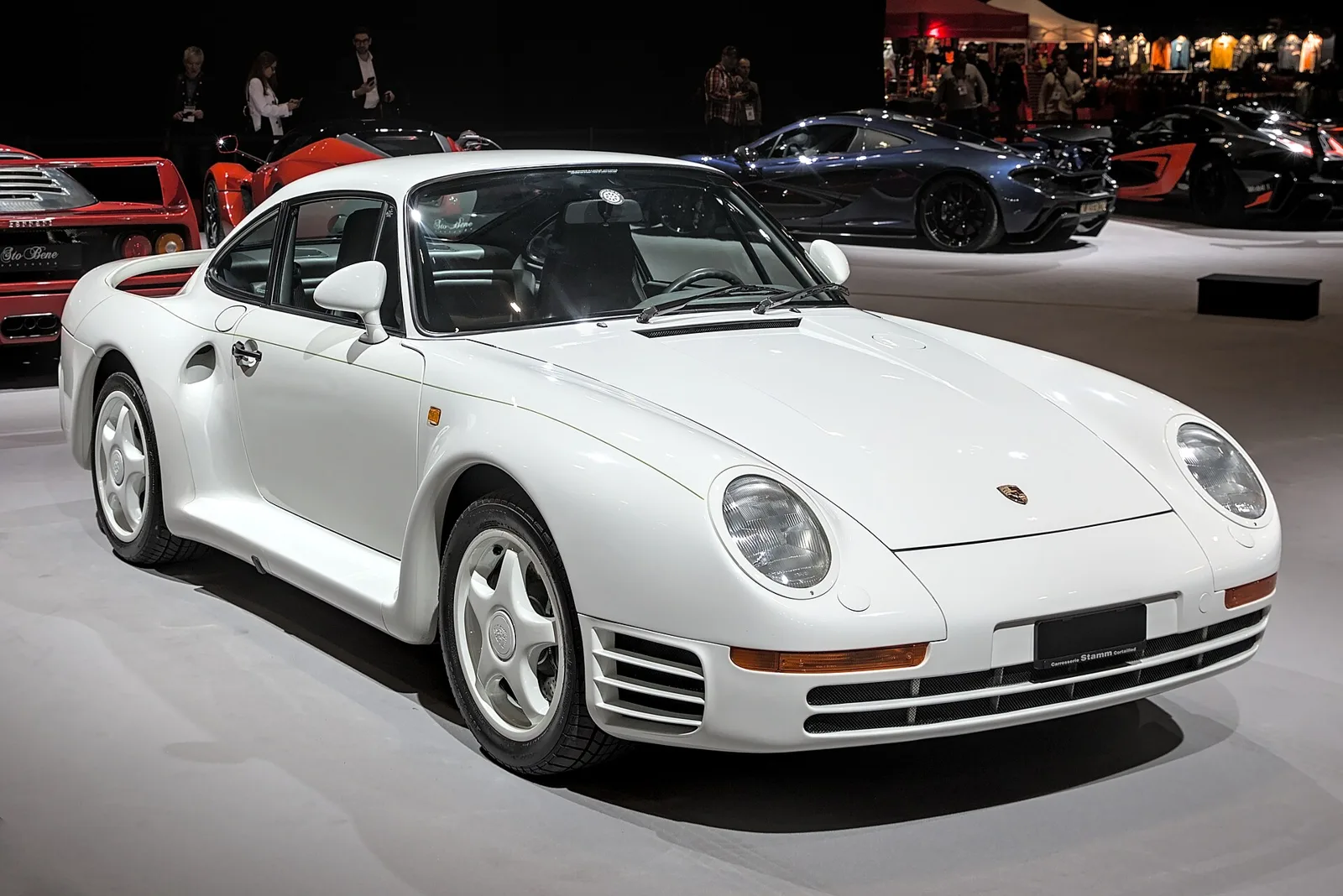
Porsche's twin-turbo, all-wheel-drive 959 began as a rally development car in 1981 and reached customers in 1987 as a 317 km/h (197 mph) road car.
The Porsche 959 was a twin-turbocharged, all-wheel-drive sports car that Porsche built from 1986 to 1988 as a Group B rally car and then as a road car homologated for production. It used a 2,849 cc flat-six making 450 PS, and 337 cars were built in total.
The Porsche 959 started life as a Group B development project in 1981 and reached the road as a 1986 model. Porsche built it with a sequential twin-turbo flat-six and all-wheel drive, a combination that set it apart from the rear-wheel-drive 911s it was based on. The car remained one of the defining Porsches of the 1980s.
Where did the 959 come from?
The 959 began in 1981 as the Gruppe B project, shortly after Peter Schutz became Porsche's managing director. Chief engineer Helmuth Bott proposed researching a new all-wheel-drive system, and Group B rallying was chosen as the place to test it. The road car then followed.
The 1983 Frankfurt Motor Show was where the Group B prototype was unveiled to the public. The road car was shown at the 1985 Frankfurt Motor Show, where it was badged as a 1986 model. Production slipped by more than a year because of a string of problems. First customer deliveries did not start until 1987.
Porsche's development programme used rally cars before the road car existed. The 953 development cars entered the 1984 Paris-Dakar Rally and gave the engineers real-world data on the all-wheel-drive system that would later appear in the 959.
A rally car turned road legend: the 959 put all-wheel drive and twin turbos into a production sports car.
How did the 959's all-wheel drive work?
The 959 used the Porsche-Steuer Kupplung system, usually shortened to PSK. It could change the torque split between the front and rear wheels in both normal and slip conditions, which gave the car the adaptability it needed as both a race car and a road car.
Under hard acceleration PSK could send up to 80% of the available power to the rear wheels. It could also vary the power bias with the road surface and changes in grip, which helped the car hold traction in more conditions than a rear-driven car could manage.
The dashboard carried gauges that showed rear differential slip and the power sent to the front axle. Those instruments made the system's work visible to the driver, and they were a clear sign of how much engineering had gone into the car.
The engine itself is a sequential twin-turbocharged DOHC flat-six of 2,849 cc, with four valves per cylinder and Bosch Motronic 2.1 fuel injection. The unit was largely based on the four-camshaft race engine used in the Porsche 956 and 962, and it was used virtually unchanged in the road car.
The sequential turbos were one of the car's key features. Rather than two identical turbochargers feeding each bank, the layout gave smooth power delivery across the rev range, in contrast to the abrupt on-off character of Porsche's other turbocharged engines of the period.
How fast was the 959?
When introduced, the 959 was credited with a top speed of 317 km/h (197 mph). Some variants reached 339 km/h (211 mph) in testing, and the figures were confirmed by independent magazine tests of the period.
Auto, Motor und Sport recorded 318 km/h (198 mph) at the top end, and reached 100 km/h (62 mph) in 3.7 seconds. Guinness World Records recognised those road-tested figures as the highest recorded for a road car, both for top speed and for 0-100 km/h acceleration.
Road and Track recorded 3.6 seconds to 97 km/h (60 mph) and 8.2 seconds to 161 km/h (100 mph). Its quarter-mile run took 11.9 seconds at 192.3 km/h (119.5 mph),
Car and Driver measured 3.6 seconds to 97 km/h in Komfort trim, which it described as nine tenths quicker than any other car it tested in the 1980s. The Komfort trim was the more comfortable of the two specifications offered.
A factory upgrade for customer cars was also available. Paul Frere reported an optional 530 PS (390 kW; 523 hp) setting, reaching 336 km/h (209 mph).
How was the 959 built?
The 959 was not built at Porsche's Zuffenhausen factory. It was produced at Karosserie Baur, on an assembly line where Porsche inspectors oversaw the finished bodies. Baur's workers also handled most of the special-order leather for the interior.
Porsche's engineers wanted a shell that was both rugged and light, and the car's bodywork was built by a specialist coachbuilder under Porsche's inspection. The body and chassis used an aluminium and Aramid (Kevlar) composite, along with a Nomex floor in place of the steel floor normally fitted to production Porsches. That material choice produced a rugged, lightweight shell.
Porsche also developed the car's aerodynamics. The drag coefficient was as low as 0.31, and the design eliminated aerodynamic lift. The road car gained automatic ride-height adjustment, which the race cars did not have.
The magnesium alloy wheels were hollow and sealed around the tyre, and they carried a built-in tyre pressure monitoring system. Each detail was part of a package aimed at a car that could be driven hard on road and track.
The Frankfurt prototype was not the first version of the car. After the first two prototypes, the bodywork was modified with air vents in the front and rear wheel housings, and the first prototype to receive those changes was code-named F3.
How many 959s were built?
Production ended in 1988, with 292 cars finished. Counting prototypes and pre-production cars, the total came to 337, and at least one 959 and one 961 remain in Porsche's historic hall in Stuttgart.
In 1992 and 1993 Porsche built eight more cars from spare parts in the Zuffenhausen inventory. All eight were Komfort versions, four red and four silver, and each cost DM 747,500, which was far more than the earlier cars.
Those eight late cars are a useful reminder of how small the programme became. Once the original run had ended, Porsche relied on leftover parts to complete a final handful, and the price rose well above the launch figure. The late cars also featured a newly developed speed-sensitive damper system. Selected collectors bought them once works personnel had driven them for a while, and they are now the most sought-after 959 models.
What was the 959 S?
The standard car came in Komfort and Sport trims, and the 959 S was a further step in the Sport direction. It was a Sport-specification car with larger turbochargers. Those turbos raised output to 515 PS (379 kW; 508 hp), which lifted the figure to 339 km/h (211 mph) when tested by Auto, Motor und Sport at the Nardo Ring in 1988.
To save weight, air conditioning, central locking, electric window lifts, rear seats and the chassis levelling system were omitted. Twenty-nine 959 S cars were built.
How did the 959 perform in racing?
The 959 was originally meant for Group B racing, but development took longer than expected. The first development race cars, modified 911 Carreras with the all-wheel-drive system known internally as the 953, finished 1st, 6th and 25th at the 1984 Paris-Dakar Rally.
The rally programme was therefore more than a publicity exercise. At the 1986 Paris-Dakar Rally the 959 finished 1st, 2nd and 6th, with Rene Metge taking the win.
The Group B programme was cancelled a year before the 959 reached homologation in 1987. That decision ended Porsche's participation in Group B, though the car's racing record remained a central part of its story.
The racing version, the 961, debuted at the 1986 24 Hours of Le Mans. The car returned in 1987, when a crash led to a fire that was later repaired, which shows how demanding that programme was. It finished first in its class and 7th overall, driven by Rene Metge. The 961 also took part in the IMSA championship, but it suffered tyre issues on the banking at Daytona.
Could the 959 be driven legally in the United States?
The car never won approval from the National Highway Traffic Safety Administration for American street use. Porsche designed and tested the car to European safety standards only, and the company had concluded that the exchange rate made each US sale unprofitable.
The legal path was narrow, which is why the few owners who wanted a 959 in the US relied on storage arrangements. Each 959 that reached the country needed paid storage in foreign trade zones, where the cars were not considered to be in the US for legal purposes.
Bill Gates bought a 959 in 1988. Because the car had no NHTSA or EPA approval, it was denied entry into the US, and the Customs Service then stored it for 13 years instead of destroying it. The Show or Display law came into force on 13 August 1999 and allowed the car to be used, limited to 2,500 road miles a year.
All 959s are now over 25 years old, so they no longer need to meet the special NHTSA and EPA rules that once threatened their destruction by US Customs.
Why does the 959 still matter?
Sports Car International named the 959 the number one car on its list of top sports cars of the 1980s in 2004. Many enthusiasts consider it the most technologically advanced road car of its time.
The car also shaped Porsche's later models. It provided the basis for the first all-wheel-drive 911 Carrera 4, and Porsche made all-wheel drive standard on all turbocharged 911s from the 993 onwards, so the 959's influence reached the whole range. The twin-turbo system used on the 959 also influenced later turbocharged Porsche sports cars.
In 2003 Canepa Design began an upgrade programme for the 959, changing its turbochargers, exhaust and engine computer so that the car could meet US emissions rules. The upgrade programme has since grown to three generations, with a sportier trim also available.
Porsche 959 specification
| Specification | Standard 959 | 959 S |
|---|---|---|
| Engine | 2,849 cc sequential twin-turbo flat-six | Same engine with larger turbochargers |
| Output | 450 PS (331 kW; 444 hp) at 6,500 rpm | 515 PS (379 kW; 508 hp) |
| Torque | 500 newton-metres (369 lb ft) at 5,000 rpm | Not separately listed |
| Top speed | 317 km/h (197 mph) when introduced | 339 km/h (211 mph) in testing |
| 0-100 km/h | 3.7 seconds (Auto, Motor und Sport) | Not separately listed |
| Built | 337 in total, including prototypes | Twenty-nine |
| Launch price | US$225,000 | Not separately listed |