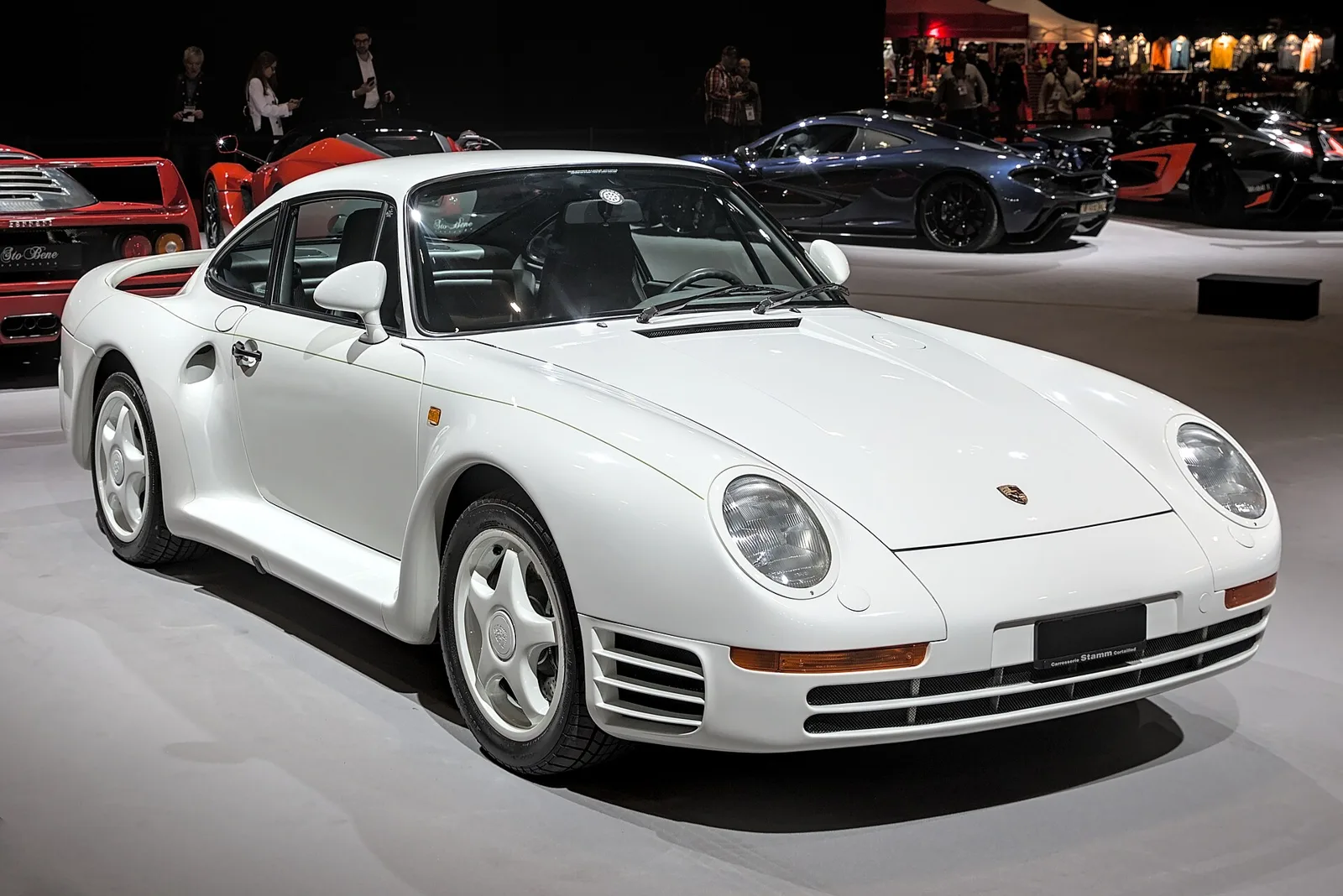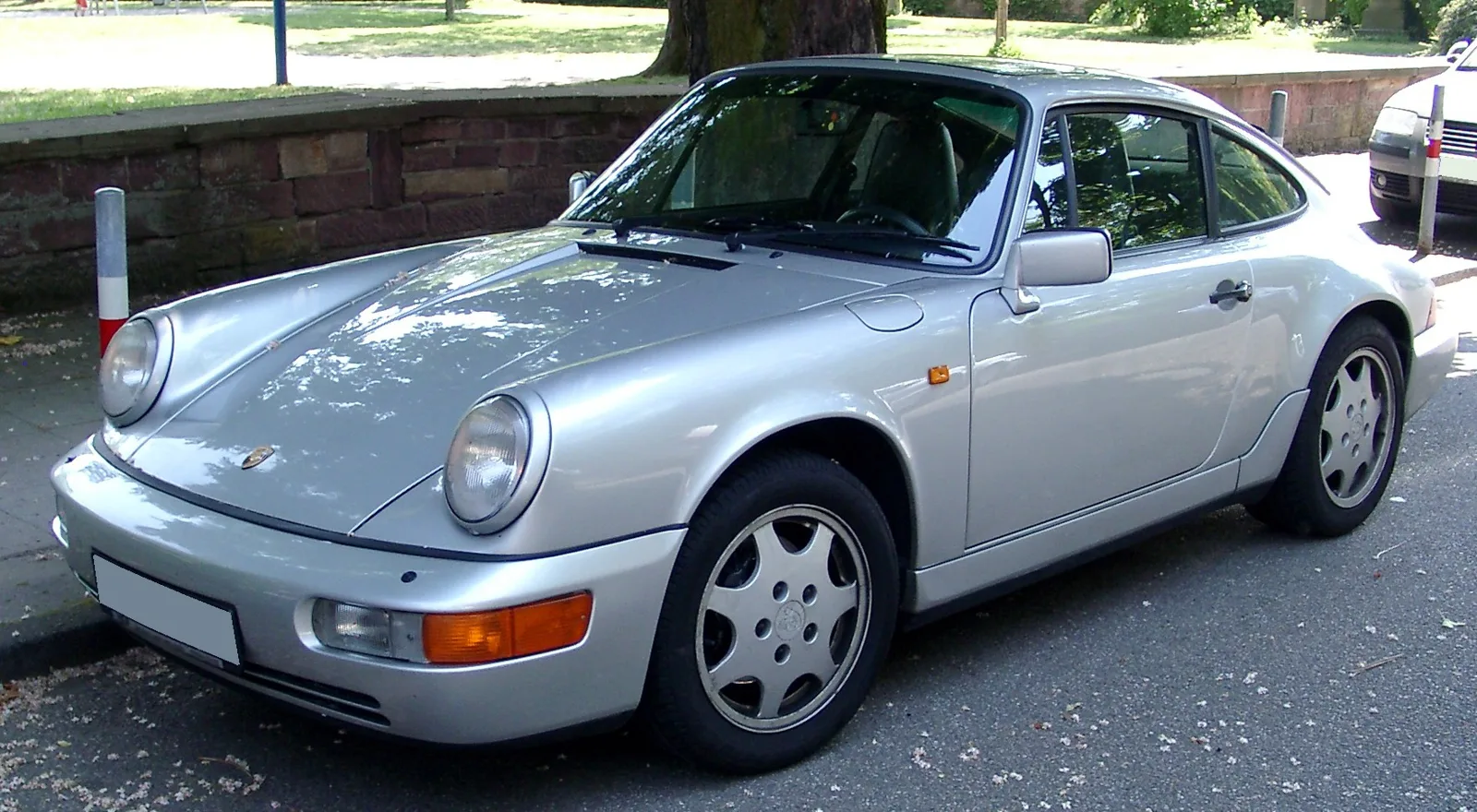
A 1989-1994 911 with coil springs, optional all-wheel drive and Tiptronic, a 250 PS flat-six and a run of Turbo, RS and racing variants.
The Porsche 964 was a 911 built from 1989 to 1994 as the Carrera 2 and Carrera 4. Its 3,600 cc flat-six made 250 PS (184 kW; 247 hp), and the car spawned RS, Turbo, Speedster and racing variants.
The Porsche 964 was the 911 generation built from 1989 to 1994, known internally as the Carrera 2 and Carrera 4. It brought flush bumpers, coil springs, standard power steering and ABS, and it was the first 911 offered with Tiptronic automatic and all-wheel drive. The family that grew from it ran from the 250 PS Carrera to the 360 PS Turbo 3.6.
What made the 964 different from earlier 911s?
Porsche considered the 964 85% new compared with the Carrera 3.2 it replaced. The most visible changes were flush bumpers and fog lamps, an electric rear spoiler and a revised interior. The first cars of 1989 were all-wheel drive Carrera 4 models, and the rear-drive Carrera 2 followed in 1990.
Benjamin Dimson is credited with the design work through January 1986. The bumpers and fog lamps sit flush with the bodywork for better aerodynamics, and the electric rear spoiler rises above 80 km/h (50 mph) before lowering flush with the engine lid at lower speeds.
The body was offered as a coupe, a targa or a cabriolet. The 964 was the last generation to offer a traditional removable Targa roof before the 2011 991.
A 911 that brought flush bumpers and coil springs, then spread into Turbo, RS and racing models.
How was the 964 engineered?
The 964 used the M64, a 3,600 cc air and oil-cooled flat-six with a compression ratio of 11.3:1. It made 250 PS (184 kW; 247 hp) at 6,100 rpm and 310 N m (229 lb ft) at 4,800 rpm, with a speed limit of 6,700 rpm.
The M64 was naturally aspirated and used electronic fuel injection with a DME controller and twin-spark knock regulation. Its forged crankshaft ran on seven main bearings, and the block and heads were aluminium alloy. Each bank carried one overhead cam driven by a double chain.
The suspension was the biggest chassis change since the original 911. Coil springs replaced torsion bars, MacPherson struts were used at the front, and semi-trailing arms stayed at the rear. Power steering and ABS brakes came as standard, a first for the 911.
Inside, standard dual airbags arrived from late 1989 for North American 1990 model year cars. A new automatic climate control system improved heating and cooling, and the instrument panel gained a large set of warning lights tied into the central warning system.
How did the Carrera 2 and Carrera 4 compare?
The Carrera 4 was the all-wheel drive model that launched the generation in 1989, while the Carrera 2 added rear-wheel drive in 1990. The manual car covered 0-60 mph in 5.5 seconds, while the Tiptronic took 6.2 seconds. Both bodies were available as coupe, targa or cabriolet.
Quarter-mile times were 13.6 seconds for the Carrera 2, 14.0 seconds for the Tiptronic and 14.1 seconds for the Carrera 4. Top speed was 260 km/h (162 mph), or 256 km/h (159 mph) with Tiptronic. The coefficient of drag was 0.32, and fuel use was approximately 24 mpg.
Curb weight was 1,375 kg (3,031 lb) for the Carrera 2, 1,406 kg (3,100 lb) for the Tiptronic and 1,475 kg (3,252 lb) for the Carrera 4. The wheelbase measured 2,270 mm (89.4 in), with an overall length of 4,270 mm (168.3 in) and a width of 1,650 mm (65.0 in).
What was the Carrera RS?
The Carrera RS was a lightweight, rear-wheel drive model sold only in Europe from 1992. It took its foundation from Porsche's Carrera Cup race car and recalled the earlier 2.7 and 3.0 RS and RSR cars. Its revised M64/03 engine was rated at 260 PS (191 kW; 256 bhp) at 6,100 rpm.
The RS used a lightweight flywheel and a G50/10 gearbox with closer ratios, along with an asymmetric limited-slip differential and steel synchromesh. Its suspension sat 40 mm (1.6 in) lower on stiffer springs and shocks, and most cars did without power steering. Right-hand drive UK cars did have power steering.
The Clubsport option, code M003, stripped out the interior and added a roll cage. Porsche built 290 cars with that package. The Carrera RS weighed 1,217 kg (2,683 lb), about 123 kg (271 lb) lighter than the US-market RS America.
Later the Carrera 3.8 RS took the wider Turbo body and a 3,746 cc engine rated at 300 PS (221 kW; 296 bhp). It was built in Europe toward the end of the production run.
Was the RS America sold in the United States?
The Carrera RS itself was never sold in the US, because of crash and emission laws. Porsche instead produced the RS America for model years 1993 and 1994, based on the US Carrera 2, and 701 were built.
Before that, 45 US-legal cars similar to the RS were imported in 1992 for a proposed Carrera Cup racing series. The series was cancelled before it began, and the cars were sold quietly through dealers with a Carrera Cup US Edition dash plaque.
The RS America had a whale tail spoiler, 17-inch wheels and M030 sports suspension. Power steering, cruise control, air conditioning, the sunroof and the radio were deleted to save weight, although some could be ordered as options. It weighed 2,954 lb (1,340 kg), 77 lb (35 kg) lighter than a standard Carrera 2.
What was the 964 Cup?
The 964 Cup was the 1990 racing version built for the new Porsche Carrera Cup. It produced 265 PS (195 kW; 261 hp), added a welded roll cage and sat 55 mm (2.2 in) lower than the road car. Much of the interior comfort, including the sound-proofing, was removed to save weight.
The 1992 revision adopted the body of the 964RS and produced 275 PS (202 kW; 271 hp). It also gained 18-inch magnesium rims and sat a further 20 mm lower.
What were the Turbo models?
The 964 Turbo appeared in March 1990 as the successor to the 930. Porsche had not had time to develop a turbocharged 3.6-litre M64, so the first Turbo reused a revised 3.3-litre engine from the 930, producing 320 PS (235 kW; 316 hp) at 5,750 rpm. In total 3,660 Turbo 3.3 cars were built.
The Turbo S Leichtbau, or light build, arrived in 1992 with 381 PS (280 kW; 376 hp). Porsche had planned 25 to 50 units, later raised to 80, and the car was 180 kg lighter than the standard Turbo. It was lowered by 40 mm, and production began in July 1992 for the 1993 model year.
The Leichtbau removed the under-body protection, soundproofing, air conditioning, power steering and rear seats. Thinner glass, aluminium doors, a carbon-fibre luggage compartment and thinner carpets added further savings.
What was the Turbo 3.6?
Introduced in January 1993, the Turbo 3.6 used a KK&K K27 turbocharged version of the 3.6-litre M64, with 360 PS (355 bhp; 265 kW) at 5,500 rpm, and 520 N m (384 lb ft) of torque arriving from 4,200 rpm. It was built only for the 1993 and 1994 model years, with fewer than 1,500 made.
At the end of 964 production in 1994, Porsche still had about 90 Turbo chassis left. Porsche Exclusiv turned them into the Turbo 3.6 S, either with the standard Turbo body or with the slant-nose Flachbau option. The Flachbau kit added slant-nose fenders and the Turbo S engine, and it cost US$60,179 on top of the US$99,000 base price.
The Flachbau was built as 39 cars for the US, 27 for other international markets and 10 for Japan, all in Polar Silver. A further 17 Package cars for the US kept the original 964 nose instead. A black 1994 Turbo appeared in the film Bad Boys, starring Will Smith.
Which other special 964s were built?
The 30th Anniversary C4 arrived in 1993 to mark 30 years since the 911 launched in 1963. It used the wider Turbo body with four-wheel drive and a normally aspirated engine, with a standard small lifting wing. 911 units were produced, in Viola, Polar Silver or Amethyst.
The 1989 Speedster was shown at the 1988 Frankfurt Motor Show beside the Carrera 4. It shared more with the 930 Turbo than with the new 964, and more than three quarters of its 800 cars had the Turbo look wide body. The 1994 Speedster was based on the Carrera 2 platform, and 936 were built against a planned 3000.
The America Roadster was a turbo-bodied cabriolet released in 1992. Mechanically it matched the standard model, apart from 17-inch Cup wheels and Turbo-specification brakes and suspension. Only 250 were produced for the 1992 and 1993 model years.
What was the Turbo S LM-GT?
The Turbo S LM-GT was a 1993 prototype for international motorsport, based on the road-legal Turbo S but stripped and modified for circuit use. Its engine was a twin-turbo 3.2-litre unit rated at 475 hp. It debuted at the 1993 12 Hours of Sebring, where it finished seventh overall and first in class with the Brumos Porsche team.
Its bodywork gained a deep chin spoiler, two air inlets above the rear wheel arches and an adjustable racing wing on top of the Turbo's own. Wider arches housed 12-inch (300 mm) wide racing slicks. The interior was stripped, a roll cage was fitted and the windows were replaced with plastic.
The car failed to finish the 1993 24 Hours of Le Mans after its engine was damaged early in the race. For 1994 it moved to Larbre Competition, where a 3.6-litre engine based on the 993 unit replaced the 3.2-litre. The team took second at the 24 Hours of Daytona, then won all four BPR Global GT races it entered, including the 1000 km Suzuka.
The development work fed into the 993-generation 911 GT2 of 1995. Some teams built their own twin-turbo 964 Turbo racers to copy the LM-GT, but they lacked the success of the factory project.
What was the Porsche 969?
The Porsche 969 was a concept meant to succeed the 959, and it was based on the upcoming 964 platform. It dates from 1982, when it was envisioned as a twin-turbo 911 with four-wheel drive and a PDK gearbox, and it was later scrapped.
The planned 3.3-litre flat-six, rated at 374 hp (379 PS; 279 kW), could not be used because of cooling problems. Alternatives were considered, including a water-cooled flat-six and two variants of Porsche's Indy V8. Its styling carried over the slanted headlights and wide tail of the 959.
Ongoing engine problems and a projected price above 200,000 DM, in the wake of a recession, kept the 969 from ever reaching production. Fifteen of the 16 prototypes were destroyed in December 1988. The last prototype has not been seen since, and Porsche later disclosed that it was kept hidden at a warehouse near Zuffenhausen.
What are the Porsche 964 specifications?
| Specification | Detail |
|---|---|
| Built | 1989 to 1994 |
| Engine | 3,600 cc M64 flat-six, air/oil-cooled, rear-mounted |
| Compression | 11.3:1 |
| Carrera 2 and 4 output | Peak power 250 PS (184 kW; 247 hp) at 6,100 rpm; 310 N m (229 lb ft) of torque at 4,800 rpm |
| Carrera RS output | 260 PS (191 kW; 256 bhp) at 6,100 rpm; torque 312 N m (230 lb ft) |
| Turbo 3.3 | 320 PS (235 kW; 316 hp) at 5,750 rpm |
| Turbo 3.6 | 360 PS (355 bhp; 265 kW) at 5,500 rpm; torque 520 N m (384 lb ft) at 4,200 rpm |
| 0-60 mph | 5.5 seconds manual; 6.2 seconds Tiptronic |
| Top speed | 260 km/h (162 mph); 256 km/h (159 mph) Tiptronic |
| Coefficient of drag | 0.32 |
| Curb weight (C2) | 1,375 kg (3,031 lb) |
| Wheelbase | 2,270 mm (89.4 in) |