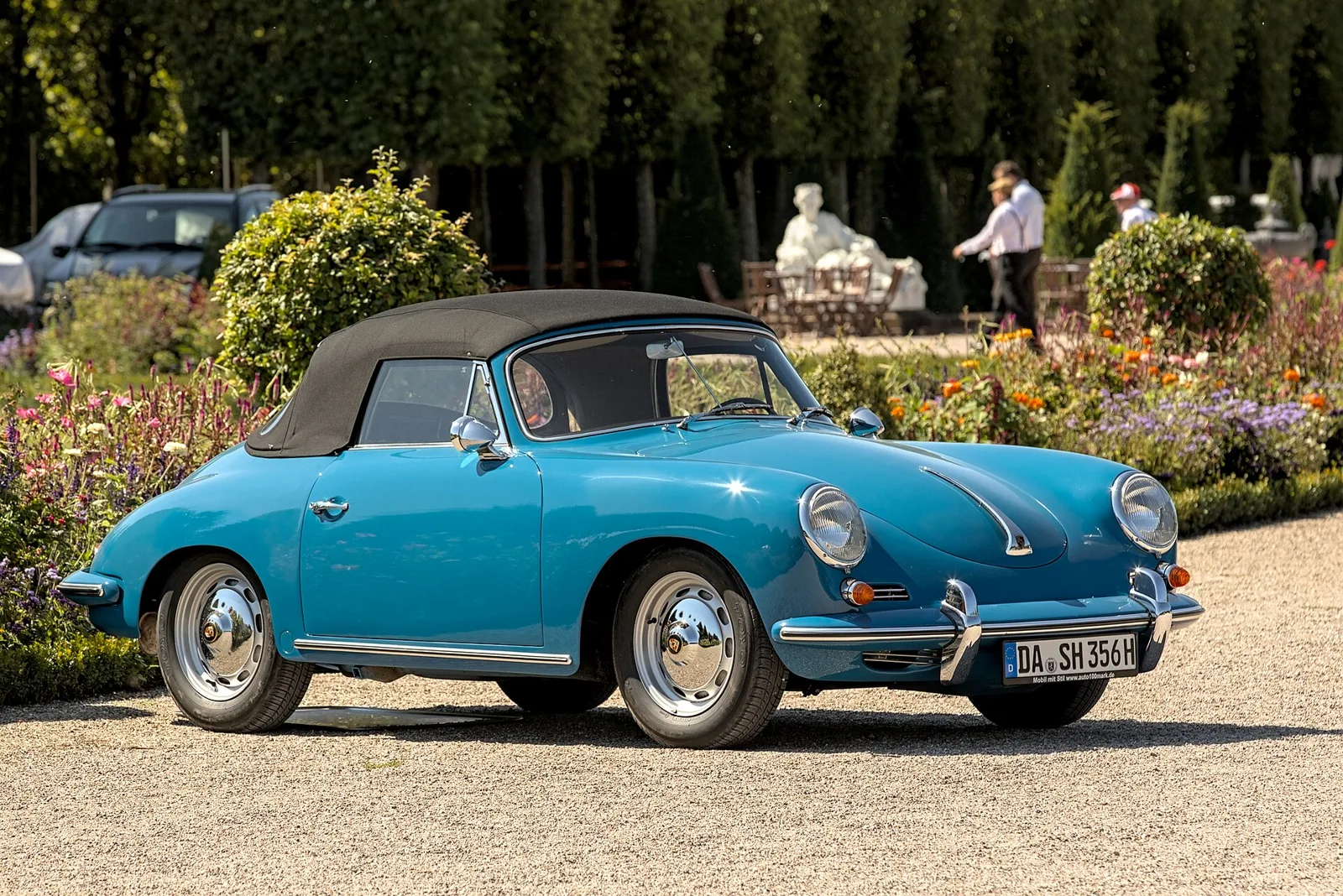
From a 1948 prototype in Austria to the last cabriolets of 1965, the 356 built the reputation that the 911 carried forward.
The Porsche 356 was a rear-engine, rear-wheel-drive two-door sports car and the first production Porsche. Built from 1948 until April 1965, it came as a hardtop coupe or open car. Of roughly 76,000 cars made, about half survive today, which keeps prices high.
The Porsche 356 was a light, nimble two-door that carried the company from a small Austrian workshop to an international marque. Few sports cars carry as much history in one shape, and the 356 laid the groundwork that the 911 later built on. Its story runs from a 1948 prototype to the final cabriolets of 1965.
Where did the Porsche 356 come from?
The 356 was developed by Ferdinand Ferry Porsche, son of the company's founder, who set up the Austrian firm with his sister Louise. The first road-certified car was registered in Austria on 8 June 1948. It won its class at a race in Innsbruck, shortly after going on the road.
Porsche built its first 50 cars at Gmund, and it took two years from the 1948 prototype to finish them. Ferry Porsche described the car as a small, lightweight machine with plenty of power, which he thought more enjoyable than a large car that was also overpowered.
Earlier designs from the same Austrian company included the Cisitalia Grand Prix car, the Volkswagen Beetle and the Auto Union Grand Prix cars.
Prices in 1948 were US$3,750 for the coupe and US$4,250 for the cabriolet. Those figures equal about $50,300 and $57,000 in 2025 money, which shows how much the car's original price was in its own time.
A rear-engined two-door from a small Austrian workshop that became the foundation of everything Porsche built afterwards.
How was the 356 engineered?
The 356 was a four-cylinder, air-cooled, rear-engined car with unitized pan and body construction. Its engine case came from the Volkswagen Beetle, while Porsche added new heads, a camshaft, a crankshaft, manifolds and dual carburettors. The result made 52 kW (70 hp), more than double the Beetle's horsepower.
The chassis was a completely new design, and the body was drawn by Porsche employee Erwin Komenda. Some mechanical parts, including the suspension components, were based on and initially sourced from Volkswagen, and they were refined during the car's run.
Early engines were 1,100 cc, and in 1951 Porsche introduced 1,300 and 1,500 cc units with considerably more power. The typical engine of the 356 A was a 1,582 cc flat-four rated at 60 PS (59 hp; 44 kW) at 4,500 rpm, with 110 N-m (81 lb-ft) at 2,800 rpm.
A four-cam unit was offered as an optional extra on the 356 A from late 1955. It was a totally new design, unique to Porsche's sports cars.
How did the 356 change over its production run?
The 356 went through four main series: the original pre-A, the 356 A, the 356 B and the 356 C. The changes were evolutionary rather than yearly restyles, and the car kept its basic outline until production ended in 1965.
The split windscreen of the first cars gave way to a single V-shaped windshield in April 1952. Coupes and cabriolets with a bent centre-creased screen followed from 1953 to 1955, and the curved windshield arrived with the 356 A in late 1955.
Late 1959 brought the T5 356 B, followed by the redesigned T6 in 1962 with twin grilles and an external fuel filler. The 356 C, introduced for the 1964 model year, replaced drum brakes with discs and offered the 95 hp (71 kW) SC engine as the most powerful pushrod unit Porsche had built.
Why is the Speedster so popular?
The Speedster came out of advice from Max Hoffman, the sole US importer of Porsches, who wanted a cheaper and more spartan open car for American buyers. Introduced in late 1954, it had a low, raked windscreen that could be removed for racing, bucket seats and a minimal folding top.
A total of 4,854 Speedsters were built across all years, and production peaked at 1,171 cars in 1957 before the figures began to fall. The model was an instant hit, especially in Southern California.
The Speedster was replaced in late 1958 by the convertible D, which had a taller windscreen, roll-up side windows and more comfortable seats. The 356 B roadster followed in 1959, though soft-top sales declined significantly in the early 1960s.
Why do some 356s carry the Continental badge?
Max Hoffman wanted a model name rather than just a number, and the factory used Continental for cars sold in the United States in 1955. Ford owned the naming rights and objected, so the name survived only for that year and was not used again.
About 1,200 early 356s were badged as Continental in the United States. A further 156 from autumn 1955 to January 1956 carried the rarer European name, after which the car reverted to its numerical designation.
How did the 356 perform in motorsport?
The 356 made its name in racing. At the 1951 race at Le Mans, Porsche was the sole German marque to enter, and its streamlined 356 SL Gmund-Coupe with an aluminium body and covered wheels won its class.
Auguste Veuillet and Edmond Mouche took the 751 to 1100 cc class and finished 20th overall. The result was a strong showing for a car that was still new to racing.
Many 356s were stripped and modified for racing, and the 356 SL and the 356 A Carrera GT are notable examples. In the early 1960s Porsche worked with Abarth to build the 356 B Carrera GTL Abarth coupe, which enjoyed some success in competition.
The Carrera Speedster was built with a special DOHC racing engine, and only about 140 Carrera variants were made. Those cars are among the most desirable 356s for collectors who want a competition-bred example.
What is a Porsche 356 worth today?
Collector values are high. Auction prices often start near US$20,000 and can climb past US$100,000, and restored Carrera variants have sold above US$800,000, with most fetching more than US$300,000.
The most expensive 356 to change hands was the daily driver of rock singer Janis Joplin, which RM Sotheby's sold in New York for $1,760,000 (1,163,630 pounds sterling) in 2015. A first Carrera, number 53456, was analysed in February 2018 and estimated at about 335,000 euros.
Unibody construction makes restoration difficult for cars kept in rust-prone climates.
Did Studebaker ever want a 356-based car?
Yes. In 1953 Studebaker asked Porsche to develop a new engine, but Porsche developed an entire car instead, a four-seat version of the 356. The prototype, called the 530, was rejected because Studebaker wanted a larger car with a larger engine, and mounted at the front.
The replacement prototype was called the Porsche 542, and it was also known as the Studebaker Z-87. That project never reached production, but it shows how far the 356's basic concept could be stretched when a client asked for something different.
What replaced the 356?
The 912 replaced the 356 in April 1965 as a standard version of the 911, which debuted in September 1964. It used a higher-revving version of the 356's pushrod engine, the 616/36 unit, and it was priced at DM 17,500, the same as a 356 1600 SC.
Customers bought nearly 33,000 912 coupes and targas powered by the 616 engine. The 356 hit its output high of 14,151 cars in 1964, which was also the year the 911 reached American showrooms. The 912 drew on many of the older car's components.
Did police use the 356?
Yes. The last ten 356 cabriolets were assembled for the Dutch Rijkspolitie in March 1966 as 1965 models. Dutch highway patrols found the cars so effective that the police kept buying Porsche 911s for many years afterwards.
Who built the 356's bodies?
Early cars had aluminium bodies made by hand at Gmund, while production moved to steel bodies once the company relocated to Zuffenhausen in 1950. Reutter built those steel bodies under contract until Porsche bought the company in 1963.
The seat-making part of the Reutter business kept its own identity and changed its name to Recaro. That name later became familiar in performance and racing seating, and it began as a by-product of the body arrangement.
The aluminium-bodied cars from the Gmund period are now referred to as prototypes, because the company that made them was very small and the numbers involved were tiny.
What was the Karmann notchback?
The Karmann notchback was a unique 356 B model built in 1961 and 1962. It was essentially a cabriolet-style body with a permanent metal roof, and the 1961 run used a cabriolet body with the optional steel hardtop welded in place.
The 1962 line was a different design. Its T6 notchback coupe body did not start life as a cabriolet, and it combined the cabriolet rear end with a coupe windscreen frame and a hardtop of its own. Both years are now known by the Karmann notchback name.
What was the M422 Mighty Mite?
The M422 Mighty Mite was a military light utility vehicle built for the United States Marine Corps. It originally used the engine from the 1300 S, but the production version had to use a different engine because US military vehicles had to be built with US-made equipment.
The Mighty Mite shows that the 356's engine family could be adapted beyond the sports car range, even if the military vehicle remained a small chapter in the company's early history.
How common were cabriolets in the early years?
In the early 1950s cabriolets were sometimes more than half of total production. Cabriolets were convertibles with a full windscreen and a padded top, and they were offered from the start of the 356 story.
The Speedster later offered a cheaper open alternative to the cabriolet, and it became one of the most desirable versions of the car. Its low windscreen and minimal top set it apart from the fuller cabriolet body.
Porsche 356 specifications at a glance
| Specification | Detail |
|---|---|
| Production | 1948 to April 1965 |
| Total built | About 76,000, roughly half surviving |
| Launch factory | Gmund, Austria (1948) |
| Main factory | Zuffenhausen, Germany (1950 onward) |
| Typical 356 A engine | 1,582 cc flat-four, 60 PS (59 hp; 44 kW) at 4,500 rpm |
| 356 C SC engine | 95 hp (71 kW) |
| 1948 coupe price | US$3,750 |
| Peak annual output | 14,151 cars in 1964 |
Frequently asked questions
How many Porsche 356s were built?
About 76,000 were produced between 1948 and April 1965, and roughly half still survive. Output reached its highest point in 1964, when the factory made more cars than in any other year.
Where was the 356 built?
Production began at Gmund in Austria in 1948, where about 50 cars were built. The factory moved to Zuffenhausen in Germany in 1950, and general production continued there until April 1965.
What engine did the 356 use?
The engine was an air-cooled pushrod flat-four based on the Volkswagen Beetle's case. Output of the typical 356 A unit was 60 PS (59 hp; 44 kW), and later cars used the more powerful SC.
Is the 356 a good collector car?
Collectors value the 356 highly. The 356 C ranked tenth in Sports Car International's 2004 list of the top sports cars of the 1960s, and the most desirable examples bring well over US$100,000 at auction.