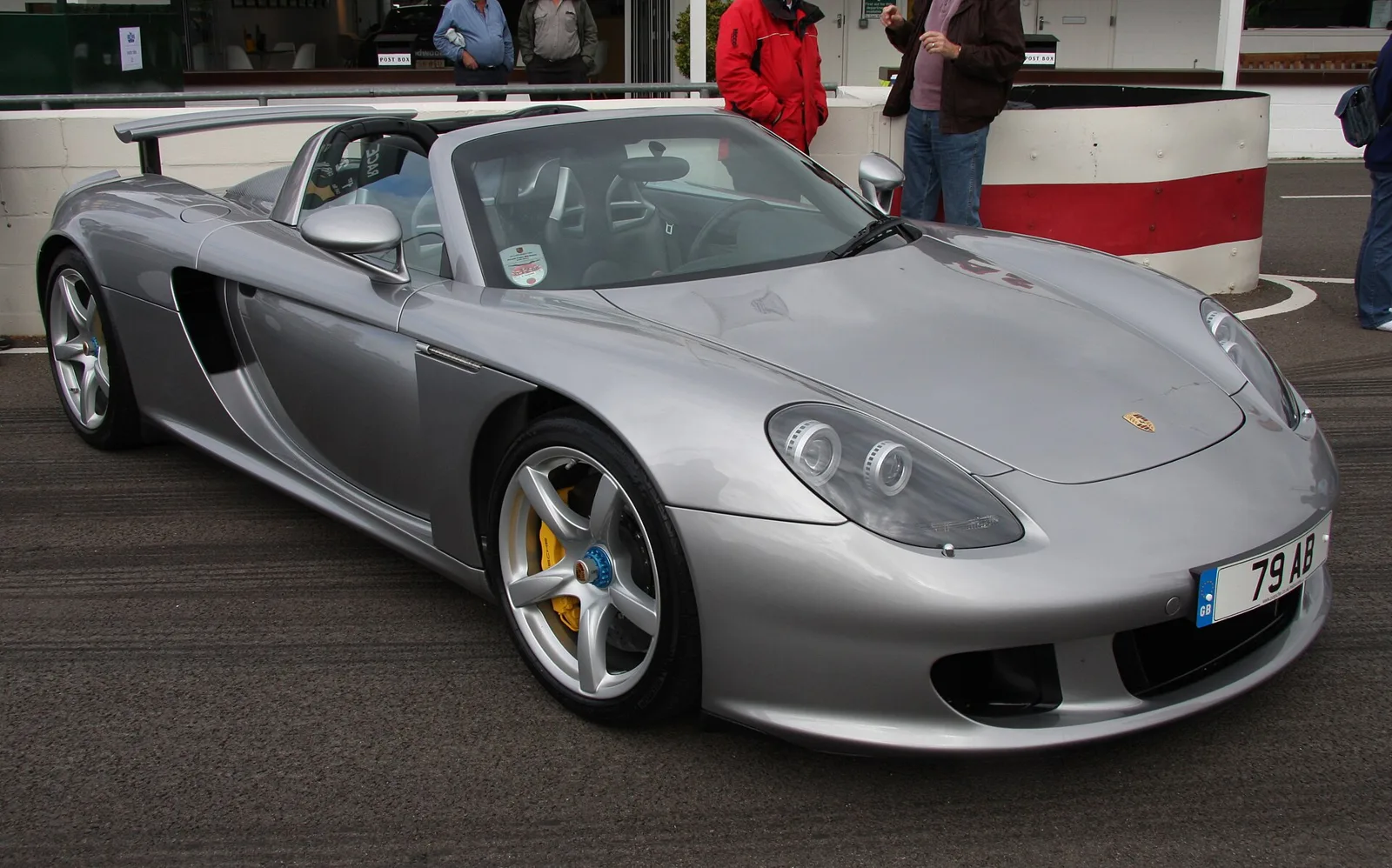
A carbon fibre supercar with a 5.7-litre V10, a six-speed manual and a racing pedigree that began with a cancelled Le Mans programme.
Built by Porsche between 2004 and 2006, the Carrera GT paired a 5.7-litre V10 with a six-speed manual. The V10 began life in a cancelled Le Mans prototype, and 1,270 cars were produced before the run ended.
The Porsche Carrera GT was a mid-engined sports car with a 5.7-litre V10 and a six-speed manual as its only gearbox. It began life as a cancelled Le Mans prototype, and it ended with 1,270 cars built between 2004 and 2006.
\n\nWhere did the Carrera GT come from?
\nIts roots lie in the 911 GT1 and LMP1-98 racers. After FIA and ACO rule changes in 1998 ended those designs, Porsche planned a 1999 Le Mans prototype, first as a turbocharged flat-six and later as a V10 derived from a Footwork Formula One unit.
\nThe LMP 2000 project was cancelled in November 1999. Rumour linked the decision to a wider deal with Volkswagen over the Cayenne, which would let Audi race at Le Mans without Porsche in the way.
\n\nA Le Mans prototype's V10 in a road car that was built for only a few years and ended with 1,270 examples.
How did the road car come about?
\nPorsche kept part of the project alive. The 5.5-litre V10 from the prototype powered a concept car shown at the 2000 Paris Motor Show, and the interest it drew, together with Cayenne revenue, persuaded the company to build a limited road car at its new Leipzig plant.
\nThe first customer cars reached American showrooms on 31 January 2004. Porsche had planned 1,500 cars, but in August 2005 it said it would stop early, citing changing US airbag rules.
\n\nHow many Carrera GTs were built?
\nThe final car was built on 6 May 2006, and the total came to 1,270 cars. Of those, 644 were sold in the United States, 31 in Canada and 49 in the United Kingdom, which made those three markets the destination of more than half the run.
\n\nWhat powered the Carrera GT?
\nA 5.7-litre (5,733 cc) V10 produced 450 kW (612 PS; 603 hp) at 8,000 rpm, with 590 N m (435 lb ft) of torque at 5,750 rpm. The engine was a 68-degree aluminium V10 with four valves per cylinder and a redline at 8,400 rpm.
\nThe bore and stroke measured 98 mm by 76 mm, with Nikasil-coated bores, forged titanium rods and a 12.0:1 compression ratio. A twin-plate ceramic clutch sent power to a six-speed manual, the only gearbox offered.
\nThe concept car had used a 5.5-litre V10 rated at 416 kW (566 PS; 558 hp), so the production engine was enlarged before the car went on sale.
\n\nHow fast was the Carrera GT?
\nA Car and Driver road test in June 2004 recorded 0-60 mph in 3.5 seconds, 0-100 mph in 6.8 seconds and 0-130 mph in 10.8 seconds. Porsche's official top speed was 330 km/h (205 mph), while a tested top speed reached 334 km/h (208 mph).
\nPerformance testing put the 0-100 km/h sprint at 3.57 seconds and the quarter mile at 10.97 seconds. Sport Auto measured lateral acceleration of 1.35 g, reaching 1.4 g on the Nordschleife's Schwalbenschwanz section.
\n\nWhat was the chassis and brake setup?
\nIts structure combined a carbon monocoque and subframe made by ATR Composites Group in Italy, plus dry-sump oiling and inboard suspension. The radiator was roughly five times the size of a 911 Turbo's of its era, and the dampers were pushrod-actuated with anti-roll bars at both ends.
\nThe brakes were carbon fibre-reinforced silicon carbide discs from SGL Carbon, with 15-inch (380 mm) rotors inside 19-inch front and 20-inch rear five-spoke wheels. A rear wing rose above 113 km/h (70 mph) to cut lift.
\n\nWhat did the interior and layout look like?
\nThe cabin was trimmed in soft leather, with Bose audio and navigation standard. The ignition switch sat left of the steering wheel, a nod to early Le Mans running starts, when drivers hopped into their cars and started them before racing away.
\nThat placement let a driver start the car with the left hand and select gear with the right. Standard colours were Guards Red, Fayence Yellow, Basalt Black, GT Silver metallic and Seal Grey, and custom colours were offered later.
\n\nHow did the car handle on track?
\nLap times on the Nordschleife were recorded at 7:28 in an early test and 7:12 in a 2024 run. Bedford Autodrome recorded 1:20.2, and the Top Gear test track recorded 1:19.8.
\nThe skid pad averaged 0.99 g, and braking from 100 mph to zero took 277 feet (84 m). From 60 mph the car stopped in 101 feet (31 m), and from 100 km/h it needed 33.5 metres.
\n\nWhat did the Zagato GTZ add?
\nZagato introduced the Porsche Carrera GTZ in 2013 for a Swiss Porsche collector who was also a former racing driver. It used a modified carbon fibre body that was more aerodynamic, while keeping the same technical specification as the standard car.
\nOnly six GTZs were built, so the variant stayed rare beside the 1,270 standard cars.
\n\nWhat have Carrera GTs sold for at auction?
\nBring-a-Trailer sold a 250-mile 2005 Silver GT for US$2,000,000 in January 2022, and Jerry Seinfeld's black GT went for US$1,865,000 in March 2022. Prices across the auctions cited here ranged from about US$1 million to close to US$2 million.
\nBroad Arrow's June 2023 Porsche 75th Anniversary Auction sold a GT Silver Metallic for $1,028,000 and a Speedster Blue for $1,462,500. Its 2023 Amelia sale saw a black GT bring $1,517,500, and RM Sotheby's sold GT #0994 for 1,545,000 USD in February 2025.
\n\nWhat is the car's legacy?
\nSports Car International ranked the Carrera GT first on its list of the 2000s' top sports cars and eighth on its all-time list. Popular Science gave it the Best of What's New award in 2003 for its technology and chassis development.
\nDoug DeMuro bought one for himself and published a 2024 video review, which kept the car in front of enthusiasts long after production ended.
\n\nHow much fuel did the Carrera GT use?
Official EPA figures were 9 mpg-US in the city and 15 mpg-US on the highway, with a range of 241 miles (388 km) from the 92-litre tank. European NEFZ figures were 28.3, 11.7 and 17.8 L/100 km, with CO2 of 429 g/km and a Euro 4 rating.
Auto Motor und Sport recorded a maximum of 22.5 L/100 km and an average of 19.7 L/100 km. Those test figures show how thirsty the V10 was in everyday driving, which mattered for a car with a tank of this size.
What were the acceleration figures?
Performance testing timed 0-60 km/h in 2.06 seconds, 0-100 km/h in 3.57 seconds and 0-160 km/h in 6.46 seconds. The car reached 180 km/h in 7.59 seconds, which made its standing-start pace impressive even by the standards of its time.
Rolling acceleration from 80 to 120 km/h took 6.35 seconds in sixth gear, and a 1,000-metre run took 19.42 seconds at 284 km/h (176.5 mph). The 400-metre standing quarter took 10.97 seconds.
How did the six-speed gearbox and clutch work?
The clutch was a Porsche Ceramic Composite Clutch, a twin-plate ceramic dry unit, and it fed a traditional six-speed manual. That gearbox was the only transmission offered, so the car never came with an automatic option.
With a redline of 8,400 rpm, the gearing let the V10 work through its rev range in each gear. The engine's specific output of 78.493 kW per litre equalled 105 hp per litre.
How did the rear wing work?
The rear wing was electronically operated and deployed at speeds above 113 km/h (70 mph), a mechanism Porsche also used on the 911. At higher speeds it raised into the airflow to reduce lift.
Together with the large side inlets and air dams that cool the V10, the wing formed the car's main visible aerodynamic equipment. The drag coefficient of 0.39 came from the overall shape rather than a single feature.
What were the V10's internal details?
The V10 used chain-driven DOHC with four valves per cylinder and variable valve timing on the intake camshafts. Its exhaust valves were sodium-cooled, and the bores were Nikasil-coated, with forged titanium connecting rods and forged pistons.
The compression ratio was 12.0:1, and the bore and stroke of 98 mm by 76 mm suited the engine's high-revving character. The 1,380 kg mass worked out to a weight-to-power ratio of 3.23 kg per kW.
What were the car's practical details?
Practical details were modest: a 76-litre cargo volume, 86 mm of ground clearance and a 92-litre fuel tank. The 180 kg payload limit also reflected the car's low-slung, track-focused design.
Its track measured between 1,612 and 1,587 mm (63 to 62 in), and the wheelbase of 2,730 mm (107 in) gave it a stable platform on fast roads.
How did the timeline run?
The timeline ran from the 1998 rule changes to the 2006 end of production, with the cancellation in 1999, the concept in 2000 and the first US sales in 2004. The Zagato GTZ followed in 2013, and auction results from 2022 to 2025 show the car's continuing appeal.
Each step shaped the final car, from the V10 that came out of a cancelled prototype to the cap on production set by changing airbag rules.
What did the Carrera GT concept prove?
Porsche showed its concept at the 2000 Paris Motor Show, where public interest encouraged the company to press on. That reception and the revenue from the Cayenne together helped justify a limited production run, so the concept was a key step before any production decision.
The road car was to be produced in small numbers at Porsche's new facility in Leipzig, a plant that was new to the company at the time.
The early production target was lower than first planned, and the final count of 1,270 cars shows how the run ended up well short of the original ambition.
The concept's V10 remained the heart of the road car, though it was enlarged to 5.7 litres before production began.
The Carrera GT's aerodynamic approach was restrained: the rear wing is electronically controlled, and the bodywork delivers a drag coefficient of 0.39 without a large fixed wing.
What were the key specifications?
\nThe table lists the core figures for the standard car. Official values are used where Porsche published them, and test results are labelled in the text above.
\n\n| Specification | Detail |
|---|---|
| Layout | Longitudinal, rear mid-engine, rear-wheel drive |
| Engine | 5.7 L (5,733 cc) 68-degree V10, aluminium block and heads |
| Power | 450 kW (612 PS; 603 hp) at 8,000 rpm |
| Torque | 590 N m (435 lb ft) at 5,750 rpm |
| Redline | 8,400 rpm |
| Gearbox | Six-speed manual, twin-plate ceramic dry clutch |
| Mass | 1,380 kg (3,042 lb) |
| Dimensions | 4,613 mm (182 in) long, 1,921 mm (76 in) wide, 1,166 mm (46 in) high |
| Wheelbase | 2,730 mm (107 in) |
| Fuel tank | 92 litres |
| Drag coefficient | 0.39 |
| Top speed | 330 km/h (205 mph) official |
.jpg)