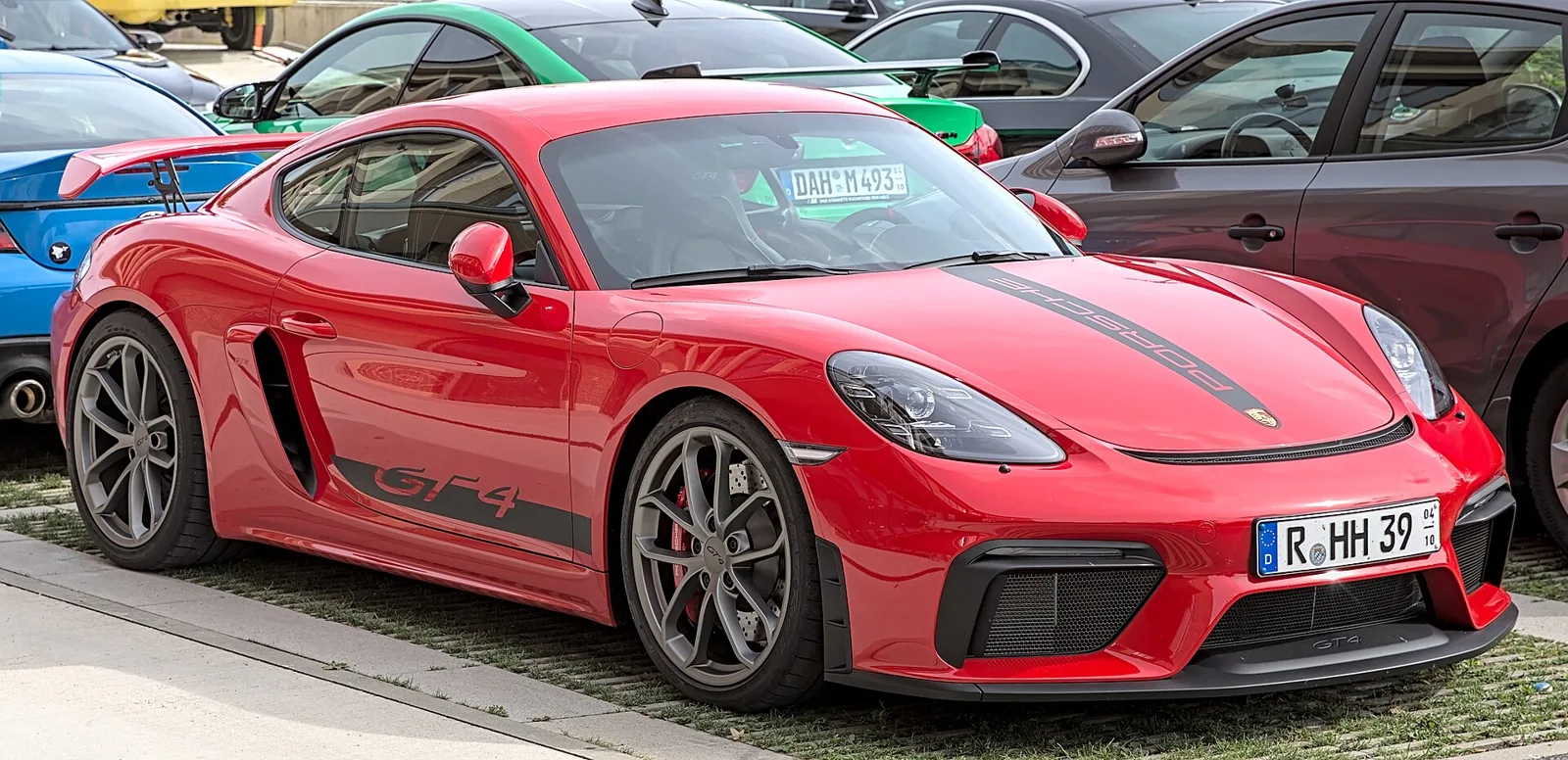
A mid-engined three-door coupe that began life as a Boxster derivative in 2005, switched to turbocharged fours in 2016 and ended production in 2025.
Porsche built the Cayman, a two-seat fastback with its engine amidships, from 2005 until October 2025. The car shares its platform with the Boxster roadster, moved from flat-sixes to turbocharged fours in 2016 as the 718, and spawned GT4 and GT4 RS variants.
The Porsche Cayman is a mid-engined, two-seat fastback coupe that Porsche built from late 2005 until October 2025. It is the three-door sibling of the Boxster roadster and shares its platform, doors, headlights and much of its interior. Across four generations it became one of the most respected sports cars in the company's line-up.
Its story is one of steady refinement. The early cars used flat-six engines, the middle years brought better chassis and more power, and the later 718 models swapped the six for turbocharged fours before the car's final production run.
Where does the Cayman name come from?
Cayman is another spelling of caiman, the alligator relative that gave the name. The islands share that name too, and when the model reached dealerships Porsche adopted four caimans at Stuttgart's Wilhelma Zoo as a nod to the new car.
The name also led to a legal dispute. In 2009 Porsche brought an infringement case against Crocs, the rubber shoe maker, over its clog called Cayman. The court granted an injunction that stopped Crocs Europe from using the name in Germany.
Names in the Boxster family follow a clear logic. Boxster combines boxer, a reference to the flat engine, with Speedster, a nod to the original Porsche Speedster of the 1950s. The Cayman name sits alongside it as a separate identity rather than a sub-model.
A mid-engined coupe with the same spirit as its roadster sibling, from the 2005 flat-six to the 500 PS GT4 RS.
When did the Porsche Cayman go on sale?
The Cayman arrived in late 2005 with the Cayman S, a fastback coupe derived from the second-generation Boxster roadster. The base Cayman followed in July 2006. The first iteration was styled by designer Pinky Lai, and the car was made in Finland by Valmet Automotive.
The second-generation Boxster had debuted at the 2004 Paris Motor Show alongside the 911, and the Cayman shares its mid-engine platform with that roadster. The two cars share their front wings, boot lid, doors and headlights, along with the forward part of the interior.
The Cayman's hatchback opens onto luggage space both on top of and behind the engine cover. Its styling borrowed cues from the 356/1, the 550 Coupe and the 904 Coupe, which gave the car a clear link to Porsche's racing history.
How did the Cayman change through its generations?
The second generation, known internally as the 987, ran until 2012. Its styling was revised, with modified headlights, larger side intakes and wheel arches that accepted wheels up to 19 inches. The interior gained a more prominent circular theme for the instrument cluster.
In 2007 the Boxster models received the engines from their Cayman counterparts, and the Boxster S grew from 3.2 litres to 3.4 litres. The Cayman therefore lost its engine advantage, and both cars were tuned to similar output.
The third generation, the 981, debuted in March 2012 at Geneva. It was built on a chassis that was 40 percent more torsionally rigid, with a wider front track and a longer wheelbase. Electrically powered steering was introduced, and the interior matched the contemporary 911.
The 981 Cayman reached showrooms as a 2014 model in the spring of 2013. Many critics ranked it among the best-handling sports cars at any price, thanks to its mid-engine layout and driving dynamics.
The Cayman R, launched in 2011, was the pinnacle of the 987 generation. It was based on the 2009 Cayman S, gained more power and shed 55 kg through lightweight wheels, carbon seats and the removal of air conditioning, the entertainment system and the rear wiper.
What engines did the Cayman use?
The first Cayman used a 2.7-litre flat-six, while the Cayman S had a 3.4-litre unit paired with a six-speed manual transaxle. A five-speed electronically controlled Tiptronic automatic was also available. The 2.7-litre engine was standard on the base car with a five-speed manual.
In 2009 the base Cayman's engine displacement rose to 2.9 litres, and the Cayman S gained direct fuel injection. A factory-optional limited-slip differential arrived at the same time. The Cayman and the Boxster now produced similar power, with the coupe holding a small advantage.
From 2016 the car moved to turbocharged flat-four engines of 2.0 and 2.5 litres. The new units had two fewer cylinders than the old flat-six, but their torque and horsepower improved, and the S used Variable Turbine Geometry to tune the boost.
The 718 Cayman GTS 4.0 arrived in 2020 with a detuned version of the 4.0-litre naturally aspirated six from the GT4. It produced 294 kW (400 PS; 394 hp) and 420 Nm (310 lb ft), with a six-speed manual as standard and a mechanical limited-slip differential.
Why did the Cayman become the 718?
The 718 name came with the 982 generation in 2016, when the marketing designation of the Boxster and Cayman changed. It was a nod to Porsche's racing heritage, because a 718 model won the Targa Florio in 1959 and 1960. The name was also meant to evoke a series won by a light car that outmanoeuvred more powerful rivals.
Some critics said the new engine cheapened the experience, but the car was praised for its handling and throttle response. Motor Trend named the 718 Cayman its second-best drivers' car in 2017, and the reviewer praised the stiff, sporty suspension.
The 718 changed more under the skin than it did on the surface. Its exterior evolved from the 981, with a long black trim bar joining the rear lights and reworked headlights and bumpers. The interior moved to the PCM 4.0 infotainment system.
The change of name did not change the basic recipe. The mid-engine layout and the shared roadster family stayed in place, which is why owners of the earlier models found the 718 familiar behind the wheel.
What are the Cayman GT4 and GT4 RS?
The 981 Cayman GT4 was introduced in 2015 with the engine from a 991.1 Carrera S, rotated 180 degrees. It had a lowered ride height, altered bumpers, a rear wing and brakes and suspension parts from the 991.1 GT3. Roughly 2,500 were built in 2015 and 2016.
In 2021 Porsche unveiled the 718 Cayman GT4 RS, a Cayman given the RS badge for the first time, a treatment normally kept for 911s. It had a 4.0-litre naturally aspirated flat-six derived from the 911 GT3, producing 500 PS and 450 Nm (332 lbf ft) of torque, with a 0-100 km/h time of 3.4 seconds.
The GT4 RS produced 25 percent more downforce than the GT4, through a swan-neck fixed rear wing. It also lapped the Nurburgring Nordschleife 23 seconds faster than the GT4, a figure that underlines how far the RS had moved on.
Those track-focused models gave the Cayman a credible role beyond the showroom, for owners who wanted more than road-going pace.
How did the Cayman perform in motorsport?
The Cayman has been a regular fixture in sports car racing. In North America, Jack Baldwin campaigned a Cayman S in the Pirelli World Challenge, and his programme scored eight wins and over a dozen podium finishes. It earned two second-place championship finishes in 2013 and 2014.
The Boxster has taken part in its own series as well. In North America it competed in the Continental Tire Sports Car Challenge Street Tuner class, and in the UK Boxsters run in the BRSCC Porsche Championship and the Porsche Club Championship.
At the 2013 Rolex 24 Hours of Daytona, Caymans took the podiums in the GX class, finishing first, second and third. That result gave Porsche its 75th class victory and the most wins in that series.
PROsport Performance ran several Cayman PRO4 cars in the GT4 European Series, winning the drivers' and teams' titles in 2016. The team also won the C class at the 2017 Liqui Moly Bathurst 12 Hour, and its final evolution was based on the 981 Cayman S.
The Cayman GT4 Clubsport has raced in many series since 2016, from the British GT Championship to the 24 Hours Nurburgring. A modified 2016 Cayman GT4 was also entered in the 2021 Trans-Am Series, powered by a 3.8-litre engine from the 911 Carrera GTS.
What awards did the Cayman win?
The Boxster and Cayman together collected many awards over the years. Top Gear gave the Boxster and Cayman its 2016 Sports Car of the Year, while What Car gave its Sports Car of the Year title to the range in 2015 and to the 718 Cayman GTS 4.0 in 2021.
Car and Driver put the pair on its 10Best list 23 times, and Motor Trend named the Boxster its 2009 Best Driver's Car. World Car of the Year gave its World Performance Car award to the model in 2006, 2013 and 2017.
Scottish Car of the Year named the Boxster its Best Drop Top in 2012, and South African Car of the Year gave the range honours in 2013 and 2014. What Car also awarded the 718 Cayman five stars out of five in its review of the car.
Were there problems with the Cayman?
Early Boxsters built between 4 May 2001 and 21 February 2005 suffered engine failures caused by a fault in the intermediate shaft bearing. That led to a class action lawsuit against Porsche Cars North America, and a settlement was agreed in March 2013 after court approval.
Porsche also issued a recall on 5 March 2019 covering 14,388 Caymans and Boxsters. A luggage compartment bracket could puncture the fuel tank in some collisions, and the company moved to fix the problem.
What are the Porsche Cayman specifications?
The table lists the principal figures across the coupe's life. It runs from the original flat-six models to the turbocharged 718 and the track-focused GT4 RS.
| Specification | Detail |
|---|---|
| Launch | Cayman S late 2005, base Cayman July 2006 |
| Early base engine | 2.7-litre flat-six, 176 kW (239 PS) |
| Early S engine | 3.4-litre flat-six, six-speed manual |
| 2009 base engine | 2.9-litre flat-six |
| 718 GTS 4.0 | 294 kW (400 PS; 394 hp), 420 Nm (310 lb ft) |
| GT4 engine | 309 kW (420 PS; 414 hp) |
| GT4 RS | 500 PS, 450 Nm (332 lbf ft), 0-100 km/h in 3.4 seconds |
| Production end | October 2025 |
Frequently asked questions
What is the difference between the Boxster and the Cayman?
The Cayman is the fastback coupe and the Boxster is the roadster, but the two share a mid-engine platform, doors, headlights and much of the interior. The Cayman's hatchback gives it extra load space compared with the open car.
Is the Cayman still in production?
No. Production of the 718 Cayman and 718 Boxster ended in October 2025. Porsche has said full-electric replacements will follow in the medium term.
Which Cayman is the most powerful?
The GT4 RS is the most powerful, with 500 PS from a 4.0-litre naturally aspirated flat-six. It reaches 100 km/h in 3.4 seconds and produces 25 percent more downforce than the GT4.
Why did the Cayman lose two cylinders?
The 718 switched from naturally aspirated flat-six engines to turbocharged flat-fours in 2016. The change cut the cylinder count, but the car gained torque and horsepower, and critics praised its handling.