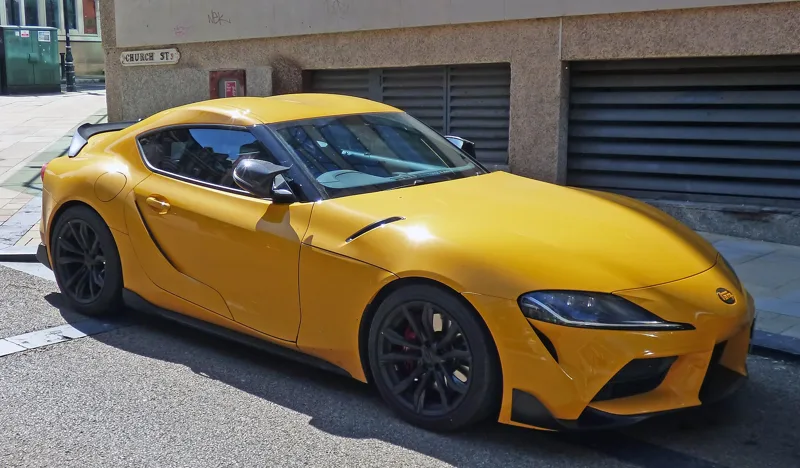
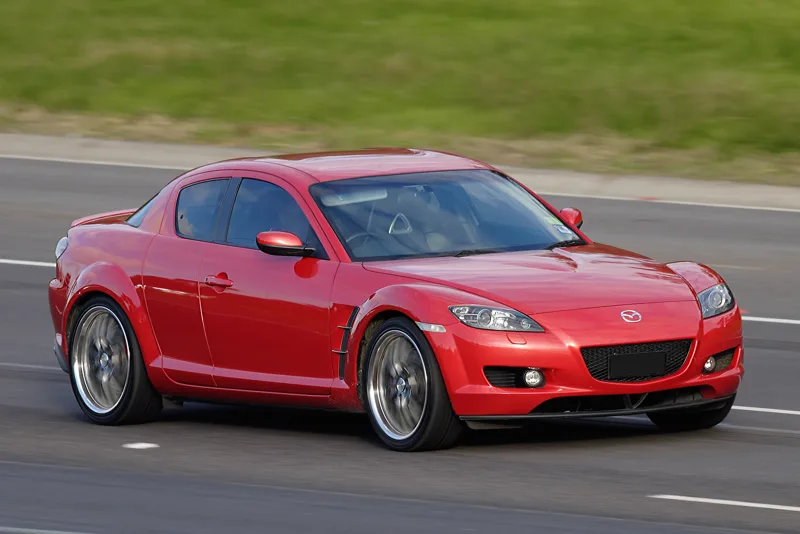
Six rear-drive favourites that make sense on Australian roads, from the Toyota Supra to the Porsche Cayman.
Australia's used market is packed with rear-drive sports cars that make sense at every budget. The Toyota 86, Mazda RX-8 and Mazda RX-7 cover the affordable end, while the Porsche Cayman and Honda NSX deliver mid-engine thrills, and the Toyota Supra offers legendary inline-six performance.
Rear-drive sports cars at a range of prices are easy to find on the Australian secondhand scene. Budget-conscious buyers can look to the Toyota 86, Mazda RX-8 or Mazda RX-7, mid-engine excitement comes from the Porsche Cayman and Honda NSX, and the Toyota Supra brings inline-six performance with a storied reputation.
Why Australia is a happy hunting ground for used sports cars
Australia has long been a strong market for Japanese performance cars, and that is reflected in what turns up on the used classifieds. The Toyota Supra built a following here through the Celica-derived generations and the later fourth-generation car, while the Mazda RX-7 developed a dedicated enthusiast base that still supports clubs, parts networks and track days today.
The Toyota 86 arrived in June 2012 and was sold here in large numbers, so the secondhand pool is deep. Mazda's RX-8 was also widely available, and Porsche Caymans have been imported and sold locally for years. The Honda NSX is rarer, but Australia has an active appreciation scene for the first-generation car.
In Australia, where rear-drive thrills and strong parts support matter, all six make sense.
What should you pay for a used Toyota Supra in Australia?
A used Toyota Supra covers a huge price range depending on generation, from affordable early Celica XX-based cars to valuable fourth-generation models. Condition, originality and service history matter more than mileage.
The Supra story starts with a name taken from Latin, meaning above or to surpass. Toyota created it after North American dealers asked for a rival to the Datsun 280Z, and the first generation was based on the Celica liftback but stretched 129.5 mm longer. The Celica XX, as it was known in Japan, launched in 1978 and served as the basis for the 1977 Tokyo Motor Show CAL-1 concept.
Beneath the bodywork, the first three generations relied on a powerplant descended directly from the Crown and 2000GT M unit, while the A chassis code was carried over from the 2000GT. On early examples, the rear employed a four-link arrangement with coil springs, a lateral track bar and a stabiliser bar, the front used MacPherson struts, and four-wheel disc brakes came as standard. With the 1981 revision came four-wheel independent suspension developed with Lotus, power rack-and-pinion steering with variable assistance, and a semi-trailing arm layout at the rear.
Midway through 1986, the A70 split off from the Celica to stand as its own model. The fifth generation, which came about through joint work with the BMW Z4, was launched in January 2019 and put together by Magna Steyr in Graz, Austria. Building of the GR Supra finished in March 2026.
| Model | Production years | Production total |
|---|---|---|
| Toyota Supra | 1978 to 2026 | |
| Mazda RX-8 | 2003 to 2012 | 192,094 units |
| Mazda RX-7 | 1978 to 2002 | more than 800,000 |
| Porsche Cayman | 1996 to 2025 | |
| Honda NSX | 1990 to 2022 | fewer than 20,000 first-gen |
| Toyota 86 | 2012 onwards |
Is the Mazda RX-8 a smart budget buy?
Absolutely, provided you are familiar with what running a rotary involves. In Australia, the RX-8 can be bought for reasonable money and is easy to find, and it delivers real driving enjoyment. The catch is that it demands regular, careful servicing, along with a mechanic who specialises in the Renesis engine.
Debuting at the 2001 North American International Auto Show, the RX-8 was introduced as the RX-7's direct successor, combining elements of that car with those of the Japan-only Cosmo. Production ended in 2012 without a successor, following its 2010 withdrawal from Europe over emissions. Assembly began in February 2003 at the Hiroshima plant, ran for nine years, and produced 192,094 units.
The styling of this car was the work of Ikuo Maeda, its lead designer, while his father, Matasaburo Maeda, had penned the original RX-7. What emerged was a four-door quad coupe featuring freestyle doors hinged at the rear and lacking B-pillars. Because the engine sits behind the front axle and the fuel tank is positioned forward of the rear axle, weight is spread almost evenly front to rear, at close to 50:50, while the polar moment of inertia stays low. Double wishbones are fitted at the front and a multi-link arrangement at the rear, with aluminium and plastic panels helping to reduce kerb weight. Cars with a manual gearbox receive a carbon fibre composite propshaft and a torque-sensing conical limited-slip differential.
Which gearbox was installed determined the figures. The six-port engine paired with the six-speed manual initially produced 238 hp (241 PS; 177 kW), later revised to 232 hp (235 PS; 173 kW) at 8,250 rpm, alongside 159 lb-ft (216 Nm) at 5,500 rpm, and its redline stood at 9,000 rpm. Opting for the five-speed manual gave 189 hp (192 PS; 141 kW) with a 7,500 rpm redline, while the six-speed automatic made 212 hp (215 PS; 158 kW), also redlined at 7,500 rpm.
How does the Mazda RX-7 compare as a used proposition?
The RX-7 is the more collectable rotary, with a dedicated Australian enthusiast base and strong performance per dollar. Prices have climbed for clean third-generation cars, but early examples remain attainable.
Mazda built the RX-7 from 1978 to 2002 across three generations, with more than 800,000 produced. The first generation, codenamed SA then FB, arrived in Japan in March 1978 to replace the Savanna RX-3 and was the lightest RX-7 generation ever, weighing under 1,100 kg (2,425 lb). It used a compact Wankel rotary mounted behind the front axle for balance, with a live axle and 4-link rear set-up with Watt's linkage.
The second generation moved to independent rear suspension and rack and pinion steering, and introduced the Dynamic Tracking Suspension System with toe control hubs for passive rear steering. The Turbo II added a twin-scroll turbocharger and air-to-air intercooler. The third generation used a sequentially turbocharged 13B REW engine.
Output grew steadily: the Series 1 12A made 130 PS (96 kW), the Series 3 GSL-SE 13B RE-EGI made 135 hp (101 kW; 137 PS) and 133 lb-ft (180 Nm), and the Series 5 facelift engine was upgraded to 205 PS (151 kW). The Efini limited edition pushed that to 215 PS (158 kW) from June 1990. In Australia, the RX-7 Finale arrived in 1985 with a numbered brass plaque reading Last of a legend.
Why is the Porsche Cayman such a compelling used choice?
Thanks to its mid-engine configuration, the Cayman offers close to ideal weight distribution and balanced, predictable responses, while second-hand models can be bought for reasonable money. Many enthusiasts consider it among the finest driver's cars available, regardless of cost.
Porsche gave the Boxster its name by joining "boxer" and "Speedster" together, and it was the marque's first sports car with the engine mounted behind the cabin. Cayman, meanwhile, comes from a variant way of writing caiman, which is one of the alligator family. Development of successors to the 928 and 968 got under way in February 1992, and the Boxster Concept was warmly received on its January 1993 launch at the North American International Auto Show. Series production started around the middle of 1996.
Underneath, the 986 Boxster shared its bonnet, front wings, headlights and cabin with the 996-generation 911. For the 987, the Carrera GT provided the styling inspiration, whereas the 981 drew on the 991 911 and the 918, and introduced a new body, a longer wheelbase and a wider front track. The 982 kept the recognisable silhouette, but its taillights were now linked by a long bar with black trim, and GT3 SportDesign mirrors were added.
On early M96 water-cooled flat-six units, cylinder liners might crack or shift, and block walls could turn porous, letting coolant and oil intermix; curing this meant boring out cast sleeves and fitting replacements. Hydraulic steering featured for the final time in the 987, while the 2008 update added Direct Fuel Injection to the Boxster S and offered a seven-speed PDK dual-clutch transmission as an option. The 981 Cayman drew acclaim for its handling, regarded among the finest sports cars regardless of cost, and the 981 GT4 is broadly held to be among the standout cars of 2015 and 2016. Building of the 718 Boxster and Cayman variants finished in 2025.
Is a used Honda NSX still a sensible exotic?
Indeed, though not without qualifications. By the standards of exotic machinery, the first-generation NSX can be depended on and driven daily, yet because so few were built, values have climbed steeply. Total first-generation output came in below 20,000 units.
The story of Honda's supercar begins with the 1984 HP-X concept, an abbreviation of Honda Pininfarina eXperimental. That study placed a 3.0-litre V6 behind the cabin and drove the rear wheels, with the goal of equalling or surpassing V8 Ferraris while being more dependable and costing less. From it came the NS-X, standing for New Sports car eXperimental. Masahito Nakano held the role of Chief Designer, Shigeru Uehara was Executive Chief Engineer, and the car's shape and aerodynamics drew on the F-16 cockpit, with Ayrton Senna contributing during the closing stages of development.
An all-aluminium semi-monocoque chassis featured on the debut model, which made it the earliest mass-produced car to adopt such a structure, paired with a transversely installed naturally aspirated V6 featuring VTEC. Buyers could select a five-speed manual gearbox or a four-speed automatic equipped with SportShift fingertip shifting. A larger 3.2-litre V6 arrived with the 1997 update, while the 2002 facelift swapped pop-up headlights for fixed units.
Should the Toyota 86 be your first sports car?
For most Australian buyers, yes. It is abundant on the used market, rear-wheel drive, practical enough for daily use and genuinely entertaining on a twisty road.
The 86 was a joint Toyota-Subaru project under development code 086A, with the name referencing the 1983 to 1987 AE86 Corolla. Project leader Tetsuya Tada invited Subaru to co-develop the D-4S boxer engine, and after an initial rejection and a six-month halt, the programme resumed. The FT-86 Concept debuted at the October 2009 Tokyo Motor Show, and the production car used a modified Impreza chassis.
Power comes from a naturally aspirated flat-four with D-4S direct injection, a 12.5:1 compression ratio and a requirement for 98 RON premium unleaded. The six-speed manual is Toyota's TL70, based on the Aisin AI AZ6, while the automatic is an Aisin-Warner A960E modified from the Lexus IS 250. A Torsen limited-slip differential was standard on most models. Suspension is MacPherson struts at the front and double wishbones at the rear, and the drag coefficient is Cd=0.27.
Australian pricing at launch in June 2012 started at A$29,990 for the GT manual, A$32,490 for the GT auto, A$35,490 for the GTS manual and A$37,990 for the GTS auto, with metallic paint at A$425 and an Aero pack at A$3,000 on the GTS only. Later model years added a limited-slip diff to the automatic GT, a rear spoiler for the GTS and revised suspension.
Which used sports car suits your garage?
Buy the 86 if you want a modern, dependable rear-drive coupe with parts everywhere. Choose the RX-8 if you accept rotary maintenance in exchange for a unique four-seat package and a soaring redline. The RX-7 rewards enthusiasts who want a classic with real motorsport heritage, including eight straight IMSA GTU class wins from 1980 to 1987. The Supra covers everything from affordable early cars to the fifth-generation machine built alongside the BMW Z4.
The Cayman is the sharpest tool here, and the NSX is the one that will keep appreciating if you can find a good one. In Australia, where rear-drive thrills and strong parts support matter, all six make sense.