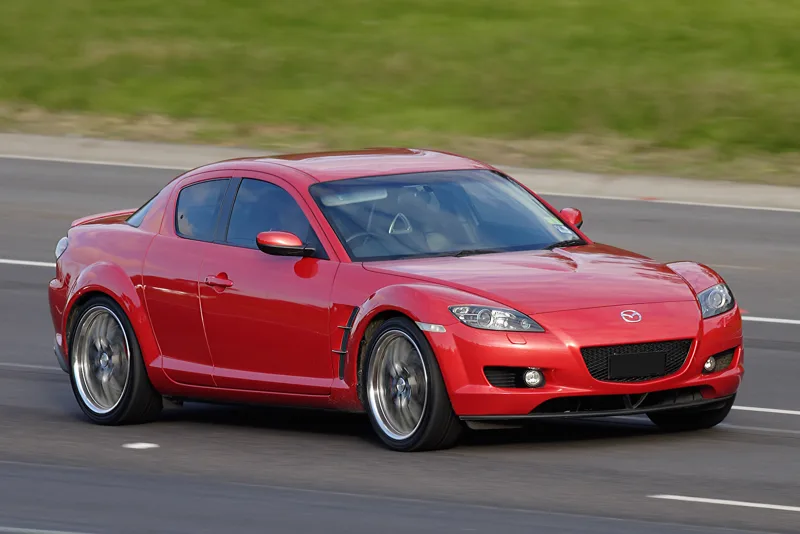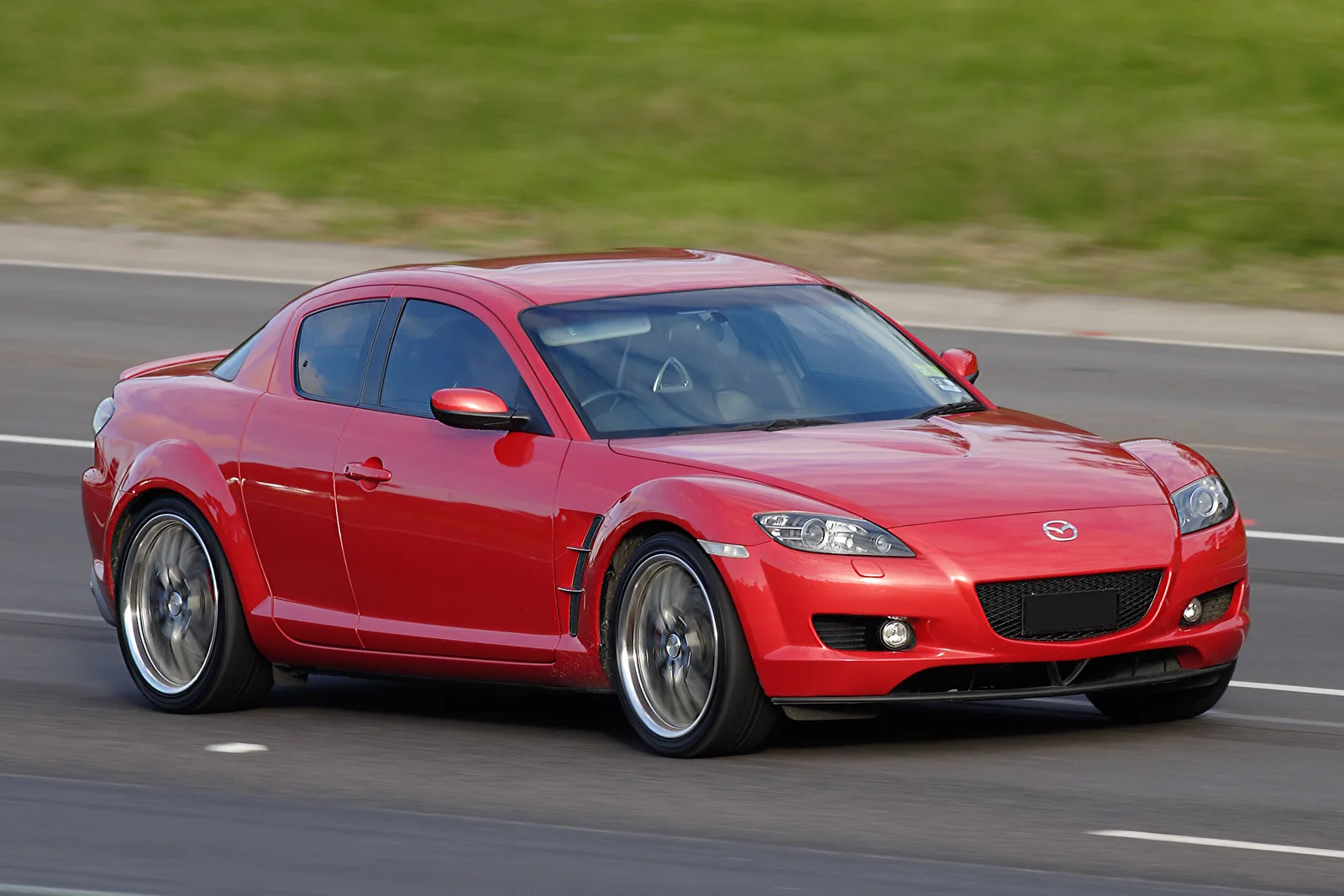
Mazda's rotary successor to the RX-7 had freestyle rear doors, a near 50:50 weight split and a production run that closed with the Spirit R in 2012.
The Mazda RX-8 was a four-door rotary sports car built from 2003 to 2012 as the successor to the RX-7. It used a 1.3-litre RENESIS Wankel engine and rear-hinged freestyle doors, and Mazda built 192,094 units before production ended.
The Mazda RX-8 was a rotary-powered sports car that Mazda built from 2003 to 2012, succeeding the RX-7 as its rotary flagship. It was a four-door coupe with rear-hinged freestyle doors and a Wankel engine. Mazda built 192,094 of them before production ended.
Where did the RX-8 come from?
The RX-8 was the direct successor to the RX-7 and carried the rotary sports car role forward. Its first public appearance came at the 2001 North American International Auto Show. Mazda had first sold rotary cars in the US in 1971, starting with the R100, and the RX-7 that followed became a cult favourite.
Mazda later withdrew the RX-7 from most major markets, leaving only Japan. The RX-8 combined the RX-7 with the Cosmo, a car sold only in Japan, and the Cosmo's three-rotor engine had ended production in 1996.
Rotary development was kept alive by a skunkworks team. Engineers used an elongated MX-5 chassis, nicknamed the cockroach car, to refine a rotary engine that was eventually shown in the 1995 RX-01 concept.
A four-door rotary sports car with freestyle doors, built until the last rotary-only car rolled off the line in 2012.
Who designed the RX-8 and how did it take shape?
Lead designer Ikuo Maeda was the son of Matasaburo Maeda, who had led the original RX-7 design. Management approved the project on one condition: the car had to have four doors. A near-production exhibit appeared at the 2001 Tokyo Motor Show before Job 1 began in February 2003.
The RX-8 was a front mid-engined, rear-wheel-drive quad coupe with a near 50:50 weight split. The engine sat behind the front axle and the fuel tank went ahead of the rear axle, which gave the car a low polar moment of inertia.
Its rear-hinged freestyle doors gave easy access to the back seats. There were no B-pillars, and the leading edge of the rear door acted as a virtual pillar, so the body stayed rigid, and Mazda quoted its stiffness at 30,000 Nm per degree.
Weight was saved wherever possible. Several body panels used aluminium and plastic, and the manual model used a carbon fibre driveshaft to reduce the rotating mass linked to the engine, which sharpened the way the car responded to throttle inputs.
How did the RENESIS engine work?
The RX-8 used the RENESIS 13B-MSP, a 1.3-litre twin-rotor Wankel with side exhaust ports. At launch the four-port version was rated 191 hp (194 PS; 142 kW). The six-port unit, sold from 2003 to 2008, produced 238 hp (241 PS; 177 kW).
The 2006 automatic, which picked up two extra intake ports, was credited with 215 PS (212 hp; 158 kW). Manual cars carried a second oil cooler, a detail the automatic gained later.
Wankel engines carry their own weaknesses. Ignition coil packs degrade faster than in piston engines, and the resulting fuel leakage can overheat the exhaust, which made the powertrain demanding to maintain.
Mazda's mechanical choices were practical as well as clever. A torque-sensing conical limited-slip differential sent power to the rear wheels, which helped the car put its power down cleanly out of corners.
What are the RX-8's specifications?
The table covers the engine, output, gearing and build figures that matter most across the production run. Power figures are given for each engine layout and market, so the four-port and six-port cars are never blended together. Production totals appear at the bottom for context.
| Specification | Detail |
|---|---|
| Engine | RENESIS 13B-MSP 1.3 L twin-rotor Wankel, 1,308 cc |
| Four-port output | 194 PS (191 hp; 142 kW) |
| Six-port output | 238 hp (241 PS; 177 kW), 2003 to 2008 |
| North American revised output | 141 kW (189 hp) and 177 kW (237 hp) |
| 2006 automatic output | 215 PS (212 hp; 158 kW) |
| Type S manual output | 235 PS (232 hp; 173 kW) at 8,250 rpm |
| Manual final drive ratio | Changed from 4.444 to 4.777 |
| Weight distribution | Near 50:50 front to rear |
| Chassis stiffness | 30,000 Nm per degree |
| Production | 192,094 units, 2003 to 2012 |
Two rows deserve a closer look. The six-port car was the performance choice, while the final drive change on the manual cars made the 2008 facelift more responsive from a standstill.
Which special editions did the RX-8 get?
Mazda produced several limited runs. The UK Evolve was limited to 500 cars, the UK PZ to 800 cars at GBP 25,995, built with Prodrive, and the Australian Revelation to 100 cars with a Bose sound system and sand beige leather.
The UK Nemesis totalled 350 examples, split 200 Copper Red and 150 Stormy Blue. The Kuro arrived in 2007 as a 500-car UK edition, with an evolved engine delivering 169 kW (230 PS; 227 hp) and a 6-speed manual.
The anniversary edition of 2008 marked four decades of the rotary engine. Australia received 200 examples and the UK 400, with the Japanese car finished in Marble White as a nod to the Cosmo Sport.
How did the Mazdaspeed and Spirit R versions work?
Mazdaspeed sold a factory version exclusively in Japan. A total of 480 Mazdaspeed RX-8s were built, and Mazdaspeed accessories were sold through dealers worldwide. The package reflected the brand's performance heritage in Japan, and owners elsewhere could still buy many of its parts as accessories.
The Spirit R was the final special edition. It went on sale on 24 November 2011 in Japan with a production target of 1,000 units, and demand was strong enough that Mazda added another 1,000 in April 2012. The six-speed manual accounted for 66 percent of orders.
The Spirit R arrived as Mazda marked two decades since the 787B won Le Mans in 1991, the only overall victory for a rotary-engined car there. Rotary production stopped on 21 June 2012, and RX-8 assembly followed on 22 June at the Ujina plant in Hiroshima.
Did the RX-8 compete in motorsport?
Privateer teams ran RX-8s in many series. SpeedSource took the GT class at the 24 Hours of Daytona in 2008 and again in 2010, and the second win was Mazda rotary's 23rd endurance victory at the track. Those results gave the car a racing pedigree that outlasted its production run.
An RX-8 claimed a 2005 class win in the IMSA Continental Tire Sports Car Challenge. Ryan Eversley swept the touring car races at SCCA's Mid-Ohio round in 2010, and Mazda backed an all-female Formula Women series in 2004 that ran modified RX-8s.
In 2019 the UK's Classic Sports Car Club launched an RX-8 Trophy for road-legal first-generation cars. The class was built around the idea of cheap racing in a car that could still be driven to the track.
How did the RX-8 end?
Sales in Europe ended in 2010, when the car could no longer meet the region's emissions rules. Production in Japan ended in 2012, and Mazda had built 192,094 units since 2003. Falling sales and a stronger yen made the economics difficult, and the final cars left the line in June 2012.
The Spirit R was almost certainly the last car powered by a rotary engine alone. Mazda's later rotary development has focused on electrified applications, so the RX-8 closed the purely combustion-driven rotary chapter.
What did the freestyle doors mean in daily use?
The freestyle doors were rear-hinged, and the rear pair could only be opened once the front doors were open. Mazda used the leading edge of the rear door as a virtual pillar, which kept the body rigid while giving easy access to the back seats.
Access was the point of the design. Adults could climb into the back without a centre pillar in the way, and the car was a genuine four-seater rather than the two-plus-two layout that many coupes offered at the time.
The trade-off was a small habit that owners quickly adapted to: the front doors had to be opened before the rear ones could move, and that sequence became part of everyday use.
How did the RX-8 handle and steer?
The RX-8 combined a near 50:50 weight split with rear-wheel drive and a low polar moment of inertia, which gave it a balanced and agile feel. A torque-sensing limited-slip differential helped it put power down cleanly out of corners.
The suspension used double wishbones at the front and a multi-link arrangement at the rear, and the body mixed steel with aluminium and plastic panels to keep weight down. Plastic front and rear bumpers were among the few non-steel parts of the shell.
Mazda's stiffness figure of 30,000 Nm per degree showed that the body could support the handling its layout was meant to deliver, and the car was judged on its balance rather than its straight-line pace.
Why did the Renesis engine need careful upkeep?
The Renesis Wankel works on a different cycle to a piston engine, which puts extra strain on the ignition coil packs and the catalytic converter. Later Renesis II updates added an extra oil injection point in each rotor housing and a higher-pressure oil pump to help.
Ignition coils degrade faster on a Wankel, and unburnt fuel can reach the catalytic converter and cause overheating. That chain of events was linked to many of the engine failures reported over the car's life, so owners who kept up with maintenance fared better.
The November 2008 facelift added a trapezoidal shock tower brace and revised rear suspension geometry, and the manual cars received a shorter final drive ratio that improved acceleration off the line.
How did the RX-8's interior and seating work?
The RX-8 seated four in a genuine four-door layout, with a cabin designed for adult passengers in the rear. Higher trims added leather upholstery and premium audio, and the car's freestyle doors made the rear accessible in everyday use. The seats were designed for everyday comfort rather than track use.
The R3 version, sold in Japan from 2008, carried Recaro bucket seats and 19-inch forged wheels, along with a lower front bumper and a splitter. Its shape suited drivers who wanted a more focused setup without leaving the everyday practicality of the four-door body.
Inside, the rear cabin was tighter than a sedan's, but the seats gave adults enough room for regular trips, which was the whole point of the four-seat design.
How did the RX-8 compare with its predecessor?
The RX-8 succeeded the RX-7 with four doors and a more practical layout, but it gave up some of the older car's focus. Mazda chose a four-seat package with freestyle doors, while the RX-7 had been a two-seat sports car.
The RX-7 had a long pedigree in rotary racing and rally circles, and the RX-8 carried that tradition forward through its engine rather than its body. Its handling balance was a key link between the two cars.
Critics were divided on whether the four-door layout suited a rotary sports car, but the RX-8 kept the engine's distinctive character in a more usable package.
Frequently asked questions
How much power did the RX-8 make?
The four-port RENESIS made 191 hp (194 PS; 142 kW), while the six-port engine reached 238 hp (241 PS; 177 kW) between 2003 and 2008.
How many RX-8s were built?
Mazda built 192,094 units from 2003 to 2012, with rotary production ending on 21 June 2012.
Was there a factory RX-8 Mazdaspeed?
Yes. A factory Mazdaspeed version existed, sold only in Japan, with 480 units built.
Why did the RX-8 leave Europe?
The car could no longer meet European emissions rules, so Mazda withdrew it from Europe in 2010 and did not return.