From the 1965 10A to the Renesis and the 8C generator, Mazda kept refining the rotary through road cars and racing.
The Mazda Wankel engine is a family of rotary combustion engines built by Mazda from the 1965 10A to the 2023 8C generator. Its best-known versions are the 13B in RX-7 and RX-8 sports cars and the 13B-REW sequential turbo. Wankel designs are compact and light but have struggled with fuel economy and emissions.
Mazda's rotary engines replaced the reciprocating piston with a triangular rotor that turns inside an oval-shaped housing. Mazda kept refining the Wankel layout from the 1965 10A through the 13B and the Renesis, and it now uses a single-rotor 8C as a generator in the MX-30 R-EV plug-in hybrid.
Where did the Mazda Wankel engine come from?
The Wankel engine was invented in the 1950s by Felix Wankel, a German engineer. Mazda began its own work with a single-rotor prototype called the 40A, which was much like the NSU KKM400. Its early tests exposed chatter marks and heavy oil consumption, and Mazda engineers worked on both problems.
The 40A's rotor radius was 90 mm (3.5 in), its offset 14 mm (0.55 in), and its depth 59 mm (2.3 in). The chatter marks, which became known as devil's fingernails, came from the tip seal vibrating at its natural frequency inside the housing.
The L8A, a two-rotor prototype of 798 cc (48.7 cu in), powered the first Mazda Cosmo prototype. Hollow cast iron apex seals changed the seal resonance and removed the chatter, and the L8A used dry-sump lubrication. The engine and car were shown at the 1963 Tokyo Motor Show, and the rotor radius rose to 98 mm (3.9 in) while depth fell to 56 mm (2.2 in). Engineers also built one-, three- and four-rotor derivatives for experimentation.
A triangular rotor in place of pistons gave Mazda a compact engine that won at Le Mans and powered its sports cars for decades.
The 10A: Mazda's first production Wankel
The 10A series arrived in 1965 as the first production Wankel from Mazda. Each chamber displaced 491 cc (30.0 cu in), so the two-rotor engine totalled 982 cc (59.9 cu in). The name reflects that figure, with "10" suggesting about 1.0 litres. Its rotor housing was sand-cast aluminium with chrome plating, while the rotors themselves were cast iron, and aluminium and carbon apex seals solved the chatter problem.
The first 10A engine, the 0810, served in the Series I Cosmo, built between May 1965 and July 1968. Those cars are often called L10A models. The gross rating was 110 hp (82 kW) at 7000 rpm, with 130 Nm (96 lb ft) at 3500 rpm. Those gross figures are generally regarded as optimistic because they were quoted at crankshaft speed.
The 0810 used twin side intake ports per rotor, fed by four carburettor barrels. Under low loads only one port per rotor was used, which helped fuel economy. A lone peripheral exhaust port ran hot gas through the coolest zones of the housing, and a small amount of oil was mixed into the intake charge for lubrication.
The 0813 arrived in July 1968 in the Series II, or L10B, Cosmo, with Japanese-spec output of 100 hp (75 kW) at 7000 rpm. Its torque was 133 Nm (98 lb ft), and cheaper components raised the engine mass from 102 kg (225 lb) to 122 kg (269 lb). The final member of the 10A family was the 0866 of 1971, which added a cast-iron thermal reactor and re-tuned exhaust ports. Mazda called its emissions package REAPS, and the rotor housing received a new coating process. Output reached 105 hp (78 kW) at 7000 rpm, with torque of 135 Nm (100 lb ft).
The emissions push was partly a response to Japanese Government legislation from 1968, with implementation beginning in 1975. Mazda also built a kei car engine, the 3A, a slimmed-down 10A derivative of 360 cc (22 cu in). It never reached production, and a prototype is displayed at the Mazda Museum in Hiroshima.
How is rotary displacement counted?
A Wankel engine's displacement is calculated from rotor depth, rotor radius and eccentric offset, which play roles similar to bore and stroke in a piston engine. Only one face of each rotor counts toward the total, because the crankshaft spins three times for every turn of the rotor, producing one power stroke per output revolution.
Most Mazda production Wankels share a rotor radius of 105 mm (4.1 in) and a crankshaft offset of 15 mm (0.59 in). The rare 13A used a larger radius, 120 mm (4.7 in), and the 8C, which is based on the 13A, shares that radius. The 13A also had a different offset of 17.5 mm (0.69 in).
Racing bodies had to decide how to compare these engines with piston units. Most of the field used piston engines, so rather than halve their quoted figures, most organisers doubled the quoted displacement of Wankel engines. The cycle is the key: a four-stroke engine needs two crankshaft revolutions, or 720 degrees, to complete a cycle, while a Wankel needs three, or 1080 degrees.
On that comparison, four faces of 654 cc (39.9 cu in) each work out to 2.6 L (160 cu in), and six faces come to 3.9 L (240 cu in). Those figures explain why a rotary could be rated larger than its physical size suggests.
The 12A and the long road-car years
The 12A was an elongated 10A. Its rotor radius stayed the same, but the depth was extended to 70 mm (2.8 in), 10 mm (0.39 in) more than before. Each chamber displaced 573 cc (35.0 cu in), giving 1,146 cc (69.9 cu in) for the two-rotor layout. The model ran for 15 years, from May 1970 through 1985.
Mazda reached a notable milestone in 1974, when a 12A became the first engine made outside western Europe or the US to finish the 24 Hours of Le Mans. That same year Mazda adopted the Sheet-metal Insert Process, a steel liner with a chrome-plated surface. The REST process then produced a housing strong enough that cast iron seals could replace the old carbon seals.
Early 12A engines carried a thermal reactor, but lean-burn versions arrived in 1979 in Japan and 1980 in America, swapping the reactor for a conventional catalytic converter. The 12A powered the RX-2, RX-3, RX-4, Luce and RX-7, and an Aero Design DG-1 racing aircraft used two RX-3 engines, one at each end of the aircraft, each driving a propeller.
Why did the 13B become the most-produced rotary?
The 13B was the most widely produced rotary engine and the basis for every later Mazda Wankel. It is a lengthened 12A with 80 mm (3.1 in) rotors, and it stayed in production for over 30 years. Each chamber displaced 654 cc (39.9 cu in), giving 1.3 L (1,308 cc) for the two-rotor engine.
In the US the 13B appeared from 1974 to 1978, then returned in the 1984 and 1985 RX-7 GSL-SE. From 1985 to 1992 it powered the FC RX-7 in naturally aspirated or turbocharged form, and the FD RX-7 arrived in 1992 with twin turbos. US-spec RX-7 sales ended in 1995. In Japan the engine ran from the 1972 Luce and RX-4 through to the 2002 RX-7.
The AP name marked early 13B cars, including the 1975 Cosmo AP, which were built for strong performance alongside cleaner emissions. The 13B-RESI followed in 1984 and was the first Wankel with a tuned intake manifold. RESI stood for Rotary Engine Super Injection, and its Dynamic Effect Intake used Helmholtz resonance from the opening and closing intake ports to give a supercharger-like effect.
The RESI also used Bosch L-Jetronic fuel injection, which lifted output to 135 PS (99 kW) and 180 Nm (133 lb ft). The 13B-DEI brought together the 6PI variable intake system and four-injector fuel injection for the second-generation RX-7, delivering 146 PS (107 kW) at 6500 rpm, with 187 Nm (138 lb ft) peaking at 3500 rpm.
Turbo and sequential versions of the rotary
The 13B-T arrived in 1986 with a twin-scroll turbocharger. Engines from 1986 to 1988 produced 185 PS (136 kW) at 6500 rpm and 248 Nm (183 lb ft) at 3500 rpm. From 1989 to 1991, a divided manifold fed the twin-scroll design, and the FC RX-7 reached 200 PS (147 kW).
The 13B-REW became famous for high output and low weight. The primary turbo worked alone up to 4,500 rpm, and the second joined after that, which made it the world's first volume-production sequential turbo system. Output rose from 255 PS (188 kW) in the 1992 to 1995 RX-7 to 265 PS (195 kW) from 1996 to 1998, then 280 PS (206 kW) for the 1998 to 2002 model. That final figure matched Japan's unofficial DIN maximum.
The 13B-RE in the JC Eunos Cosmo from 1990 to 1995 produced 230 PS (169 kW). It had the largest side ports of any later rotary engine, and approximately 5000 optioned JC Cosmos were sold, which makes the engine almost as hard to find as its three-rotor sibling.
Three-rotor and four-rotor racing engines
The first three-rotor engine in Le Mans racing was the 13G, fitted to the 757. It was renamed 20B in November 1987 after the 767, and its three 654 cc chambers gave 1,962 cc (119.7 cu in). The 20B-REW was used only in the 1990 to 1995 Eunos Cosmo, where twin sequential turbos at 0.7 bar (10 psi) boost produced 280 PS (206 kW) and 407 Nm (300 lb ft).
The 13J-M powered the 1988 and 1989 767 Group C racers as Mazda's first four-rotor racing engine. Its successor, the R26B, displaced 2.6 L (2,616 cc) and developed 700 hp (522 kW) at 9000 rpm. It used peripheral intake ports, continuously variable intakes and a third spark plug per rotor. In 1991 the R26B-powered 787B won the 24 Hours of Le Mans, becoming the first Japanese car to win the race outright.
The Furai concept, released on 27 December 2007, used a three-rotor R20B built by Racing Beat. Its engine was tuned for E100 ethanol and developed in partnership with BP. In 2008, during a Top Gear photo shoot, a fire broke out in the engine bay. A delay in informing the fire crews meant the car was destroyed, and the details were not made public until 2013.
What made the Renesis different?
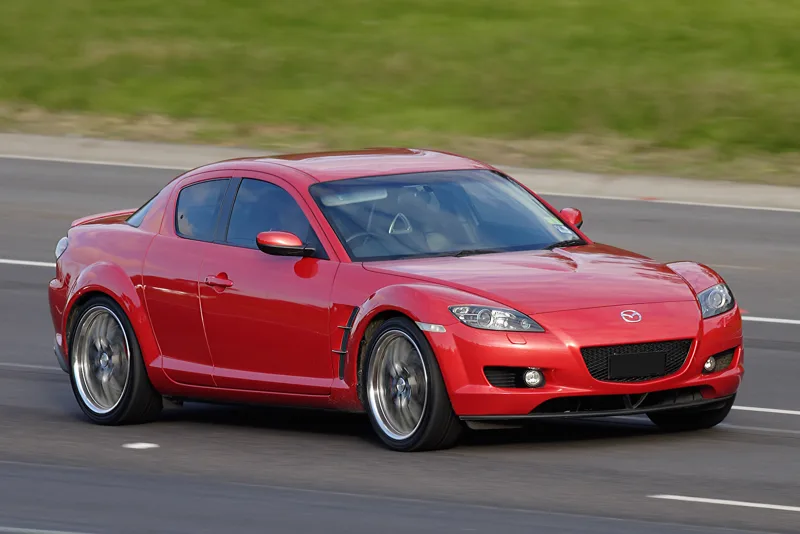
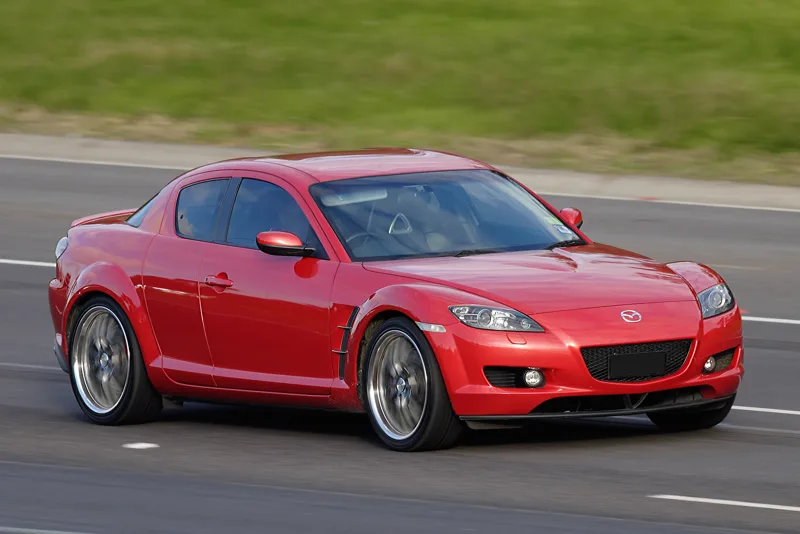
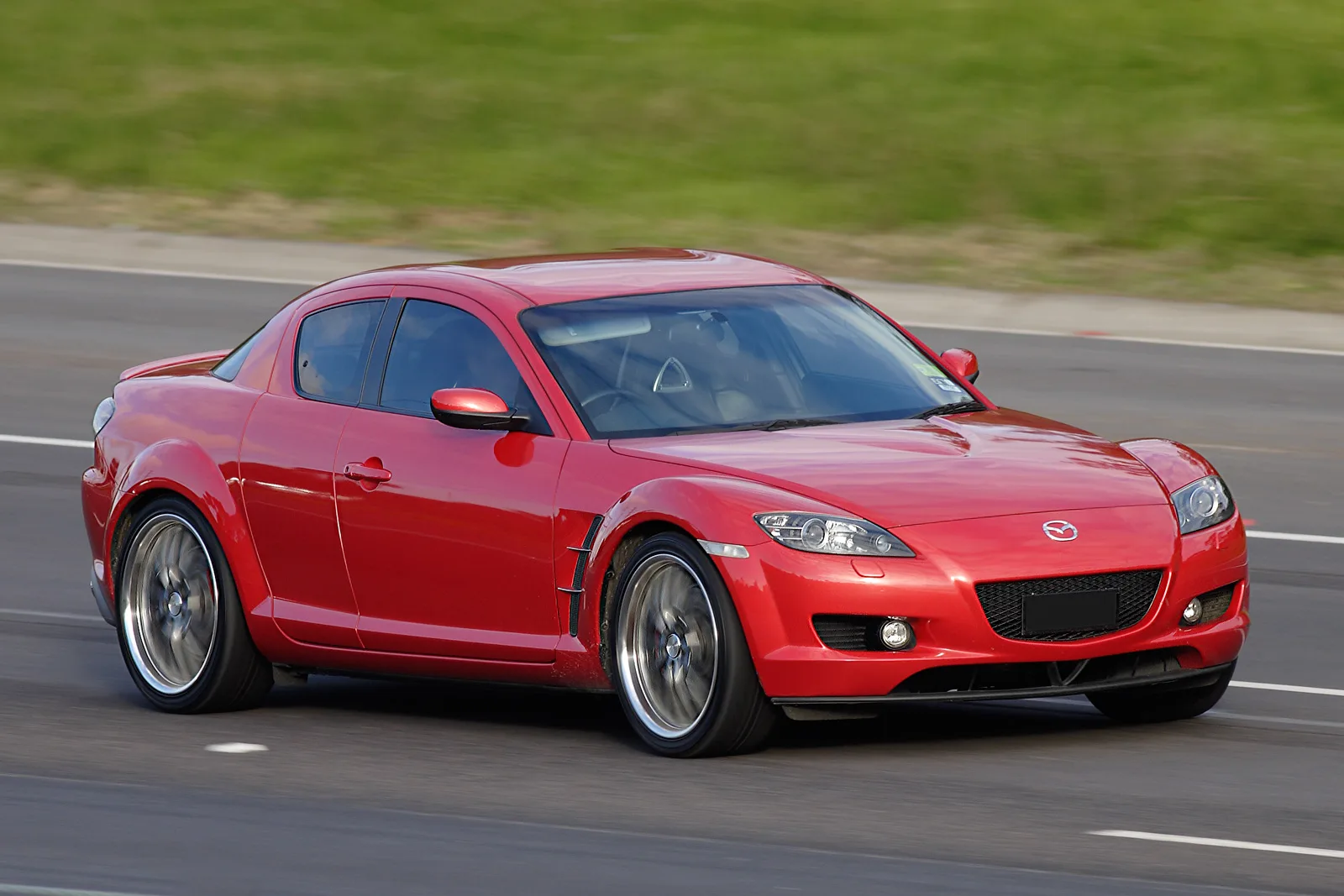
The Renesis, also known as the 13B-MSP for Multi-Side Port, first appeared in the 2004 model-year RX-8. It moved the exhaust ports from the periphery to the side housing, which removed overlap and allowed a redesigned intake area. The engine was naturally aspirated and claimed 49 percent more output.
Side exhaust ports brought a carbon build-up problem that could stop the engine, so engineers added a water jacket passage to the side housing. Redesigned side seals, low-height apex seals and an extra cut-off ring completed the sealing changes. Hydrocarbon emissions fell by about 35 to 50 percent compared with the 13B-REW, which let the RX-8 meet US LEV-II standards.
In 2003 the Renesis collected International Engine of the Year and Best New Engine honours. Mazda designates it a 1.3 litre engine, but it was entered in the 2.5 to 3 litre award class in 2003 and 2004, because a Wankel completes two combustion cycles in the time a four-stroke completes one. Unmodified, the 13B-MSP weighs 112 kg (247 lb) without fluids and makes 157 to 175 kW (211 to 235 hp).
The Renesis also ran on hydrogen as well as petrol in the Premacy Hydrogen RE Hybrid and the RX-8 Hydrogen RE. A later Renesis II, shown in the Mazda Taiki concept at the 2007 Tokyo Auto Show, featured up to 300 hp (224 kW), direct injection and aluminium side housings, but it did not reach production.
What is the 8C in the MX-30?
The 8C is a single-rotor engine with a 120 mm radius, a 76 mm depth and 830cc of displacement. It produces 75 hp (55 kW) at 4700rpm, while its torque peaks at 116 Nm (85 lb ft) at 4000 rpm, with direct injection and an 11.9:1 compression ratio.
Its design also uses exhaust gas recirculation and plasma-sprayed coatings inside the housings, which together help improve fuel economy by as much as 25 percent. Aluminium side housings saved 15 kg (33 lb). The engine does not drive the wheels. In 2021 Mazda announced that the MX-30 plug-in hybrid would use the rotary as a range extender that recharges the battery, and the MX-30 R-EV launched in 2023 with that generator.
Late in 2025, production of the 8C-powered MX-30 reportedly ended in Europe, while Japanese-market production was expected to continue in 2026.
Engine line-up at a glance
| Engine | Rotors | Displacement | Output | Used in |
|---|---|---|---|---|
| 0810 (10A) | 2 | 982 cc (59.9 cu in) | 110 hp (82 kW) at 7000 rpm | Cosmo Series I, 1965 to 1968 |
| 13A | 2 | 1,310 cc (80 cu in) | 126 PS (93 kW) | R130 Luce |
| 12A | 2 | 1,146 cc (69.9 cu in) | 130 hp (97 kW) | RX-2, 1970 to 1974 |
| 13B-REW | 2 | 1.3 L (1,308 cc) | 255 PS (188 kW) | RX-7, 1992 to 1995 |
| 13B-RE | 2 | 1.3 L (1,308 cc) | 230 PS (169 kW) | Eunos Cosmo, 1990 to 1995 |
| 13B-MSP (Renesis) | 2 | 1.3 L (1,308 cc) | 157 to 175 kW (211 to 235 hp) | RX-8, from 2004 |
| 20B-REW | 3 | 1,962 cc (119.7 cu in) | 280 PS (206 kW) | Eunos Cosmo, 1990 to 1995 |
| R26B | 4 | 2.6 L (2,616 cc) | 700 hp (522 kW) at 9000 rpm | 787B |
| 8C | 1 | 830cc | 75 hp (55 kW) at 4700rpm | MX-30 R-EV generator |
How did rotary sales and production end?
Mazda had all but eliminated piston engines from its range by 1974, a move that came close to ruining the company as the 1970s energy crisis struck. Through the 1980s it ran a three-part approach of piston-gasoline, piston-diesel and Wankel, which confined the rotary largely to sports cars. The RX-8 ended in June 2012.
The RX-8 outsold its predecessors, peaking at 23,690 in 2004 before sales fell below 1,000 in 2011. Production ended with 2000 RX-8 Spirit R models built for the Japanese market, and Mazda was then the only maker of Wankel-powered cars.
The engine stayed alive in racing. It powers SCCA Formula Mazda and the Pro Mazda Championship, which is sanctioned by the Indy Racing League as INDYCAR. The Star Mazda Championship used a Wankel until 2017, when the series moved to a Mazda piston engine in 2018.
Will Mazda build another rotary sports car?
Mazda has said that it would return the rotary to a sports car if the engine matched a piston unit. In November 2011, chief executive Takashi Yamanouchi said the company remained committed to the rotary. In October 2017, Kiyoshi Fujiwara said work on a rotary sports car continued, possibly with hybrid drivetrains in some markets.
Mazda had also shown a Mazda2 RE prototype in 2013 that used a similar rotary range extender system. The 2023 MX-30 R-EV follows that concept, though the rotary still does not drive the wheels in that car.